
Listen to the AI generated audio article.
Our garden is measured in eras.
My earliest memory is of grapevines shielding the garden floor from the sky, sunlight sparkling through the cracks between the leaves, and me sneaking sour, unripened grapes into my mouth while my grandfather looked away. Then came the fruit trees. The peaches were so large and fragrant that a soldier from the neighboring barracks scaled the fence at night to steal them. I noticed, but my grandfather pretended not to. It was 1993, and inner-city military barracks struggled to feed the soldiers who were “safe” and far from the front lines.
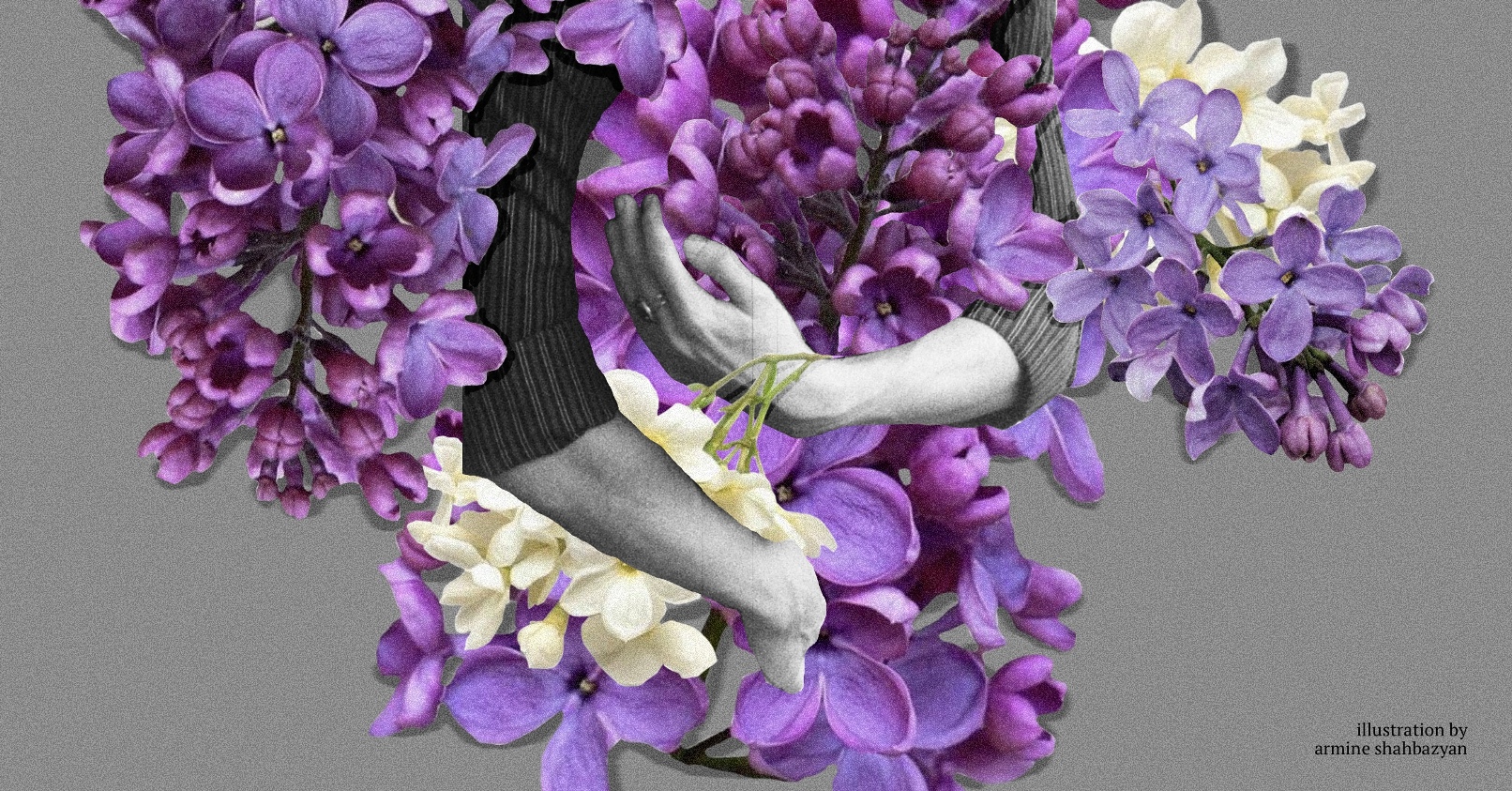
Then came the lilacs—one whose fragrance intensifies after rain; one white, breaking into tight clusters, smelling sweeter, and one at the back of the house that managed to grow taller than the rest despite being planted last. All three bloom simultaneously every spring. My grandfather taught me the rule: trim the blossomed branches so the tree grows taller and thicker. And so the house fills with lilacs every April, with plenty left over to pass around.
Each garden era thrived and carried on to the next, effortlessly.
As a child, I had the impression that the garden simply was: lush, fruitful, and self-sustaining. The digging, weeding, scraping, and watering all seemed like things one does for the sake of doing them, without any real goal. I was certain the garden would manage itself.
It took me a long time, and painfully, the passing of my grandfather, to realize it existed entirely because of him. Silently and systematically, he was ever-present: disciplined, consistent, and well-groomed, even when he was digging.
I am telling you about my grandfather, and not his parents, deliberately. He is not the one who experienced the Genocide. He is among the first to inherit it.
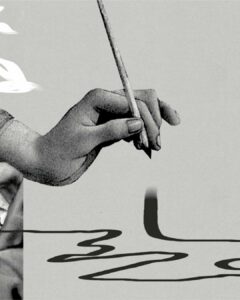
As a young man, he left home after his mother, a Genocide survivor from Van threw his paintings into the fireplace. To justify it, she said something along the lines of “You will become an engineer. Artists starve.” He chose the Voyenno-morskoy flot, the Soviet Navy, over the Army, four years at sea instead of two on land, because, as an artist at heart, one must choose the horizon. Or maybe it was because he was deeply wounded by his mother’s actions.
The way my grandfather retold his life to me was akin to what the artists and writers of the 1920s called magical realism. It sounded very real, but it carried elements of fantastic fiction, and often you couldn’t tell where magic began and where it ended.
And this is key, I think, to what I am trying to analyze in this essay. He would tell me things like diving into the icy darkness of the Black Sea, his body braced against storms, his arms fighting waves to reach rope-tangled propellers. He said that he ate fish fat before drinking vodka so the alcohol wouldn’t burn a hole through his “zest”.
After returning to Etchmiadzin, building a house (“real wood, not laminated”), and managing a factory, he eventually succumbed into retirement—out in the garden, pulling weeds every morning, digging at the roots of trees so they “wouldn’t feel trapped to the earth and could fly away when they chose to.” That probably was fantasy. But when I pulled a chunk of bark from the cherry tree as a child, he wrapped the wound in soft cloth “until the skin was strong enough to face the wind again”— that was probably real. I still can’t fully tell.
He taught his “magic” to us, his grandchildren. He rowed five of us in an inflatable boat to the middle of the lake and made us stay “silent for the lake monster,” then stopped rowing and let the boat drift perilously. He pointed out constellations and said, “that’s a shooting star, it fell in the neighbor’s backyard, go and get it” and I believed him. He told the same story every night, Ukanna the King, his beautiful daughter, a golden city, a traveler, until we all knew it by heart.
But often, when alone, he seemed lost in thought: brows furrowed, deeply concentrated on something that looked like anger. Whatever it was, it was not for us.
His father was from Kars. During the deportations, one sister was killed and another starved. Understanding that men and boys were being exterminated first, his father took him separately, along another road. They went into hiding. One evening, his father went out to get water from a nearby well and did not return. He reached Gyumri alone and ended up in a Near East Relief orphanage.
His mother was perhaps four years old when their house in Van was attacked and plundered. She does not remember the route to survival. What she carried instead was the myth of before: someone spoke to her in French; she threw pebbles into the lake; she wore intricate needle-laced collars. She passed down her own grandparents’ love story, how they met on the shore of Lake Van before their arranged marriage.
These two survival stories are asymmetrical, and the asymmetry matters. His father’s story has a precise last moment: went to get water and did not return—a sentence with no ending. His mother’s story has a gap where the trauma should be, replaced entirely by paradise: a radiant before, and then somehow an after.
But his mother was not only paradise. She was deeply troubled: extreme mood swings, cold and distant, sudden cruelty that seemed to come from nowhere, a pride that could not bend. These were silent signs of something, an invisible monster living alongside the lace collars, the lake, and the French speaker, transmitted not through words but through the body, through the atmosphere of the household, through what it felt like to be her child.
His father was different. More mellow, more measured. Capable of expressing vulnerability, of showing grief directly. Tender. Patient. Grounded. Yet he carried an enormous weight of loss, so much so that he made sure to have seven children. And when one of them died at birth, he was devastated in a way that connected, visibly, to the larger pattern of loss he had survived. His grief had a face and could be seen.
My grandfather inherited two things from two people who survived the same catastrophe through entirely different interior architectures. From his mother: the capacity to construct paradise, to make myth, to build beauty over the void, but also the nameless rage, the coldness, the invisible monster. From his father: tenderness, patience, the ability to feel and show it, the grief that was legible, and also the knowledge, carried in the body, of what it means to lose everything again and again, and still insist on filling the world with children.
Researchers have described how trauma survivors externalize post-traumatic symptoms through nonverbal behaviors and unconscious reenactments—the child becoming a container for the unwanted, troubling experiences of the parent. My grandfather absorbed both containers.
Following the genocide, many survivors repressed their memories and tried to bury their trauma, focusing instead on self-preservation to help ensure the survival of future generations. Their children inherited not the stories but the orientation toward ground, toward continuity, toward what can be built and kept. Descendants of the Armenian Genocide report a recurring theme in their family systems: the need to compensate for familial losses. In my grandfather’s case, it was quieter than achievement. It was an accumulation against absence. A tending against erasure. The unspectacular, daily work of keeping things alive.
But he did not build in private grief. He built inside a specific historical container with its own demands on memory, on identity, on what a man was supposed to be.
Seventy years of Soviet silence on the genocide all but erased historical memory in Eastern Armenia. Survivors and their children who had flooded in after 1915 were given refuge, then folded into a new identity: not genocide survivors or refugees, but Soviet citizens—forward-facing, productive, builders of socialism. They rebuilt Armenia from a largely agricultural hinterland into an industrial center, while the state-building project and private grief ran on parallel tracks, never touching. You managed your factory. You planted your trees. You did not necessarily speak of Kars or Van at the dinner table, but you made sure everyone was fed, that the toasts were slow and wise, that the house had real foundations.
The Soviet mold added its own layer to what my grandfather already carried. The stoic man who grinds his gears, works hard, achieves a good life. You serve the republic. You believe in the working class. You do not indulge in private sorrow when there is a nation to build. For a child of survivors, it must have felt like a continuation of something already in his body, the discipline his parents’ survival had required, now given political form, a uniform, a purpose.
It was not until 1965, fifty years after the genocide, that thousands of Armenians poured into the streets of Yerevan, defying the cultural and political hegemony of the Soviet center, in what became a watershed in contemporary Armenian political thought. Only after those demonstrations did Moscow permit official references to the genocide in Armenian history textbooks, and in 1967 the memorial complex was built at Tsitsernakaberd.
My grandfather spent his Navy years, his factory years, the years he built the house with real wood, not laminate, his entire formation as a person, in a country where the thing that had shaped his parents was officially unspoken. Not denied, exactly. Not named. Not permitted as the central organizing fact of who you were. Alone in the garden, his furrowed brows were where it all surfaced when no one was watching: the unnameable inheritance, the Soviet silence, the anger with nowhere to go. Survivors and their children who kept silent often struggled to integrate their traumas into the rest of life, creating a psychological limbo.
He protected us from being vessels for it. The shooting star in the neighbor’s backyard. The inflatable boat as an ocean voyage. Foundation without myth is just survival. Myth without foundation is just longing. He held both, and handed us the garden, already blooming, as though it had always been that way.
After he died, the garden couldn’t sustain itself. My brother and I tried. The fruit trees went barren, then dried, then disappeared one by one: the cherry tree, the apricot, the peaches, gone. As it turns out, a garden is not a thing. It is a practice. It is a specific person, present every morning, well-groomed, digging.
Except for the lilacs. The three lilac trees still bloom every April, still break into tight blossoms at the same time, still fill the air with a fragrance that intensifies in rain. And so I have made a principle of returning to cut their branches and distribute them: a bouquet for this woman, a bouquet for that neighbor, some to take home, some to leave. I am doing what he did, imperfectly, with full knowledge that I cannot replicate what he was.
We talk about the genocide every April. We talk about the survivors, the deportations, the numbers, the denial, the recognition campaigns. What we talk about less, what we in Armenia talk about less, perhaps, than our diaspora counterparts, is what it means to be the inheritor rather than the experiencer. The diaspora carries the genocide as a central wound, as an organizing identity, as the thing around which community and memory cohere. I understand that story. I can recognize myself in parts of it.
But the experience of living in Armenia, in the actual republic, the one the survivors fled to, the one the Soviets reorganized, the one that has had its own subsequent traumas and wars and losses and reinventions, is not quite that story. For the Armenian community, the unresolved historical loss of the genocide, combined with the continued denial by Turkey, subsequent generations’ refugee experiences, and the threat of acculturation for a large diasporic population, may compound transgenerational trauma in ways that are still not fully understood. But for those of us who stayed, who were Soviet, who rebuilt inside the republic, the genocide is something different, foundational rather than foregrounded, present in the soil rather than carried visibly in the hands.
Marianne Hirsch calls the experience of the generation after “postmemory”, the relationship people bear to trauma they did not live through directly, transmitted so deeply it can seem to become memory itself—mediated not by recall but by imaginative investment, projection, and creation. My grandfather was the first postmemory generation. He was the first to inherit without experiencing. He built a life shaped entirely by something that lived through him: in the furrowed brows, the discipline, the myth-making, the rage that surfaced.
Every April, when the lilacs bloom and I pick up the shears, I face the challenge of preserving not just the garden but something harder and less resolved. I am not a survivor. I am not a victim. I am a person living in Armenia now, in April and beyond, shaped by layers I can name but cannot fully claim—genocide, Soviet silence, post-Soviet fracture, new losses, new uncertainties—trying to understand what position I actually occupy inside all of it.
Researchers have found that children of traumatized parents may inherit traits that promote both resilience and vulnerability, passed on not through words but at a more fundamental level. What interests me is not the pathology of this inheritance but its texture. It arrives not as a wound but as an orientation. It arrives as a tendency toward foundation-building and myth-making simultaneously. As a capacity to wrap wounds in soft cloth and wait for the skin to strengthen.
The lilacs grew because he trimmed them, because he understood, in the way his parents’ survival had taught him, that you do not protect a living thing by leaving it alone. You tend it, consistently. You show up every morning, well-groomed, and you dig.
And the lilacs still bloom. They are the only thing in the garden that survived without him. Every April I go back, cut the branches and give them away, to the women, to the neighbors, to whoever is there.
Raw & Unfiltered
Armin Wegner and the Burden of Witness
Marking April 24, Narine Vlasyan speaks with Michele Wegner, son of Armin Wegner, one of the key eyewitnesses of the Armenian Genocide, about memory, moral courage, and the burden of bearing witness, then and now, and the haunting question of why so few chose to truly see.
Read more
Armenians in Lebanon: A “State” Within a State
From refuge to power, and now to uncertainty, Lebanon’s Armenians built a remarkable “state within a state.” Arno Khlgatian explores how it emerged, endured war and upheaval, and what its gradual decline reveals about the future of diaspora identity and influence.
Read more
Getting Sicker, Younger
A young doctor’s death from advanced gastric cancer reflects a troubling shift in Armenia, where cancers are increasingly diagnosed late and at younger ages. As cases rise, limited screening, delayed detection and unequal access to modern treatments are straining patients, families and the healthcare system.
Read more
The Month Between: On Armenian Motherhood and Autism
In Armenia, where motherhood is revered and sacrifice expected, raising an autistic child exposes the gap between cultural ideals and lived reality. In this deeply personal essay, Ani Poghosyan explores identity, fear, resilience, and the invisible labor of mothers navigating autism in an unprepared system.
Read more
The Invisible Masterclass of Productivity
Challenging the notion that mothers on maternity leave or outside formal employment are “economically inactive”, Hasmik Soghomonyan examines Armenia’s invisible care economy, and argues that unpaid caregiving and early childhood development are vital investments sustaining families, society and long-term economic growth.
Read more
Ararat-73 and “Apricot Socialism”
Nearly half a century later, Ararat-73 still looms large in Armenia’s collective memory. More than a football triumph, the team embodied national pride under “apricot socialism,” blending Soviet structure with Armenian identity and leaving behind a legacy that continues to shape nostalgia, culture and belonging.
Read more
Cold Waters, Long Nights: Tales of Sevan’s Fishermen
A portrait of Noratus fishermen on Lake Sevan reveals nights of cold, risk and fragile livelihoods, following Armen and Vardan as they navigate storms, shrinking catches and limited choices, capturing a community bound to the lake for survival and dignity.
Read more