

Listen to the AI generated audio article.
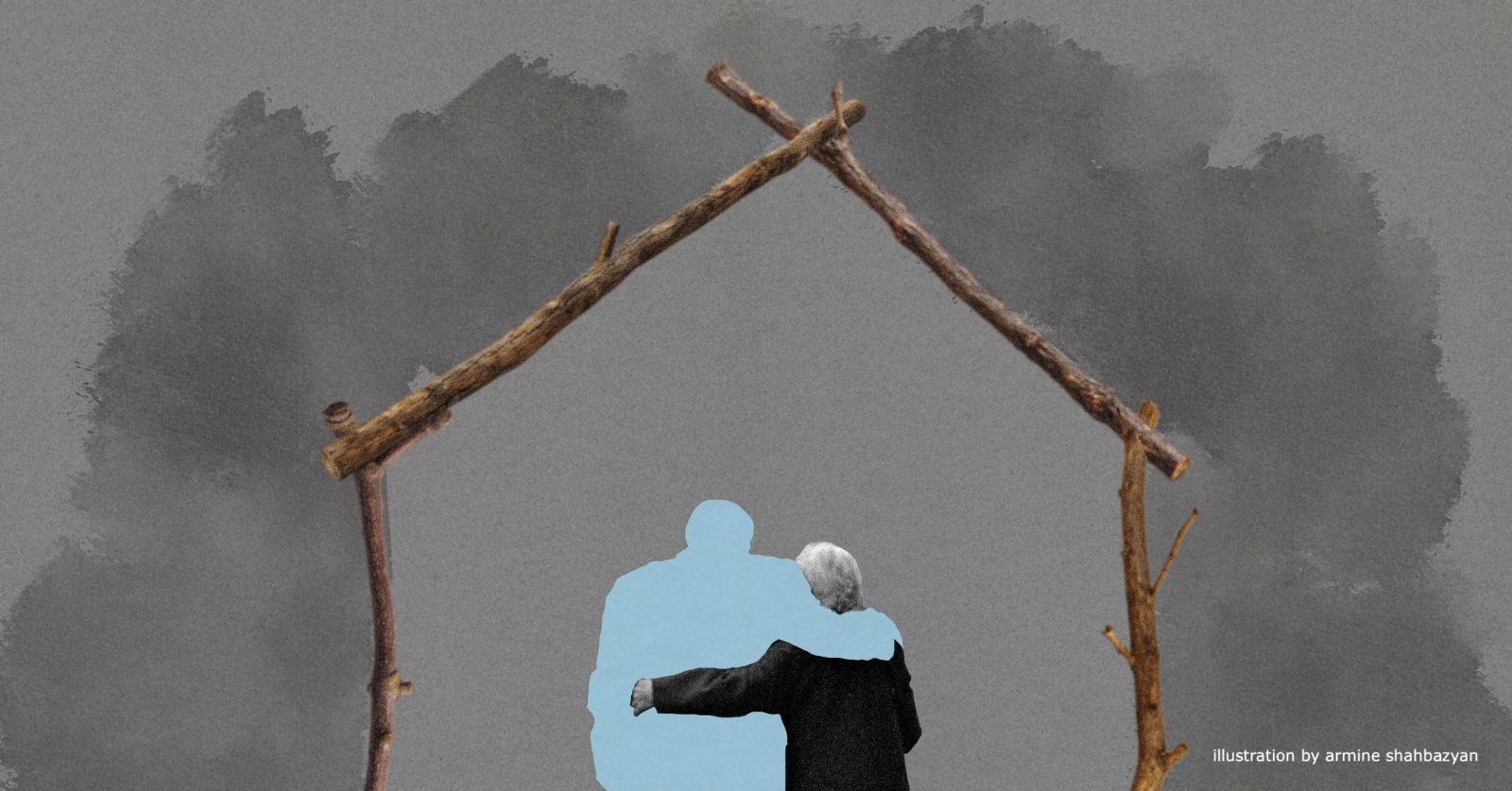
Hasmik, 67, hasn’t visited her son’s grave in three years. The cemetery where he is buried lies right below a military post in a part of her village now occupied by Azerbaijani troops since 2022.
Like many of the residents in the village of Nerkin Hand, the hardest part of living in this remote part of Armenia is the lack of security.
“If we had security, we could survive. It’s not that we can’t live, breathe. We work,” Hasmik explains. “Today alone, I was afraid three times […] It affects me deeply, my spirit, my soul.”
In the shrinking border village of Nerkin Hand, tucked into Armenia’s Syunik region, the 20 or so families remaining, down from 113 people in 2001, live just a few hundred meters from the Azerbaijani military. Villagers and local reports continue to point to a decreasing population. Mines linger in the fields. Children and young families are a rare sight.
Hasmik, a short, plump lady with cropped red hair, lost a son during the First Nagorno-Karabakh War. Now, five years after the 2020 Artsakh War, and two years after the ethnic cleansing of the Armenian population, residents in the Syunik region, which is now the country’s newest frontline, remain on edge. Since May 2021, border skirmishes have occurred directly on the Armenia–Azerbaijan frontier, a separate phenomenon from fighting in Nagorno‑Karabakh. Azerbaijani forces have crossed into Armenia in Syunik and other border areas, and have occupied a small, but strategic chunk of Armenia’s sovereign territory. In Nerkin Hand, 2,120 hectares of rural land are now occupied.
I visited Syunik in late July, just three weeks before the leaders of Armenia and Azerbaijan signed a joint declaration at the White House, being touted as a U.S.-brokered peace deal, although peace is far from being established. On the ground, there are a host of tensions that have yet to be resolved in the wake of the ethnic cleansing and the stalled demarcation between the two countries.
And Armenia’s southernmost region is at the heart of everything: this is where the new Trump Route for International Peace and Prosperity (TRIPP) is meant to run, connecting Azerbaijan proper to the east with its exclave of Nakhchivan to the west. Many people here fear that the East-West road—through which Azerbaijan has been promised “unimpeded” passage—will, in effect, cut off the north-south trade corridor with Iran, which is crucial for landlocked Armenia. As details remain to be completely fleshed out, the fate of those on the edge is uncertain. As recently as February 2024, another skirmish killed four Armenian soldiers and injured another, and on the night of June 20, 2025, residents reported shots being fired from enemy lines, damaging some homes and solar panels, the only source of electricity. No casualties were reported.
“They shoot during the night, sometimes in the day,” says Rafayel ‘Rafik’, Hasmik’s husband. “Sometimes just in the air, sometimes at us. We don’t know when it’ll hit. We just sit quietly, praying nothing happens.”
Towns like Kapan and border villages such as Nerkin Hand have become frontlines in a conflict that stems back to the Soviet Union. For outsiders, the fear of war feels distant, but in Syunik, it’s a quiet and constant presence. The few brave enough to endure the pressure are older, attached to the land, or have nowhere else to go.
“Don’t even say the word ‘leave’. If we leave, then this land will also be left to the enemy,” says Norik, 73, whose wife Laura is the local school teacher.
Hasmik works at the cantina on a nearby Armenian military base and lives with her 72-year-old husband, her son, her daughter-in-law, and two grandkids. They are the largest family in the village. The grandkids are two of the four children attending the local school, whose population has dwindled over the years and is now being shut down.
Inside their home, Hasmik offers staples of Armenian hospitality—watermelon, coffee, cakes, and homemade mulberry vodka. One of her grandsons, also named Rafayel, plays games on his phone. Sitting beside her, Rafik, 72, explains that part of the struggle in Nerkin Hand is the lack of attention from politicians back in the capital, Yerevan, a six-hour drive away. Since 2023, the village’s water supply has been cut off by Azerbaijan, forcing residents to carry buckets filled from a nearby well back home by hand. The roads are poorly maintained, and gas and electricity are limited.
The Armenian government provides villagers with 15,000 drams per month, or the equivalent of just under $40, Rafik says.
“They say, ‘You live here, you should be happy.’ But we can’t live like this. We can’t even bury our dead. The cemetery is over there, and we can’t reach it,” Rafik explains.
But some costs are highly symbolic. The village’s cemetery and the adjacent World War II memorial are now under Azerbaijani occupation, and residents risk being shot or turned away by the Azeris, making the trip too risky. Some villagers also report that the memorial itself, usually seen from the village, has been destroyed by the Azeris.
Norik described feeling abandoned by their government leaders in Yerevan. “Here, if you think about it, we’re like orphans,” he says.
“I don’t like politics, I don’t care who’s right or wrong. But I do care about the truth. And in our time, since we’ve lived here, we’ve been here, we’ll stay here,” Hasmik says.
While most of the villagers have been able to sustain themselves from their lands, that source of provisions is also undermined. Residents in villages along the Azerbaijani border say the 2023 incursion of the Azerbaijani army into Armenia proper has led to the loss of farmland in a region where 60% of the rural population works in that sector.
Along with the loss of land, the lingering presence of mines has made raising livestock challenging for villagers. Many animals wander off in mined zones or into Azerbaijani territory—residents are unable to retrieve them and have thus decided to stop raising any animals. Andranik, 55, lost some land to Azerbaijan as a result of the new borders drawn and the occupation. He has stopped raising livestock due to the presence of mines near his land. His land now mostly produces fruits and vegetables to sustain his family.
“We can’t really farm anymore, nor raise livestock,” Andranik says. “The lands are just sitting there. People now mostly raise chickens, keep bees for honey.”
Like a majority of the remaining older residents in Nerkin Hand, Andranik grew up in this village. He knows “every tree, every rock, every flower, every bend in the road.” Despite the growing challenges of living in this shrinking village, staying isn’t the hard part—it’s being given the chance to.
“For villagers, it’s not just the land. They need something on the side, too, to be able to live,” Andranik explains. “Our villagers are not the type to leave. If we help them, they won’t leave, I’m sure of that. If they were going to leave, they would’ve done so long ago.”
When the first Nagorno-Karabakh War started in 1991, many villagers in Nerkin Hand went to the frontlines to fight for Armenia’s claim to the territory. Andranik, like many of the older residents, was one of the 30,000 to 40,000 Armenians who fought in the first war. He explains that many of the soldiers then were villagers from border communities who knew the region and were able to navigate the treacherous terrain successfully, hence Armenia’s victory.
Instead, men as young as 18 were brought in from the cities for the second Nagorno-Karabakh War, who did not know the land. Many villagers in Nerkin Hand believe that this is part of the reason why Armenia lost the 2020 war. “That’s why things turned out this way,” Andranik says.
“If there had been more people from the older generation, the war might have gone differently. Definitely—I don’t even doubt it,” Andranik says.
In neighboring villages, like Tsav, there is a similar determination to thrive despite the circumstances. Just across from an Armenian military post is Basuta Guesthouse, run by Margarit, 45, and her family. The guesthouse opened in 2020 as additional land for the family to grow produce and a fish pond. It eventually grew into an oasis for visitors in an often-tension-filled region.
“We’ve had a lot of guests this year who were visiting Syunik for the first time,” Margarit says. “They were enchanted by nature, the human connection, the hospitality. Sure, our conditions aren’t ideal—it’s a village, after all—but what do people love most? The nature, the calm, the human interactions, the good attitude. We don’t have extravagant things to offer, but that human connection—they really love that.”
Some of the tourists coming to stay in her guesthouse are afraid of the shootings, says Margarit, but “you can’t live in fear.” That’s why running this guesthouse is so important for small communities like Tsav, she says.
“Loving your country is not just taking arms, it’s also about caring for your village,” Margarit notes.
While life in the border villages remains uncertain, war is not too far from the minds of residents in the nearby cities of Kapan and Goris. Inside the TUMO Center in Kapan, an after-school program housed in an old railroad station and orange shipping containers-turned-classroom, students come from the surrounding cities and villages to attend workshops in animation, coding, film and graphic design.
Many of the students in attendance at TUMO were born and raised in the Syunik region and plan on staying in Goris or Kapan to contribute to their community instead of moving to Yerevan or other provinces.
Maria, 15, was in Goris during the 2020 war and the 2023 ethnic cleansing and subsequent expulsion of Armenians from Nagorno-Karabakh. Her uncle and his family were among the families who sought refuge from Stepanakert, the capital of the territory, to Goris. In total, three families lived in Maria’s home in 2020 and again in 2023. She volunteered at 13 years old with the Red Cross to provide first aid to families fleeing the conflict in 2023.
“Our home was pretty small and there were too many people,” she explains. “We would sleep on the floor, and we had to buy so much stuff to eat that there was nothing left to eat anymore.”
After the 2020 war, Maria and her family left for Russia for two years before returning. They feared the attacks in 2023 might trigger another war and questioned if returning was the right decision. Her father currently serves in the military.
“It’s better to stay and live in the place, on the soil where you were born, where you were raised, and to die on that soil,” Maria says. She plans to become a doctor.
Gohar, also 15 and a TUMO student from Kapan, wants to join the army when she grows up and follow in her father and grandfather’s footsteps. She recalls tagging along with her father to his training sessions with the military.
“Once we went to work early in the morning, and they were doing a full drill lineup. I stood next to (my dad),” Gohar shares. “He told me to move aside, but I stayed. Then the commander came and asked, ‘Who are you?’ I said I came for drill training. I was even wearing my dad’s uniform pants. They were big on me. I joined the lineup.”
During the 2020 war, Gohar was in Vanadzor, in the northern part of the country. She used her savings to buy goods for the residents of Nagorno-Karabakh. She also claims to have stolen car tires to send to the frontlines.
“I was the only girl in the building. I gathered the boys, and we stole everything,” she says.
Despite the instability associated with the Syunik region, life is continuing in the province and its many border towns. Residents are finding work with the military posts, in tourism, or in construction. Ali, a construction manager from Khoy, Iran, was assigned to work in Martuni, Armenia, by his employer back in 2016. He is now based in Tsav.
“I really love this village. The people here are so simple and pure,” Ali explains. “I’ve been offered work in other countries too, but I told them, ‘No, I want to stay here.’”
Even when war came to Armenia’s border regions with Azerbaijan, Ali was already working in the country and wanted to volunteer, he said. He was turned away because of his nationality.
“I saw 18- and 19-year-old boys becoming martyrs. It was heartbreaking,” Ali recalls. Despite living on the border, he tells family and friends who are concerned, “I have no fear.”
The lack of fear and the love for the land in defiance of the Azerbaijani presence nearby is what many Armenians say keeps them in their villages. Back in Nerkin Hand, the older residents are holding on to their homes and their legacy in these places. But as the youth continue to leave the villages for the cities and safety, the livelihood of these villages is uncertain.
Recently Published
France–Armenia Defense Partnership: From Symbolic Solidarity to Support for Sovereignty
France’s defense cooperation with Armenia marks a decisive shift in its policy toward the EU’s eastern periphery. Moving from symbolism to substance, Paris now helps Yerevan build deterrence and resilience, reshaping how sovereignty and stability interact in the South Caucasus. Sossi Tatikyan explains.
Read more
Notes From Armenian Street: Lessons on How Moldova Defeated Russia’s Hybrid War
Moldova’s quiet resilience tells a story of survival. Political analyst Mikayel Zolyan traces how this small nation confronted Russian hybrid warfare, reclaimed its democratic voice, and reflects on what its hard-won lessons might mean for Armenia’s struggle against disinformation and dependence.
Read more
How Small Powers Turn Vulnerability Into Strength
At a time when multilateralism is faltering and power politics dominate international relations, micro-states and small powers can still exist, assert themselves on the world stage, and turn vulnerability into strength—becoming indispensable to others.
Read more
Tentative Gestures of Peace
Three months after the Washington accords, Armenia and Azerbaijan are cautiously signaling steps toward peace. The gestures are encouraging, but lasting progress depends on concrete actions that convince people in both countries that peace is possible, and the conflict belongs to the past.
Read more
Waiting for a Ride That Never Comes
In Armenia, people with mobility disabilities face daily barriers not only in accessing care but in simply getting around. And even as attitudes toward disability have changed, the lack of accessible transport keeps people on the margins. Lori Youmshajekian reports.
Read more
When Technology Meets Health
From AI-powered diagnostics to digital therapy, Armenia’s emerging health-tech scene is redefining how we think about wellness. Mane Mkhitaryan spotlights Armenian-led startups bridging technology and healthcare to make expert care, better sleep, and mental resilience more accessible.
Read more
When Tradition Isn’t Enough: New Approaches to Parenting in Armenia
As young parents confront sleepless nights and conflicting advice, many are turning from tradition to science-based parenting. Through sleep consultants and Armenia’s first Parenting School, some families are redefining child-rearing with modern tools, research and empathy.
Read more