

Listen to the AI generated audio article.
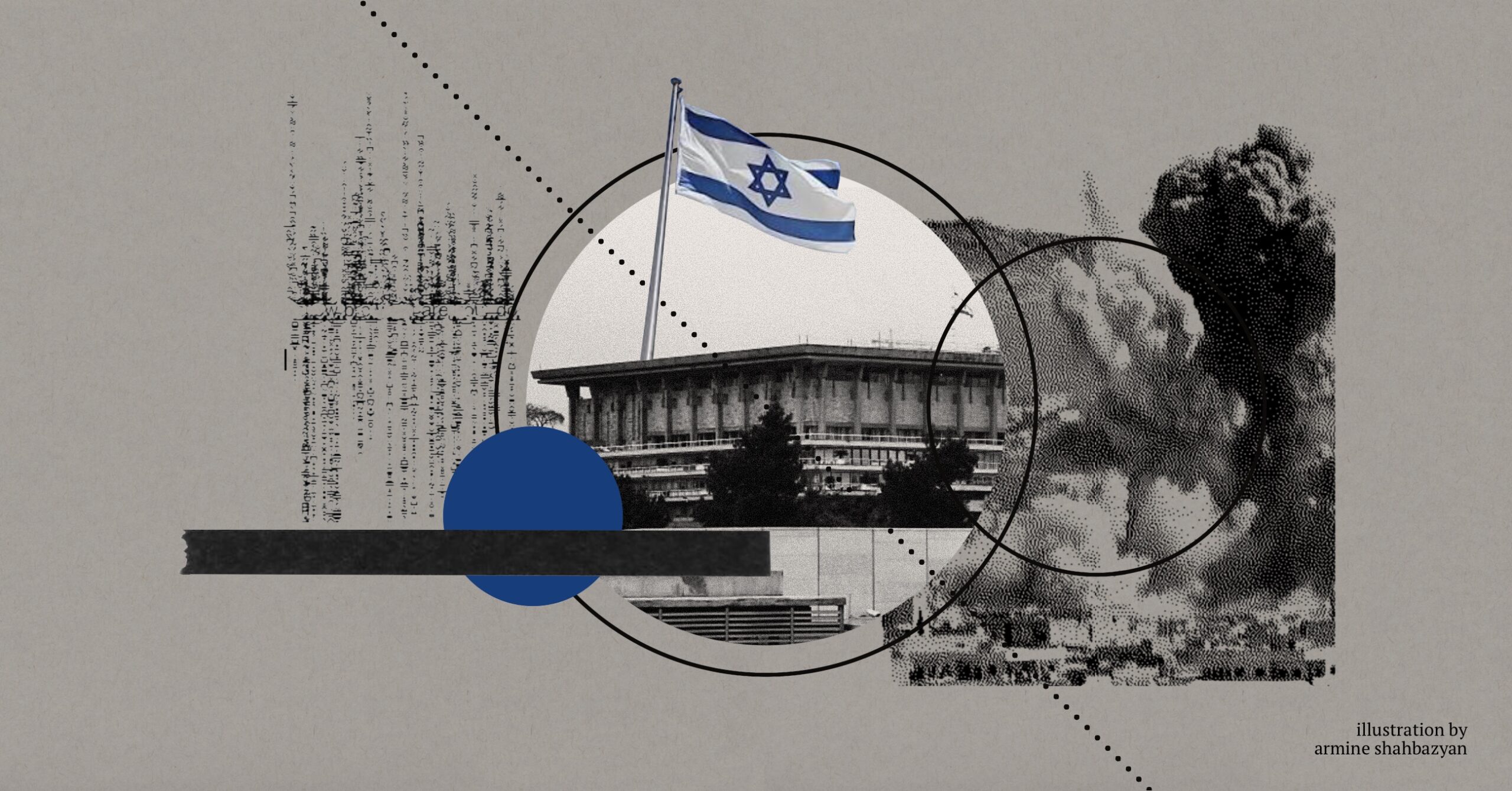
On June 28, 2026, Israel’s cabinet unanimously approved a proposal by Foreign Minister Gideon Sa’ar to recognize the Armenian Genocide. Sa’ar called recognition a moral and historical duty and condemned what he described as an institutionalized campaign of denial led primarily by the Turkish government. “It is never too late to do the right thing,” he said after the vote. The measure still requires approval by the Knesset, a vote that was suspended on July 13 as parliament headed into recess, but even in this incomplete form the move marks a reversal of decades of careful avoidance.
For decades, Israel declined to say the word. The reluctance was never about the historical record, which is extensive and unambiguous. It was about geopolitics: relations with Turkey, a strategically vital if increasingly hostile neighbor, and the partnership with Azerbaijan, which supplies Israel with oil and buys its weapons. Successive Israeli governments treated recognition as a card too expensive to play. The issue resurfaced in the Knesset whenever relations with Ankara soured and disappeared whenever they improved.
The reactions were predictable. Turkey denounced the decision as politically motivated and accused Israel of using it to deflect attention from Gaza. Azerbaijan called it a distortion of historical facts and urged Israel to reverse course. Armenia’s own response was strikingly cool. Prime Minister Nikol Pashinyan said that Yerevan saw no need to respond because staying out of what he called the weaponization of the Armenian Genocide serves Armenia’s interests.
So what does recognition of this kind actually do? It does not adjudicate anything. It does not establish responsibility, order reparations, or convict anyone. Yet it would be too quick to dismiss it as theater. Recognition is the official state speech. It fixes a public position, contests denial, and shapes the vocabulary through which societies name atrocity. Understanding what recognition can and cannot do matters now more than ever, because Israel has chosen to name a genocide at the very moment it stands accused of one.
Why Recognition Matters
The Armenian Genocide did not become more true on June 28, 2026, and it would not have become less true had Israel maintained its silence for another century. The truth of what happened between 1915 and 1923 rests on the archival record, on survivor testimony, and on a century of scholarship. It does not depend on the political calculations of any recognizing state.
What recognition does is weaken the political architecture built around denial. Turkey’s denial has been an active policy, sustained through diplomatic pressure, lobbying against recognition abroad, and what the Israeli resolution itself calls the manipulative rewriting of history books. That architecture depends on states finding it too costly to speak. Every recognition raises the cost of silence for everyone else and shrinks the space in which denial can present itself as a respectable diplomatic position. Israel’s recognition carries particular weight in this respect, precisely because Israel held out for so long and because its own legitimacy is bound up with Holocaust memory and the insistence that genocide must be named.
At the same time, a cabinet or a parliament cannot perform the function of the International Court of Justice or a criminal tribunal. Genocide has a precise legal definition under the Genocide Convention: specified acts committed with intent to destroy a national, ethnic, racial, or religious group, in whole or in part. Courts apply that definition with demanding standards of proof, above all on the question of specific intent.
The ICJ’s judgment in Bosnia and Herzegovina v Serbia and Montenegro shows what judicial determination looks like. The Court found that the Srebrenica massacre constituted genocide (para 297). It held that the duty to prevent genocide is an obligation of conduct rather than result, measured by due diligence and by a state’s capacity to influence events it knows carry a serious risk of genocide (paras 430 to 431). On that basis, it found Serbia in breach of its duty to prevent (para 438). A recognition resolution does none of this. It determines no facts, attributes no conduct, and awards no remedy.
Recognition As Legal Memory
The word “recognition” carries baggage in international law, and some of it should be set down before going further. Classically, recognition concerns status. States recognize states, governments, belligerents, and territorial situations, and a century of debate between the constitutive and declaratory schools settled, more or less, on the view that recognition does not create the thing recognized: a state exists, or it does not, whatever others choose to say. Under the principle ex injuria jus non oritur, no right arises from a wrong, and states must withhold recognition from situations created by serious breaches of international law. In the Namibia Advisory Opinion, the ICJ held that states were obliged to refuse recognition to the legality of South Africa’s continued presence in Namibia and to lend no support in maintaining it (paras 117 to 126). In the Kosovo Advisory Opinion, by contrast, the Court found that general international law contains no prohibition on declarations of independence (para 84), leaving recognition to the political judgment of each state.
Genocide recognition belongs to a different family, and confusing the families breeds misconceptions. One treats such recognition as constitutive, as if the Armenian Genocide needed foreign acknowledgment to be real. It does not, and the point cuts both ways: Turkey’s non-recognition subtracts nothing from the historical record, just as Israel’s recognition adds nothing to it. Another assumes recognition confers or withholds some legal status on the victims or the perpetrators, when the object here is a historical crime rather than an entity claiming personality. What genocide recognition genuinely shares with the classical doctrine is the underlying logic of ex injuria. Just as non-recognition denies legal effect to the fruits of wrongdoing, recognition of an atrocity refuses to let a century of denial harden into a settled and respectable state of affairs.
If recognition falls short of adjudication, it does not follow that it is legally weightless. It is best understood as a form of legal memory. It is legal because it uses the vocabulary of international law and refers to a crime defined by treaty. It is memory because it concerns historical truth, victimhood, and commemoration rather than the resolution of a pending dispute.
Legal memory has real effects. State recognition shapes education, diplomatic practice, and official commemoration. It enters the record of state positions and can inform how future claims are framed and argued. It delegitimizes denial by making clear that the naming of genocide is not the exclusive property of courts. Courts adjudicate responsibility. States may still take positions on historical truth, and those positions accumulate into something denial must fight against.
The ICJ’s own jurisprudence supports the idea that genocide is everyone’s business. In The Gambia v Myanmar, the Court held that all states parties to the Genocide Convention share a common interest in compliance with it, and that any state party may invoke the responsibility of another for alleged breaches (paras 107 to 108). The Gambia, with no direct connection to the persecution of the Rohingya, had standing to sue Myanmar (para 112). Genocide is never a bilateral matter between perpetrator and victim. If every state party holds a legal interest in preventing and punishing genocide, then a state’s official position on a historical genocide is more than sentiment. It participates in a shared legal order.
For the Armenian Genocide, this distinction has a sharper edge than it does for most cases, because the judicial route was closed from the outset. The Genocide Convention was adopted in 1948 and entered into force in 1951, and it binds states only with respect to conduct occurring after they became parties. The Court confirmed as much in Croatia v Serbia, holding that the Convention is not retroactive and cannot ground responsibility for acts predating a state’s accession to it (para. 100). The events of 1915 precede the Convention by more than three decades, which places them outside the reach of Article IX even between states that are now parties to the Convention. There is, in short, no case to be filed at the ICJ over the Armenian Genocide and no merits judgment to await. That absence is part of why recognition carries the weight it does here. When no international court can pronounce on the crime, recognition by states and other public actors becomes the principal means through which the historical wrong is formally acknowledged and preserved in the public record.
The Shadow of Gaza
This is where Israel’s decision becomes more complicated than a story about Armenia and Turkey. Israel is currently defending itself before the ICJ in proceedings brought by South Africa under the Genocide Convention concerning its conduct in Gaza. The Court has not decided the merits. In January 2024, it found that at least some of the rights South Africa claimed on behalf of Palestinians in Gaza were plausible (para 54) and ordered provisional measures requiring Israel, among other things, to prevent acts within the scope of the Convention, punish incitement, enable humanitarian assistance, and preserve evidence (para 86). In May 2024, it added further measures concerning the Rafah offensive, the reopening of the Rafah crossing for humanitarian relief, and access for investigative bodies (para 57). Provisional measures protect rights while a case is pending. They are emphatically not a finding that genocide has occurred. Israel rejects the allegations, and the case continues.
Those qualifications matter, and any honest analysis must hold them firmly. Yet the context cannot be bracketed out, if only because Turkey immediately placed it at the center of its response, and because the latter has itself intervened in the ICJ proceedings.
Here lies the real tension. By recognizing the Armenian Genocide through a cabinet resolution, Israel has affirmed that political organs may name genocide outside a completed judicial process. That position is sound, and in the Armenian case, it is compelling: no one seriously proposes waiting for a court to rule on events of 1915 before speaking honestly about them. But the position cuts in more than one direction. A state that names genocide by executive act cannot easily insist that genocide language directed at itself is illegitimate merely because judicial proceedings remain pending. Israel can argue, with force, that its conduct in Gaza does not meet the Convention’s definition. What it can no longer argue is that the word itself must wait for a verdict.
The Armenian Genocide is a historical atrocity, exhaustively documented, whose denial has persisted for over a century. Gaza is the subject of live litigation and an undecided merits phase. The difficulty there is legal rather than evidentiary. The record of destruction is abundant and extensively documented; what remains before the Court is whether that record satisfies the Convention’s demanding test of specific intent (here, here, here, and here). And whatever the Court decides, the naming will not end in The Hague. States, international organizations, and legal scholarship may come to recognize genocide in Gaza even absent a judicial finding of breach, just as the Armenian Genocide came to be recognized by dozens of states without any court ever ruling on it.
Beyond Symbolism, Not Beyond Politics
Is the recognition beyond symbolism, then? Yes, if symbolism means an act without consequence. Recognition contests denial, fixes an official position, contributes to legal memory, and alters the normative environment in which the Armenian Genocide is discussed. Those are real effects, even without a courtroom.
But it is not beyond politics, and Armenians should resist the temptation that it is. Israel’s decision arrived amid a rupture with Ankara, at a moment when recognition had become politically less costly with respect to Turkey and useful as a rebuke. It may be morally right and politically instrumental at the same time. Both readings are true, and the honest response is to hold them together.
Events then supplied the confirmation. On July 13, days before the Knesset adjourned for recess running until the October elections, an Israeli official confirmed that the parliamentary vote had been suspended. The timing was difficult to ignore. The ceasefire with Iran had collapsed, a NATO summit in Turkey had just seen Ankara press Washington over F-35 aircraft, and reducing tension with Turkey had recovered its market value. The foreign minister’s office offered no comment, and none was needed. Nobody needed additional proof that the memory of a genocide was being traded at the highest political level, but it was delivered anyway, unsolicited. A recognition that can be shelved to ease a diplomatic season was never a conviction. It was leveraged, extended, and withdrawn, with the possibility of being reintroduced whenever the market moves again.
Armenia’s own posture deserves the same honesty. Prime Minister Pashinyan met the decision coolly, seeing no need to respond, and he did so after a year of questioning how the genocide is framed and of treating its recognition abroad as a low priority. Because a head of government speaks for the state, his reticence is the Republic of Armenia’s own, and it softens a position the country has otherwise held with unusual consistency, one that has left a real international trace. The inconsistency is the point. A cool word from the actor entrusted with that capacity is a thin and insufficient answer, while the crime is still denied next door. Recognition is welcome. It is also somebody else’s move on somebody else’s board. The Armenian Genocide does not need Israel’s recognition to be true, and Armenians do not need to adopt the recognizer’s agenda to accept the recognition. The task is to take what weakens denial, decline what instrumentalizes memory, and keep insisting that the naming of atrocity, wherever it occurs and whoever it implicates, should answer to the same standards. That is a demand worth making of Israel, of Turkey, and of ourselves.
Statecraft & Governance
The Cost of Ruling and the Rise of the Anti-Incumbent Base
Armenia's 2026 parliamentary vote confirmed the incumbent’s victory, but it also revealed the growing effects of the "cost of ruling," an emerging anti-incumbent electorate, and a more sophisticated voting public. Nerses Kopalyan dissects the data behind the country's evolving political landscape.
Read moreState of Play
The Cost of Ruling: What Armenia’s Election Really Revealed
Politics

After Defeat: Lessons From Marc Bloch
What can a French historian's account of his country's collapse in 1940 reveal about Armenia after the 2020 war? Taline Papazian revisits Marc Bloch's “Strange Defeat” to examine leadership, society, resistance and the difficult work of national self-reflection and rebuilding.
Read more
An Armenian Drone Fleet At Last?
Nearly six years after the Second Nagorno-Karabakh War exposed Armenia's vulnerability to drone warfare, the country's military has unveiled a dramatically expanded UAV fleet. Hovhannes Nazaretyan examines how Armenia got here, and whether new capabilities can translate into real battlefield effectiveness.
Read more
Armenia’s Next Democratic Challenge: Building a Credible Opposition
Democracies are judged not only by those who govern, but also by the strength of those who challenge them. Reflecting on Armenia’s 2026 parliamentary election, Armine Bagiyan argues that building a credible, constructive opposition is essential to the country’s democratic consolidation.
Read more
Armenia’s New Army: Diversification, Rearmament and the Military Balance
The May 28 military parade in Yerevan was more than a showcase of new weapons. It revealed the contours of Armenia’s emerging “new army”, one built on diversified international partnerships, expanding domestic defense production and a determined effort to adapt to a transformed regional security landscape. In this in-depth analysis, Sossi Tatikyan examines what these changes mean for Armenia’s evolving military balance and regional security.
Read more
The Enclave Issue Between Armenia and Azerbaijan
As Armenia’s parliamentary election campaign intensifies, the issue of Soviet-era enclaves between Armenia and Azerbaijan has re-emerged as a sensitive political and security question. Sossi Tatikyan explores their historical origins, legal status, international parallels and the possible scenarios being discussed within the peace process.
Read moreTimeline Table
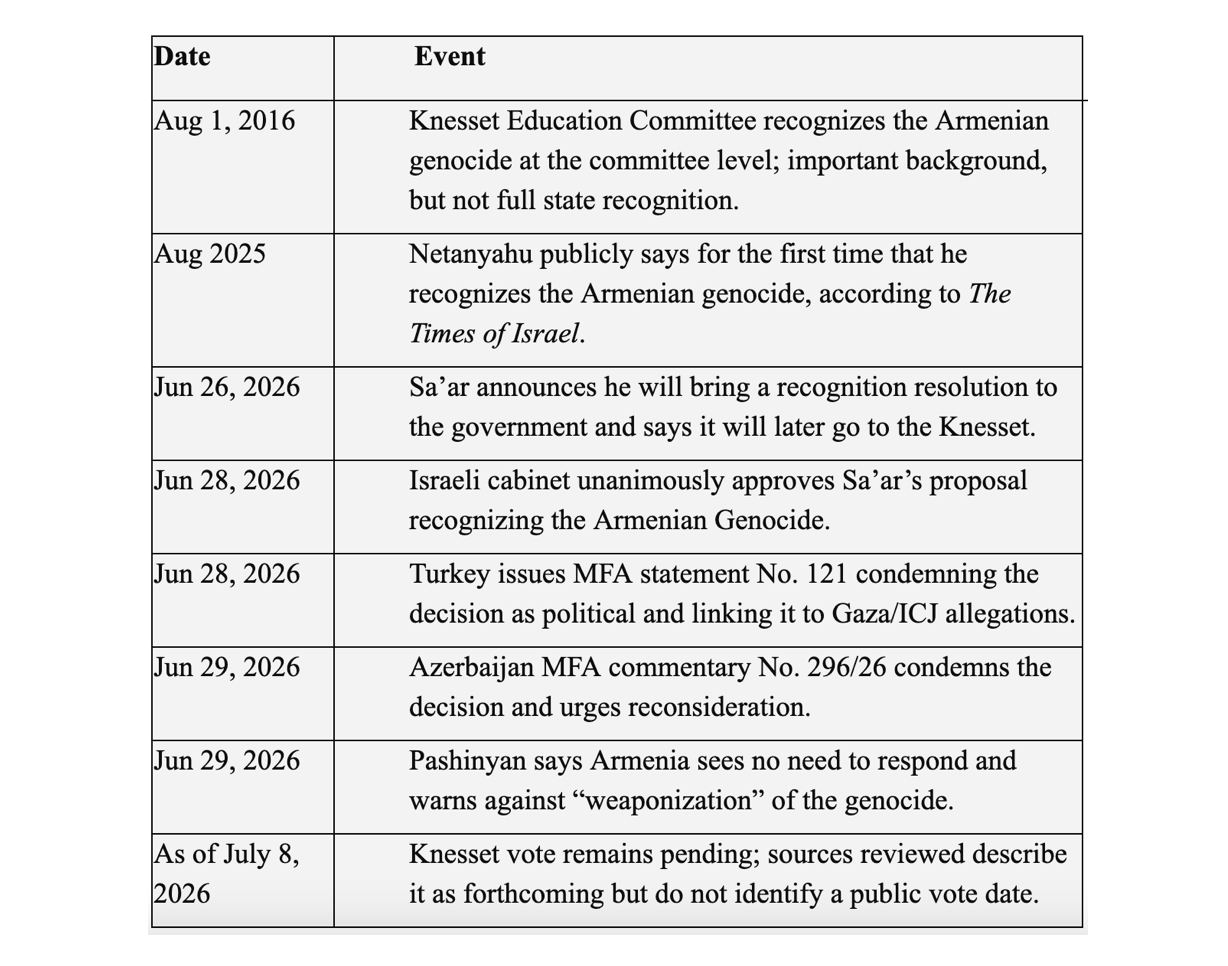


Despite the government cabinet approval, Israel’s parliament (the Knesset) most likely will not recognize the Armenian Genocide. There is too much arm sales profits and dependency on oil imports from Azerbaijan at stake. Also, let’s not forget that Israel uses Azerbaijan as a platform to attack and destabilize Iran.
Already, the Knesset has postponed the Armenian Genocide recognition hearing to later this year.
Let’s face the truth, Israel like many other countries will place its national interests ahead of the Armenian Genocide recognition. Morality plays no role in politics until Armenia becomes an economic powerhouse in the region. And, Israel becomes aware that at the end, Azerbaijan will always side with Turkey against Israel.
Has EVN Report become a platform for Hasbara and Donald Trump?