


Listen to the AI generated audio article.
The 2026 Armenian Parliamentary elections were perhaps the most competitive and electorally complex in Armenia’s post-independence history, as the electorate demonstrated pluralistic aspirations, pocketbook voting, and narrowing of the urban-rural divide. The relatively, and unexpectedly, high voter-turnout displayed a nascent, yet growing, anti status quo-sentiment among voters, while at the same time displaying the strengthening and institutionalization of the incumbent party’s voter base. Finally, this election demonstrated the growing sophistication of the Armenian voter, as vote preference was not simply reduced (as has been the case in the past) to a simple dichotomy (oligarchy versus democratic reformers; corruption versus rule-of-law; patronal system versus civil society, etc.), but demonstrated a multiplicity of issues that drove voters: healthcare, pensions, infrastructure-building, rural development, jobs, U.S.-Armenia relations, U.S.-Russia relations, security and the peace process, and of course, the economy. The anti-incumbent vote, for example, cannot simply be reduced to a pro-Russia/anti-West vote, and the pro-incumbent vote cannot simply be reduced to anti-Russia/anti-oligarchy vote. This election, to a large extent, collapsed the dichotomous structuring that has defined voting preferences within Armenia’s electorate. The Armenian voter sought to balance personalistic leadership with policy preferences.
In the confluence of these contextual observations, the 2026 election remains even more unique for three primary reasons. First, it demonstrated the growing complexity of Armenia’s electorate. The results showed not only that the incumbent has consolidated a durable electoral base, but also that the opposition demonstrated an increasing ability to coalesce and mobilize an anti-incumbent coalition. Second, this was the first democratic election in Armenia’s history that was subjected to expansive and multi-tiered hybrid and subversive interference operations by Russia, thus exerting immense pressure on Armenia’s developing-yet-underdeveloped institutions. Third, it demonstrated that the “cost of ruling” postulate is now a reality in Armenia, in that while the incumbent party handedly won the elections, there has been a diminishing in their performance from previous elections: the cost of ruling is taking its toll.
Disaggregating the data for the 2026 elections offers wide-ranging insight into four analytical categories: 1) comparative treatment of voter turn-out between 2021 and 2026; 2) the performance of both the incumbent and the anti-incumbent coalition between the two elections; 3) the shift in performance of the anti-incumbent opposition in large cities outside of Yerevan; and 4) the distributive performance of the incumbent and anti-incumbent groups within Yerevan.
For both the 2021 and 2026 elections, Civil Contract is the incumbent party, led by Prime Minister Nikol Pashinyan, and by definitional extension, voter preference for the incumbent party is primarily defined by preference of the policies of the Pashinyan Government. The anti-incumbent or anti-Pashinyan opposition, generally defined as either illiberal and pro-Russia, or both, is defined by two different sets of groupings. In the 2021 elections, this grouping entailed the Armenia Alliance (led by second-president Robert Kocharyan), I Have Honor Alliance (led by third-president Serzh Sargsyan’s Republican Party), and Prosperous Armenia (led by Kocharyan ally and business tycoon Gagik Tsarukyan). In the 2026 elections, I Have Honor Alliance was replaced by Strong Armenia, led by Russian-Armenian tycoon Samvel Karapetyan, while Armenia Alliance and Prosperous Armenia remained in this grouping. Structurally, Sargsyan’s Republican Party opted to dismantle the I Have Honor Alliance and utilize its party infrastructure to support Strong Armenia. But in either iteration, the anti-Pashinyan opposition participated in the elections as an informal coalition, thus representing, collectively, the preference of the electorate that opposed the incumbent party.
Voter Turnout
The voter turnout in the 2021 elections stood at 1,281,313 voters, roughly 49.4% of the electorate, while the turnout for 2026 was at 58.76% (1,472,950). Approximately 191,600 more voters showed up in 2026, thus increasing the voter turnout by ~9.3%. In raw numbers, Civil Contract increased their vote share by 38,000 voters, while the anti-Pashinyan coalition increased their share by 156,700 voters. In comparative terms, the anti-incumbent forces were able to mobilize four times more voters than what Civil Contract was able to bring out compared to 2021.
This robust disparity demonstrates two important factors. First, while the anti-incumbent opposition performed much better, the voter base of the incumbent party not only held, but also demonstrated a numerical increase. Second, the fact that the anti-incumbent forces were able to mobilize four times more newer voters than the incumbent, ceter paribus, clearly demonstrates that the “cost of ruling” postulate has arrived in Armenia’s electoral domain, and for every future nationwide election, if the incumbent party participates under the leadership of Pashinyan, they will see a diminishing of their vote between 2.25% to 4%.
Sociodemographically, the disaggregated data on voter turnout offers two very fascinating outcomes. First, similar to 2021, more women voted than men (by roughly a margin of 7%), with a slight increase of male voters for 2026 (approximately 1.3%). The relative constant in the number of female voters is one of the primary reasons why Civil Contract’s base holds strong electorally, as far more women, proportionally, vote for Civil Contract when compared to men. Second, the distribution by age also offers an explanatory framework on where the anti-incumbent opposition improved and where the incumbent consolidated its voter base.
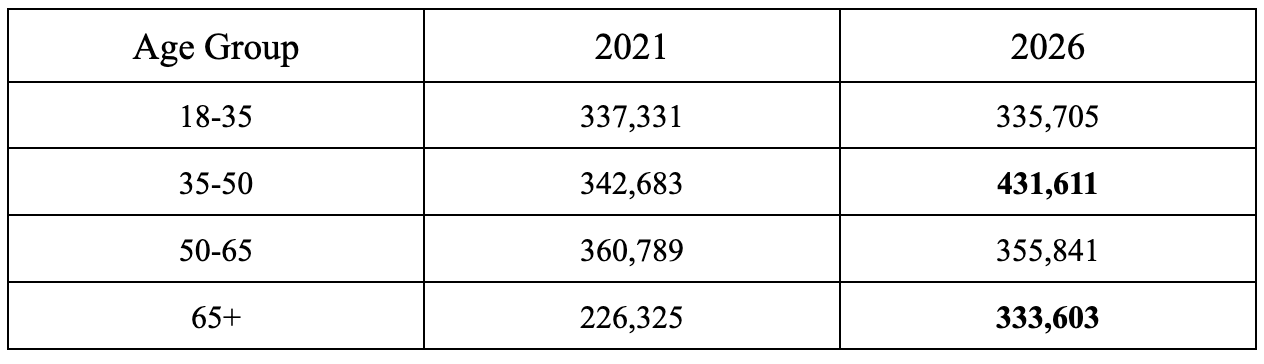
As is typical of most democratic societies, youth turnout remained low, and declined slightly in 2026, suggesting that the youth vote did not significantly influence the electoral outcome. Two age groups, however, stand out: those aged 35-50 and those 65 and over. The 35-50 age group demonstrated a very large increase in voter turnout compared to 2026, suggesting that some (or many) that were in the 18-35 range in 2021 turned out at a higher rate as their age increased into the 35-50 bracket in 2026. But more so, it is not too difficult to deduce that a significant share of this cohort voted for the anti-incumbent opposition, making it one of the primary factors behind the increase in support for the anti-Pashinyan grouping.
At the same time, the robust increase in the vote share of the 65 and over age group is even more surprising: their participation, in raw numbers, increased by over 100,000. Similarly, it is not too difficult to deduce that a significant portion of this age bloc voted for Civil Contract, as the entirety of available data demonstrates that the voter base of the incumbent party remain older.
Collectively, with youth turnout being consistently low, while the age bloc of 50-65 remained constant, it appears that quadragenarians are increasingly making up the anti-incumbent vote, while the oldest of voters are consolidating the incumbent vote. This trend will become quite acute in the 2028 Yerevan City Council elections, as well as for the 2031 Parliamentary elections, as the base of so-called Velvet voters gets older or they pass away, while the relatively younger voters tilt towards anti-status quo or anti-incumbent preferences.
Overall Performance
The overall electoral performance displays the incumbent’s continued strength, with Civil Contract securing a third consecutive victory despite the typical “cost of ruling” problem. At the same time, the results reveal an approximately 11% shift since 2021: Civil Contract underperformed by 4%, while the anti-Pashinyan grouping increased their vote-share by 7%. Interestingly, the anti-Pashinyan faction’s improved performance was not in Yerevan (generally viewed as the highest concentration of anti-incumbent voters), but rather in the larger cities of the regions. In comparative terms, Civil Contract actually slightly overperformed in Yerevan and Vayots Dzor, while demonstrating declines in the remaining regions and the largest cities of those regions.
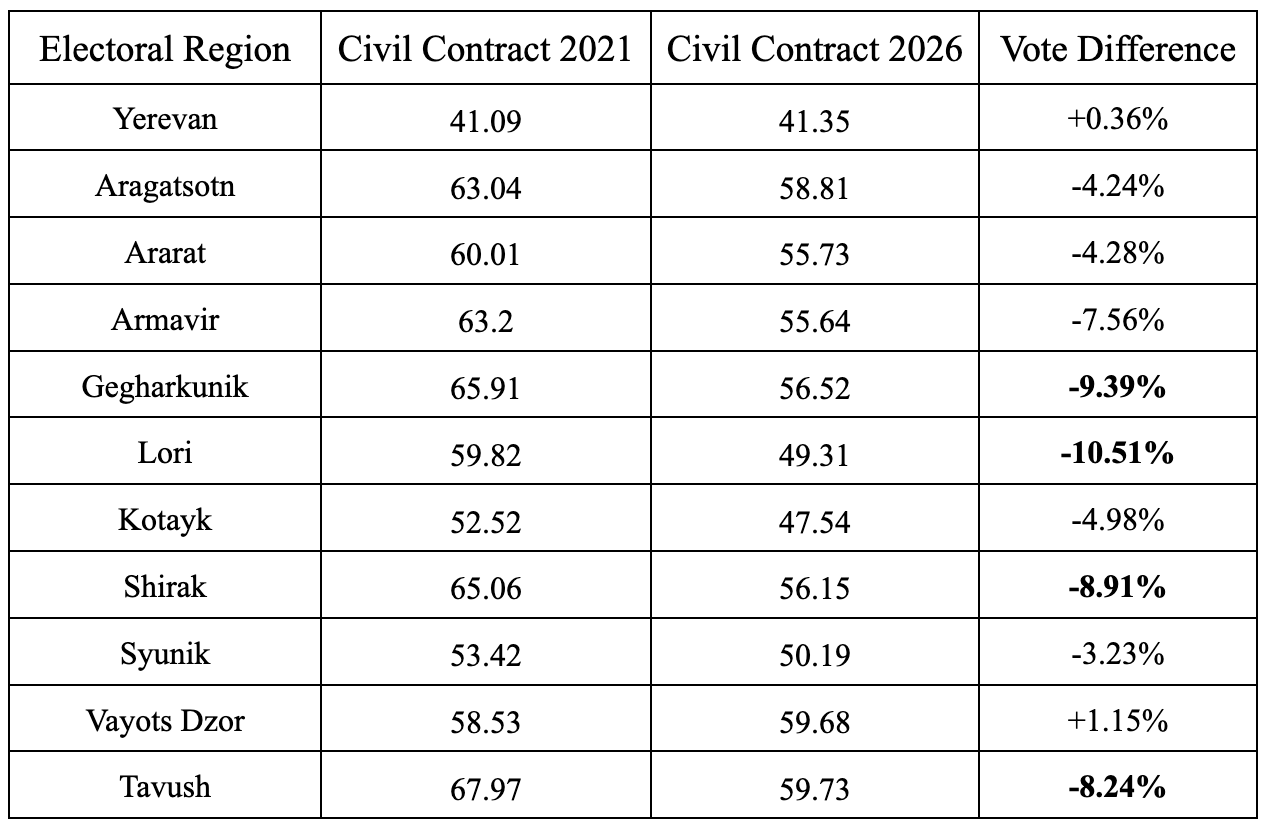
Civil Contract’s largest underperformance in the regions, compared to their performance in 2021, were Lori, Gegharkunik, Shirak, and Tavush, collectively underperforming by ~9.3% in these regions. Their performance in Aragatsotn, Ararat, Kotayk, and Syunik were generally consistent with an incumbent’s “cost of ruling” decrease, while improvements in Yerevan and Vayots Dzor were minimal. The numbers for the anti-incumbent opposition, on the other hand, while demonstrating an improvement compared to 2021, came nowhere close to actually challenging the outcome of the elections. Civil Contract won every electoral region, including Yerevan, which is empirically the electoral hub of anti-incumbent sentiments. However, and at the same time, the relative and collective improvement of the three anti-incumbent parties did not translate into a close election. However, the analytical output demonstrates consistent improvements in 11 of the 12 electoral regions.
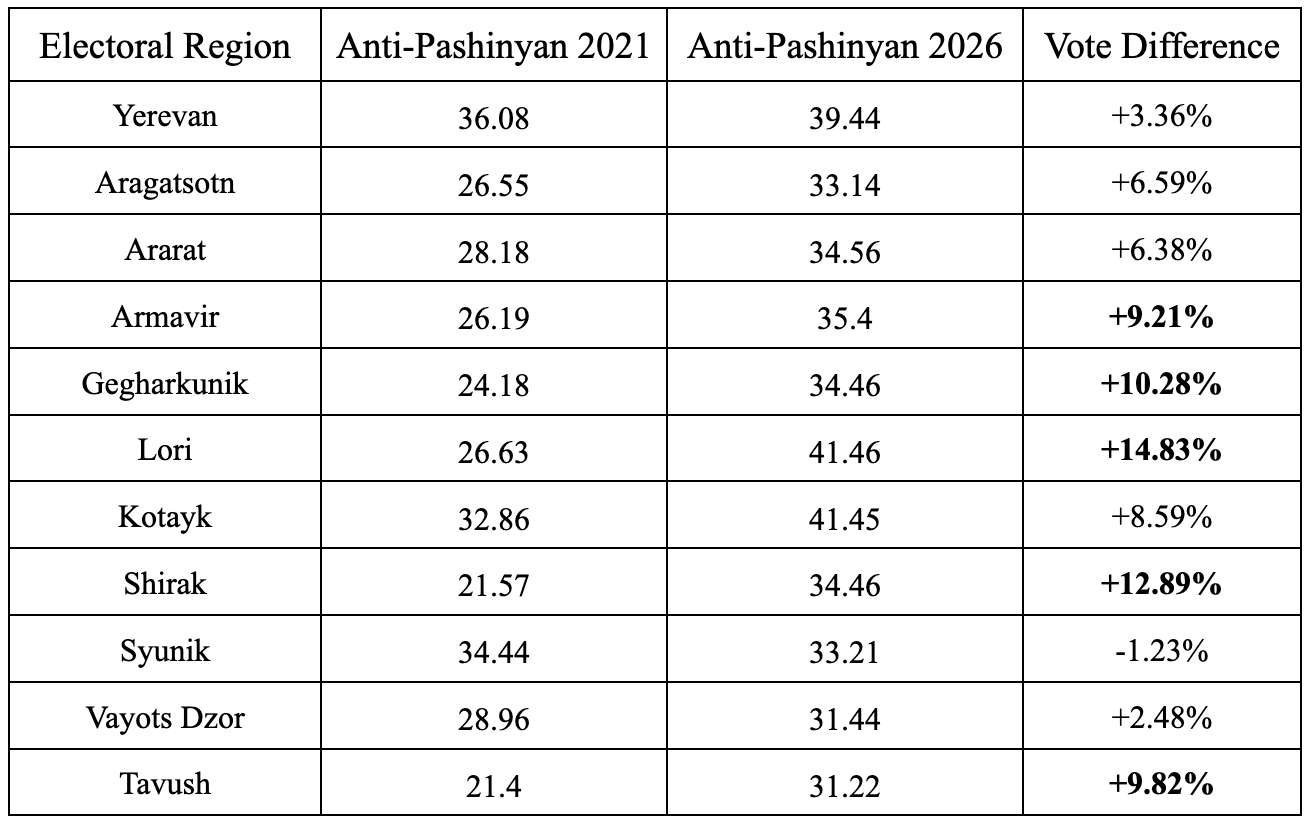
In displaying the performance improvement matrix between the two factions, the vote difference gives a healthier picture of how the anti-incumbent opposition performed better, yet still lost by a very substantive margin to the incumbent party in the final outcome.
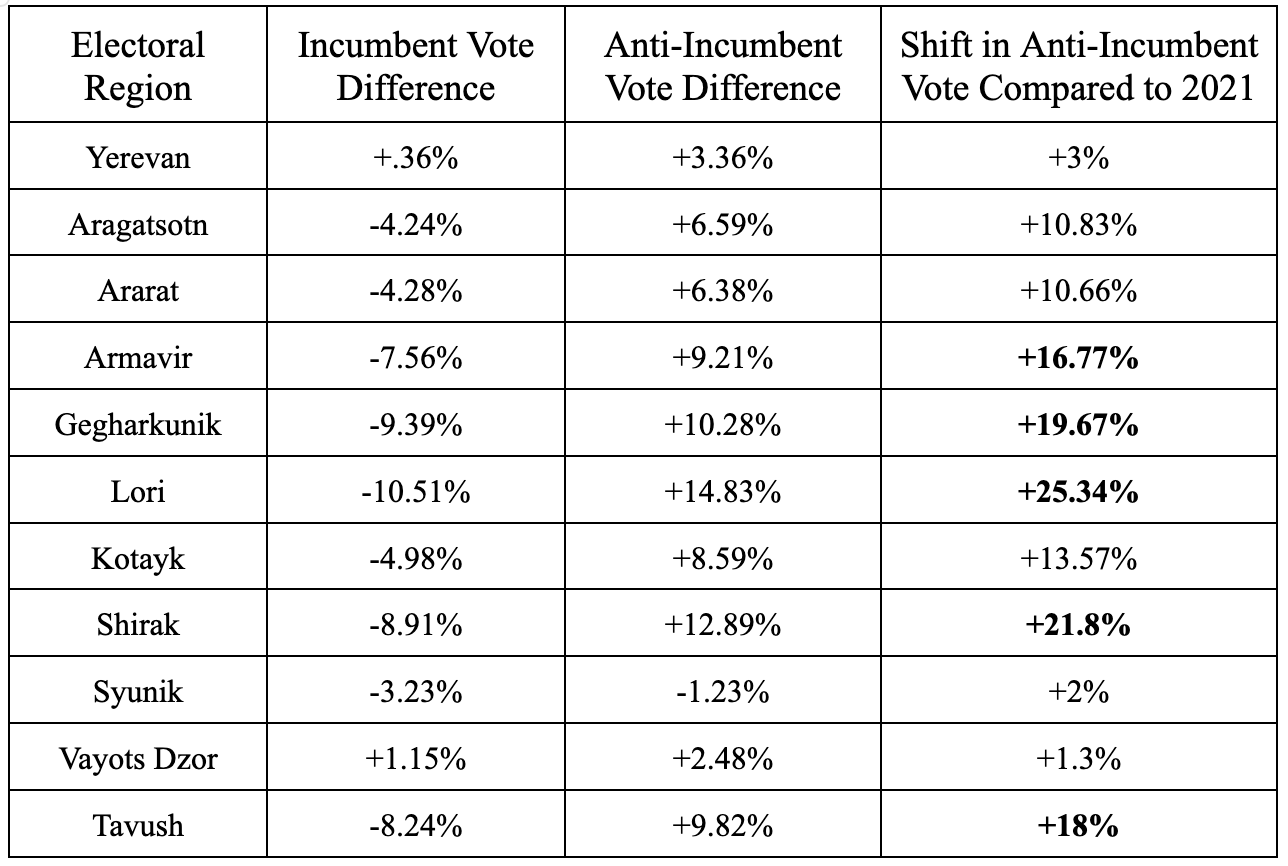
As the above chart shows, the anti-incumbent vote robustly increased in Lori, Shirak, Gegharkunik, Tavush and Armavir, while staying relatively constant in Yerevan, Syunik and Vayots Dzor. The increase in the anti-incumbent vote in Lori can be contextualized by the fact that the leader of the Strong Armenia party, Samvel Karapetyan, hails from this region, and as such, the overperformance of the collective opposition has a clear correlative basis. Similarly, the increase in the anti-incumbent vote in Gyumri can be traced back to the 2025 municipal elections, where Civil Contract won plurality, but a coalition of ad-hoc opposition groupings coalesced to form a coalition city council. The numbers in Armavir and Tavush, however, are quite interesting, since Armavir has generally been part of Prime Minister Pashinyan’s base, while Tavush stands out because this is the region that the prime minister hails from.
The robust increase in the anti-incumbent vote in these regions not only demonstrates the “cost of ruling” effect, but also indicates that the ruling incumbent party may soon be subjected to the “grievance-assymetry theory.” This theory holds that the effect of the positive changes implemented by the incumbent party will not reflect equally with negative perceptions of the incumbent. In more simple terms, if an incumbent party does 10 things that are popular and positive, but there are 3 things that citizens are unhappy about or have grievances towards, those 3 things will have a much larger effect on citizen perception of the incumbent than the 10 positive things. Hence the “asymmetry” component of grievance-assymetry theory. This theory is specific to the incumbent, and is thus an important part of the cost-of-ruling effect. More so, because it is incumbent-centric, it also diminishes the incumbent’s ability to leverage the opposition. Meaning, citizens will have a much higher criteria of expectations from the incumbent than the challenger, and as such, the weaknesses or negatives of the opposition will not be equal to the strengths of the incumbent. In layman terms, voters simply start giving the benefit of the doubt to the challenger, while asymmetrically targeting the incumbent with grievances. There are potentially observable signs of this when looking at the distribution of vote shares in cities, and specifically, narrowing of the urban-rural divide: the shifts in the anti-incumbent vote in rural areas are real and not simply specific to urban Yerevan.
The Cities
In the 2021 elections, Civil Contract’s dominance of the major cities in the regions were commensurate with their strong performance through the said regions, and as such, in the regions (areas outside of Yerevan) the incumbent comfortably performed at the 60% range, while in Yerevan, it remained in the low 40% range. In the 9 largest cities outside of Yerevan, Civil Contract averaged 57.6%, aligned with its average of 60% for the entirety of the regions. It is within the confines of such data that we speak of an urban-rural divide: the vote discrepancy between the two was immense. This appears to have shifted in the 2026 elections, and hence this article’s claim that the urban-rural divide has narrowed. The incumbent party’s vote share in the rural areas decreased from an average of 60% to 54.5%, while its average performance in the 9 largest cities outside of Yerevan decreased from 57.6% to 51.5%. At the same time, the numbers in Yerevan held constant, thus demonstrating that the urban-rural cleavage has narrowed. In and of itself, Civil Contract continues to dominate the rural areas and far outperforms the entirety of the opposition field, but within the domain of disaggregating Civil Contract’s performance numbers and observing trends, the decline in the incumbent vote is quite evident.
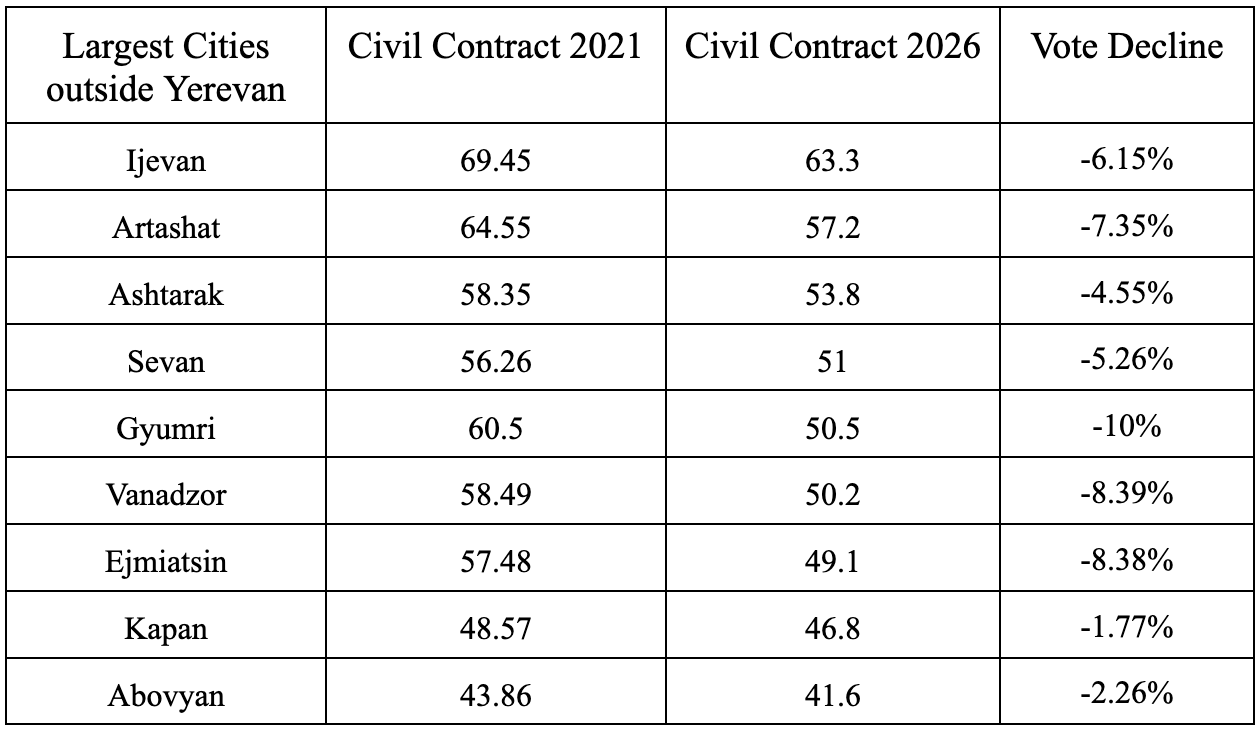
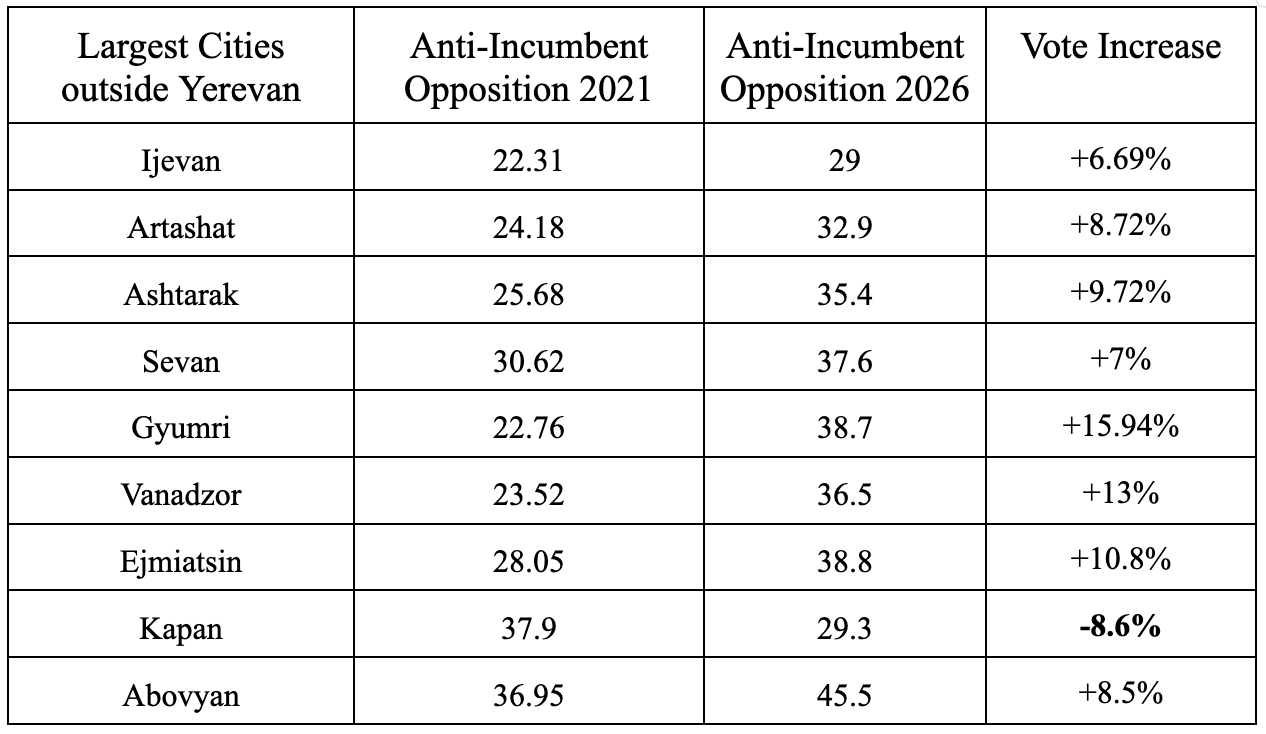
The increase in the vote of the anti-incumbent grouping clearly reflects the relative decline in the Civil Contract vote, but even within the domain of an observable decline, Civil Contract still outperforms all three of the anti-Pashinyan parties combined. The one exception is the city of Abovyan, where tycoon Gagik Tsarukyan, leader of the Prosperous Armenia Party, hails from.
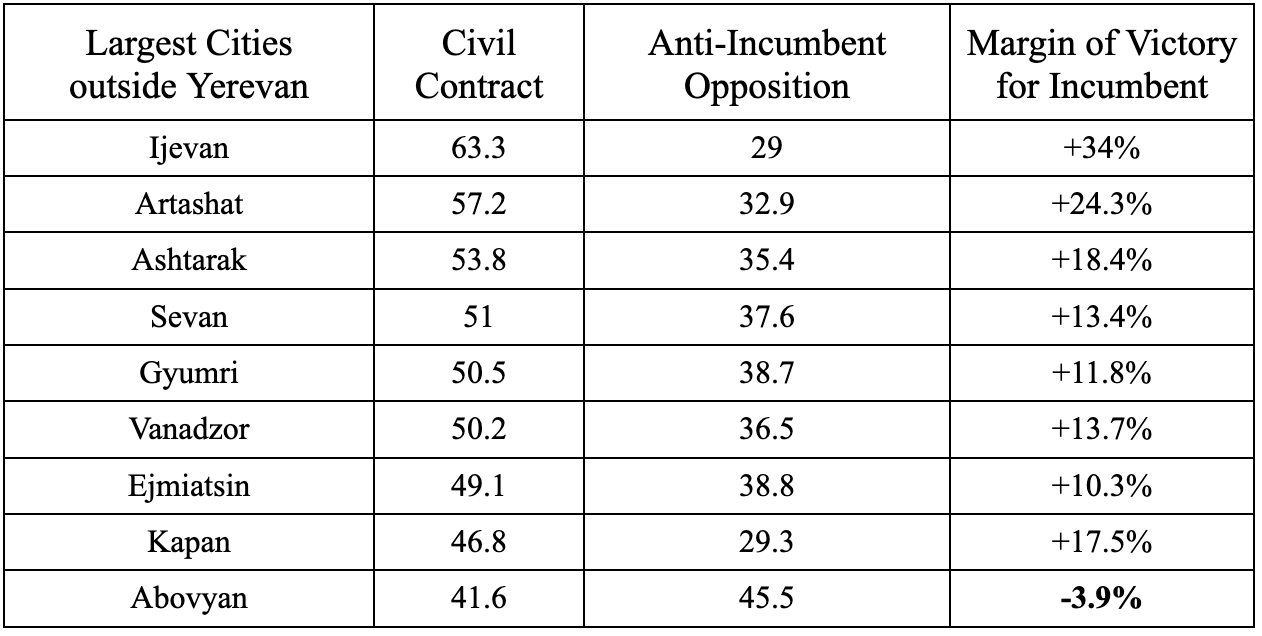
As the chart above demonstrates, the electoral outcomes in these cities were by no means close (with the exception of Abovyan being an outlier) and the improvement of the anti-incumbent factions did not, in any iteration, make the overall elections competitive. However, for analytical and trend analysis purposes, observing and disaggregating the shifts in the anti-incumbent vote are fundamental in empirically understanding the cumulative effect that postulates such as “cost of ruling” and “asymmetrical grievances” will have in the upcoming municipal elections of 2026 and the Yerevan City Council elections of 2028.
Which brings us to the largest electoral district in the country, Yerevan. While initially noting the narrowing of the urban-rural divide axiom, the ability of the incumbent party to maintain its base in Yerevan suggests an inverse gain. Meaning, while the anti-incumbent vote increased in rural areas, it did not demonstrate much increase in Yerevan, which is the core of the anti-incumbent vote preference. Just as interestingly, Civil Contract’s performance in Yerevan remains empirically interesting: it underperformed in its areas of strength (outside of Yerevan), yet demonstrating no decline in Yerevan (its area of weakness).
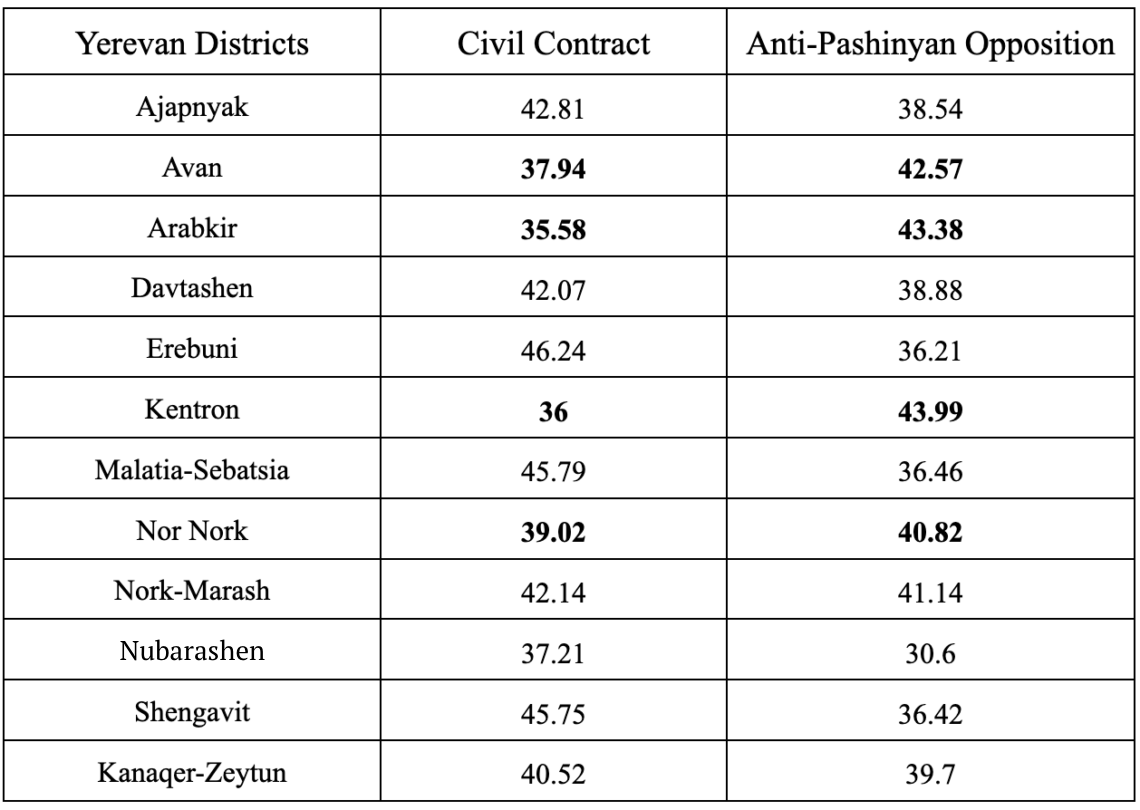
Civil Contract lost 4 districts in the 2026 elections, exactly similar to 2021, while winning the remaining 8. While most of the numbers in the districts remained constant, give or take a percent, what seems to have allowed Civil Contract to hold its numbers in Yerevan was its overperformance in two of the most affluent districts: Kentron and Arabkir. In 2021, Civil Contract received 31.4% in Arabkir and 31.2% in Kentron, respectively. In 2026, while still losing those districts, they did, nonetheless, increase their vote share, receiving 35.6% in Arabkir and 36% in Kentron. Being two of the more populated, and being economically the two of the most affluent electoral districts of Yerevan, the incumbent parties ability to overperform by a combined 10% in these districts was one of the more unexpected outcomes when observing anti-incumbency trends in Yerevan.
Conclusion
The body of disaggregated data for the 2026 elections displays the growing complexity of Armenia’s electorate, as shifts in the regions, narrowing of the urban-rural divide, and the incumbent party’s unexpected performance in Yerevan all indicate that previously held assumptions about Armenia’s electorate need to be changed. Armenia’s electorate is not defined by simple geopolitical dichotomies or on-the-surface pontifications of voter preferences. The incumbent party dominated the electoral landscape, but the anti-incumbency vote was also substantiated as an electoral base. While the incumbent party has claimed its base, the anti-incumbency base is not yet claimed and does not have a consolidated leader. Future elections will show if the anti-incumbency base is consolidated, or whether it is a fluid coalition of voters engaging in grievance-asymmetry.
Indeed, as the results below show, this was not a close election, and when the anti-Pashinyan faction is reduced to individual parties, this was a landslide victory for the incumbent. However, since Armenia is a parliamentary system, coalition-analysis is a more accurate qualifier of voter preference, and while even within this qualifier the elections were not close, we nonetheless see very important trends in voter shifts and urban-rural dynamics.
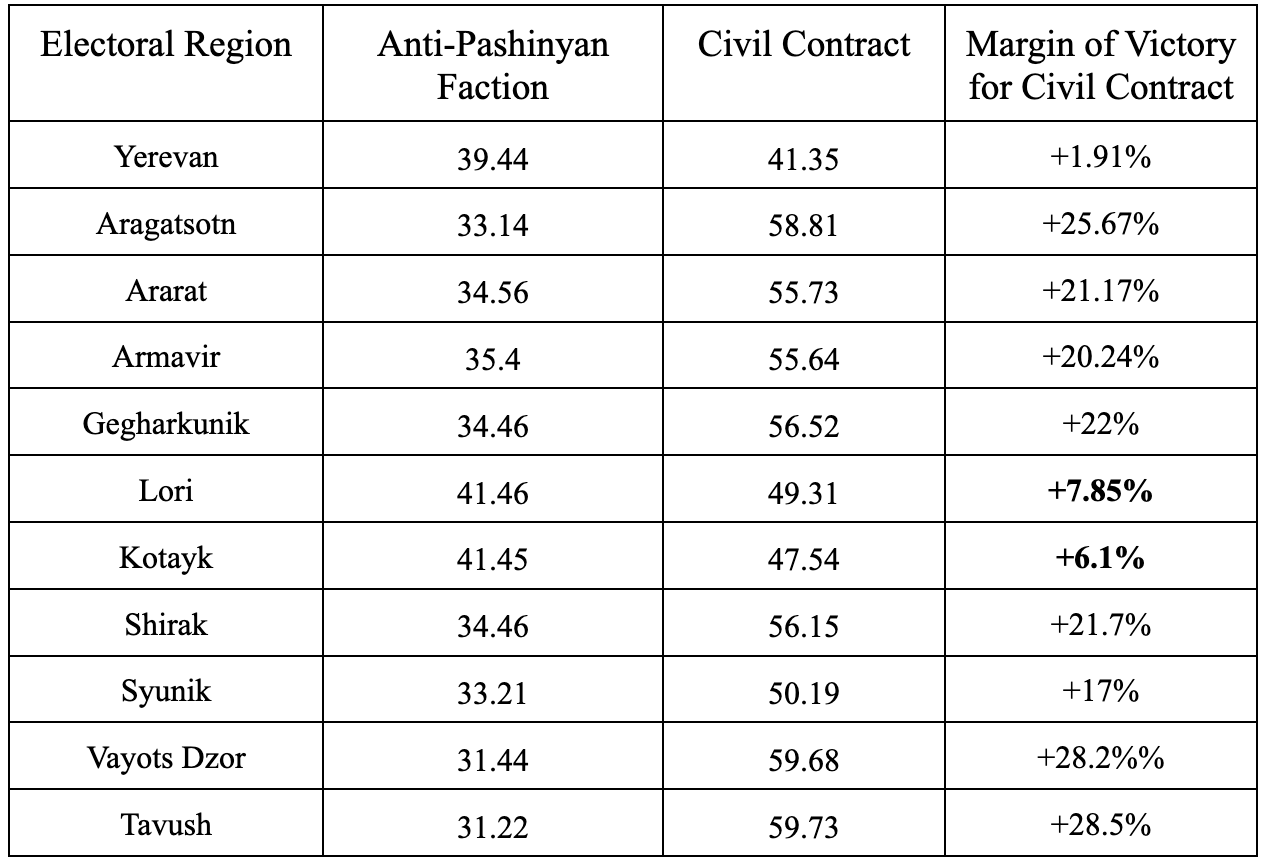
Finally, what the electoral process in 2026 demonstrated is that Armenia remains acutely vulnerable to both expansive foreign subversion operations, as observed by Russia’s wide-ranging application of its hybrid toolkit, as well as systemic vote-buying schemes initiated by Russian proxy parties. Because this analysis is purely based on the empirical outputs, it refrains from speculating the effect of such factors on the electoral outcome or the analytical interpretation of the disaggregated data. But in triangulating threats to Armenia’s democratic process and the trajectory of democratic consolidation, three important observations stand out.
First, the anti-incumbency vote is not, in of itself, an anti-democracy vote, but rather, the use of the democratic process to express political grievance or disagreement. The extent to which vote-buying took place, or the extent to which administrative resources were used, there is no evidence to suggest that either shifted the will of the people or the outcome of the vote. In this context, Armenians are learning to address political differences and policy preferences through the ballot box and not the streets. Second, the Russian subversion threat will remain acute into the future, and the best way to mitigate this is to democratize future opposition parties that will seek to absorb the anti-incumbency vote: Armenia needs new, fresh, youth-led opposition parties that espouse and advance the democratic ethos. And third, Armenia’s alternative democratic parties are electorally dead: none came anywhere close to meeting the threshold of entering Parliament, and none performed above the 1% mark outside of Yerevan.
To this end, while Armenia’s voters are becoming more sophisticated, Armenia’s political parties are not. The widening gap between a developing political culture and an underdeveloped party system will be the biggest challenge facing the country’s democracy. The incumbent cannot rule forever, and the cost-of-ruling effect is an enduring feature of all democracies. How will this be absorbed by Armenia’s electoral landscape, and can the electorally declining incumbent nurture and cultivate pluralistic options that will absorb the anti-incumbency vote and thus produce a healthy democracy devoid of external proxy actors?
Statecraft & Governance

How America Became a Pillar of Armenia’s Security
From access to American weapons systems, to implementation of TRIPP, to cooperation on critical minerals, the agreements signed during U.S. Secretary of State Marco Rubio’s visit represents a new stage in U.S.-Armenia relations. Nerses Kopalyan examines their security significance and writes that it was a recognition by Washington that Armenia’s security and stability have become increasingly important components of its regional policy.
Read more
Armenia Flexes Its Smart Power
Armenia is seeking to redefine its global role through “smart power". By hosting the European Political Community Summit and a series of major international forums, Yerevan is leveraging diplomacy, connectivity and strategic partnerships to expand its international relevance, resilience and foreign policy autonomy.
Read more
Iran War, Escalation and Armenia: Managing Ambiguity and Risk
The Iran War has produced two escalatory models: the U.S.-Israeli “escalate to de-escalate” approach and Iran’s “horizontal escalation” strategy. Armenia’s response is strategic ambiguity: avoiding entanglement while preserving ties with competing partners. To be successful in risk-mitigation, Yerevan must use “situational ambiguity” to navigate crises and de-risk the danger of entanglement.
Read more
Aliyev’s Forked-Tongue Policy: Peace Meets Anti-Armenian Propaganda
While Azerbaijani President Ilham Aliyev portrays himself globally as a proponent of reconciliation and regional cooperation, the data clearly demonstrates his questionable commitment to the peace process. In this expansive study, Nerses Kopalyan and a team of researchers produce empirically-grounded analysis, utilizing an AI machine-learning toolkit, of Azerbaijan’s media ecosystem, revealing the disconnect between Aliyev’s domestic propaganda and his diplomatic rhetoric on peace.
Read more
Armenia’s Doctrine of Multi-Alignment: Strategic Partnerships, Not Alliances
Armenia’s foreign and security policy realignment is reshaping regional dynamics. Nerses Kopalyan introduces the doctrine of multi-alignment to Armenia’s policy discourse, arguing that diversification is rooted in this doctrine, one that favors strategic partnerships over alliances to de-risk security and enhance statecraft.
Read more