
Listen to the AI generated audio article.
And the wind smelled of papa’s tobacco…
Each time I pass these fields, I fear it will be the last. I feel it in my fingers and toes, in my eyes. I lean toward the window to drink in the landscape. The wind moves through the warm green wheat and through my hair the same way; it breathes, then fades at once. A tear stings behind my eyelids. Still, I do not cry.
My brother, feverish and restless, adjusts the barrels of the binoculars borrowed from one of our uniformed neighbors, a soldier. He gently rotates the focusing ring until he spots the distant hill where papa used to drive us.
It had taken him a while to decide to make the trip to our village of Patara in Askeran. Petrol was something one had to procure in our land.. Months earlier, it had still been possible to find, but now it had become as rare as milk and honey. Thrifty by nature, he had stored 10 liters of petrol in a pale green jerrycan, saving it for a “black day”.
Why he finally changed his mind, I have no idea. Yet somewhere, likely in his fingers and toes, he sensed that this would be the last time.
We took a rutted road through the hills. Every 40 meters, trees toppled by the heavy rains struck the car, as if we had forced them to bow and they were now taking their revenge. Later, an old fisherman told me the storm had washed away the vegetable plots of his fellow villagers.
As we approached the village, there was the sweet scent of hay bales mixed with fresh cow dung. “I love that smell,” I exclaimed. “It feels so… village.”
“Another one of your silly jokes?” Mama asked with a light grin.
The playful disdain I had as a girl walking past the rustic houses and farms of my ancestral village of Qarahunj in Martuni region, had become a yearning for those days, when the smell of cows lingered in the air and every corner carried the taste of flatbread baked in a tonir.
Sat around a wooden table, the elderly folk in Soviet caps are playing blot. Someone rolls the dice and hurls curses that carry beyond the border, because he no longer owns a field to grow corn, to de-weed the soil, to turn the earth that once smelled of his sweat and homeland.
Papa presses the brake pedal reluctantly. A quiet, brown figure, squatting by the roadside, rises and comes forward to ask if we need help.
“Go past the lake. Take the narrow passage on the left,” he says, then mutters something under his smoky breath. All I could make out is that we’d have to continue on foot once we reach the end of the black, serpentine water pipe.
One radio station plays the folk ballad Ay Laçin; another mumbles the latest news from Azerbaijan. I shut it off. Damn you!
“Dragonflies! Look over there. What do they remind you of?”
“Helicopters,” my younger brother says, lighting up.
“I used to watch them for a long time… Once, I caught them sitting on the barbed wire that fenced grandma’s house,” I say proudly.
A river rushes through the forest, a fierce sweep of water that drowns out every other sound. We are silent now. The yellow bird perched on a nearby tree is silent too.
The two brothers set about building a fire. Using the excuse of gathering more logs, as if I hadn’t been asked to wash the potatoes, I wander around instead: mushrooms here and there, orange and red; spiders with huge heads that I would later learn were actually vicious scorpions.
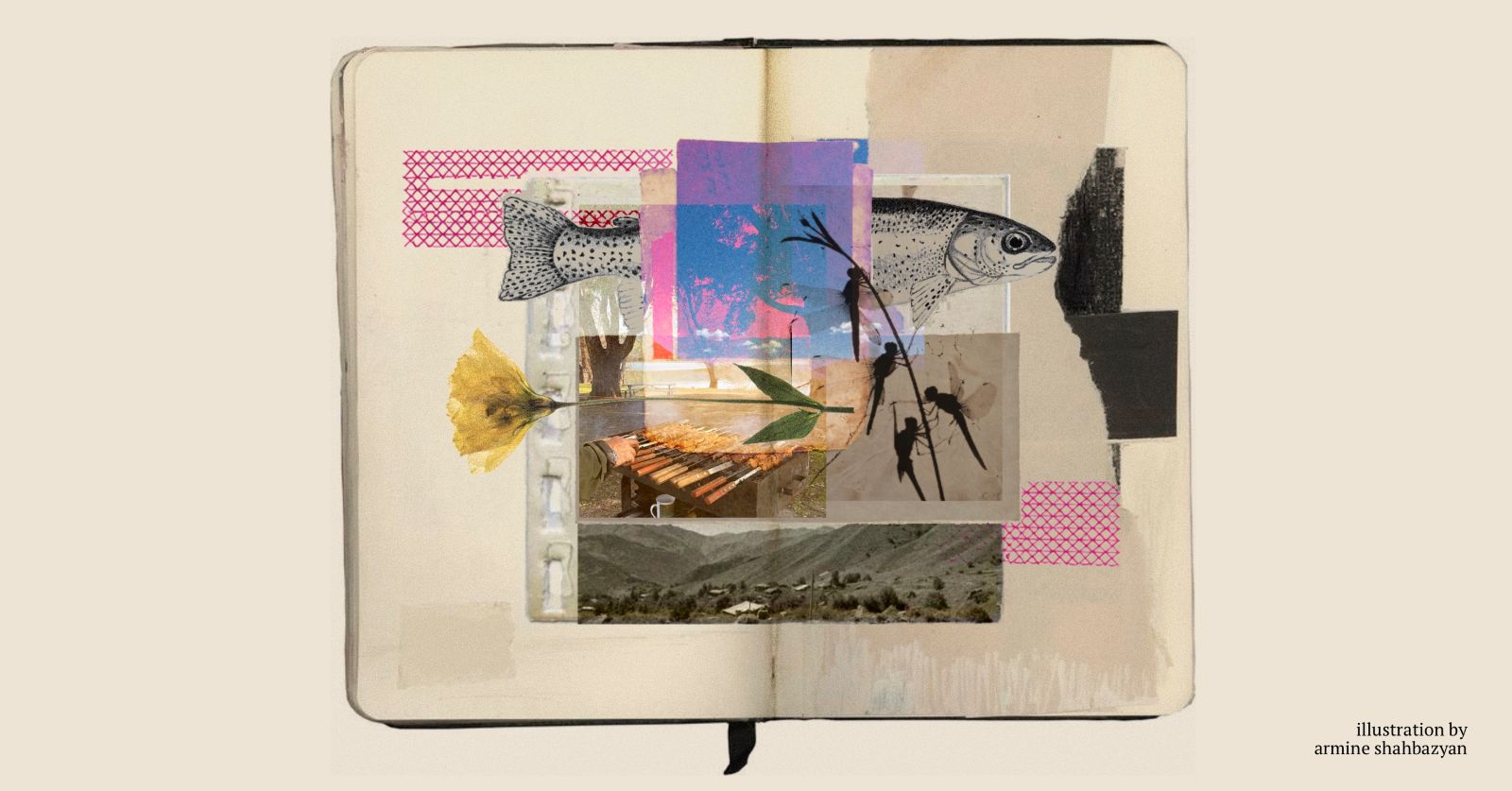
Mama lays a mat on the damp earth and watches the clouds. Meanwhile, papa portions the raw meat with an axe, grumbling about his back pain. He sprinkles the meat, already on a skewer, with a few tablespoons of mint, red pepper and rosemary. The manghal he has made from damp branches, and the ashes beneath, press thickly against the grey skewers. I watch the meat lose its bright pink and the potatoes turn a deeper yellow over the fire.
A man clad in green stands by the river. I stare for a while before noticing his rod, reel and float.
“A fisherman,” my brother exclaims.
We call out to him and invite him to join us.
“Come, akhper, let’s drink some vodka and speak of our dards (burdens).’’
They drink in silence. The first glass: the glass of peace, the glass of honor.
The fisherman then hands mama a golden hessian sack.
“There are some karmrakhayt in there, you can take them home.”
“We can clean them and grill them over the coals. The barbeque pit is still hot,” mama says with a half smile.
I inspect the tiny red spots on the fish’s big belly as it spins in the air like a whirlwind, though it was already dead. Remorsefully, I hand the bowl of fish to papa. He sprinkles them with salt and threads them onto a skewer. The two smallest he wraps in mulberry leaves and buries deep in the coals. “It’s lazzat (real pleasure),” he says, “to eat this way.”
For the last time, the water caresses my face. I feel at peace. I walk away. Unable to leave the feeling behind, I come back running. I let the river cover my face and my toes. I feel it against my skin.
I was aging.
As the late afternoon sunrays fade over the river and the trees’ ghostly shadows grow tall, we walk up the hill. Mama carries a pot of khorovats, the onions pleasantly soaked, brown and crusted. In a woollen bag, I carry soft, star-shaped flowers. We call them zveraboy. Granny used to brew tea from them and say they were good for pain relief. I never learned another name for them. In our house, as in so many others, Armenian and Russian lived in the same sentence, slipping into one another so naturally that no one ever stopped to ask which language a word belonged to.
It doesn’t rain, just as mama believed it wouldn’t, never giving up her chase of the clouds. They are golden now, as are the wheat fields and the woman on the rooftop, stretching a clothesline between her hands.
The touch of a kiss drifts down from the distant mountains, slowly cooling my fingers. I feel it in my fingertips, in the flute, in my toes, until it comes to rest on my lips.
At the threshold of the passage, my brother, who never spoke of the war, says, “We have no more earth to lose.”
“Here we will die, or here our blood will plant pomegranate trees,” I hear papa’s frail voice through the open window. In the side-view mirror, I catch a tear gathering in his left eye.
I feel it in my nostrils…
I struggle. The earth struggles.
And the wind smelled of papa’s earth.

The Future We Keep Postponing
Three years after the displacement of Artsakh’s Armenians, the routines of exile have become ordinary. Siranush Sargsyan explores how a displaced community navigates grief, memory, identity and belonging while rebuilding lives in Armenia and abroad, and struggling to imagine a future beyond loss.
Read more
When “Diplomacy” Becomes a Vehicle for Information Manipulation
The European Union has invested heavily in Armenia’s resilience against foreign information manipulation. But when its own Special Representative reduces Azerbaijan’s state-sponsored historical revisionism to competing “narratives,” diplomacy risks becoming a vehicle for the very manipulation the EU seeks to counter.
Read more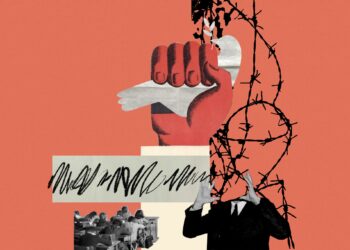
Regional Peace Cannot Be Built by Ignoring Azerbaijan’s Rhetoric
Baku’s “Western Azerbaijan” narrative continues to be prominent in state media, education and official discourse. Tatev Hayrapetyan examines how the concept has evolved, how it is being institutionalized, and what its continued promotion means for Armenia and the prospects for lasting regional peace.
Read more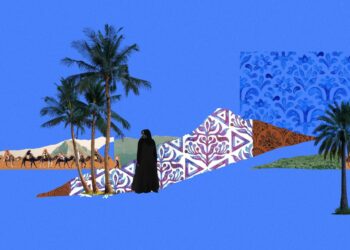
Traveling With a Lost Homeland
What does travel mean when you can’t return to the one place you most long for? Journeying through Morocco, Siranush Sargsyan finds traces of her lost homeland, Artsakh, in unfamiliar landscapes, traditions and people, revealing how displacement transforms the experience of elsewhere.
Read more