

Listen to the AI generated audio article.
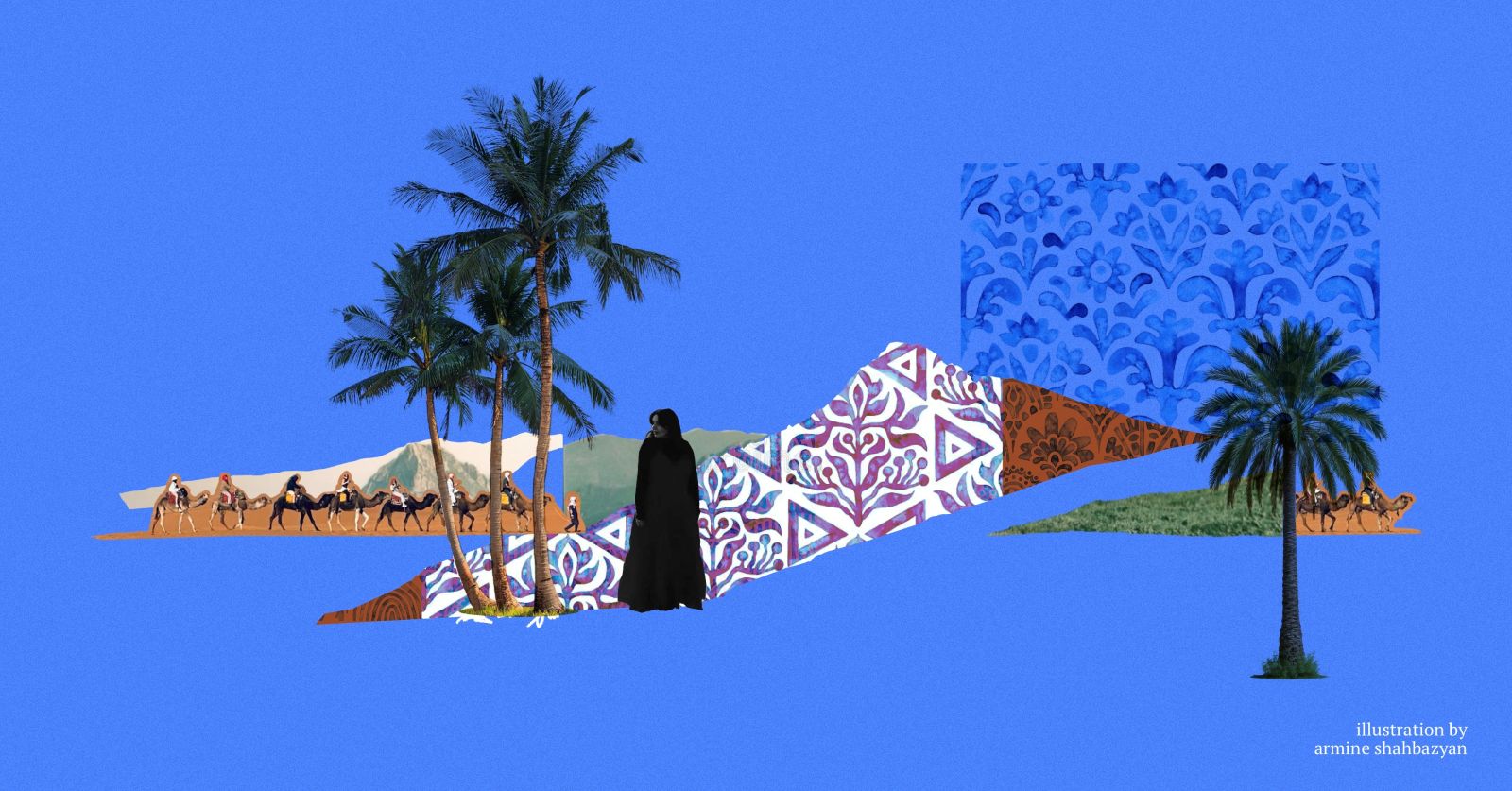
I travel every night, when everyone is asleep, when no one is checking the borders. I slip over the eagle‑crowned mountains, through ancient villages, past cemeteries where the stones tilt and the grass grows wild, past crumbling, unattended churches and moss‑covered khachkars, until I reach my home. I slip through its already broken gate, rush inside, and warm my hands over the wooden hearth. In that warmth, I wake up.
For someone who grew up in a war‑torn rural area, travel was, for many years, nothing more than a distant, lifelong dream.
It was through persevering that I finally reached the places I had only read about in books or seen in films. Yet after losing Artsakh, my homeland, the meaning of travel quietly changed: instead of dreaming of distant lands, whenever I travel, I mostly long for a home that I can’t return to.
Over time, traveling became a quiet, almost subconscious search for familiar traces, an effort to connect the unfamiliar with the familiar home I had been deprived of and lost. Even with the pain, exploring the unknown was somehow healing; for a moment, it offered a brief escape from the reality I live in as an exiled person.
Many people of my generation in Armenia remember the famous Brazilian telenovela O Clone. Parts of the show were filmed in Fez, Morocco, with its sprawling, traditional market, and it made me decide that one day I would travel there.
With a winter break from my studies in Lisbon, and Morocco just a short flight away, I finally seized the opportunity. Before my trip, my Facebook feed was flooded with anxious warnings in “Solo Female Travelers” Facebook groups—everyone was questioning whether Morocco was safe for solo women travelers. My sense of danger had long been shaped by experience, having lived through wars. My life had become a different kind of risk, so the warnings only made me more determined.
When Moroccan border control officers asked about my profession, instead of taking the easy route and saying “student,” I answered, “journalist.” The officers exchanged terrified glances. It took some convincing to assure them that I was now a student on a purely touristic visit, before they finally let me through.
With just a week to cross the country—from the Sahara’s golden dunes to the blue shades of Chefchaouen in the north—and not knowing how to drive, I joined a few group tours to cover the long distances. On one such tour, we set off from Marrakech and made our way to Rabat, taking in the rich history and cultural heritage at landmarks like the Kasbah of the Udayas and the Hassan Tower. From there we went to Casablanca, with the majestic Hassan II Mosque, and finally reached Fez. It was off-season, and the region had suffered heavy flooding just a month earlier, so our group was small: just me, an Italian couple, and our driver.
In Fez, with a local guide, we explored the medieval medina, the Bou Inania Madrasa, and the Qarawiyyin Mosque, which houses one of the world’s oldest universities, dating back to the 9th century. As we followed the usual route, listening to stories about the ancient medina (the old walled city) and its historic tanneries, our guide eventually steered us into a few shops where his personal connections were obvious. I didn’t buy anything, saving my time for the lunch break, when I hoped to slip away and lose myself in the maze of souks—wandering alone, as I had always imagined in the films that first made me dream of this place.
When that long‑awaited moment came, I was told that going off on my own was out of the question. Disappointed but not surprised, I realized it was still a man’s world. During the drive back, I kept thinking about how difficult it is to be a woman in a society that sets such rigid borders around freedom.
The local guide spoke proudly of Moroccan marriage customs, insisting that outsiders often misread local traditions. He justified polygamy as a safeguard for women: if a wife cannot bear children, her husband may marry again without abandoning her.
Later, he mentioned that the King of Morocco is divorced. It struck me that while the country’s most powerful man could end his marriage at will, ordinary men’s inability to do the same was framed as an act of mercy and not as self-interest: rather than divorcing an infertile first wife—a step custom forbids, as it would leave her destitute and disgraced—a man takes a second, preserving the first wife’s nominal status while enjoying the benefits of polygamy. Yet the King, lionized as a moral exemplar, divorced his own wife with impunity, a glaring double standard that exposes the self-serving logic of the rhetoric of “mercy.”
The next day, when the driver called me “Fatima,” I smiled and said that I could hardly inhabit her world. Still, I found myself quietly admiring the resilience of the women who navigated those unyielding traditions.
My second group tour, this time on a bus with about 20 other tourists, took me to the Sahara to explore Berber culture. Before traveling to Morocco, I had been warned not to ask questions about the King, politics, or, especially Western Sahara. Naturally, as someone who often does exactly what I’m told not to do, I was most curious to discuss those topics.
Back in Lisbon, I stared at the book on my desk for my Human Rights Advocacy class: Samuel Moyn’s Humane: How the United States Abandoned Peace and Reinvented War. Moyn examines the troubling paradox of modern conflict and how attempts to make war more ethical have sometimes helped justify its endless continuation rather than fostering peace. One of the wars he discusses is the Rif War (1920-1927), describing Berber resistance against Spanish and later French colonial forces. It was during that war that chemical weapons were dropped on the now-beloved blue city of Chefchaouen. The account reminded me of the 2020 war in Artsakh, during which Azerbaijan used white phosphorus on civilians and our rich agricultural fields.
Inspired by this history, I was determined to ask about the Rif War when visiting Berber settlements. To my surprise, the local Berbers avoided the subject. Having lived through the wars of mountainous Artsakh, I felt a deep connection to their ancestors’ struggle against colonial powers. I wanted to celebrate that shared spirit of resistance, yet I was surprised to hear their descendants speak mainly about how their ancient villages had been used as film locations for Game of Thrones and Gladiator, which had brought them tourists and income.
I could sense that if Berbers found their own fight for freedom too dangerous to mention, then asking an Arab from Marrakech about Western Sahara would be a total act of recklessness. When I finally tried to broach the topic, the guide’s face darkened. He kindly suggested that I never ask anyone else about it, which reminded me of a Soviet saying: “The East is a delicate matter.”
The Sahara Desert’s Hypnotic Golden Sand
The Sahara Desert, of course, was a miracle. Its hypnotic golden sand felt like an endless, magical space where the dunes meet the sun, a place in which the Sahara itself seemed to refuse the very idea of a border.
The warmth of ordinary people was unmistakable and felt familiar. If a service worker doesn’t have what you ask for, they offer ten different alternatives just to please you. You eventually realize that Morocco is actually physically safe for solo women travelers; tourists are rarely robbed there compared with many other countries.
However, local guides and merchants often push hard for tourists to overpay, and their salesmanship can be difficult to resist. I traveled with a single backpack, leaving a small, deliberate space inside for a colorful woven bag I wanted to buy. But in the end, it wasn’t the bright textiles that captured me, it was the heavy clay of a local tajine pot. For someone who dislikes cooking, unlike most Armenian women, I hardly ever buy myself kitchenware. My sister usually takes care of such domestic chores. Yet there I was, giving up the space reserved for my long-awaited bag so I could safely wrap a fragile tajine in my clothes and carry it across continents, quietly hoping that one day I might try to recreate the flavors I had discovered in Morocco.
There were moments when the landscape stirred my memories. The Todra Gorge and the Atlas Mountains kept reminding me of the mountains of my childhood: Kachaghakaberd, Kirs, and the mountains in Karvachar. It was impossible not to long for my lost home. After all, even the very name of my homeland—Nagorno-Karabakh—carries the word “mountainous” within it.
No, Artsakh has no oceans or desert sands. Still, walking through endless olive groves instantly transported me to my grandfather’s mulberry orchards and vineyards near the 4th-century Amaras Monastery. In Fez, watching locals grind cosmetic pastes with traditional stone tools, I saw my grandmother sifting wheat. In the colorful threads of Berber carpets, I searched for the familiar patterns of Artsakh rugs. Even amid the lively chaos of the medinas and souks, my mind wandered back to the market in our capital, Stepanakert, where, even during a total blockade, the stalls stood nearly empty, except for the women who gathered wild herbs and baked our traditional herb bread, zhengyalov hats, keeping the taste and smells of the market alive.
In the boundless hospitality of Moroccan locals, I felt the welcoming warmth of my own people.
On my return, a Brazilian tourist sat next to me. When he learned I spoke Armenian, he said, “That must be a disadvantage. It makes traveling and connecting harder.”
I smiled and thought of my people, how empires tried to make us forget our mother tongue, yet we held on to it like nourishing bread and faith. To him, it sounded like a burden; to me, it was the one thing I will always carry deep within me from the homeland I was forcibly displaced and torn away from. I live every day with the deep-set fear that the precious, distinct dialect I proudly speak, one that keeps the memory of a place and my ancestors alive, will one day be lost. And with it, the last thread that preserves my identity will unravel.
They say you never return from a journey quite the same, and Morocco proves it true. The towering mosques, ancient multicolored cities, and dramatic mountains are breathtaking, but what lingers most is the people and the flavors, quietly reshaping you long after you have left.
I know now that with every journey, I am not just searching for new places, but for traces of a home I have lost—finding them in the kindness of strangers and in unfamiliar tastes that stay with me long after I move on.
Raw & Unfiltered
Women, Mining and the Unpaid Labor of Reproduction
Women are increasingly visible in Armenia’s mining industry, but employment does not necessarily mean equality. In Kajaran, Gayane Ghazaryan explores how women navigate hazardous work, limited economic alternatives and the unpaid domestic labor that begins when their shifts end.
Read more
Beyond the Promised Land
For generations, Armenians in the diaspora have been told that returning to the homeland is a duty. But what if the stronger case for Armenia is not sacrifice, obligation or identity alone, but the possibility of building a meaningful life in a place that offers connection, opportunity and belonging?
Read more
Tracing Memory: Unfinished Conversations of War
Through a series of unfinished questions, photographer Vaghinak Ghazaryan’s photo essay explores the lasting emotional imprint of the 44-day war on the soldiers who lived through it, tracing memory, loss and the difficult process of carrying war into everyday life.
Read more
Cry Me a Hrazdan River
Yerevan’s Hrazdan River embodies the city’s contradictions: beauty and neglect, belonging and exclusion, ecological loss and fragile possibilities for coexistence, public life and environmental consciousness. In this personal observation, Taline Oundjian looks at what the river reveals about the city itself.
Read more
Lilac Season: On Inheriting the Genocide
A soulful and moving essay on inheritance, memory and survival, Ani Poghosyan traces her family’s story from the Armenian Genocide to the present, exploring how trauma endures across generations, not as memory alone, but as ritual, silence, and the quiet work of tending what remains.
Read more
Armin Wegner and the Burden of Witness
Marking April 24, Narine Vlasyan speaks with Michele Wegner, son of Armin Wegner, one of the key eyewitnesses of the Armenian Genocide, about memory, moral courage, and the burden of bearing witness, then and now, and the haunting question of why so few chose to truly see.
Read more