

Listen to the AI generated audio article.
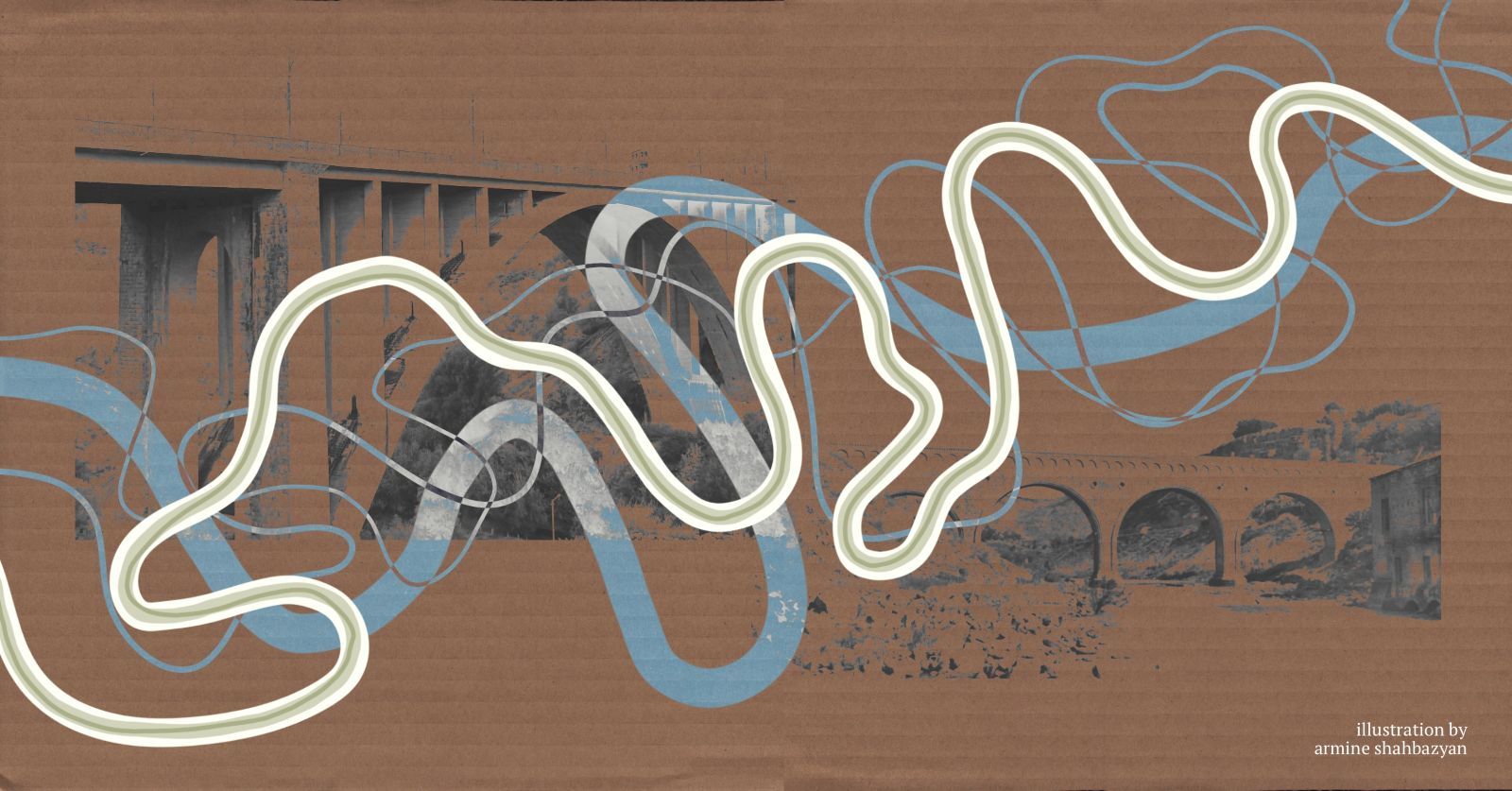
It took me two years to realize that Yerevan had a river. I could blame my poor skills as an explorer, but I also wonder why none of my local friends ever mentioned it. When I moved to Armenia almost five years ago, neither my host family, nor my coworkers, nor my new friends suggested spending time along the Children’s Railway path. It was only one day, while wandering on Google Maps, that I noticed a thin blue line.
Believing in Fairy Tales
One way to reach the river is through an unwelcoming, dark tunnel at the end of Aram Street. Passing through it feels both hazardous and endless, like a set from a post apocalyptic science fiction film with zigzagging orange lights, murals that oscillate between vague political messages and genuine street art, and walls that seem on the verge of collapsing under the weight of what feels like a moving mountain behind them.
After emerging into the light, you are not quite there yet, although it already feels as if the city is left behind, replaced by cliffs and silence. The first time, trying to find the river felt like a quest for a hidden gem. Like in a fairy tale, the old train station appears as a promising castle, with pink walls, a blue floor, and colorful stained glass. Some of it is broken; the whole place abandoned, which only adds to its charm. Beyond it, the “children’s train” itself looks as if it were taken straight out of a Disney movie. And then you hear it. Unlike rivers flattened and erased by urban development in large cities, you can hear the Hrazdan River flowing, and feel the inherently calming effect of that sound passing through you.
Cities historically formed around rivers because they provided everything a settlement needed to survive and grow: fresh water, fertile land, natural defense, energy, and trade routes. Today, from the Hudson River in New York to the Seine in Paris, a river in a city often feels as good as dead. At first glance, the Hrazdan seemed wild—trees, currents, rocks and birds. I chose not to notice the litter everywhere, deluding myself; I just wanted the fantasy of a fresh place to breathe in Yerevan to last. I had learned to get used to trash anyway. On any hike in Armenia, it is almost impossible not to encounter it, which I believe perfectly embodies the disillusionment within the Armenian national and diasporan narrative: our perception of the homeland as a sanctified, pure space. We keep repeating that “We are our mountains,” yet those mountains are systematically covered with litter, their trees torn down and their rivers spoiled. On top of Mount Khustup, on the slopes of Aragats, in the forests of Dilijan, or along the shores of Sevan, we might be our mountains, but we are also full of crap.
Back to Reality
After a couple of years in Armenia, after a lifetime disconnected from my ethnic roots, I was still enchanted by everything I discovered. I began to ritualize my visits to the river. I journaled there, and sometimes ran or took photographs. A group of male friends started a weekly cold-plunge ritual at the nearby outdoor pool, and I joined them from time to time. It is supposed to be healthy, and it probably is, but more than anything, the shock of cold water brings a powerful sense of being alive in every fiber of your being.
Those sessions were my first clue that I was an outsider in this environment. No matter the day or the temperature, you can almost always find a man doing a cold plunge at the Hrazdan outdoor pool. Yet in all those years, I never saw another woman doing it, except for a few tourists once. Perhaps women do come, but if they do, they certainly know how to remain invisible.
It took me a few months to accept that my imagined fairy tale was not meant for me, and I realized it in a brutal way. During one of my walks, as I approached a small tunnel along the railway, I came face to face with a man masturbating, his penis pointing toward the path. He did not stop when he saw me. At the time, my Armenian was limited, and all I could manage was “lurj?”—“seriously?” I quickly walked away, aware that I was alone in an isolated place and worried he might follow me.
I could no longer ignore the litter. The condoms scattered along the path were unambiguous. I began asking people who had grown up here. They responded with a mix of amusement and exasperation at what they rightly saw as another diasporan indignation. Yes, the Hrazdan gorge was known as a place where sex workers operated and where queer couples could find intimacy. Most men were aware of this. As a result, men dominate this public space.
These intrusions were not isolated. Several times, I witnessed a man changing in public without hesitation, imposing his nudity on everyone around. On other occasions, strangers approached me to hit on me or comment on my body. Once, a man stood watching women pass by, licking his lips—including a group of girls who were clearly in their teens. By then, my Armenian had improved enough for me to ask him (or, more accurately, to yell at him) whether he felt any shame looking at kids like that. He did not. He briefly looked away, then continued.
It doesn’t have to be this bad for women and other marginalized bodies to feel unwelcome at the river. At times, when I went with male friends, I was received more positively by kinder, older men at the pool, who seemed surprised but encouraging. Near the pool, a narrow bridge leads to an outdoor gym where people lift weights and stretch. As a woman, entering that space means being scanned from head to toe by groups of men who make it clear you do not belong. The space functions as a form of self-organized social life, but only for a specific part of the population.
When Prime Minister Nikol Pashinyan and Yerevan Mayor Tigran Avinyan visited the Hrazdan Gorge in September 2025, they brought development plans with them. The project aims to transform part of the gorge into a multifunctional recreation zone with playgrounds, sports facilities, and an open air cinema. Officials describe it as ecological restoration and sustainable development rooted in heritage. Such a drastic change sounds promising for greater inclusivity, but so far it is hard to envision, since there is no major construction work in sight. The only recent visible changes are the renovated pool, new locker rooms, and updated sports equipment—in other words, improvements for the men who use the space. Of course, they expressed their gratitude to the Prime Minister. Why wouldn’t they? This area has long been theirs, and the state has effectively reinforced that reality. The river continues to flow, but for whom?
Water Is a Collective Experience
CSNLab recently organized an exhibition titled Blue Archives, which explores water in Yerevan as a living body and its place in collective memory and political imagination. The exhibition also deepened my own observations. As they write:
“Water [is] a shared body […] a flow of communication linking different territories and communities; a site of accumulation that brings together environmental experience and memory; and a space of exchange that participates in the everyday life and practices of individuals and communities through small architectural forms that enable social interaction.”
In the case of Hrazdan, this is both tangible and fractured. The pool and outdoor gym create a unique social life, yet access remains symbolically limited, while dominant users contribute to pollution and exclusion. Rivers have the rare capacity to both connect and divide. It is up to us to choose connection over artificial boundaries.
“Water is a form of interrelation: through its droplets emerge oases of exchange. Circulating within small architectural forms and becoming part of daily life, it also unites people, transforms into a space of reciprocity, a space where we grow into our communities and relate to one another continuously.”
It is a reciprocity that is often broken. Just as society shapes the conditions that marginalized bodies adapt to, we shape the fate of water. The exhibition highlights how Yerevan has lost many of its water bodies through neglect and urban transformation, including the buried Getar River, which my grandmother often described from her childhood in the Aygestan neighborhood during Soviet times. She played along its shore, rolling a small piece of tissue around her thumb to make a doll. When she returned to Armenia for the first time at 72, it broke her heart to see her childhood river replaced with concrete.
“By controlling, concealing, piping and archiving the coolness of the blue, we have lost the sound and freshness of water, its social presence, and the ways of engaging in dialogue with nature.”
In Troubled Waters
Water has long been politically significant in the region, including during the 2020 Nagorno-Karabakh war. Without genuine environmental care, it becomes difficult to distinguish legitimate concerns about water safety, from manipulative narratives used to justify violence and hide internal hypocrisies.
The Hrazdan River has been heavily industrialized since Soviet times through hydroelectric projects and urban development. As CSNLab puts it, even the cute little children’s train can be seen as a symbol of domination over nature. Soviet industrial priorities often placed economic growth above environmental protection, as part of a centuries-old relationship between imperialism and extractivism worldwide. Yet Armenia also has a strong history of environmental activism. In 1987, thousands protested environmental degradation and called for the closure of the Metsamor Nuclear Power Plant. Although it was shut down from 1988 to 1995, it continues to operate today, with its lifespan repeatedly extended. This illustrates how quickly environmental risks become normalized when civil society weakens and stops actively addressing them. In more recent years, the Amulsar gold mine sparked very effective, organized protests. Since then, years of conflict, and the 2023 ethnic cleansing of the Armenians of Nagorno-Karabakh, have intensified profound political fatigue and weakened the stamina of environmental movements. Last year, the government announced deeper investments in the mine.
Water spaces could become sites for renewing ecological awareness—an opportunity to understand and dismantle the intricate dynamics shaped by patriarchal capitalism, which enables violence against the bodies of nature as well as the bodies of its people.
Water shapes local narratives. It offers shade, calm, play, and connection across time. The Hrazdan begins at Lake Sevan and flows into the Araks River, linking Armenia to Iran, Turkey and Azerbaijan. Its interconnected nature could inspire new ways of considering our region, yet ecological issues remain marginal in public discourse. The environmental crisis is civilizational. It reflects a broader disconnection between humans and their environment, one that will ultimately lead to their downfall.
Conclusion
Despite rapid social changes in Yerevan over the last few years, this section of the Hrazdan remains a place suspended in time. It holds the potential to become a shared space of nature and coexistence, something the city deeply lacks. Understanding the social architecture of the Hrazdan River in Yerevan gradually mirrors an understanding of Armenia itself, beyond idealized narratives. Although this process can be difficult, it allows for a more honest connection to the country.
Reclaiming the Hrazdan as an inclusive, living space could foster belonging and open up possibilities for a more concrete ecological politics—one that also reconsiders what creates boundaries. Rivers shape both borders and social realities. Within these spaces, marginalized groups often face exclusion. Yet rivers are not uniform. Just as they vary across time and place, our solutions must adapt to local socio-political realities.
As the warmer days approach, I can think of one small, joyful act of reclamation: girls and gays, anyone up for a picnic? I know just the place.
Raw & Unfiltered

Lilac Season: On Inheriting the Genocide
A soulful and moving essay on inheritance, memory and survival, Ani Poghosyan traces her family’s story from the Armenian Genocide to the present, exploring how trauma endures across generations, not as memory alone, but as ritual, silence, and the quiet work of tending what remains.
Read more
Armin Wegner and the Burden of Witness
Marking April 24, Narine Vlasyan speaks with Michele Wegner, son of Armin Wegner, one of the key eyewitnesses of the Armenian Genocide, about memory, moral courage, and the burden of bearing witness, then and now, and the haunting question of why so few chose to truly see.
Read more
Armenians in Lebanon: A “State” Within a State
From refuge to power, and now to uncertainty, Lebanon’s Armenians built a remarkable “state within a state.” Arno Khlgatian explores how it emerged, endured war and upheaval, and what its gradual decline reveals about the future of diaspora identity and influence.
Read more
Getting Sicker, Younger
A young doctor’s death from advanced gastric cancer reflects a troubling shift in Armenia, where cancers are increasingly diagnosed late and at younger ages. As cases rise, limited screening, delayed detection and unequal access to modern treatments are straining patients, families and the healthcare system.
Read more
The Month Between: On Armenian Motherhood and Autism
In Armenia, where motherhood is revered and sacrifice expected, raising an autistic child exposes the gap between cultural ideals and lived reality. In this deeply personal essay, Ani Poghosyan explores identity, fear, resilience, and the invisible labor of mothers navigating autism in an unprepared system.
Read more
The Invisible Masterclass of Productivity
Challenging the notion that mothers on maternity leave or outside formal employment are “economically inactive”, Hasmik Soghomonyan examines Armenia’s invisible care economy, and argues that unpaid caregiving and early childhood development are vital investments sustaining families, society and long-term economic growth.
Read more