

Listen to the AI generated audio article.
In a single day, we had crossed three countries and four border checkpoints, encountered armed Turkish police flaunting their submachine guns while pacing around our van somewhere outside of Artvin, and came across Georgians on the Sameba border who were not exactly friendly either. By the time we reached the final checkpoint at Bavra, the van still carried the stale scent of the döner we had eaten six hours earlier, and we were too exhausted to speak.
An officer stepped on board and called out barev joghovurt! with a little too much energy for the time of night, cracking a wide smile when he took in our exhausted faces. The tension broke because at last, we knew he was one of our own. He worked his way down the aisle making jokes at peoples’ expense as he checked our passport stamps.
It crossed my mind that we probably would have found a handful of mutual connections if we had spoken long enough, asked for something and he’d probably have helped, or have known someone who could. Those who live in Armenia might be rolling their eyes by now, but many people, including myself, have spent their entire lives in places where such assumptions only apply to their family or close friends. The relief of coming back to this familiarity is hard to translate.
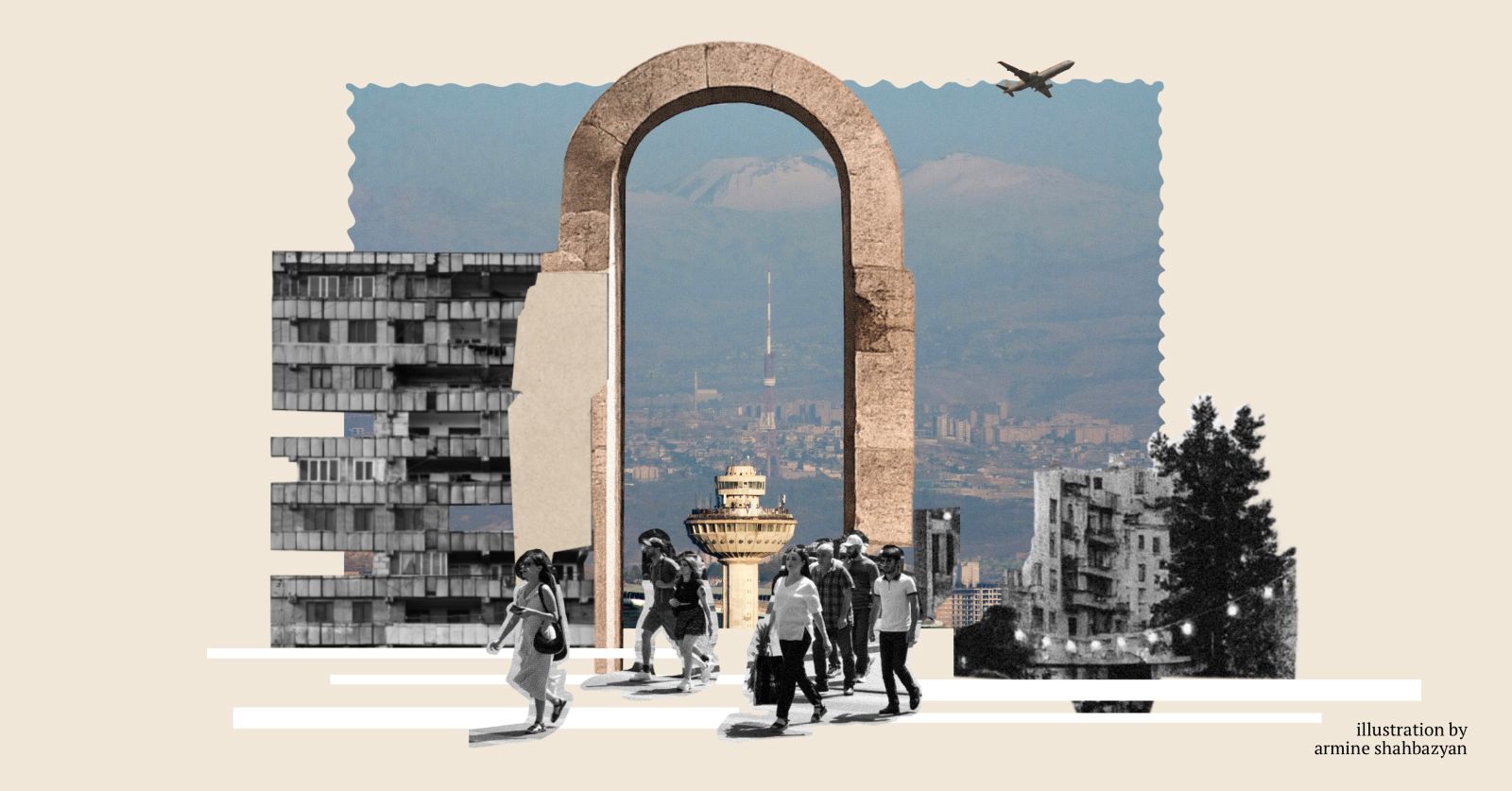
That feeling begins before you even touch Armenian soil. At the last leg of a flight to Yerevan, from afar, you can spot the Armenians carrying duty free bags stuffed with items that don’t fit the backpack limit. When you get closer people will stare, trying to determine whether they know you from somewhere, and there’s a chance they do. No one ever heeds the rules of a queue, and on the plane, flight attendants look ahead in dismay as passengers stand while the plane is angled downward to land. People will still clap when it does eventually hit the tarmac, particularly if the swells of wind in Yerevan’s dusk hours propel the plane to and fro. On a recent flight back from Budapest, an extra identity check slowed down the line at the last checkpoint before the gate. One of the airline staff ran up to the line frantically searching for everyone heading to Yerevan. Every hand in the line went up, predictably late. “Sagh Yerevane stegh a,” someone quipped, all of Yerevan is here.
That collective mindset extends to almost every part of life. When I first came to Yerevan, I used to laugh at how bizarre it felt sending a voice message to my water company on WhatsApp, or getting my lab results pinged in a Viber thread. Once I forgot to pay a power bill and obtained the phone number for the guy who flips the switches, not realizing he was in charge of an entire quarter of the city. “Apartment 24, which Apartment 24, sister?” Imagine having such a direct line in countries where these interactions are mediated by an opaque online portal. Arguments about administrative chaos aside, the fact these interactions remain thoroughly human is extraordinary in itself, and not necessarily less efficient.
In Yerevan, being anonymous is not an option. Try leaving your apartment without seeing somebody you know, believe me, even the yankees hat and black sunglasses I wear to go incognito are a dead giveaway. There are few routes through the city that don’t go past a friend’s apartment, a friend’s business, or a local store where the owner will recognize me. In a sense, the center of the city is akin to a playground. Typical Yerevan nights, particularly in the summer, turn into a serendipitous meet up with friends, their acquaintances, visitors. You’ll see groups of tourists, sport teams, foreign diplomats mingling with the local who’s-who, the mayor sitting one table away, the person who produces the wine you’re drinking a few meters to his left, a musician you recognize some tables down. There are some friends I cannot get anywhere with on time because every meter or so there is another greeting. I’m aware not everyone can live this way, and there are hierarchies in all of this of course, the authentic and the superficial, the exclusive, the wealthy, the intellectuals, the down-to-earth. But somehow, these groups exist at arms-length from one another. Most days I feel like I’m living in an episode of Friends. And understandably, in all this tangled web of connection comes the baggage. A few Sundays ago, my mother told me someone at church had congratulated her on my upcoming engagement. That’s news to me, she said laughing, anything I should know? That person had a family member visiting Yerevan who had seen me having coffee with a friend.
Many will never know this side of Yerevan without spending at least a few months in the city. These moments of warmth and unlikely connections are not often part of the pitch to Armenians dispersed around the world, possibly because they are difficult to articulate, but also because the narratives surrounding repatriation have, for so long, been borne from an existential crisis that necessitates the “sacrifice” of moving. That one must give up a part of their life for the greater good of our country and community. It comes from a mindset of lack, not abundance.
For the older generation of diasporans, the urgency of repatriation was tied to a newly independent republic in the early 1990s, hemorrhaging its own population and in desperate need of people, capital and skill. The rhetoric of the era was: Armenians around the world must return to their homeland in its time of need, despite all of its flaws and shortcomings. But the idea of Armenia as a sovereign homeland being enough justification for current generations for diasporans to upend their lives and move is no longer the most effective argument.
Some estimates put the global diasporan population as high as ten million people. Now in their second, third and fourth generations, many of these millions relate to their Armenianness as something they’ve been born into, but the feelings of affiliation toward the identity fall at various extremes on a spectrum. Perhaps it’s a conversation starter when someone points out an unusual surname, or tries to pinpoint their ethnicity based on physical features. Whereas others might describe themselves as Armenian first and their adopted nationality second. Pushing repatriation onto the former group by framing it as a sense of duty to their ethnicity is hardly going to land.
There are so many ways this group already feels isolated, mostly from the shorthand many use to assess “Armenianness” — language, faith, food, engagement. I know this from having been embedded in several of our communities around the world, and also having felt isolated myself at several points in my life. I’m grateful that language was never a huge issue, but my Protestant upbringing, thoroughly Australian schooling and formative years, and almost complete lack of engagement in any community or political activities apart from a weekly language school became a mental hurdle for a long time. It was only when I got a message the first week of my undergraduate studies saying, Hey, are you Armenian? that the door creaked open again. A handful of us enterprising students realized we could gather Armenians and receive funds for events that were mainly just an excuse to eat.
But still, this renewed feeling of community didn’t lead to Armenia becoming a “homeland” as such for me. The village that’s home to my mother’s side of the family on the shores of the Mediterranean in Syria is still nominally Armenian. The house an ancestor built remains standing across from a water fountain in the center of town — not something that many descendants of genocide survivors can claim. If I were going to follow the emotional pull of a homeland, barring the obvious deterrents of war, would that not be the destination?
Add to this complexity the fact that the imagined Armenia will often precede the real one. Many diasporans who engage with the community on some level, through schools, dance groups, sport, or church, are fed a version of the country in its most mythologized form. I remember coloring books of Charents’ Arch and Mt. Ararat, apricot trees and pomegranates at my Saturday school. We learned about Shamiram, Hayk and Bel. None of this is necessarily irrelevant, but reality was not part of the curriculum, nor were any real tools to help you interpret eastern Armenian or understand modern Armenia’s vastly different cultural influences. History seemed to pause around 1918 at Sardarapat. One teacher would throw a book each time we would stumble reading a Tumanyan poem, yelling that had our ancestors been Turkified, we would be named Fatima, that our lack of fluency was doing them a disservice. That was our raison d’etre, to live as an Armenian for our ancestors. To be clear, I don’t think this is wrong, it has created momentum from the diaspora toward Armenia for generations, it gives us purpose and structure, but it also neglects that there is much, much more to modern Armenia than we acknowledge in this narrative.
Those who grew up a similar way and then go to spend a few months in Armenia tend to experience a rather rude awakening. I remember my own first confronting visit at sixteen, driving to a border village in Tavush where several young men had died in the previous weeks. The road was so damaged it took more than thirty minutes to navigate a short downhill stretch. Walking through the local school, we were told not to get too close to the windows. Many were wearing black in mourning. This was a reality we never spoke about abroad.
A few years later, some months into my Birthright experience, a man struck up a conversation with me at the bus station, and a few sentences in, said, ba duk iskakan hay chek, you’re not a real Armenian. It felt a little unsolicited in the moment and I rolled my eyes. I was waiting for a barely roadworthy van to take me to Stepanakert, coffee in hand from the 100-dram CoffeeTime machine. Others take issue with my Protestant background which has branded me unpatriotic more times than I can count. I’ve been in monasteries around the country with my dad when he’s been called an anti-Armenian heretic, and has simply shrugged in response. I now laugh off these examples, because who is really the judge of my right to be here? That seems a more appropriate conversation between me and the immigration office. I won’t rehash all the petty disagreements between locals and diasporans that many others are bound to have experienced, too, but I can guarantee that they’ve pushed some people to conclude that Armenia is not the place for them. Birthright Armenia’s own statistics might confirm this to be the case, since only about 10% of those who’ve done the program choose to stay or come back. Perhaps somewhat naively, the expectation is that in Armenia, you will be among your people, but for the first few months or even years, it doesn’t tend to feel that way. At first, your friends will be mostly other foreigners, until you begin to understand the mindset of those from here, or they you.
This is the problem with pitching Armenia as a magical homeland that we must aspire to return to; it implies that there are certain conditions to diasporan belonging, such as language, Apostolic faith, a willingness to push aside your adopted nationality, and in addition to those, a whole other rulebook for “Armenianness” that you discover in the country itself. As the generations of diasporans grow more distant from these markers of “Armenianness”, meeting them, or at least having a willingness to negotiate their existence within them, becomes more unattainable. Many who decide they don’t meet this arbitrary threshold are then rebuked for never having visited Armenia, or for not staying, or for not wanting to take the step to engage, by those who’ve found their place more easily.
For me, there was something intangible that stuck with me from my few months of living in Yerevan those years ago. I remembered the times I had hitchhiked to other cities from Yerevan, always ending up at a table loaded with food and family. The exchanges with random train conductors, drivers, bakers, store owners, basically anyone who would strike up a conversation, were immediately intimate in the way that would take much more effort to reach abroad. I knew this was a place I could satisfy my penchant for adventure, and find friends who felt like family. I had promised myself that after I wrapped up my degree in New York, I would try living there for six months. It was daunting for many reasons, but I thought, why not now, and why not Yerevan? I had nothing to lose, I had decided to build a career freelancing and could go back to New York if it all went sideways. I didn’t think the place would offer any more opportunity, and was convinced the opposite would be true.
What I found instead were friends in their twenties holding government positions that their equivalents abroad would aspire to at forty. Social enterprises that would have taken a decade elsewhere come together in a few years. People who left careers in other countries have built their own businesses here because there is room to grow and experiment in ways that their home countries don’t allow, and because here, good work stands out. People are able to do and succeed in ways that would take much more effort abroad.
Even in my own reporting, had I focused only on American or Australian news, things would certainly have been more efficient. No fight to get someone to respond to emails and calls, and no hunting for a mutual connection to give them a nudge. But I would have missed the stories that I discovered in this frustrating process, the interviews that might take thirty minutes abroad but here, begin with a coffee and end with someone’s grandmother pressing more cake into my hands three hours later. People are more open and willing to bring you into their lives because more often than not, no one has ever stopped to listen. Reporting here is harder and takes longer, but the material it produces cannot easily be found anywhere else. There’s no playbook for how to do the job, you just get better at creating something from whatever is there.
But having the choice I did is a luxury that many others in the diaspora don’t have. What do you do with a career that took years to build in one city and doesn’t translate across borders? What about medications and care that are simply not available? We need to do away with the berating of those who cannot just up and leave, who feel excluded from the definitions we put on a typical repat, and who are overwhelmed by the expectations on them when they’re here. We shouldn’t look down on those who tried, and failed, to build a life here. Or those who simply decided it wasn’t for them. The concept of duty to the homeland, which is certainly enough of a driver for some people to move, often drowns out the more durable and relatable sentiment — that people should consider coming because they might actually thrive here. There are opportunities that make Armenia more attractive than in previous decades. We should be proud of this, and pitch this as the selling point.
Calling the move a sacrifice implies that what you got in return is worth less than what you left, and that’s not necessarily true. The approach I’d argue for is different, to show people a country where they might actually build a life and build something of their own. A place where the warm embrace of “home” grows on you little by little. Somewhere you become jumbled into the chaotic web that is Yerevan’s milieu. Where, instead of feeling disappointment of it not being the country you imagined from abroad, you acknowledge it as one worth knowing on its own.
Raw & Unfiltered

Tracing Memory: Unfinished Conversations of War
Through a series of unfinished questions, photographer Vaghinak Ghazaryan’s photo essay explores the lasting emotional imprint of the 44-day war on the soldiers who lived through it, tracing memory, loss and the difficult process of carrying war into everyday life.
Read more
Cry Me a Hrazdan River
Yerevan’s Hrazdan River embodies the city’s contradictions: beauty and neglect, belonging and exclusion, ecological loss and fragile possibilities for coexistence, public life and environmental consciousness. In this personal observation, Taline Oundjian looks at what the river reveals about the city itself.
Read more
Lilac Season: On Inheriting the Genocide
A soulful and moving essay on inheritance, memory and survival, Ani Poghosyan traces her family’s story from the Armenian Genocide to the present, exploring how trauma endures across generations, not as memory alone, but as ritual, silence, and the quiet work of tending what remains.
Read more
Armin Wegner and the Burden of Witness
Marking April 24, Narine Vlasyan speaks with Michele Wegner, son of Armin Wegner, one of the key eyewitnesses of the Armenian Genocide, about memory, moral courage, and the burden of bearing witness, then and now, and the haunting question of why so few chose to truly see.
Read more
Armenians in Lebanon: A “State” Within a State
From refuge to power, and now to uncertainty, Lebanon’s Armenians built a remarkable “state within a state.” Arno Khlgatian explores how it emerged, endured war and upheaval, and what its gradual decline reveals about the future of diaspora identity and influence.
Read more
Getting Sicker, Younger
A young doctor’s death from advanced gastric cancer reflects a troubling shift in Armenia, where cancers are increasingly diagnosed late and at younger ages. As cases rise, limited screening, delayed detection and unequal access to modern treatments are straining patients, families and the healthcare system.
Read more
The Month Between: On Armenian Motherhood and Autism
In Armenia, where motherhood is revered and sacrifice expected, raising an autistic child exposes the gap between cultural ideals and lived reality. In this deeply personal essay, Ani Poghosyan explores identity, fear, resilience, and the invisible labor of mothers navigating autism in an unprepared system.
Read more