Listen to the AI generated audio article.
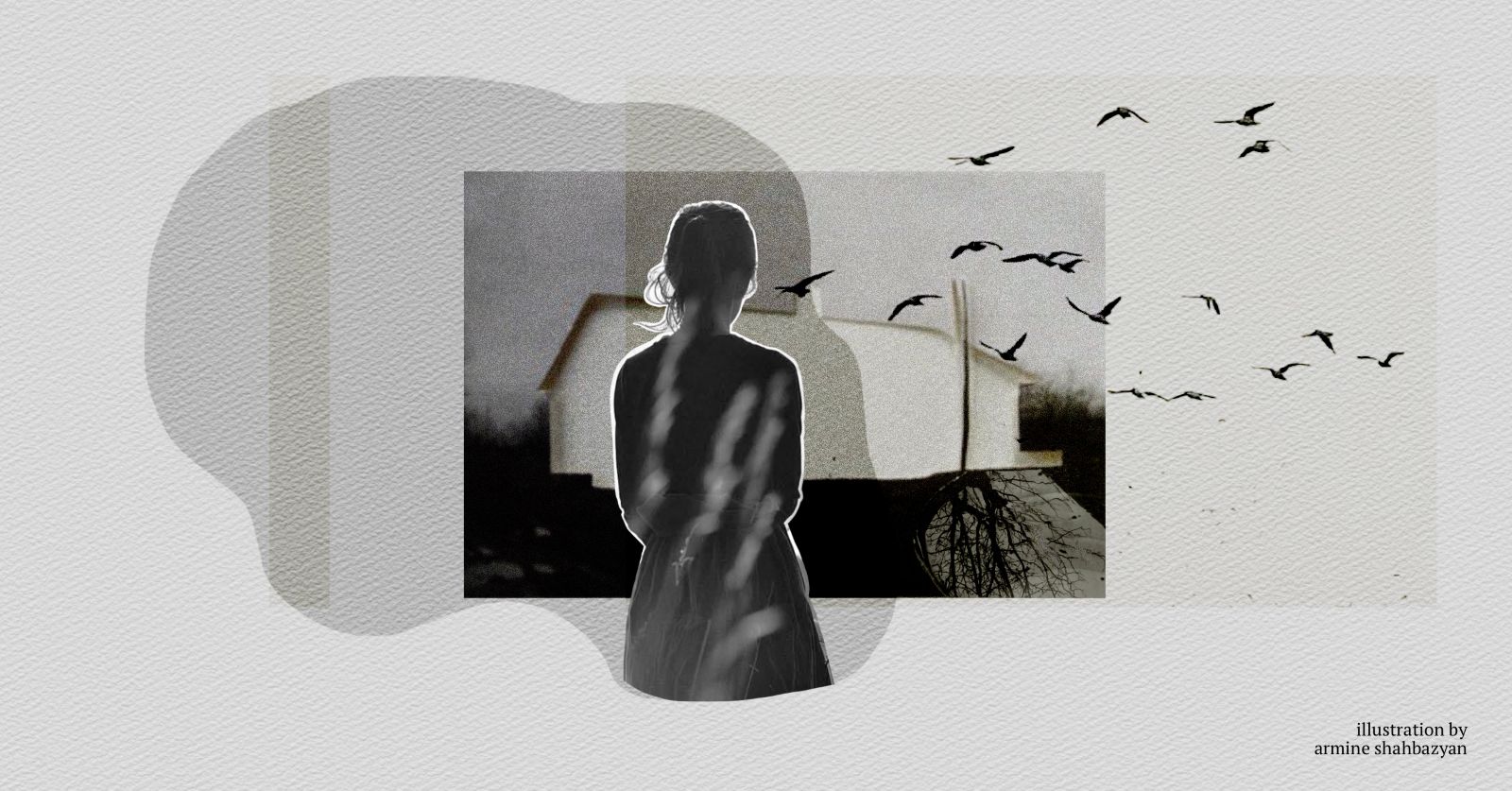
Three years after the entire indigenous Armenian population of Artsakh, known to the outside world as Nagorno-Karabakh, was forced into displacement, the unusual has become part of our usual routine. We still wake up in sheets that belong to someone else. Some of us wake in the homes of relatives or strangers who have taken us in, our suitcases still half-unpacked in the corners, as if we might leave tomorrow. We drink our morning coffee from cups with unfamiliar patterns, in rented kitchens whose windows face streets we still do not know. Some of us wake up outside Armenia, most often in a small town in Russia, where relatives who left after the first Karabakh war in the 1990s now invite us to begin rebuilding our lives for the third time. Some of us are braver, and have chosen the United States or Europe, where our claims to refugee status are often questioned because they assume Armenia has already granted us protection.
We go online before we speak to anyone. We open Facebook—the online village—and search for news of the places we left behind. There we scroll down and search for news from our lost towns, villages, neighborhoods, relatives, and former colleagues. Some of us do not survive grief intact. Almost every day, another post appears in the online village: the mother or wife of a fallen man has a life-threatening health condition and cannot afford the treatment that might keep her alive.
Some of us search Azerbaijani social media pages late at night, afraid that we will find our front door broken, our orchard cut down. We learn that another house may have been destroyed, though nobody knows for certain.
Some of us receive calls every day from relatives who moved to Russia after the forced displacement of 2023. One of our relatives calls from Stavropol. She speaks half-jokingly, half-seriously about her husband, Hamlet, who has just returned from the funeral of another man from our village. Hamlet came home angry. He sat with his eyebrows drawn together and told his wife, Hamest, that he did not want to die there. He did not want his funeral to be held in Stavropol.
“What happened?” Hamest asked him.
“Did you see the grave?” Hamlet said. “There was water at the bottom. The coffin was practically lowered into water.”
Hamest looked at him and laughed.
“What are you afraid of?” she asked. “That you will catch the flu after you die, when they put you in the ground?”
We laughed when we heard the story. We have learned to laugh in the middle of grief because we believe laughter is the slap we give back to war and displacement.
Some of us have already buried husbands, wives, parents, sons, daughters, brothers and sisters outside Artsakh. Some of us wish we could exhume our loved ones and bring them here, to a cemetery where we could visit them. Some of us find comfort in knowing that our loved ones are buried near their own relatives.
Some of us go to funerals not only to honor the dead, but to find the living, where we see distant relatives and old classmates or former colleagues. We meet neighbors we have not seen since the deadly exodus. We ask where they live now. We ask whether they have found work.
Some of us travel across the city to beauty salons where the same hairdressers who once worked in Stepanakert, Shushi, or our villages now work under new signs, in rented rooms. We go to them not only because they know how to cut our hair in the best way. We go because they remember us and we remember them, and we can exchange the news and gossip in our beloved dialect. We speak about the blockade. About the days without electricity and shampoo and how we managed to get our hair done.
Some of us still feel a small tremor in our hearts when we hear our dialect on a bus or at a bus stop. We turn our heads. Sometimes there is no need to ask. We begin speaking as if we have known each other all our lives.
We talk about the sixth rented apartment in three years. We discuss affordable housing-support programs whose conditions are not affordable at all. About landlords who ask for too much money or refuse to rent to us because, to them, we are others. In these chance encounters, we learn that some of us have managed to buy good homes. Some have opened businesses. And some of us did so with money that had not been earned by honest means over the years in Artsakh.
Some women speaking in our dialect wear small pendants with photographs of smiling or young boys in military uniforms. These tell us that they were martyred in one of the four wars we experienced or killed in the deadly explosion. Sometimes we miss the bus because we just want to be with them.
We look for work with one condition above all: there must be at least one other person from Artsakh there. One person with whom we can speak our dialect during the lunch break. Some of us work two or three jobs to make ends meet.
Some of us were soldiers, teachers, civil servants, artists, musicians, researchers and managers; now we are learning to bake and sew. We bake our traditional jingalov hats and pakhlava. We clean offices. We drive taxis.
Some of us are told that these are the only courses available to refugees, as if we arrived without professions, diplomas, skills, years of experience or the memory of work well done.
Some parents have stopped speaking to their children in the dialect we once spoke before. Some children still long for the toys they left behind. Some learn to play with new or donated ones; others refuse them altogether, as if wars and being uprooted from their homes had made them grow up overnight.
And none of us, not even the adults, have stopped flinching at the crack of celebratory fireworks, at hail striking the windows, or thunder rolling somewhere far away.
Some of us are criticized simply for wearing nice clothes, travelling or going to a concert, as if refugees must constantly justify ordinary moments of joy.
We wear T-shirts, pendants, or brooches connected to the places we loved and lost, because sometimes they are the only pieces of home we can still carry with us.
Some of us go to study abroad, even in middle age, because for a while it is easier to be a student than to decide where to live, how to earn money, which country to choose, or what kind of future to imagine. In this way, we postpone the future. We do not say that we are suspended between a past that is gone and a future that has not yet begun.
Some of us remain in the past and cannot forgive those who have learned to move forward. Some of us have adapted quickly and cannot forgive those who remain in the past.
Some of us marry as a way of beginning again. We hold weddings with our food, our songs and traditions. Some of us remarry after losing husbands in the wars. Some of us divorce. We wanted to divorce before, but Artsakh was a small place. Every separation had witnesses. There were families, traditions, judgments, and the old fear of being talked about.
Some of us become artists. We try to deal with our grief through art. Some of us can no longer make art at all. Some of us write poems. Some of us write books. Some of us no longer write at all.
Some of us console ourselves by saying that we lost our homeland and our homes, but at least our families survived. They survived a blockade that brought us to the brink of starvation. They survived the devastating wars. They survived the fuel-depot explosion, when people waiting for fuel to leave were swallowed by fire and ash. They survived the exhausting road into exile.
Some of us repeat this until it sounds almost true. Some of us console ourselves that at least we were able to bury our loved ones. Some of us could not. Some of us are still waiting for news of loved ones whose fate remains unknown, hoping that they are alive and imprisoned in Baku rather than lost forever. Some of us are waiting for our loved ones to be freed from Baku’s prisons.
Some of us go to Yerablur every day, to the graves of sons, husbands, brothers. There, we have made new friends and found new relatives. We know people whose loved ones lie close to ours.
Some of us remain irreconcilable because some representatives of the Armenian government, along with some of the locals, blame us for almost everything. They speak as if we had simply run away as cowards, as if we had been given a choice to stay, as if our loved ones had not died on the front lines for our security, as if we are only a burden now—an obstacle to the peace we had dreamed of all our lives.
But others welcomed us with open arms. Each time they see these accusations, they do what they can to defend us and to reassure us that we belong here too.
Some of us, even three years later, are still trying to sort out the documents we could not bring with us, still trying to prove that we lived and worked in Artsakh. We are forced to reconstruct not only our documents, but also our past. We are asked to accept that it is over, to stop looking back, as if our lives had been a mistake, as if we had never existed.
Some of us have settled in Yerevan and nearby villages because work, schools, doctors, transport, and relatives are easier to find there. Some of us have settled in villages because we had never lived anywhere else before displacement. We cannot imagine our lives in highrises or on streets where no one stops to ask about how we are doing. Some of us chose a new settlement because it had the same name as our old one. Sometimes that is enough.
Some of us say that we should leave Armenia because we are not fully accepted here either. Some of us speak about places, sometimes imaginary islands that might take us in together rather than scatter us again across cities and borders. If we have to leave again, some of us say, we want to go collectively: with our families, our relatives, the people from our villages, and those who still speak our dialect. We want to live near one another.
Some of us still believe we will return soon.We return every night in dreams. We walk familiar roads. Some of us ask the impossible question every day: What would have happened if we had stayed? Would we still be there? Would we have been forced out later? Would we have survived? Some of us no longer wait, but cannot admit it aloud.
Some of us still keep the keys to homes that may no longer exist. Some of us have made miniature models of our lost houses and placed them in the most visible corner of a rented apartment, like shrines. Others publish photographs of the places where they once lived—villages erased so completely that even their outlines are gone. Karintak is one of them. Its name means under the stone. Now there is no stone. Only a name mourning the place it once held.
After three years, we console ourselves that at least we are refugees in our homeland. But even then, we cannot say that we are home.

Aslo see
When “Diplomacy” Becomes a Vehicle for Information Manipulation
The European Union has invested heavily in Armenia’s resilience against foreign information manipulation. But when its own Special Representative reduces Azerbaijan’s state-sponsored historical revisionism to competing “narratives,” diplomacy risks becoming a vehicle for the very manipulation the EU seeks to counter.
Read more
Anchored in the Past: History as Ontological Resource in Armenian Collective Memory
Why do nations cling to familiar stories, even when reality changes? Drawing on theories of ontological security, collective memory and political psychology, Andronik Papyan examines how the loss of Artsakh unsettled Armenia's national narrative and the search for a new sense of collective identity.
Read more
Regional Peace Cannot Be Built by Ignoring Azerbaijan’s Rhetoric
Baku’s “Western Azerbaijan” narrative continues to be prominent in state media, education and official discourse. Tatev Hayrapetyan examines how the concept has evolved, how it is being institutionalized, and what its continued promotion means for Armenia and the prospects for lasting regional peace.
Read more
Traveling With a Lost Homeland
What does travel mean when you can’t return to the one place you most long for? Journeying through Morocco, Siranush Sargsyan finds traces of her lost homeland, Artsakh, in unfamiliar landscapes, traditions and people, revealing how displacement transforms the experience of elsewhere.
Read more
Hung On a Line
Laundry, suspended on lines, throughout Artsakh once told stories of home, pride and domestic ritual. Amid war, blockade and exile, it became a fragile thread of memory and survival, a line of cloth carrying the weight of loss, resilience and love for a vanished home.
Read more
The Guest Who Stayed: Rasmus Canbäck’s Last Dispatch From Artsakh
In “I Die Slowly Every Day”, Swedish journalist Rasmus Canbäck offers a rare, intimate account from Artsakh before its ethnic cleansing—a powerful testament to memory, resistance, and the journalist’s role amid silence and political erasure. Review by Ani Poghosyan.
Read more