Listen to the AI generated audio article.
I am a filmmaker, a screenwriter and a photojournalist. I made a film called Die Like a Man about a 17 year-old in West Los Angeles with a gun, a bike and a horrible decision he makes to prove his “manhood” to a local tribe of fading gangsters in our gentrified era. As I received a stream of gracefully worded rejection letters from major festivals, an advisor for one festival took issue with the title, “Die Like a Man.” The title, in this individual’s eyes, could be interpreted as “aggressive” or “offensive” to a contingent of the festival going public.
Furthermore I, the filmmaker, was not Latinx or Black since the story is rooted in, and unfolds inside, the multiethnic Los Angeles society that I grew up in for 44 years. As a kid, my entire life was enriched by Mexican, Black, Asian and Middle Eastern cultures.
All these assumptions were far from the audience’s mind when we premiered the film at the Million Dollar Theater, the oldest movie palace in Los Angeles. Healers, ex-convicts, social workers, moms who’ve lost children to gun violence––Angelenos from all cultures that knew the world of the streets where the film is set and made––echoed the story’s call for healing and dialogue. One mother who had lost a child to gun violence even told me, “I wish the boy who murdered my son had seen your film the night before. Maybe he would have changed his mind.”
As an Armenian-American filmmaker and writer, my experience raises sad yet necessary questions about the roadblocks created by so-called cultural gatekeepers who admit or reject works of art based on what they feel is a propos in our increasingly Balkanized society. So, who am I to tell your story and make images about your culture? The short (and perhaps sentimental) answer is someone who believes deeply in the universal power of cinema. The longer answer starts with a transcontinental voyage.
My parents were born in Iran. I was born in the former Soviet Armenia. My younger brother was born in East Hollywood. We are ethnic Armenians. Three generations traveled across three continents to set roots in a city that is now the 21st century’s Ellis Island of the West Coast.
I was named after Eric Burdon, a British Invasion Rock n’ Roll icon who found inspiration in the American Black Blues music of the Deep South. My dad was a hippy cineaste, raising me on five truths that I carry to this day: 1) You are a human being first, then an Armenian; 2) You are a drop in the ocean of human history and are connected to people and places you may not be aware of until much later in life; 3) There is only one thing to hate in life—waste. Waste of life, waste of talent, waste of food, nature, resources, money and time; 4) Whatever you choose to be, ask yourself everyday, “Who are you enabling and what are you contributing?”; 5) Vision means nothing. Perception is everything.
For his generation in the USSR, an intrinsic love and fascination with exploring world cultures through cinema and music was their only escape trapped behind the Iron Curtain. The outside world could only be imagined through song and image but not experienced until they fled. My father always joked that art, cinema, literature and music were his four passports to travel the world.
When I brought home an LP of Metallica’s Ride the Lightning, he couldn’t get into heavy metal but he did pause at one track—For Whom the Bell Tolls, he explained, takes its name from Hemingway’s novel which itself was rooted in the poetry of John Donne centuries prior. Hemingway’s generation went to foreign countries far away to fight and possibly die for people they didn’t know. Why? Because there was a collective calling that went beyond ethnicity, familiarity and the homogenous. It continues to this day in Kurdistan, Ukraine and elsewhere.
He encouraged me to be a citizen of the world, steeped in all cultures. Art and awareness had no passport, no flag, saw no color. International solidarity among artists and people who cared about improving human and planet life was necessary. It’s what made lasting change possible.
I grew up in L.A. as a working-class immigrant kid with Mexicans, Blacks, Salvadorans, Asians and Armenians. Our apartment on Lomita Street was the United Nations of food, music and where the parents of my non-Armenian friends would trade croquetas and dolma on any given weekend.
That was the pre-Perestroika 1980s when fresh-off-the-boat refugees from wars in the Middle East, Latin America and the Soviet Bloc were first setting down roots in L.A.
Back then, after the Islamic Revolution in Iran and the last act of the Iron Curtain, Armenians were considered Middle Eastern. Or, as some of the white kids in our elementary school used to refer to us as “Ir-may-nian” as if we were cut from the same cultural cloth as the Iranian WWF villain “The Iron Sheik” who was the bald and unsavory nemesis of the blonde and very white ubermensch…Hulk Hogan.
We were stamped as Middle Eastern. Little did I know then that a landmark court case in 1909 in Lowell, Massachusetts had ruled that Armenians were no longer considered “Western Asian” per the New York Times but “have become so mixed with Europeans during the past twenty-five centuries that it is impossible to tell whether they are white or should come under the statutes excluding the inhabitants of that part of the world…”
In 1923, a self-proclaimed Oriental rug merchant from Oregon named Tatos Cartozian went to court in a landmark case The United States vs. Cartozian, after the state argued he was not a “free white person” and therefore ineligible to become naturalized in the land he spent nearly 20 years living, working and raising a family. By 1925, District Judge Charles E. Wolverton concluded that “it may be confidently affirmed” that Armenians passed the whiteness test in part because, “they readily amalgamate with the European and white races.”
Go figure. We were “Western Asian” then became “White” because a white man in a robe said so over a century ago. So, how did Armenians become “Middle Eastern” in the L.A. of the early 1980s? First, we were “Asian,” then “White” and now “Middle Eastern”? We are still categorized as “West Asian” in Canada, while some communities in Western Europe refer to us as “Orientals” since the Armenian Church is considered Oriental Orthodox, among other denominations.
How about we just kibosh this mess into the “all of the above” box: Armenians are “Middle Eastern White Orientals from West Asia.” Wouldn’t this make more sense in the Theater of the Absurd than in the halls of American justice where naturalization according to race is a re-writeable legislative issue?
In our era of segregated and polarizing identity politics, those who tell stories are increasingly politicized and expected to stick to their own ethnic lanes or face online mauling in the public court of X as was the case with Meg Smaker. In the cultural wars stemming from the heinous and violent legacy of white supremacy, art and storytelling are the first to be politicized, even within minority groups who are supposed to be on the same side.
Until recently, I convinced myself that it was understandable because of the “pendulum swinging” argument that racist white America screwed up so badly in the media and exclusionary practices for a very long time. Now that the democratization of technology defines the Operating System of our hyper-connected world, dominant ethnic minorities still reeling from the stinging burn of Hollywood’s racism are taking agency into their own hands and telling stories that drastically flip the script in a quest to recreate true authenticity and representation in how we experience Black, Latin, Asian, Middle Eastern and other cultures on-screen.
My dad learned about The Black Panthers, Dennis Banks and the American Indian Movement (AIM) through Marlon Brando; the story of Emmett Till and the justified rage of Black America through Nina Simone, Joan Baez and Bob Dylan; the tragedy of Ira Hayes through Johnny Cash.
I grew up on Dr. Dre, a musical genius who saw in Marshall Mathers (Eminem) a white guy from Michigan with a monumental talent for Hip Hop that is pure Black music. Dre found Eminem. My late USC film school mentor John Singleton supported Craig Brewer who wrote and directed Hustle and Flow, Black Snake Moan and My Name is Dolemite. All Black stories made by a white guy.
Gillo Pontecorvo was an Italian Jewish master filmmaker who made The Battle of Algiers, one of the greatest films in world cinema about the Algerian war for independence from France. Chloe Zhao from China made Songs My Brothers Taught me about the struggles of the Oglala Lakota youth on the Pine Ridge Indian Reservation. The list is endless.
Going back to my cultural roots, the Armenian troubadours and filmmakers from generations past left a plethora of artistic masterpieces that continue to transcend time and all flags. As a child, I grew up nourished by the stories and songs of Sayat Nova who composed in all the languages of the Caucuses. In high school, it was the pioneering filmmaker Rouben Mamoulian from Tbilisi who excelled on Broadway with adaptations of Gershwin’s Porgy and Bess and Oklahoma! and in the Hollywood studio system with the trailblazing adaptation of Robert Louis Stevenson’s Dr. Jekyll and Mr. Hyde. In film school, discovering Sergei Parajanov, who made films in Ukraine, Armenia, Georgia and Azerbaijan, cemented my hopes to be a world traveller with a camera. Since my early teens, no other Armenian filmmaker has left a more indelible mark of inspiration and wonder to create than Atom Egoyan whose films, especially The Sweet Hereafter, based on the novel by Russell Banks, Calendar, Exotica, Speaking Parts and Family Viewing each became a periscope into the heart of a true auteur with a deeply humane and universal soul that was nourished by his Armenian roots.
We love food when it is cooked by so many different chefs from around the world experimenting with different kinds of cuisine; South Asian Indian cuisine fusing with the West Coast Mexican street taco palette, or Far Eastern Chinese spices blending with Peruvian cuisine.
International musicians are interweaving folk musical traditions from opposite ends of the earth and bridging them with their local colors and sounds like Manu Chau, Calexico and Gogol Bordello. Why is it that we embrace cross-cultural fusion with music and food, but when it comes to film and storytelling there is a segregationist policy of being expected to stick to your own culture? I received six calls from executives last year asking me if I have a “uniquely familiar” Armenian mafia TV series idea that’s family friendly. The next time I may very well make them an offer they won’t refuse.
I am tired of being expected—by the very multiracial, multiethnic L.A. society and industry I was raised in and have been working in as a WGA writer and filmmaker for several years—to stay in my ethnic box and be expected to represent mainly my culture as if I am the gatekeeper of all things Armenian. I want films from Mexican, Vietnamese and African storytellers who can shine a different light on my culture as much as I support and endorse my fellow Armenian filmmakers in Armenia and the Diaspora.
As an industry and as a society, are we not failing to understand that “identity” is much more complex and multilayered than merely color-coding people in ethnic boxes based on their ancestral geographies? When will we come to embrace the truth that no box or census will ever accurately represent nor define our identification with cultures outside of our own? East L.A. Chicano culture, music, lowriding and varrio oldies are just as much part of my hybrid identity as are the cathartic liturgies of Komitas that carry me deep into my culture’s ancient soul.
And so, I return to my father’s enduring insight. Music and art are the truest universal passports for all humans. Art and culture, when created with love and without prejudice, are open hands that defy age, ethnicity and borders.
When the Germans came to Mexico in the 1800s they brought the polka and the waltz that sowed the seeds for norteño and mariachi music. Then came the Lebanese and Middle Easterners who brought the shawarma on a vertical spit that was adapted and Mexicanized for pastor.
Cultures migrate, mix, adapt and coalesce as much as they clash. Globalization is not an American thing and it didn’t begin with the Internet. It goes back way before the Silk Road.
If we start to dwell too long in our own ethnic bubbles without endorsing intercultural storytelling bridges, we risk ignoring the gifts that cross-cultural fusion has created for humanity by producing Frida Kahlo, Wilfredo Lam, Ruth Negga, and Anthony Quinn, among many biracial humans who are testaments to the global consciousness that we all belong to, beyond race. It is up to us to choose to embrace the foreign as familiar. Perhaps this is the first step in a journey of thousands.
I believe in the Lakota wisdom of Mitakuye Oyasin (All Are Related) and have been writing Asian, Mexican, Vietnamese, Nigerian, Apache, Lakota, Seminole, Basque, Bedouin, Mongol, Armenian, Indian, Kurdish and Zapotec characters in my scripts since my USC film school days. My screenwriting professor Paul Wolff once mused that the characters in my screenplays were part of a greater cosmic orbit of “people who left this earth unrequited whose souls are hovering over you, asking you to tell their stories.” For most of my creative life, I’ve never chosen consciously what to write. These “souls” remain with me to this day, gifting me with portals into cultures and traditions I would have no other way of discovering were it not through ink and cinema.
Who am I to tell the Native, Armenian, Mexican, African stories? A filmmaker who was born and raised to look at art as probably the only true human gift that transcends all borders, all countries, real estate and, most importantly, the boring and the obvious tropes that we have boxed ourselves in as human beings. We must learn to unlearn the generational traumatic legacies of genocide, displacement, appropriation and hatred engineered by the empire.
The states of America will remain divided. Artists should not be. Unity can come through the uniquely layered threads in our multicultural rug braiding together, just like Mr. Cartozian’s Oriental rugs, to sustain our patterns and individual strands that reinforce the whole. The more we self segregate creatively, the deeper our myopia is in danger of reinforcing ethnocentrism.
Every human being living in the Americas owes a debt of acknowledgement and respect—at the very least—to the first nations and indigenous cultures. However we choose to pay it forward symbolically or tangibly is up to us. I chose to create social impact and inclusion programs baked into my films by partnering with local non-profits dedicated to social justice, indigenous and minority empowerment through integrative cinematic literacy. I did this with my films Die Like a Man and Tatanka and hope to do it with every film I make.
Art must be the alternative to the madness of all empires’ segregationist, subjugating and racist policies seeded since the ancient world. I firmly believe that art and cinema are at their finest when they speak to our intrinsic capacity for ferment and unity. Now, more than ever in the wake of the inhumane ICE raids and federal attacks on working families, not only is cross-cultural storytelling a tool of empowerment and empathy, it is also an act of narrative resistance that can strengthen the human ties that weave all immigrant communities together beyond borders.
Seemingly irrelevant people from unrelated places have united for millennia to melt the pot of cultures and deepen our common humanity through the primal acts of storytelling and image making. Each storyteller and image-maker is a thread in the greater global carpet of our humanity. I write, direct and produce films. My commitment is to making films rooted in worlds, characters and cultures that I have a spiritual affinity for. I don’t need to justify my allegiance and love for your culture. I am a part of it and you are a part of me.
Arts & Culture
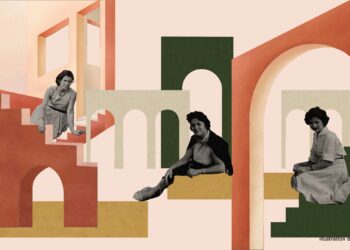
Of Roland Barthes, Ludwig Mies van der Rohe and Photographs of Women Architects
Through forgotten photographs and Barthes’ language of studium and punctum, Talinn Grigor uncovers the overlooked histories of Armenian women architects in modern Iran, tracing their encounters with Mies van der Rohe and revealing silent, resilient cosmopolitanism in a male-dominated world.
Read more
The Armenian Refugee Who Photographed a Defining Era of European Migration
The archives of Studio Rex, a photo studio founded by Armenian Genocide survivor Assadour Keussayan in Marseille, document decades of European migration. These once-practical photographs have become powerful historical artifacts chronicling diverse immigrant experiences from the 20th century.
Read more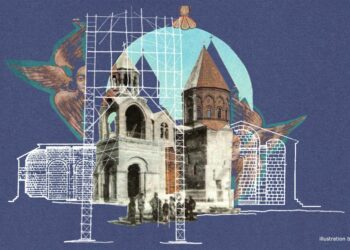
The Seven-Year Restoration of the Mother See
After a seven-year restoration, the Mother See of Holy Etchmiadzin, considered the world’s oldest cathedral, was reconsecrated in 2024, a historic effort that preserved sacred murals, reinforced the ancient structure and culminated in a chrism blessing.
Read more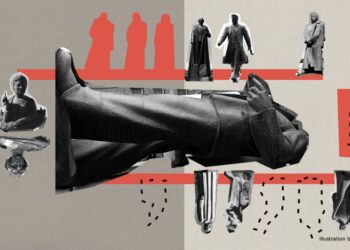
The Power and Politics of Yerevan’s Statues
Yerevan’s statues reveal shifting political ideologies and national identity, from Soviet heroes to national figures, international allies and “symbolic” women. Hovhannes Nazaretyan explores how public monuments reflect power, memory and Armenia’s evolving historical and geopolitical narratives.
Read more
Dreams Against Empire: Parajanov’s Cinematic Defiance
In this poetic exploration of filmmaker Sergey Parajanov’s radical defiance against Soviet conformity, Ani Poghosyan traces how his visionary cinema, rooted in Armenian identity and artistic freedom, challenged empire, celebrated cultural memory, and outlived the system that sought to silence him.
Read more[Art Speak]
Column