

Listen to the AI generated audio article.
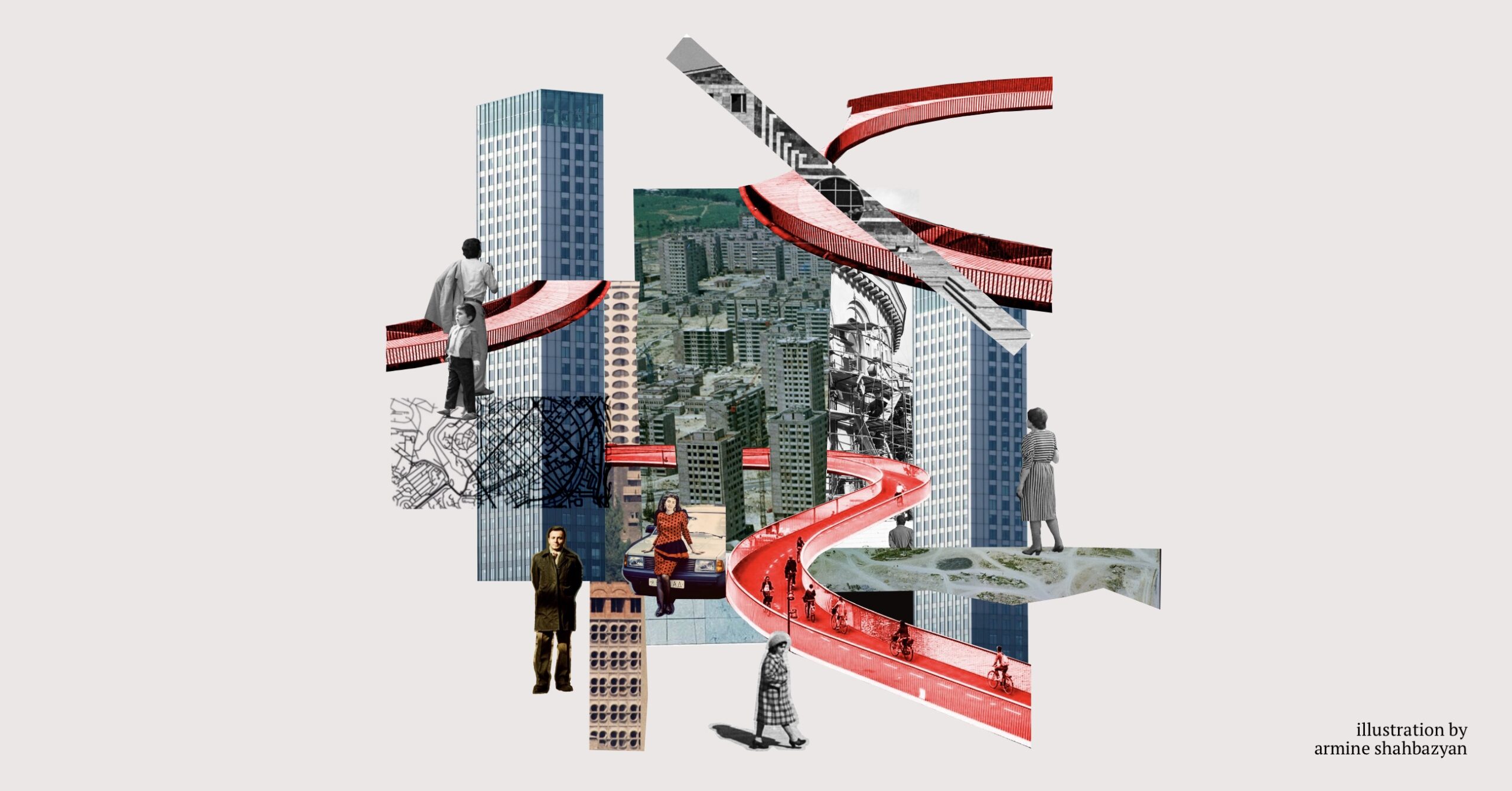
A city’s cultural identity is not secured by monuments alone. It also depends on the continued presence of institutions, habits, spatial hierarchies, and everyday settings through which urban life acquires continuity over time. When these become vulnerable to redevelopment, displacement, or administrative reordering, a city may remain active and expanding while becoming thinner in its cultural and civic texture.
Yerevan’s cultural degradation does not arrive with the clarity of a single demolition. It happens more quietly: institutions made more administratively pliable, the city center increasingly viewed as an investment opportunity, continuity displaced by redevelopment, and inherited forms of cultural life thinned out by the very forces that make the city more commercial and less affordable.
These are not separate processes but different expressions of the same urban transformation. As land value, private consumption and redevelopment shape the city’s priorities, the institutions and spaces through which the city recognizes itself over time become easier to marginalize, relocate or replace.
The Misplaced Burden of the Creative Class
Responsibility for resisting this transformation is often placed on the so-called creative class: artists, architects, academics and other professionals expected to speak out, object and provide moral resistance as the city is hollowed out. The concept of the “creative class,” popularized by urban theorist Richard Florida, casts these groups as engines of urban vitality. Yet mobilizing a city is not the same as possessing the political leverage required to defend its institutions, continuity, or public goods.
The artistic and educated professions are often treated as a city’s public conscience, as though their presence and criticism could compensate for institutional weakness. Yet this expectation mistakes having a voice for having power. A city’s cultural institutions are not preserved by the symbolic labor of artists, architects, academics and other educated professionals alone, nor simply by their presence in the life of the city. They are preserved only when officials treat them as non-negotiable elements of urban life, and when the city’s cultural identity is strong enough to resist being easily rewritten by new capital, shifting class interests, and imported visions of urban success.
Particularly consequential in Yerevan is the role of a market-oriented middle class whose preferences are readily absorbed into the city’s redevelopment logic. This is not because the middle class alone is responsible for Yerevan’s degradation, nor because social mobility is itself a problem. Rather, many of the priorities associated with this group align closely with the forces reshaping the capital.
In Yerevan, this dynamic can be seen in a largely pragmatic relationship to urban life: centrality is valued for access, housing as an asset, transport failure as an inconvenience to be privately circumvented, and culture as an amenity rather than something sustained through institutions. These preferences are more easily accommodated by a city increasingly organized around land value, private convenience, and consumption than by one organized around institutional continuity, cultural depth, and public goods.
The result is not an openly anti-cultural project but a gradual displacement of priorities, in which convenience acquires greater political weight than continuity, and purchasing power proves more effective than civic attachment.
Unequal Leverage in the City
Yerevan is not unique in this regard. Urban theory has long examined how different groups wield unequal influence over the way cities develop. The growth-machine theory of cities captures something essential about this dynamic, above all in its distinction between the use value of urban space, that is what the city offers as a lived environment, and its exchange value: what it yields as a field of speculation, development and accumulation.[1]
Under such conditions, actors tied to land, redevelopment, and consumption-oriented growth are structurally better placed to organize, aggregate their interests, and shape urban priorities. By contrast, the artists, cultural institutions, academics and residents invested in preserving its cultural and civic life rarely wield comparable political or economic power. Their commitments are dispersed, their institutional dependence often precarious, and their influence largely limited to petitions, protests and commentary.
In Yerevan, the asymmetry is familiar: those best able to describe what the city is losing are seldom those best equipped to prevent the loss.
Under-formed Civic Expectations
Political asymmetry is reinforced by the underdevelopment of civic expectations. For decades, much of the country has lacked consistent exposure to well-functioning public systems, especially beyond the capital. Where transport, public space, basic urban maintenance, greenery, and other collective goods are weak, irregular, or absent, they cease to be experienced as constitutive elements of citizenship and instead appear as unstable externalities to be managed through private adjustment.
Under such conditions, dysfunction is normalized, expectations are lowered and civic demand remains under-formed. What is weakened is not only the quality of public provision, but also the social capacity to imagine and insist upon the city as a shared system that should function well.
The City As Reproduction, Not Lifestyle
This is why the creative-class thesis is so inadequate in the case of Yerevan. The problem is not a shortage of designers, curators, architects, media workers or culturally literate professionals, nor can the city’s fate reasonably be placed on their shoulders. What matters more is whether Yerevan can sustain the institutions and civic habits that make urban culture durable.
The relevant question, then, is not simply whether a city attracts educated, inventive or culturally active people, but what kinds of dispositions—values, expectations and attachments—it cultivates over time through education, family life and institutions.
Pierre Bourdieu’s concepts of habitus and cultural capital remain instructive here: the issue is what forms of judgment, expectation, competence and attachment a city can cultivate over time. Where civic habits are weak and institutional reproduction is fragile, the mere presence of educated professionals, however refined their tastes, is no guarantee of urban cultural depth.
Schools are part of this question. In some societies, they are expected not only to produce employable individuals, but also to cultivate basic forms of citizenship: an understanding of public institutions, a sense of obligation to collective goods, familiarity with how cities work, and a disposition to treat transport, greenery, libraries, museums, and public order as common concerns rather than optional amenities.[2]
The same applies to curiosity, hobbies, and other non-instrumental forms of cultivation. A city’s cultural depth depends in part on whether it continues to produce people capable of valuing what has no immediate utility: music, reading, historical memory, amateur knowledge, and ordinary urban continuity. This resembles what Thorstein Veblen called idle curiosity: a disposition toward exploration and learning pursued beyond immediate utility or reward.
When advancement, acquisition and instrumental success become the dominant organizing principles of life, these capacities do not disappear altogether, but they become weaker, receive less protection, and are less likely to shape collective expectations. A population may become educated, successful, and professionally mobile without becoming civically urban in any serious sense.
Institutions Made Movable
The recent treatment of cultural and academic institutions in Armenia should be read not as a sequence of discrete controversies, but as evidence of a broader weakening in the conditions that sustain institutional authority, continuity, and autonomy. What is at stake in cases such as Academic City is not merely relocation or administrative reorganization, but a shift in the status of institutions that once derived part of their meaning from embeddedness, historical presence and symbolic centrality. Many of the buildings in question date to the period in which Yerevan’s educational and cultural core was materially consolidated in the first half—and, above all, the middle decades—of the 20th century.
The issue now is that such sites are increasingly legible not as institutions whose centrality carries civic and historical meaning, but as valuable urban assets. This is evident in the Academic City discussion itself: the project is explicitly framed as a clustering and merger of institutions, and the government has also discussed leasing vacated, historic university buildings in Yerevan to international management companies.[3] Public resistance to the possible relocation or merger of the Komitas Conservatory has made visible the extent to which such institutions can now be treated as movable units within a managerial scheme. The issue, therefore, is not simply institutional change, but the downgrading of cultural permanence itself.
The same applies to the controversy around the Armenian Genocide Museum-Institute.
What such episodes reveal is not only political interference in a particular case, but a more general permeability of the cultural field to executive power, administrative override and weakened procedural integrity. Together, these developments suggest a cultural sphere that is less secure in its autonomy, less anchored in public authority of its own, and more easily subordinated to managerial, financial or political priorities than a robust urban culture ought to permit.
When the City Center Becomes Movable
What is changing is not only the city’s fabric, but the centrality itself. The city center is increasingly treated not as a historically sedimented urban condition—grounded in institutions, memory and symbolic density—but as something that can be reproduced elsewhere. This does not mean that central Yerevan was ever simply a cultural domain, untouched by status; it carried prestige in earlier periods too, when proximity to the center was associated with education, institutional life, and the social world of the intelligentsia.
What is changing is the logic through which centrality acquires value. The Noragyugh redevelopment project, pitched as the “new downtown of Yerevan,” offers a stark manifestation of this shift. It is imagined less as a place with its own locus and accumulated urban meaning than as a surface available for inscription: a tabula rasa onto which a replacement centrality can be projected.
In this sense, Yerevan is not only degrading its historical center; it is also normalizing the idea that centrality itself can be manufactured elsewhere, in a newer, cleaner, and more marketable form. What the historical center once accumulated through time—memory, institutional density, symbolic gravity, and also a distinct status rooted in cultural and intellectual centrality—redevelopment proposes to simulate through master-planned modernity.
What the City Cannot Outsource
Part of what makes this degradation easy to miss is that it rarely appears as overt destruction. It does not present itself with the stark legibility of an adversary razing monuments. Unlike the destruction of Armenian heritage in Artsakh—legible as an act of hostile intent—Yerevan’s cultural degradation is quieter and more procedural, and therefore easier to absorb into the ordinary language of development. It comes not as an assault by an adversary, but through redevelopment, institutional displacement, managerial consolidation, and the gradual subordination of continuity to commercial value. Yet the lesson is related: where there is no firm governmental position, no durable institutional defense, and no sufficiently formed public demand, the petitions of the educated professions rarely suffice.
That is why the creative class will not save Yerevan. Not because culture does not matter or the professions are unimportant, but because the city’s crisis runs deeper than symbolic production.
Yerevan is being reshaped by a coalition of land value, redevelopment, and commercial pragmatism that faces too little resistance from institutions, education and a culturally self-confident public. Until that changes, even the most polished new downtown will only reproduce a thinner city: lively, expensive, visually active and increasingly unsure of what, in itself, must be defended.
Footnotes:
[1] On the growth-machine approach and the distinction between the use value and exchange value of urban space, see John R. Logan and Harvey L. Molotch, Urban Fortunes: The Political Economy of Place (Berkeley: University of California Press, 1987).
[2] OECD, Civic Education as a Pathway to Inclusive Societies (2025), arguing that civic education can equip students with the knowledge, skills and attitudes needed for meaningful democratic participation and can help reduce inequalities in civic engagement.
[3] On the financial and spatial logic of Academic City, see Hetq’s December 18, 2024 article, “Armenian Government Plan to Build $3 Billion ‘Academic City’ Lacks Financing Details,” on discussions about leasing current university buildings in Yerevan to finance the project; and CivilNet’s April 18, 2025 article “Ambitious Academic City Project Raises Concerns Over Feasibility and Vision,” on the planned relocation of Yerevan-based universities and concerns about weakening the city’s academic ecosystem.
From our
Et Cetera section

Culture in the Time of Real Estate Wars
Why has the Armenian Government initiated a controversial takeover bid of the Writers' and Artists' Union properties and what does it mean for the wider cultural sector? Vigen Galstyan explains.
Read more
Kond: Urban Information Storage
Kond is the oldest surviving vernacular neighborhood in Yerevan. Its significance lies not in the current cultural, social and political interpretations but rather in this district’s capacity to store and transfer information across generations.
Read moreFrom our
Arts & Culture section
The Geometry of Power: From the Louvre to Yerevan
Tracing how power reshapes cities, Heghine Pilosyan’s essay moves from Paris to Yerevan to show how architecture, land and urban form have served as instruments of authority, across monarchy, socialism and post-Soviet capitalism, revealing striking continuities beneath shifting ideologies.
Read more
The Power and Politics of Yerevan’s Statues
Yerevan’s statues reveal shifting political ideologies and national identity, from Soviet heroes to national figures, international allies and “symbolic” women. Hovhannes Nazaretyan explores how public monuments reflect power, memory and Armenia’s evolving historical and geopolitical narratives.
Read more
Heritage and the Contemporary
When emphasizing the preservation of historic structures and their integration into unban life, we should keep in mind that heritage should not be perceived as only architectural heritage and we should not think that it is only the physical heritage that is endangered.
Read moreFrom our
Raw & Unfiltered section
Rethinking Monument Preservation in Armenia
Armenia is developing policies to inventory, preserve, restore and promote historical monuments, recognizing their economic and cultural value. While progress aligns with sustainable development goals, significant challenges in preservation and management persist.
Read more
The Revered and Overlooked Legacy of Rafayel Israelyan
Rafayel Israelyan, one of the most prolific architects of the Armenian world, left an enduring mark on Armenia’s architectural landscape with his visionary designs that included memorials, fountains, bridges, churches, government buildings, and more. Despite his remarkable contributions, his legacy is underappreciated.
Read more

Great article, thank you for polishing this. It was equal parts insightful and depressing, but this is the reality that Yerevan, and indeed most cities around the world, find themselves in today.