

Listen to the AI generated audio article.
Armenia’s government has often set ambitious timelines for major reforms and infrastructure projects, sometimes delivering on them, but frequently falling short of initial expectations. From transportation and healthcare to routine public works, implementation has tended to lag behind planning.
The reasons are varied, ranging from political incentives to demonstrate progress to structural weaknesses in project design and execution, as well as more practical constraints that can delay delivery.
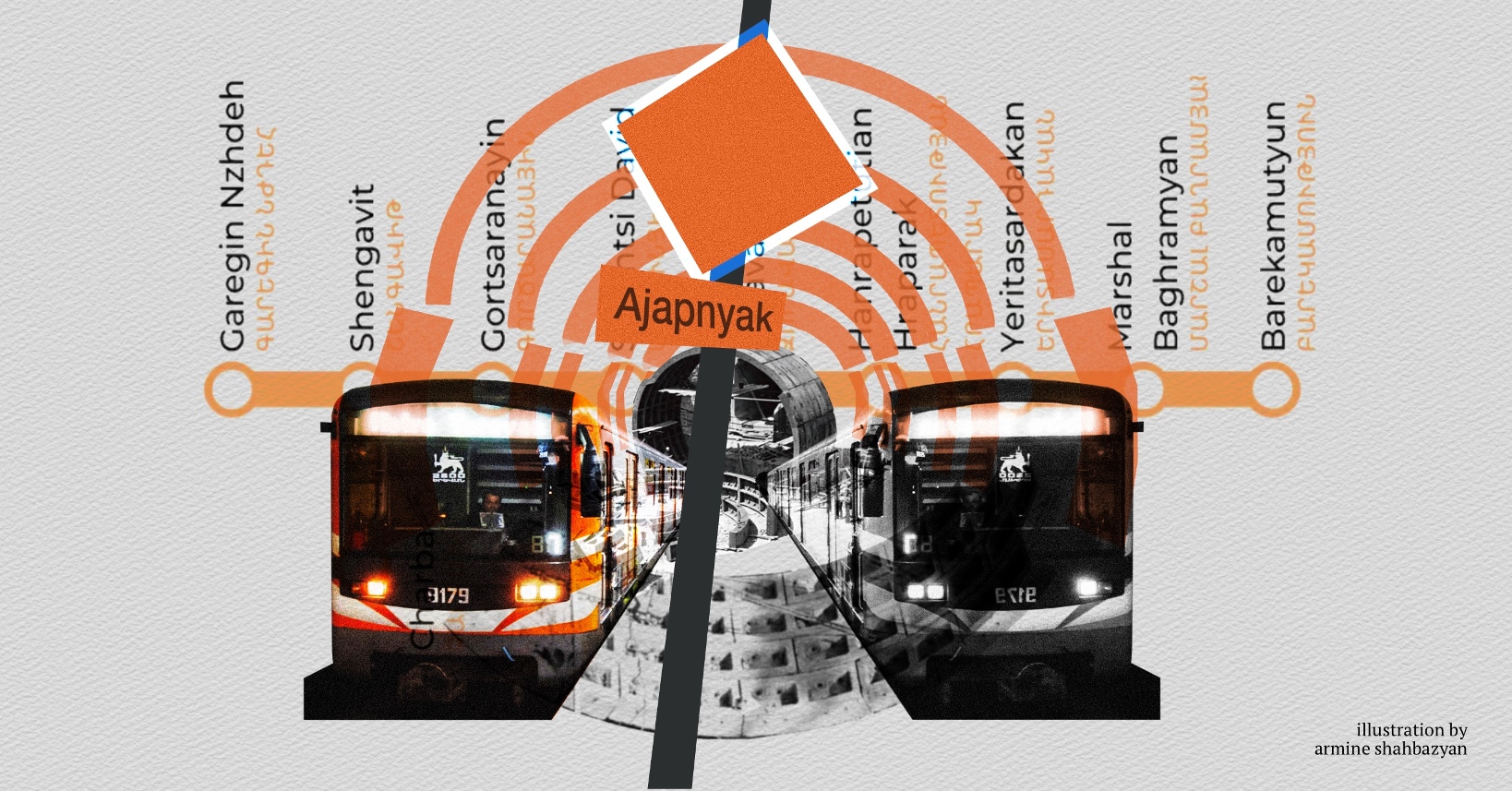
The much talked about and long-promised expansion of the Yerevan metro, adding just one station to a system largely unchanged since the Soviet era, offers another telling example.
The Unfinished Story of the Yerevan Metro
Yerevan’s metro is the smallest among post-Soviet capitals that inherited or built subway systems. It consists of a single line with ten stations, serving only a limited part of the capital.
Its origins are often recounted through a well-known urban legend. At the time Soviet authorities were building and expanding metro systems across the Union, Yerevan did not meet the one-million population threshold required to secure funding from Moscow. Armenian authorities are said to have improvised. During a visit of a delegation from Moscow, drivers from nearby towns were instructed to enter the capital at a set time, creating an artificial traffic jam. Faced with the resulting traffic, visiting officials were reportedly persuaded of the need for a metro.
The Yerevan Metro officially opened in 1981, though construction was still ongoing. It was halted in 1988 after the Spitak earthquake, leaving the system unfinished with nine operational stations. A tenth station, Charbakh, opened in 1996—the network’s most recent expansion to date. According to the original development plan, the metro was intended to include 32 stations across three lines.
Discussions about extending the metro resumed in the early 2000s. Like today, the need to expand the metro system was framed around the need to ease traffic congestion.
In 2007, then-mayor Yervand Zakharyan presented metro expansion as the most effective response to rising congestion. Ajapnyak station was identified as a priority, in part because more than 500 meters of tunnel extending from the Barekamutyun station had already been built during the Soviet period, reducing potential costs.
Over the next two decades, a familiar pattern followed: announcements, feasibility studies, negotiations with international lenders, but no transition to construction. Political cycles changed, but the substance did not. Successive mayors reiterated commitments, discussed funding options, and announced timelines, only for those timelines to shift or quietly disappear.
Revolutionary Mayors, Old Promises
Like previous administrations, the post-revolution government also pledged to expand the Yerevan metro, focusing on extending the line into Ajapnyak. During the 2018 Yerevan City Council elections, then-mayoral candidate Hayk Marutyan made the construction of a new station a central campaign promise.
In early 2019, a few months after the new authorities took office, Yerevan’s Chief Architect Artur Meschyan announced plans to construct new stations in Ajapnyak, noting that a project with preliminary calculations and architectural solutions was already being prepared for government submission. He acknowledged that securing funding would be difficult but pointed to investor interest as a potential solution.
Soon after, Mayor Hayk Marutyan reaffirmed the plan, noting that a working group was advancing the project. The proposal involved two stations, with the first to be built near the TUMO Center for Creative Technologies and the second extending toward the Kvartal district. He estimated construction costs at roughly $100 million per kilometer.
Because securing funding was a central challenge, Marutyan emphasized private investment, suggesting the station could be integrated with a commercial center to ease the burden on the state budget. Meschyan echoed this approach, describing the project as a “100 percent business venture,” combining infrastructure with commercial development. Deputy Mayor Hayk Sargsyan explained that the goal was to expand infrastructure without increasing public debt.
The plan envisioned extending the Yerevan Metro from Barekamutyun Station to Ajapnyak via a 525-meter tunnel built during the Soviet period but left unfinished, which would be modernized as part of the project.
By mid-2019, the municipality said construction could begin the following year, if the design work was completed in time, though financial constraints remained an obstacle. Meschyan noted that the city lacked the resources to fund the project from its budget and was instead negotiating with developers.
In fall 2019, City Hall published design sketches of the proposed station, as officials said negotiations had progressed toward preparing design and cost estimates. Reports indicated a preliminary agreement with an unnamed investor to finance the design phase, the construction later envisioned as part of a broader commercial project, including a mall and business center at the terminal point.
Specialists hired by the investor reportedly conducted on-site studies in the gorge and tunnel sections to assess feasibility. The municipality said a final agreement had been reached to move forward with the design phase, with the investor expected to present a business model based on criteria set by the city. Officials expressed hope that initial work could begin as early as the following spring.
However, no work had begun by spring 2020, when the COVID-19 pandemic hit. Despite repeated assurances that the project remained a priority, the pandemic and the 44-day war effectively stalled both progress and public discussion around the Ajapnyak extension.
***
The issue resurfaced in March 2021, when the acting director of Yerevan Metro, Gevorg Avetisyan, said an expert commission was continuing work on the proposed station. Two months later, Deputy Mayor Hayk Sargsyan announced that a two-stage tender process had been launched, beginning with selecting a company to prepare the design package. He said this was technically demanding and required extensive data collection.
However, by June 2021, the municipality acknowledged that no tangible progress had been made despite negotiations having taken place with a private investor; a final design sketch had not even been selected and funds had not been allocated in 2020, not even for administrative costs. While a preliminary concept had been presented in 2019, subsequent working versions had never been developed.
A more concrete step came in October 2021, when the Russian company Metrogiprotrans won the tender to design the Ajapnyak station. Valery Abramson, the company chair, presented a $500 million metro development program to the Armenian government, with potential backing from Russia’s export credit insurance agency. He estimated the design phase would take around 1.5 years, but noted that, if approved, the work could be accelerated by splitting it into multiple stages, potentially allowing construction to begin within a year.
Momentum appeared to build in November 2021, when discussions began about securing a $500 million loan to finance the project. Abramson said alternative financing options would be explored if the loan did not materialize.
A few months later, in April 2022, Prime Minister Nikol Pashinyan said the project was effectively entering the construction phase, noting that financing discussions would allow design work to begin. He added that the extension would enable the metro to cross the Hrazdan River and create possibilities for further expansion toward Davtashen, Malatia-Sebastia, and other districts.
At the same time, Yerevan Mayor Hrachya Sargsyan confirmed that a contract with the design company had been signed at the end of 2021, with 510 days allocated for completion. He said the project would be implemented in three phases, with funding secured for the first two, and additional efforts needed for the third, estimating total construction costs at around $50 million.
In May 2022, the Yerevan City Council approved allocating 554 million AMD from its reserve fund to support design work for the Ajapnyak station, marking what Deputy Mayor Levon Hovhannisyan described as another stage in the broader construction process. A formal contract with Metrogiprotrans was signed in June.
Meanwhile, the pattern of shifting timelines continued.
In October 2022, Babken Sedrakyan, director of the Yerevan Metro, said construction could begin in 2023, with a projected duration of four to five years. Days later, Prime Minister Pashinyan pushed the start date to 2024, outlining a three-stage process—report, preliminary design and final design—and noting that the initial report had already been submitted.
That expectation was echoed by Tigran Avinyan, who said the first phase had been completed and that two preliminary options were under consideration, with the full design expected in 2023, and a construction tender to follow.
By spring 2023, authorities appeared to move away from earlier plans for private financing. In March, the government allocated 1.1 billion AMD to the project.
During the 2023 Yerevan municipal election campaign, Civil Contract candidate Avinyan acknowledged a pattern of missed deadlines, noting that successive administrations since 2008 had promised the station without delivering. He argued that 2023 marked the first time an actual project had been commissioned, promising to complete the design by year’s end and move to tender. The party’s platform pledged completion of the station by 2028.
In November 2023, newly elected mayor Avinyan announced that the design for the Ajapnyak station had been completed and was undergoing expert review, stressing that, unlike the campaign, the focus was now on concrete steps rather than promises. In March 2024, he said the municipality “wanted” to begin construction within the year.
At the same time, officials continued to point to preparatory work rather than any physical progress. The head of the municipal construction and investment office said a contract had been signed for expert review of the design and cost estimates, while architectural planning documents were still being prepared and land designation procedures were nearing completion. Avinyan maintained that construction could begin in 2024, pending alignment with partners and outcome of the review process.
By November 2024, however, the project remained “comprehensive expert review.” Avinyan said a contractor would likely be selected the following year, again tying progress to technical and preparatory milestones while reiterating that the station remained a campaign promise they intended to fulfill.
No visible progress was made in 2025. By the end of the year, it emerged that the municipality had not used the funds allocated for the metro, instead reallocating around 9 billion AMD, earmarked for the project to purchase trolley buses for the capital. City Hall said that an additional 9.64 billion AMD from the state budget for 2025 had been allocated for the station, of which 765.1 million AMD had already been paid to Metrogiprotrans for third-phase design and cost estimates.
Officials said that the program had been revised following completion of the comprehensive expert review on June 9, 2025. They argued that given the need for final design approval and subsequent procurement procedures, full use of the allocated funds had not been realistic within the year, and that the remaining resources were redistributed to other priorities.
However, these financial reallocations coincided with an investigation by Hetq, which raised questions not only about delays but also about how the project had been managed. The outlet reported that, despite repeated promises by the end of 2025 only the design phase had been completed, and even that remained incomplete.
Under the contract worth 1.848 billion AMD, Metrogiprotrans was responsible for both “design” and “working documentation”, the latter being essential for the construction. In practice, only the design work was delivered, while the working documentation was never prepared, despite full payment on the contract.
The investigation cited Tigran Musheghyan, head of transport and metro programs at the municipality’s investment programs office, who said the work had not been fully carried out, resulting in financial losses for the city. He argued that the output did not justify the 1.8 billion AMD cost, noting that the same amount could have covered both phases. Musheghyan, who became aware of the issue in 2025 after assuming the role, said he informed his superiors and proposed amendments to align the technical assignment with the work actually performed. Although a sixth supplementary agreement was signed, no steps were taken to reduce the payment, which he described as an attempt to conceal the violation.
The outlet also noted that no official acceptance certificate for the services was found on public procurement platforms, despite the contract and payment records being available.
As a result, the municipality will now need to spend additional funds to complete the missing documentation, a situation Musheghyan attributed to professional negligence by the responsible officials.
At a year-end press conference, Avinyan said preliminary and environmental reviews had been completed and that the project was in the final stages of comprehensive examination, with negotiations underway with the Eurasian Development Bank. He said the expert reviews and a full feasibility study were expected by the first half of 2026, along with a positive conclusion from the government’s investment committee and the selection of a contractor by year’s end—after which construction would finally begin in 2026.
He emphasized that similarly extensive expert reviews had not been conducted for comparable projects in decades. Yet, as in previous years, the start of construction remained just over the horizon.
2026
As Armenia enters the fourth month of 2026—the latest deadline by which metro construction was supposed to begin—the pattern of forward-looking assurances continues.
Deputy Mayor Armen Pambukhchyan said at a February 20 press conference that all design-related expert examinations had been completed, adding that a construction tender would likely be announced by year’s end or, at the latest, the following year. He acknowledged delays in the review process but said the project had now reached a stage where it could move forward.
In March, the Municipality told EVN Report that the design documentation had passed all legally required examinations and had been formally submitted for approval. It also said the public investment program had been prepared and sent to the government’s Public Investment Committee, chaired by the Prime Minister, for final review.
At the same time, draft decisions were circulated to initiate eminent domain procedures for affected properties within the project area and to define procurement rules for implementation, which officials said would align the project with international standards for large infrastructure contracts.
Separately, following Hetq’s publication, the Investigative Committee opened a criminal case related to the procurement and commissioning of the Ajapnyak metro project, examining allegations of official negligence.
During an April 20 Yerevan City Hall meeting, Mayor Avinyan said the metro project is the municipality’s top priority, calling for weekly briefings on its progress.
His advisor, Aneta Babayan, said the project is now estimated to cost 107.3 billion AMD (about $287 million), more than double the initially projected $50 million.
Regarding financing, she noted that 2 billion AMD are allocated under the 2026 budget, with an additional 12 billion and 10 billion AMD planned for 2027 and 2028, respectively.
Babayan added that while the full financing has not yet been secured, a funding plan is in place to cover the project’s total cost.
Armenia is also in the midst of an election cycle. As formal campaigning begins in May, the metro project is likely to draw renewed attention, particularly from the ruling party, who has once again included it in its platform. Civil Contract promises to begin construction of the Ajapnyak metro station in Yerevan and to launch work on a new above-ground station between the Zoravar Andranik and Sasuntsi Davit stations, with completion targeted for 2033.
Also see

Anatomy of a Process: Armenia’s Biometric Passport Journey
Armenia’s long, troubled journey toward biometric passports reveals much about its institutional weaknesses and European aspirations. As the EU moves forward with visa liberalization and new border controls, the country’s ability to deliver secure documents will shape its citizens’ access to Europe.
Read more
Anatomy of a Process: Yerevan Transportation Reform
Yerevan's ongoing transportation reform, launched in 2017, highlights the lack of strategic planning, leadership and accountability. Without a comprehensive approach, clear oversight and implementation, any reform process will not fulfill its intended goal: to benefit the public.
Read more
Armenia’s Long Road to Health Equity
Armenia has launched universal health coverage, replacing out-of-pocket payments with a national insurance system. After years of delay, the reform expands access and reframes healthcare as a social right rather than a privilege. The challenge is effective implementation, writes Hranoush Dermoyan.
Read more
License to Chaos: The Reality of Driving in Yerevan
From chaotic intersections to the challenges of getting a driver’s license, navigating Yerevan’s roads reveals deeper issues of enforcement, infrastructure and culture. Through personal experience and research, Hranoush Dermoyan explains what it takes, and what it costs, to drive safely in Armenia.
Read more
Electric Vehicles Surge in Armenia, But Where Will the Batteries Go?
Armenia’s electric vehicle market is booming, driven by import incentives and global trends. But as EV adoption accelerates, the country faces a looming challenge: how to safely recycle lithium-ion batteries in a system unprepared for hazardous waste disposal.
Read moreRecently published







EU to Deploy Second Mission to Armenia
In EVN Report’s news roundup for the week of April 17: The European Union to deploy second mission to Armenia; several members of Samvel Karapetyan’s Strong Armenia Party detained on alleged election-related offenses; Prime Minister Nikol Pashinyan says TRIPP is entering implementation phase and more.
Read more