

Listen to the AI generated audio article.
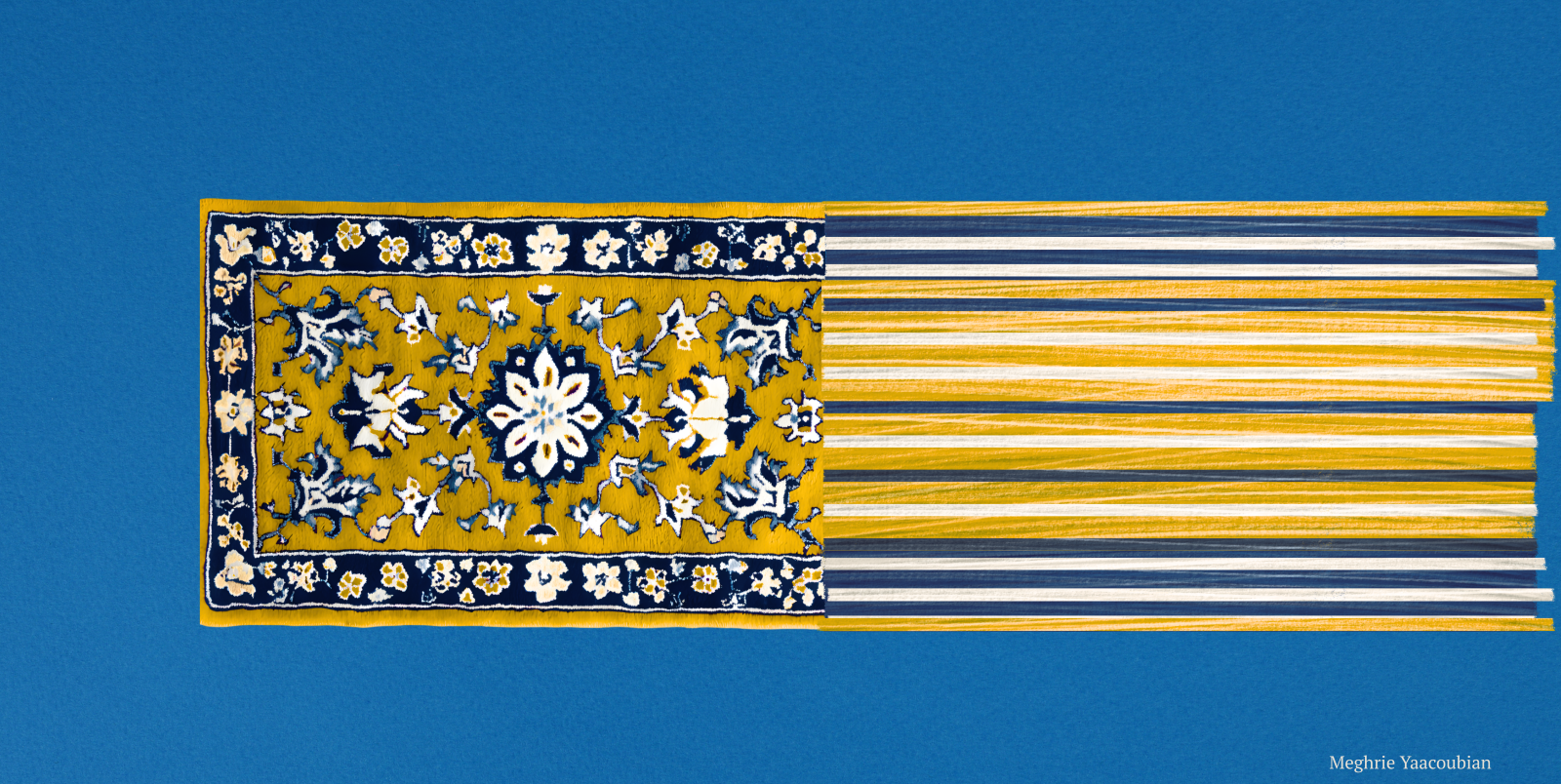
Yerevan has a habit of reinventing itself in the summer. By now, you’ve likely seen the stretch of pavement in downtown Yerevan painted in the form of a traditional Armenian rug. The crosswalk stopped people in their tracks and images quickly caught fire online, met largely with excitement and praise. It’s a small thing, as far as civic gestures go—a few cans of paint, a patch of asphalt. But in a city that wears its identity proudly, even a crosswalk can feel like a statement about what matters to its people.
The geometric shapes, astral symbols, vegetal and zoomorphic figures, and anthropomorphic ornaments we recognize in Armenian rugs come to us from the distant past. They can be found not only in rugs but across Armenia’s material culture, from textiles and pottery to metallurgy and carpentry. And, they communicate semantic meaning.
It’s not the first time rug ornaments and patterns have inspired other forms of creation. In fact, there’s a precedent for it in Armenia’s modern cityscapes and urban design. Traditional rug patterns can be found adorning the facades of Soviet housing projects, culture centers, and factories across the country. There’s a huge rug motif in the center of the roundabout in Yerevan’s Republic Square that can only be seen from the sky.
But what meaning do Armenian rugs and their ornaments really hold in our made-for-Instagram world? There’s a quiet crisis hiding in plain sight in Armenia, one that I think many of us miss, distracted by the glare of our phone screens pining for likes: rug making is an actively disappearing craft in Armenia today, one that will cease to exist as a cultural practice in our lifetimes if something isn’t done immediately.
That’s not an exaggeration. As a new rug producer in Armenia, everywhere I go and everyone I speak to says the same thing: no one makes rugs anymore in the country. Compare that to the reality just one generation ago. Today’s rug makers recall nearly every home in towns and villages having looms, when local people wove rugs for their own personal use and to mark major life occasions, a rug-related practice that’s also disappearing with the craft. Numbers are hard to come by in the handmade rug industry, especially historical numbers, but according to a Soviet industrial survey, the Armenian SSR was producing 1.2 million square meters of machine-made rugs annually by 1970. That’s about 170 professional football (soccer) pitches every year. Those rug factories closed, and the entire economy collapsed with the dissolution of the Soviet Union, and today Armenian rug making is just beginning to learn how to crawl again, despite a 4,000-year-old weaving heritage behind it.
In 2016, Megerian Carpet, one of just two large handmade rug producers (large relative to our very small market), reported making just 1,900 square meters of rugs by hand—slightly more than a quarter of a football pitch.
Today, we see rug ornaments everywhere, printed on apparel, etched into accessories, painted onto city streets, especially in Armenia, where they’re often paired with the well-intentioned mission of “cultural preservation.” But in the face of our disappearing weaving heritage, these claims of preservation ring hollow at best and lazy at worst. Few people want to do the real, hard, unglamorous work: making real rugs by hand locally.
And it’s not only about handmaking rugs. It’s about preserving and strengthening the entire local value chain, from sheep and wool to the final rug. That means re-creating demand for local Armenian wool and stopping the burning of 1,400 tons—90% of the country’s wool—every year. That means spinning Armenian wool by hand, as our ancestors did, a practice considered sacred by the ancient Urartians. That means revitalizing our traditional natural dyeing practices, which have all but disappeared due to Soviet industrialization and the introduction of chemical dyes. And yes, it means making rugs by hand, putting our bodies, minds, and souls into those sacred objects we love.
There’s no doubt that we Armenians love rugs. But loving something isn’t always enough. If this practice is to survive for another 4,000 years, we need to turn that love into action—now. Thankfully, a very small community of spinners, dyers and weavers still remains in Armenia, keeping these traditions alive despite a tidal wave of challenges: rising material and labor costs, and competition from established rug making countries (Pakistan, Afghanistan, Nepal), where costs are next to nothing and quality is very high. I receive daily emails from producers in these countries offering to make the rugs I offer my clients, and I respectfully decline. My partners and I are in this trade not to make quick profit, but because we love the craft and believe in its celestial, ancient beauty and meaning.
Another challenge to standing on our own two feet again as a rug making nation, is that those countries have state support, and we do not. The same weekend the crosswalk in Yerevan was receiving rave reviews from Armenian netizens, Baku was wrapping up its third international carpet festival, bringing together weavers, artists, producers, buyers, academics and media from around the world, funded by their government. Our neighbors’ rug industries are heavily supported by their states. Sadly, we receive no support from the Armenian government. What local producers do is done with Armenian resources through cooperation with one another and with support from international funders.
The best way to support Armenia’s rug revival, slowly happening today, is to buy truly made-in-Armenia rugs and incorporate them into daily life, wherever you are in the world.
Love Armenian rugs the way you love anything worth keeping. Not from a distance, not as an artifact behind glass, but up close, underfoot, in use. Culture isn’t preserved only in museums, or on crosswalks, or on tote bags. It survives in the hands that make it and in the homes that choose to live with it. The most radical act of preservation available to any of us right now is also the simplest: buy a real Armenian rug, made in Armenia, and use it.
For purchasing made-in-Armenia rugs and weaving workshops in and near Yerevan.
Silk Road Hotel, 53/2 Aygedzor Street, Yerevan
Artsakh Carpet, Khorenatsi 33, Tashir Shopping Center, 4th floor, Yerevan
Hadrut Artistic Center, 46 Artashesyan Street, Yerevan
Woolway Studios, 9 Kentronakan 3rd Street, Argavand
Carpet Home Anahit, Dzoraghbyur, Kotayk
Garni Craft Center, 56, Charents Street, Garni,

Cover photo by Meghrie Yacoubian.
LIFESTYLE
Summertime
It’s summertime in Armenia, and living is easy. This issue is bursting at its seams with content on what to do, where to eat, how to find joy, all while keeping the little ones in your life entertained during the 14 hours of sunlight. Set sail in Sevan, find your sourdough, grab a seat at Twelve Tables, weave your own Armenian carpet, ship your kids off to camp, just don’t forget the SPF.

Lake Sevan: Armenia’s Ultimate Summer Address
Lake Sevan has long been the summer escape for Armenian families, a place for lazy beach days, splashing kids, and picnics that stretch into golden evenings. Now, the lake is heating up in a new way, with sailing, water sports, sun-drenched cafes, open-air cultural events, and eco-tourism drawing a fresh wave of visitors.
Read more
Where Yerevan Actually Eats
Yerevan is embracing new cafes and fashionable menus, but where do locals actually eat? This personal guide looks beyond trendy cafés to the restaurants, bakeries and coffee shops where memories are made, friendships endure and familiar dishes keep people coming back.
Read more
Runnin Bakery: Keep Up or Come Back on Thursday
Tucked away in a former garage in central Yerevan, Runnin Bakery has become a word-of-mouth favorite. Maria Gunko explores how two women are redefining craftsmanship, entrepreneurship, and community, one sourdough loaf, post-run pastry, and loyal customer at a time.
Read more
A Parent’s Survival Guide to Summer in Armenia
Armenia is surprisingly good at summer, especially with kids in tow. From splash pads and dinosaur parks to circus training and Armenian-language camps, this is a dense guide for the parent who wants options without having to work hard to find them.
Read more