

Listen to the AI generated audio article.
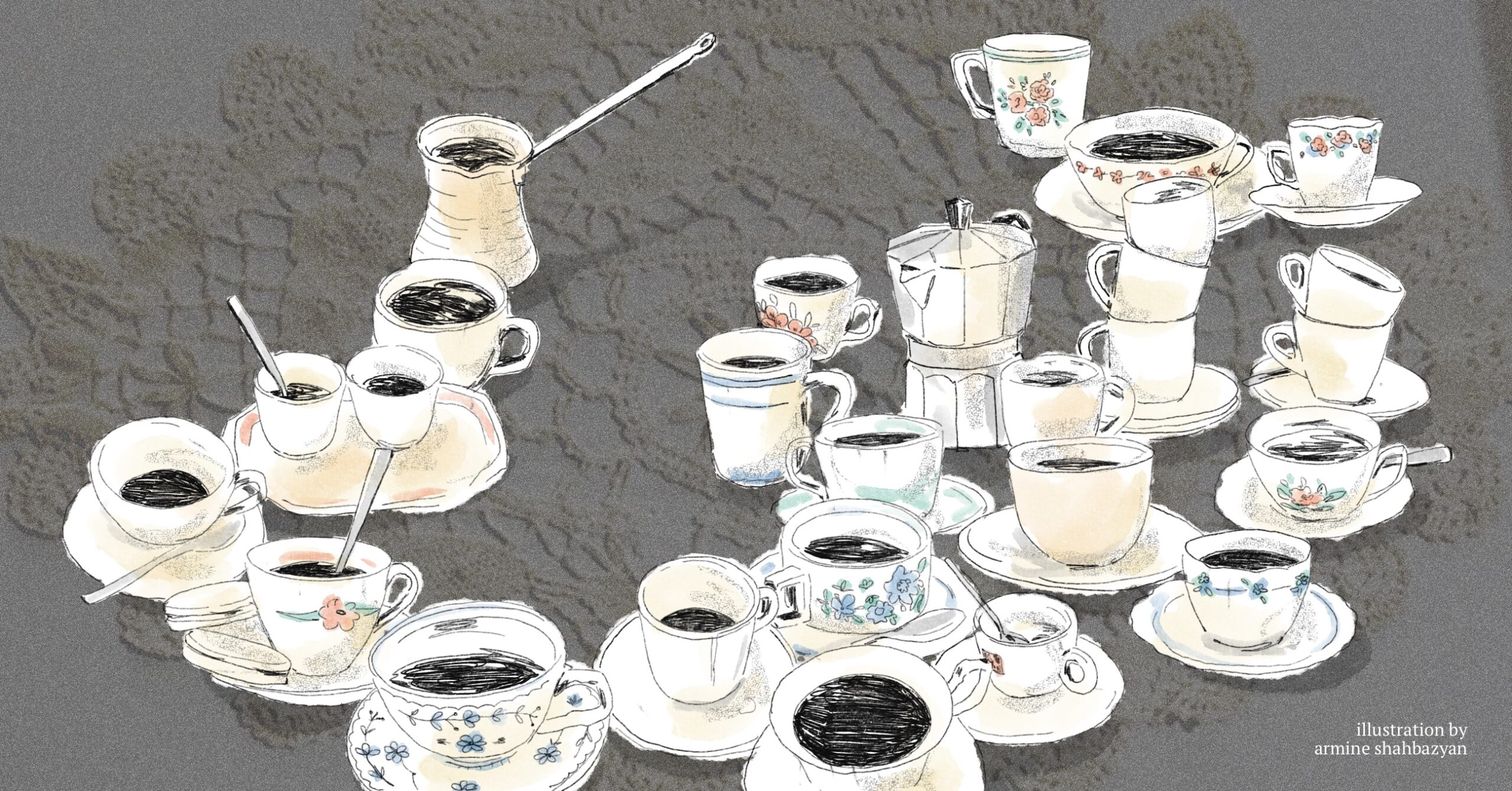
My grandfather has always loved making coffee. My earliest memories are of him rising before everyone else and offering to make coffee for his two daughters. Every morning, the kitchen belongs to him. Every morning, he stands patiently next to the stove and waits for the liquid to rise. In time, I became part of his ritual.
I never acquired a love for soorj, traditional Armenian coffee, so my grandfather and I usually prepare different coffee standing side by side in the kitchen. At some point, our routines merge in the same small choreography. I wait for the brownish liquid to finish pouring into my mug, while he waits for the black beverage to bubble up to the surface of the jazzve. We stand in silence, interrupted only by the hum of my coffee machine. We do seem to be quite out of sorts in the mornings, before our coffees, that is.
Most families in Armenia have their own shared rituals connected to soorj. “It has become ingrained into our DNA,” says Tatev Saroyan. Her words came back to me as I watched the two daughters share their morning coffee with their father. Tatev, who heads Yerevan State University’s History Museum, has been researching coffee culture in Armenia since 2012, after discovering old coffee grinders in the storage rooms of the museum. “I remembered how my grandmother would grind coffee when I was a child,” she says, “and the way its scent would spread throughout the entire yard.”
The memory that first sparked her interest grew into a decade-long research project, which later became the foundation for a series of popular lectures in 2021. Every Friday that summer, people would gather in the courtyard of the Hovhannes Tumanyan Museum to hear her speak while sampling different kinds of soorj.
The widespread place of coffee in Armenian life is often attributed to the repatriates who arrived from the Middle East. Coffee did exist in Armenia before them, references to the drink date back to the 17th century, but by the mid-20th century, it remained accessible to only a small segment of society. After the major repatriation wave of 1946, coffee gradually became woven into the daily routines of Armenians across different walks of life.
“Many early interactions between locals and Western Armenians took place around coffee tables,” Tatev explains. Repatriates helped introduce the habit of coffee drinking to locals, though not without resistance. Many locals would often complain about the bitter black water served to them after dinner. Women, however, were among the first to embrace it. According to Tatev, the chance to learn something about the future of their sons, daughters, or husbands made the bitterness easier to accept. Coffee cup readings became one of the drink’s earliest social attractions, as women sought out gatherings where someone skilled enough to interpret the patterns left in the grounds might reveal what lay ahead. Over time, coffee became so fully accepted that it soon spread into men’s social circles as well.
As coffee drinking spread in the decades that followed, the mass consumption gave rise to a growing cafe culture. At first, these spaces were largely reserved for men. Exceptions were made for the wives of intellectuals who could accompany their husbands inside. Women such as Zabel Yesayan and Arpenik Charents were among the few permitted to enter and join conversations with men. “To put it bluntly, they had the right to speak,” Tatev says.
By the 1960s, Yerevan had become known for its cafes. “In the 1960s, when tourism began to grow, it was important for tourists to view Yerevan as the town of cafes and coffee,” Tatev explains. “Neither Moscow nor Tbilisi was considered to be one; it was Yerevan.” Repatriates arriving from countries such as France, the United States, and Egypt helped shape the atmosphere of the cafes they owned and operated in Yerevan, bringing with them a stronger culture of customer service and the language skills to welcome foreign guests.
Decades later, by 1988, political upheaval and economic crisis had begun to reshape even Armenia’s coffee culture. With the country under blockade, smaller quantities of quality coffee were making their way in. The taste of coffee changed with the condition of the country itself. Dark, heavily roasted and intensely bitter coffee, what became known after the Second World War as the Italian roast came to dominate the market. The darker roast helped conceal the defects of lower-quality beans while preserving the strong, sharp flavor people had come to expect.
After the collapse of the Soviet Union, it took time for the cafe and coffee culture to fully re-enter everyday routines. Coffee was still the most sought-after beverage in the country, yet as Tatev notes, even in 2017, when she first had the idea of putting together an exhibition based on her research, there were still few companies importing quality coffee to Armenia. Only in more recent years, after 2020, did small boutique roasters and specialty importers begin reshaping the market. “I always compare it to wine,” she says. “With the available market of quality coffee nowadays, we get to choose the beverage that suits us best, just like we choose our wine.”
Coffee breaks have long been a ritual passed from one Armenian generation to the next. My grandfather and I are one example; Tatev and her grandmother are another, among countless others. It is a small portion of the day set aside for pause, pleasure and recovery. As Tatev puts it, “The body relaxes while indulging in the beverage.”
Presently, as many of us struggle to keep up with the speed of time, we drink coffee mostly next to our desks, which may lessen its enjoyment. The trick is to make sure coffee is available at all times of the day, as one is rarely enough. One for the mornings to enjoy in peace alone with oneself. One for work to keep oneself alert. A couple more to be enjoyed in the company of friends and family. That’s one successful day of coffee drinking, I would say.
P.S. The aforementioned friends insisted I note that by the time I reach the “couple more,” they are usually only on their first or second coffee of the day, and strongly encourage everyone not to follow my example.

Cover photo by Roubina Margossian.
LIFESTYLE
Of Sound & Mind
From discovering love in inherited trauma to the quiet art of navigating Yerevan’s sidewalks, from a sound keeper at public radio to a boba tea shop opened by a newcomer from China, and reflections on how Armenians listen to radio today, this month’s SALT traces an evolving society in the spaces between image and reality, past and present.

A Taste of Contemporary China on Baghramyan Avenue
A boba tea shop brings contemporary China to Yerevan through careful branding, cultural translation and taste. Its owner, a Chinese emigre, came looking for a good vibe and kind people; in return, she created a space that sits between cafe and experiment, showcasing how unfamiliar flavors, ideas and places can be introduced thoughtfully and unexpectedly.
Read more
The Sound Keeper
For more than fifty years, Ruzan Saryan has guarded Armenia’s sound memory inside the archives of Public Radio. Through wars, political change and fading technologies, this intimate portrait follows the woman who preserved the voices of a nation.
Read more
The View From the Curb
A sharp, darkly funny walk through Yerevan from curb level, where crossing the street can feel like a survival sport. Through near-misses, chaos and observation, Lori Youmshajekian explores road culture, impatience and the daily vulnerability of pedestrians.
Read more
Could We Ever Grieve It Away?
Every April 24, we focus so much on the inherited trauma and pain related to it, that we overlook the love woven through our stories. Can grief alone sustain us or do we need new rituals of gratitude, connection and renewal? What about the ethical responsibility of recognizing the suffering of others? Blending reflection with conversations with psychologists, artists and thinkers, Ella Kanagerian-Berberian searches for her own answers.
Read more

As a caffeine junkie who doesn’t particularly care for most of the cheesy Gen-X/Millennial coffee culture (self-deprecating workaholic jokes about coffee & Mondays), I feel like moving to Armenia was the exact right thing to do.
Everything-coffee is well taken care of:
– the omnipresence of vending machines;
– the range of options at supermarkets;
– the specialized stores, cafes & coffee stands (speaking of, I hope Iced Americano & Iced Espresso shots become more widely accepted. It gets really hot here in Gyumri but most baristas are only familiar with the iced creamy dessert varieties, so I often have to risk coming across as some heathen when I explain my favorites – I just want the ice-cold ones with some caffeine-kick behind them – is it really that much of a sacrilege under the summer sun? *shrug*)
I respect the established tradition, though. The article has filled some gaps for me in terms of how it all came to be this way. Thanks!