
Listen to the AI generated audio article.
I can think of a long list of dos and don’ts for crossing the road in Yerevan. Do: look left to make sure a car isn’t speeding toward you when your light is green to cross. Do: catch the eye of the driver before you step off the curb. Do: anticipate that the speed of an oncoming car is subject to change at the driver’s whim. Don’t: follow jaywalkers, they usually have a death wish. Do: expect that many drivers interpret an orange light to mean “accelerate”. And never, ever assume which direction a car will go next.
Even with this rulebook etched into mind, on narrow streets like the corner of Pushkin and Koghbatsi, you can end up standing with your fingertips touching the bonnet of a car that has slammed the brakes about five centimeters away from mangling your limbs under its front tires. Your arms go up instinctively, as if your body believes it can fend off a hunk of oncoming steel. Your muscles seize, curling inward, spasming, in anticipation of impact, and you stand there, frozen in open-mouthed horror.
The driver, a man in his mid-thirties, rolled down his window and stared at me blank-faced. He had barreled down Koghbatsi at high speed, trying to turn left quickly enough to overtake the oncoming car from the right. In his valiant effort, he neglected to look where he was turning. For those who aren’t familiar with this intersection, it’s damn near impossible to drive fast. Traffic is at a standstill and the throng of pedestrians is constant, parents with prams, groups of students, delivery scooters, people weaving around parked cars and taxis picking up and dropping off passengers. I wonder what it felt like for this particular driver to accelerate for a few seconds, feeling like he caught a gap in this chaotic rhythm. Invigorating, I bet.
I’m not naive about the reality of urban traffic around the world. I know other places I’ve lived are pedestrian havens, but having wandered the sidewalks (or lack thereof) in places less friendly to people on foot, I’d like to believe I know a thing or two about being a wide-eyed pedestrian. It’s true that in Yerevan we have ample dedicated space to walk, stroll, people-watch, smoke, skate, as we see fit. But that doesn’t mean pedestrians are dealt a fair hand against the drivers we must contend with on a daily basis.
To make my point, it seemed only fair to gather material for this article on foot, so I decided to walk up Mashtots Avenue to take note of what I see, and sit at a cafe to write it as it happened.
At 3 p.m., the rush hour is just beginning to gather momentum. At the corner of Amiryan Street, days of rain have pooled into a puddle of opaque sludge, stretching from the traffic lights to the line of waiting cars. I find the patch of soil on the right that lets me cross without submerging my foot. Across the road, repairs have turned the footpath into something resembling a pockmarked swamp, men are digging with spades and the mud is flying. The only way around is to step onto the road and try to not get in the way of oncoming traffic.
At the crossing on the northern edge of Season’s Park, just beyond the entrance to the underground Yerevan City supermarket, a driver is turning into the street while looking down at his phone. I wait until he looks up to cross. He does eventually, and stops to let me pass.
From a dalan some meters further north (one of the residential courtyards that open onto the street) a car lurches out, as if it’s the driver’s first time behind the wheel and he misjudged the weight of his foot. He narrowly misses a woman walking up to her taxi, with a bag tucked under her arm. A couple with a pram walking south have stopped abruptly, the child lurches forward. The driver is looking straight ahead. With the line of buses blocking the lane he is forced to wait anyway. We walk around him, giving the car a wide berth.
At Pushkin, the light to cross is still green as I approach, but five university-aged women have materialized to block the way forward. They’re walking shoulder-to-shoulder and don’t budge an inch. I plant my feet and wait for them to pass around me. In Yerevan, people who monopolize the sidewalk like this are as common as slow walkers and folks so unaware of their surroundings they brush past you, grazing your clothing with lit cigarettes in hand.
At the busy intersection where Mashtots meets Sayat Nova, there is an accident in the middle of the road. A white Tesla has hit a small two-seater car. The blockage creates another layer of chaos to the traffic. When the light turns green to cross on the Baghramyan side of the junction, the people ahead of me step off the curb, and then lurch back abruptly. A car, given a yellow arrow, is hurtling toward the turn at highway speed, driving close enough to the curb that I feel the dust kicked up by its wheels scratch across my face.
From the other side, five more drivers have accelerated toward us, presumably running a red or orange light. One car on the far right swerves left to avoid the pack of pedestrians that have just begun to cross. Another overtakes the car that has dutifully stopped at the crossing, also accelerating into the traffic ahead. They stop about five meters further ahead than when they began this daring maneuver. Into more traffic they go.
At Moskovyan and Mashtots, the pedestrian light has gone red but a woman with a cane has made it only halfway across the road. She is hobbling carefully and slowly when the cars begin their pulse forward, inching and inching closer toward her, willing her to move out of the way. The horns are blaring from behind them.
There is one more street to cross until the cafe, and I make it three-quarters of the way when an electric car swings onto Mashtots from Moskovyan, accelerating to try and overtake me, and slamming on the brakes when he realizes he’s too late. But he doesn’t come to a full stop, he creeps forward roughly half a meter from where I am walking, calculating how little space he can get away with before he can gun the engine and go.
I’ve lived here long enough to understand that drivers are not hostile to pedestrians out of pure malice. Driving here is stressful when the infrastructure is broken and unpredictable, corners are flooded, pedestrians zoom across the road with no warning, potholes threaten worn-in wheels, and construction colonizes the streets and pavements for months on end. I’ve seen jaywalking that defied any survival instinct and watched people cross four lanes of moving traffic to make it to a bus. Police recorded about 17,000 traffic violations by pedestrians in the first half of 2024. By some measures, pedestrians are part of the problem. But our fragile matrix of calcium and collagen, flesh and fat stand no chance against a speeding slab of metal. Who takes the blame then?
Compared to pedestrians’ behavior, what I witness from cars on a daily basis is much worse. The driving can seem reckless, but I’ve begun to interpret the behavior as a kind of aggressive impatience that treats pedestrians like an obstacle to be outmaneuvered. I find it hard to understand why someone would choose to swerve into oncoming traffic, zoom past pedestrians with a meter or so to spare, all to beat a red light or gain another few meters into yet more traffic.
When I’ve told people about writing this story, they are quick to weigh in with their own experiences. A friend described watching a four wheel driver accelerate through a residential courtyard — one of those containing benches and gardens and children running to the playground. She sprinted to grab a toddler who didn’t see, or rather, interpret, the car coming. The parent was in the store and unaware. I also used to live in a building which had a similar communal backyard which doubled as a parking lot. Drivers would speed from the boom gate to the parking spot. Another person tells me about a mother and daughter who were killed crossing the road from their house in a village. One driver has even apologized to me for driving carefully. He’d been in an accident before, he explained.
The only conclusion I can come to is that the people behind the wheel are tired and frustrated of the increasing cost of living, social and political anxieties, competing pressures on their time and attention. And a car functions as the one domain where you are in control, where you can feel like you own the speed and the direction and the outcome. You can tickle that reward mechanism in your brain when you overtake another vehicle or swerve around someone on foot. I recently rode in the back of a car careening down a highway at 170 kilometers per hour, with no functioning seatbelt. Every stomach-turning lurch on the road brought to mind videos I would have to watch working in a newsroom in Australia. Mangled bodies and bones and limbs, poking and twisted and jutting in unnatural directions. People flung out of cars, immobile, splayed across the road. Emergency services rushing to cover them with that tell-tale white tent.
Perhaps those intrusive thoughts are a little dramatic, but the data shows the reality doesn’t land too far away. Only when the prime minister’s own speeding motorcade caused a death did this inconvenient conversation enter the national consciousness. But in 2024, more than 330 people died on the road, including pedestrians, drivers and passengers. Road deaths decreased at the beginning of 2025, according to official sources, but Armenia still has the second highest traffic mortality rate among EU and former Soviet countries. In the past decade, 70,000 people have been left injured from an accident, up to 3,000 permanently disabled, according to officials. One person dies every day on the road, and more than a dozen are injured. This data is not only referring to pedestrians, of course, drivers, passengers and adjacent vehicles are also affected by bad behavior on the road.
Truly, the logic eludes me. How does somebody’s life or limb stack up in the decision to gain a few seconds before joining the next queue of stopped cars? Before I could ask, the man who came close to caving in my left knee and shattering a bone or two, rolled up his window and drove on.

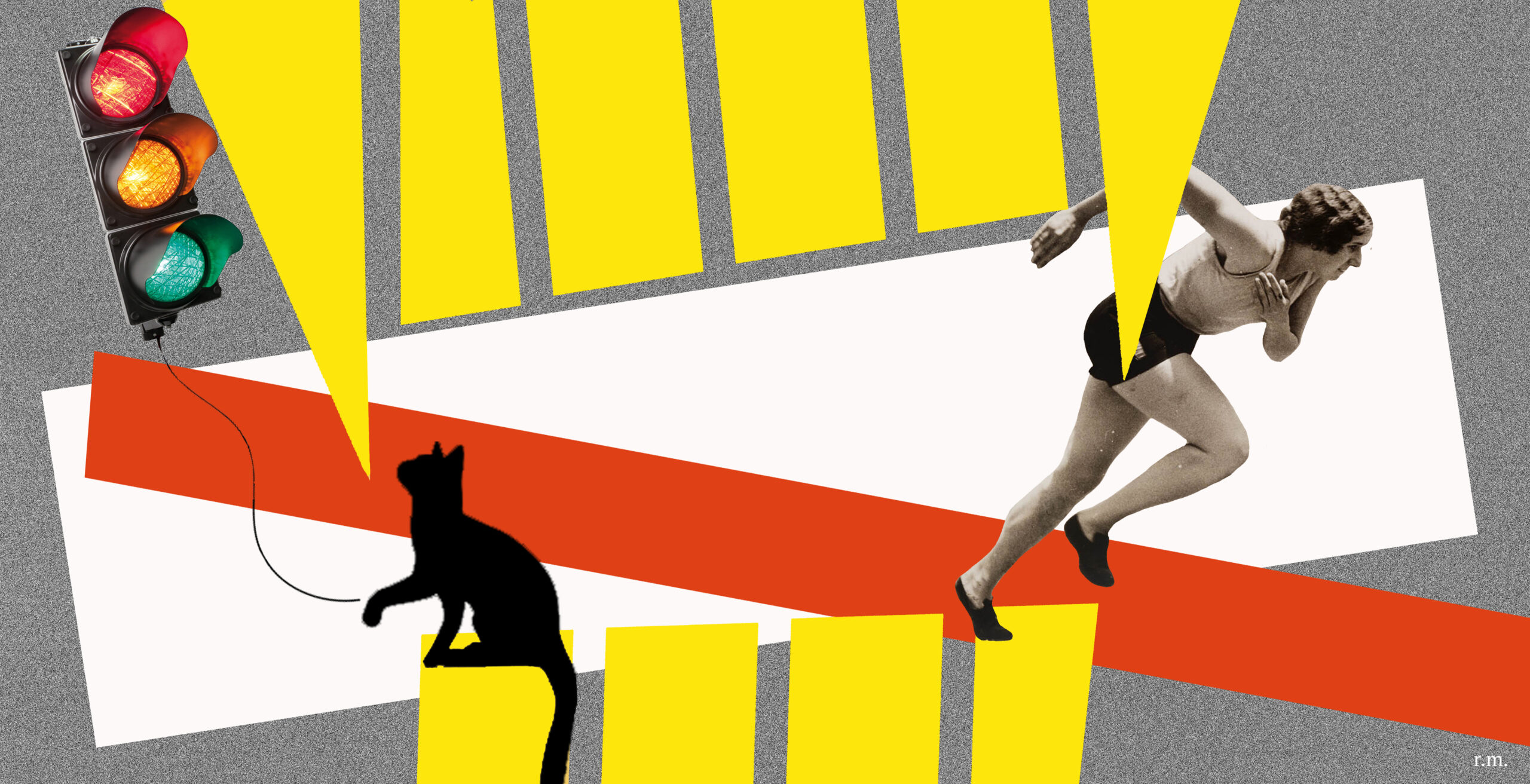
Cover photo by Roubina Margossian.
LIFESTYLE
Of Sound & Mind
From discovering love in inherited trauma to the quiet art of navigating Yerevan’s sidewalks, from a sound keeper at public radio to a boba tea shop opened by a newcomer from China, and reflections on how Armenians listen to radio today, this month’s SALT traces an evolving society in the spaces between image and reality, past and present.
Could We Ever Grieve It Away?
Every April 24, we focus so much on the inherited trauma and pain related to it, that we overlook the love woven through our stories. Can grief alone sustain us or do we need new rituals of gratitude, connection and renewal? What about the ethical responsibility of recognizing the suffering of others? Blending reflection with conversations with psychologists, artists and thinkers, Ella Kanagerian-Berberian searches for her own answers.
Read more