
Listen to the AI generated audio article.
The title question may seem unusual at first. In Armenia, accessibility is rarely discussed as a pressing societal challenge, since it directly affects only a small minority of people—as it does elsewhere in the world. Yet, for those of us few, including myself, it is a daily reality. More importantly, accessibility should not be dismissed as an issue reserved only for public debate in so-called developed Western societies.
A few days ago, I came across a lighthearted quiz in the French diaspora magazine Nouvelles d’Arménie titled “Are you ready for a trip to Armenia?” Had I written it, I would have added one more question: “Do you travel in a wheelchair?” I would not have even bothered to specify “electric,” since that would be far too optimistic an assumption.
This question would not have changed the outcome of the quiz. It does not really matter how “ready” someone in that situation is to make the journey—I am living proof of that. I have visited Armenia several times already. Still, ten years have passed between my last two trips, from 2015 to 2025, and during that time I noticed many changes, not only in terms of accessibility but also in how others responded to my presence and, by extension, to disability itself.
It is precisely for this reason that I am writing this article: to offer personal testimony about a subject that remains understudied. Times change quickly, and new norms become so established that we soon act as though they have always existed. I do not claim that this is an exhaustive or objective study; I am writing only from my own experience. There is also a major methodological limitation: my outlook, sensitivity, and even my political awareness have all developed and sharpened over the past decade. I turned twenty this year. I was only ten when I last was in Yerevan. Comparing those two perceptions is challenging.
Some changes, however, are worth noting, particularly the gaze of others (quite literally). Ten years ago, people would often stare at me in the street, or even stop in their tracks to ask what was wrong, wish me առողջութիւն (aroghtchutyun, which directly translates to “health”; a “get-well” blessing), or sometimes even begin to pray for me. A friend has a wry expression for this tendency toward hyper-fixation in Armenia whenever someone looks different from the norm: “the staring society.”
This time, though, I experienced something different. I was pleasantly surprised by people’s quiet indifference. Even better than indifference was the presence of discreet and polite assistance. During my ten-day stay, a passerby offered to help my mother, who was pushing my wheelchair, across a marked crosswalk (zebra crossing). A woman walked beside us up the steep road leading to the Matenadaran. At the Opera, the usher, noticing that I spoke several languages, asked me to translate for foreign spectators who needed assistance. I was approached simply as a person, not defined by my chair.
What explains this shift? I cannot point to a single reason. Perhaps Armenians travel more now and encounter people with disabilities in public spaces abroad. Perhaps social media has broadened the visibility of diversity worldwide. Or perhaps there are simply more tourists like me in the country. I cannot say for sure.
Friends warned me before my trip that Yerevan had undergone significant changes, especially since the war in Ukraine and subsequent influx of immigration. Some claimed the city had become unrecognizable. Indeed, shops and cafes have become gentrified, and there seems to be more money circulating, evident in the Teslas and other luxury cars on the streets.
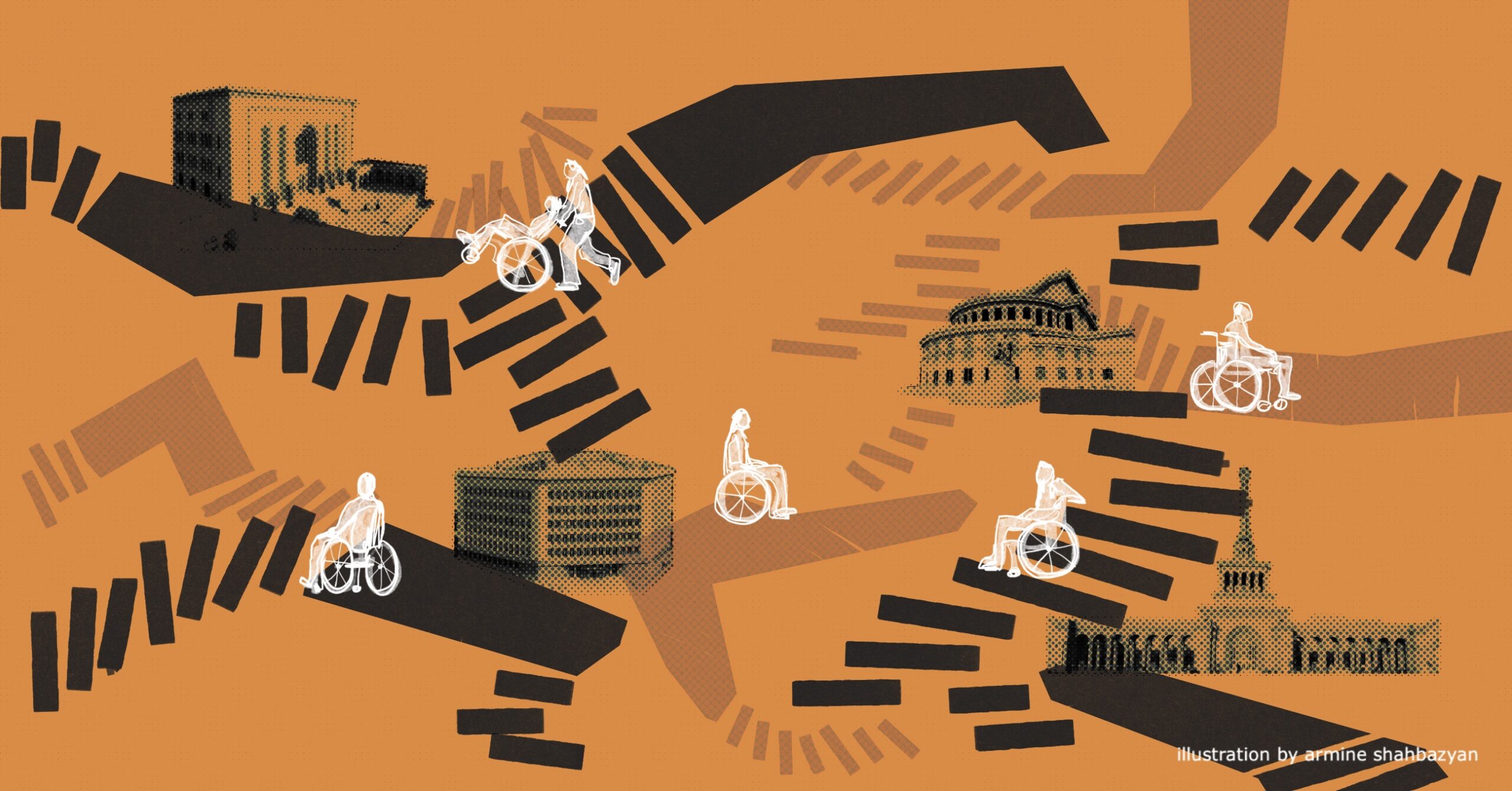
Regarding infrastructure, however, I did not notice anything revolutionary. The urban landscape remains largely unchanged, with features that sometimes border on the absurd. Many lowered sidewalks in the city center, from Tumanyan Street to Northern Avenue, are not aligned properly. Ramps often have steps at the base, are too steep or too narrow, or lead directly into walls. The Opera House ramp, made of a flexible material, bends under the weight of my chair. It is often the large foreign companies that have the most accessible stores. I could, without difficulty, purchase a Miele washing machine on Abovyan Street.
That said, these observations must be tempered. While the city itself is not always welcoming, the people usually are. During our stay, we contacted Yerevan Home Care, a paramedical service that provides a van with a ramp and two drivers. Both men were reliable and flexible, despite being in high demand. The van’s equipment, especially the wheelchair securing hooks, would no longer meet French standards, but it worked perfectly well.
In short, it is crucial to advocate for your needs—patiently but firmly. Most care workers are willing to learn. Remind airline staff multiple times that you must be properly settled into your seat. Clarify that for comfort and safety, all four hooks should be fastened, not just two.
One remarkable detail is the free access to certain services for people with disabilities, perhaps a remnant of the Soviet Union. These include cultural venues like the Opera House and trains, which have designated wheelchair areas. I took advantage of this for a day trip to Gyumri.

My most surreal accessibility experience in Armenia took place at Yerevan’s train station. Just reaching the correct track was an adventure. Each morning, the station transforms into a wholesale market with stalls spilling out onto the platforms. Imagine weaving your way between goods spread out on the ground while customers leisurely select a bucket of fruit. When you finally reach the spot to change platforms, you encounter a dirt path with even more vendors. Your only option is to ask them to move aside. Yet, do not worry—upon seeing your horrified expression at the uneven ground, these same vendors will rush to help you.
Let’s not bury our heads in the sand. During my ten-day visit, I saw only three other people in wheelchairs. Armenia clearly is not equipped for accessible tourism. While infrastructure is slowly developing, when a round trip into the city in an adapted taxi—already a rare find—costs 15,000 drams (about 45 euros), it is difficult to imagine daily life in Yerevan for someone in my situation.
Beyond tourism, the accessibility challenges are evident. Setting aside any comparison with my humanities studies in France’s classes préparatoires[1], what higher education options would be available to me in Yerevan outside the American University, which is one of the few institutions with accessible buildings?
Improving accessibility in Armenia would both make life easier for locals and make the country more attractive to visitors and professionals. This is not merely theoretical. For example, I learned that a non-resident ambassador from a Gulf country chose not to relocate to Yerevan precisely because the city could not accommodate a disabled family member.
While I want to avoid falling into clichés, I firmly believe that how a country treats its most vulnerable citizens is a key indicator of its progress. Creating an inclusive environment for everyone—regardless of physical ability, life circumstances, or age—strengthens public trust in institutions and in the future of their society. Though much work remains to be done, attitudes are shifting in the right direction.
Footnotes:
[1] Classes préparatoires aux grandes écoles (CPGE), commonly known as prépas, are highly selective two-year post-secondary programs in France designed to prepare students for the competitive entrance exams to the grandes écoles (elite higher education institutions in fields such as engineering, business, and the humanities). These programs are known for their intensity, with one of the heaviest student workloads in Europe.
LIFESTYLE
This month’s SALT takes you from the hushed halls of the National Library turned unlikely coworking hub to the sculptor’s studio of Levon Tokmajyan. We celebrate curls in all their glory, trace Armenian culture through memes, and hear the story of a young woman navigating Yerevan’s streets in a wheelchair. To top it off, a new play brings to life the story of Armenian jazz legend Elvina Makaryan. SALT is where everyday struggles meet joy, creativity and reinvention.

Lavashlife: Exporting Armenian Culture and Identity Through Memes

Silence Must Be Kept: Coworking at the National Library
Inside Yerevan’s National Library, Soviet grandeur collides with digital work culture. Once a temple to knowledge, its vast halls now host students, scholars and freelancers alike, each negotiating silence, discomfort and architectural awe in an unlikely coworking experiment.
Read more
Levon Tokmajyan’s Bronze Dust and Marble Dreams
In Yerevan’s abandoned Clock Factory, 88-year-old sculptor Levon Tokmajyan continues shaping Armenia’s memory in stone and bronze. His life, spanning triumphs, personal trials, and a legacy of public monuments, reveals an artist whose work bridges history and endurance.
Read more
Thank you very much, Mannig, for bringing up this important topic. Unfortunately, it’s not often that Armenian media addresses this issue, so your piece feels like a refreshing and much-needed start. It could even inspire a series of articles, interviews, or podcasts — something our media truly needs.
With your perspective from outside the country, combined with your experience of being here as a visitor, you have the potential to become a strong journalistic bridge between different viewpoints and communities.
I also want to say how much I enjoyed your writing style — the way you described the train station felt almost cinematic. I truly hope to see more of your work in the Armenian media. Please keep writing and give us the chance to read you again!
Thank you for such a thoughtful and beautifully written article.