


Listen to the AI generated audio article.
There is clearly a discernible pattern in the schematic design of Azerbaijan’s hybrid warfare toolkit: manufacture a mini-crisis that reproduces altercation, feign victimhood, reintroduce grievance politics, and seek to entrap Armenia in a diplomatic quarrel that disrupts Armenia’s strategic interests. All the while, of course, engaging in plausible deniability and displaying consternation at the slightest diplomatic blowback from the international community.
So why is Baku, out of the blue, initiating an unprovoked escalation and, for most observers, doing so for inexplicable reasons, considering the Aliyev regime’s praise of the U.S.-led peace process and all the hard work being undertaken to constructively maintain stability in the region? This is not a rhetorical question or one designed to attack and polemically clobber Baku. It is rather an analytical question seeking to trace the causal factors that account for Azerbaijan’s strategic thinking.
Hikmet Hajiyev, Head of Foreign Policy Affairs in the Presidential Administration, is the most influential foreign policy actor in the Azerbaijani government system after the president. He is, unequivocally, more influential than the foreign minister, and when Hajiyev speaks or acts, he is, for all intents and purposes, acting as an extension of Aliyev. And this is why the recent government-organized tour of Nagorno-Karabakh for the foreign diplomatic corps based in Azerbaijan was designed to reproduce a diplomatic fallout: it was led by Hajiyev, and as such there can be no ambiguities about what Baku was doing. The tour itself was not the issue, since the Azerbaijani foreign ministry has undertaken similar charades in the past. It is the content and objectives of the tour that speak for themselves: it was designed to provoke Armenia and thus initiate a diplomatic spat, which Baku can then instrumentalize to nourish its hybrid operations. Hajiyev was not simply giving foreign diplomats a tour of Nagorno-Karabakh (he’s far too busy to play the tour guide), but rather, he structured the tour as an exercise in propagating identicide. And this is where the provocation lies.
Identicide is the deliberate and systematic destruction of the symbols, institutions and markers that express the identity of a people, aimed at erasing their presence from both memory and landscape. Eliminating a people is not simply about expelling their physical presence, but more so, it is the systemic actions of a state to erase a people’s presence in time. Cultural heritage is not ornamental, it is foundational, for it affirms continuity, belonging and collective identity. To destroy it is to destroy the narrative of a people’s past and the legitimacy of their future. It is this logic that governed Hajiyev’s strategic goal, and by extension, Aliyev’s sustained policy of intentional cultural erasure in and around Nagorno-Karabakh. What Hajiyev was doing was not an exercise in reaffirming Azerbaijan’s sovereignty over its internationally-recognized borders, that no longer is in dispute as far as the Armenian state is concerned, but rather, engaging in cultural erasure as a tool of symbolic violence. .
This is not different from what Russia has been doing to Ukraine. One of Moscow’s broader strategic initiatives has been to deny and extinguish Ukrainian identity, while engaging in historical revisionism and the destruction of cultural heritage to reformulate a Russified classification of an entire people. By weaponizing the concept of “contested memory”, defined as two or more groups holding conflicting interpretations of historical events, Russia is distorting the very notion of what Ukrainianness constitutes. Vladimir Putin, for example, signed the “State National Policy Strategy of the Russian Federation until 2036,” which instructed state bodies to “re-educate” and absorb the occupied regions of Ukraine into a single Russified identity. What Putin is doing is no different from what Aliyev is doing, and the playbook that Aliyev revived through the “Albanization” campaign is precisely the playbook that Putin is emulating against Ukraine.
Baku’s policy of historiographic erasure has aimed at redefining Armenian heritage as “Caucasian Albanian” or conceptually denying its very existence. This Albanianization campaign, promoted through textbooks, state-funded academic institutions, and cultural ministries, has targeted prominent sites such as Dadivank, Gandzasar, Amaras, Tsitsernavank and Tigranakert, advancing the delusional claim that these churches and monasteries belong to a long-extinct Caucasian Albanian culture unrelated to Armenians. Surrounded by foreign diplomats, this is precisely what Hajiyev was propagating: that there is no indigenous continuity of the Armenian people in these lands. At the policy level, the reattribution of Armenian cultural heritage is not simply a case of contested memory, but a strategic goal operationalized by the Azerbaijani state to do to Armenian heritage what Russia is doing to Ukrainian heritage.
The empirical data, unfortunately, provides much support to this rather concerning policy approach advanced by official Baku. Data was collected across the full Azerbaijani media ecosystem for the two month period (July 1-August 31, 2026) preceding Hajiyev’s orchestrated diplomatic tour, with the data collection process organized by point of origin, modality, publication, and collection date: web and the press corpus of all major portals. We utilized the Global Database of Events, Language, and Tone (GDELT), along with various sources across web, broadcast (state and state-aligned television, via YouTube transcripts) and print media that are independently collated by the analytical and data science team at Suduput, Inc. We machine-categorized all of the following that are government-related: articles, tracking events, event mentions, semantic themes in the data, locations, official statements, government documents, persons and organizations part of the government apparatus, along with direct quotations and metadata. The corpus of data includes 30,600 unique entries for the two-month period.
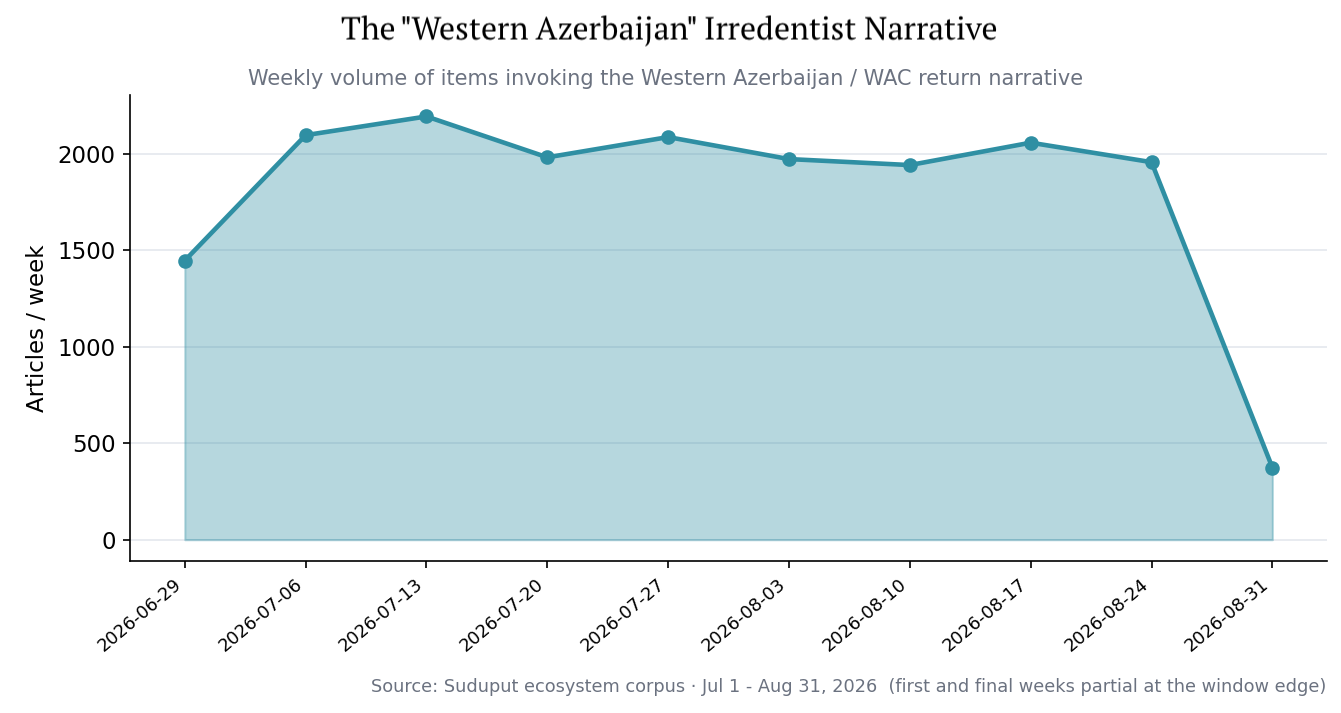
In a previous study conducted for EVN Report, this author produced findings on the activities of the Western Azerbaijani community (WAC) demonstrating that at the cumulative level within the eight months after the August 8, 2025 Washington Accords, the activities of the WAC increased five-fold. Subsequent trend analysis, only within the domain of printed content, showed an average of 500 articles per week produced within the Azerbaijani ecosystem that either advanced the narratives of the WAC or made irredentist claims against Armenia. In our recent study, as displayed in the graph below, the WAC-adjacent content and irredentist narratives increased from an average of 500 articles per week to an average of nearly 2,000 articles per week leading up to Hikmet Hajiyev’s orchestrated event, demonstrating a systemic build-up and intensification of hybrid activity.
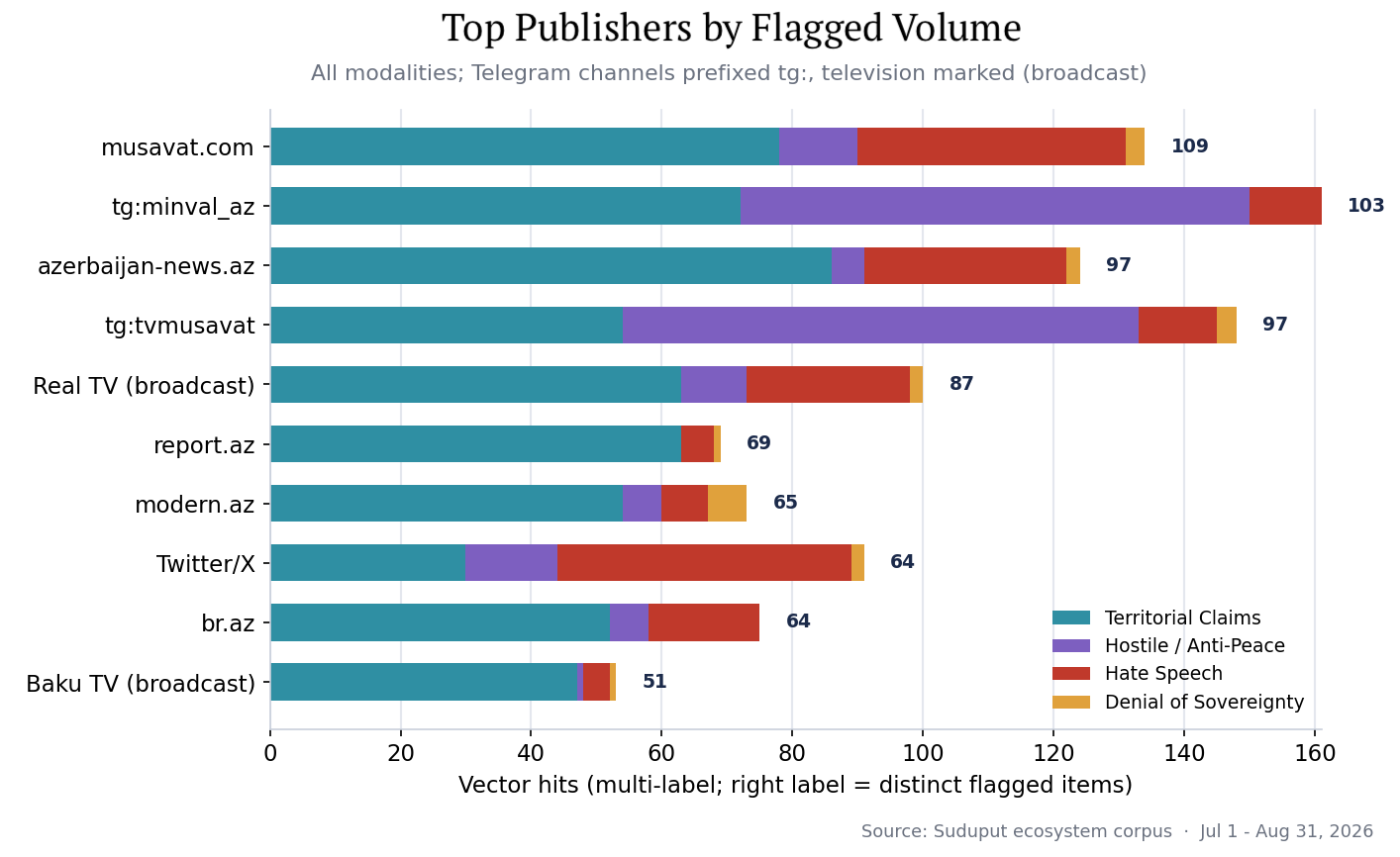
Similarly, when observing media output by the top ten outlets in the Azerbaijani ecosystem, the dominant topic remains territorial claims against Armenia, part of the government’s structured narrative model that aligns and corroborates WAC narratives. In the two-month period leading up to Hajiyev’s diplomatic tour, over 800 programs were produced by these outlets that are flagged in our dataset as meeting the criteria of anti-Armenian messaging. In its totality, when triangulating the data at hand, along with our deep pattern analysis of Baku’s political behavior and hybrid operational schematics, the picture becomes empirically indisputable. The diplomatic tour of Nagorno-Karabakh was not a one-off initiative or just another organized visit, like numerous others, organized by the government. Rather, it was a well-planned provocation campaign designed to produce a diplomatic fallout.
Which brings us to our initial question: why do this at the level of Hajiyev, why now, and why keep doubling-down on an issue that all serious actors view as nonsensical? Two causal factors account for Baku’s strategic thinking and their objectives.
The Caucasus Albanian revisionism espoused by Baku is collectively rejected by all serious international scholars, as there is a consensus that the “Albanian” theory is a Soviet-era conspiracy theory that the Aliyev regime revived for identity-construction purposes. But at its core, Aliyev is not stupid, he knows the theory is absurd and has no merit. It is, however, the only instrument he has, as weak as it is, in attempting to disrupt the immense political capital Armenia has accrued through its “Christianity” narrative. Aliyev does not care about Europe or Brussels, as his endless vitriols demonstrate. What he does care about, however, is the United States and the preponderance of narratives that shape thinking in Washington. Within this domain, Aliyev feels that he is not only losing the narrative, but that Armenian interests have been able to organize a broad coalition of Christian groups and advocates whose sympathy toward the plight of Christian Armenians is reproducing access to President Trump and his inner circle. The overwhelming pro-Armenianness of the Christian coalition in D.C., and the level of influence that this coalition has on the White House, is a new form of strategic depth that Armenia never had, but is now able to formulate.
Azerbaijan, on the other hand, having consistently surpassed Armenia in almost all domains of strategic depth, finds itself at a critical disadvantage. To mitigate this disadvantage, Aliyev is attempting to take the “Christianity” card away from Armenia and neutralize the reigning narrative in D.C. Namely, that Azerbaijan did not destroy Armenian Christian heritage, since there is no such thing, and more so, as the heirs of the Caucasian Albanian Christian heritage, they are, in fact, the ones preserving and protecting Christian heritage. By de-Armenianizing the Christian heritage in Nagorno-Karabakh, Baku is attempting to establish for itself a tenable argument which it can then use to appease the powerful Christian coalition in D.C. In this context, Baku’s strategic thinking is not simply about enraging Armenians or humiliating Yerevan, but rather, attempting to foundationally construct a counter-narrative in D.C. to disrupt Armenia’s newly-formed strategic depth.
The second causal factor in accounting for Baku’s behavior is the notion of “peace capital.” Azerbaijan remains exceedingly concerned that Armenia enjoys significant advantage on this matter, since everyone in Washington and beyond unequivocally accept the fact that Armenia is the more credible peace-seeking actor. Thus, Armenia has much more diplomatic capital on the issue of peace than Azerbaijan, and within the corridors of power in Washington, this gives Yerevan a strategic advantage in relation to Baku. Since the entirety of the Trump Administration’s South Caucasus policy is hinged on the Washington Accords, and on the President’s own role in making the process successful, the actor with more “peace capital” becomes the actor with more strategic depth.
Baku has been doing everything in D.C., from hiring numerous lobbying firms, to holding “cultural” events, to even bringing Mathew Bryza, former U.S. ambassador to Azerbaijan, as an operative to advance this argument. But Aliyev’s initiatives have not achieved the same level of recognition as Armenia’s standing as the more credible peace-seeking actor. Thus, Baku needs to manufacture a fallout to mitigate the scope of Armenia’s “peace capital” in Washington. How does one do that? Initiate an altercation, seek escalation, play the victim, and claim the opposing side is not ready for peace. And this is exactly what Hajiyev was seeking to initiate, and when Armenia’s government did not fall into the trap, Baku changed the narrative and tried to frame Armenian society as unready for peace. That Baku’s immediate response was to question Armenian society’s penchant for peace is clearly indicative of what one of the end games was for this entire endeavor that Hajiyev orchestrated.
In conclusion, three observations stand out based on both the body of empirical evidence as well as Azerbaijan’s strategic initiation of escalatory behavior. First, when Baku unnecessarily or inexplicably engages in unconstructive behavior, especially given that Aliyev is a highly rational actor who always prioritizes gains against risk, it indicates that, in their internal thinking, they find themselves at a disadvantage within the given area of concern. Second, competitive advantage in Washington is extremely important for Aliyev, since it offers him a degree of strategic diplomatic depth that he otherwise lacks with other Western partners. And third, Baku is increasingly finding itself in a more inflexible area with respect to the peace process, as it says one thing, but does another, and the aporia between seeking to reap the benefits of the peace process without signing a peace treaty is not a sustainable model. Thus, Aliyev needs more strategic depth in its relations with the United States to conceal his commitment problem. So when he triggers the Albanization option, and he will keep selectively doing so, he’s not just projecting Azerbaijan’s identity crisis. He is in dire political need for a culture war with Armenia to rearticulate the scope of Baku’s strategic depth.

How the Washington Accords Changed the South Caucasus and Made Armenia Safer
One year on, the Washington Accords have achieved something Armenia was unable to secure on its own over the past two decades: peace on the ground. Nerses Kopalyan examines how the Accords have deepened ties with the United States, accelerated Armenia's technological development and enhanced its security environment.
Read more
The Cost of Ruling and the Rise of the Anti-Incumbent Base
Armenia's 2026 parliamentary vote confirmed the incumbent’s victory, but it also revealed the growing effects of the "cost of ruling," an emerging anti-incumbent electorate, and a more sophisticated voting public. Nerses Kopalyan dissects the data behind the country's evolving political landscape.
Read more
How America Became a Pillar of Armenia’s Security
From access to American weapons systems, to implementation of TRIPP, to cooperation on critical minerals, the agreements signed during U.S. Secretary of State Marco Rubio’s visit represents a new stage in U.S.-Armenia relations. Nerses Kopalyan examines their security significance and writes that it was a recognition by Washington that Armenia’s security and stability have become increasingly important components of its regional policy.
Read more