


Listen to the article.
The text of the peace treaty between Armenia and Azerbaijan was agreed upon on March 13. However, despite calls and signals from different international partners, specifically from the White House, President Aliyev continues to refuse signing the agreement. He has openly raised the price of his signature, demanding not only additional concessions from Armenia but also specific actions from Washington and other partners interested in this “peace treaty” and long-term regional stability. While Aliyev is clearly raising the stakes, recent developments reveal a deeply alarming reality: Aliyev appears to have no genuine intention of signing the treaty.
His strategy suggests that he gains most from extending the process and introducing new demands. Several key indicators suggest Aliyev is not committed to finalizing a peace deal, recognizing Armenia’s sovereignty and territorial integrity, or establishing normalized relations and lasting peace between the two nations and the broader region.
Azerbaijan’s Institutionalization of the “Western Azerbaijan” Expansionist Agenda
Baku is deliberately institutionalizing the expansionist concept of “Western Azerbaijan,” a narrative that Ilham Aliyev began promoting in December 2022—just two months after the Armenian Prime Minister recognized Nagorno-Karabakh as part of Azerbaijan. At the time, Aliyev declared, “Armenia was never present in this region before. Present-day Armenia is our land.”
An examination of Azerbaijani textbooks and educational curricula, revised after the 2020 war against Nagorno-Karabakh, reveals Azerbaijan’s entrenchment of an expansionist narrative, claiming the Republic of Armenia is historically “Western Azerbaijan.” This once-fringe propaganda has gained momentum, particularly following the expulsion of more than 100,000 Armenians from Nagorno-Karabakh. Now actively taught in schools, Azerbaijani history textbooks portray Armenian territories as historically Azerbaijani, attempting to erase Armenia’s history and its rich Christian heritage. Children’s literature and fairy tales, such as “Irevan for Children”, depict cities like Yerevan as ancient Azerbaijani homelands, embedding this revisionist ideology from an early age.
This campaign extends beyond the classroom to higher education and state institutions. In 2023, Baku State University established a “Center for Western Azerbaijan Studies” to legitimize this narrative. Politically, this strategy serves multiple purposes: it provides a pretext to stall peace negotiations under the guise of “peaceful return” initiatives, fosters national unity amid potential leadership changes, and subtly lays the groundwork for broader territorial ambitions.
The institutionalization of this expansionist myth signals that without proactive resistance from Armenia and the international community—through diplomatic, legal and educational means—these expansionist claims could become normalized and pose serious threats to Armenia’s sovereignty.
Criminalizing Peace: Reconciliation Framed as Treason in Azerbaijan
Recently, Bahruz Samadov, a prominent peace advocate, was sentenced to 15 years in prison on charges of treason and alleged ties with Armenians. “Aliyev has openly admitted why Bahruz is being punished: because he ‘mingled’ with Armenians. Because he refused to hate. Because he dared to love peace in a country where peace has become a crime,” wrote Azerbaijani historian Altay Goyushov on his X page. Goyushov, a vocal critic of President Aliyev, currently lives abroad.
After the verdict, Samadov gave an interview to journalist Ulviyya Ali, who was arrested in the “Meydan TV case” and is currently held at the medical facility of the Baku Pretrial Detention Center. During the interview, Samadov called his harsh sentence contradictory to the ongoing peace talks: “From the beginning, I said this charge contradicts the state’s own interests. Charging an academic with treason and subjecting him to torture damages the country’s reputation and undermines the so-called peace agenda.”
When addressing accusations of being “pro-Armenian,” Samadov clarified that his writings actually focused on the traumas of Azerbaijani society caused by war. “To those accusing me of being ‘pro-Armenian,’ I suggest they actually read my articles. I’ve written openly about the traumas suffered by the Azerbaijani people,” he said.
Samadov expressed hopes of surviving prison but said he would never forget the trauma or the punishment he received for advocating peace: “I hope I’ll get out alive, but I’ll never forget the trauma, the way the state treated me like a terrorist, or that I was punished for my peaceful stance.”
Bahruz is not the only alleged Armenian “spy.” Research published by Cambridge University Press this April confirmed that anti-war narratives—those that contested the war and rejected hatred toward Armenians—came from only a minority of individuals and political activists. These anti-war voices faced severe societal backlash, often being stigmatized as “traitors to the homeland,” “Armenian-lovers,” or simply “Armenians.”
This deliberate silencing of dissent and suppression of peace discourse carries serious implications for regional stability. By eliminating space for critical voices, Azerbaijan constrains public imagination and reinforces a rigid nationalist identity built on a dangerous expansionist narrative that resists diplomatic engagement. This environment severely undermines the potential for meaningful dialogue and sustainable peace.
Azerbaijan’s state policy of suppressing peace efforts and upholding a post-2020 ban on normalizing relations with Armenia further erodes prospects for reconciliation. This reflects Aliyev’s apparent unwillingness to foster a peaceful environment. While some observers may have once considered this stance “understandable before 2020,” it has become increasingly difficult to justify its continuation after the war in Artsakh and the forced displacement of Nagorno-Karabakh Armenians—particularly given the lack of serious political or legal consequences for Aliyev.
Staged Trials Weaponized to Vilify Armenians
Azerbaijan’s ongoing sham trials against Armenians serve to dehumanize and vilify them. Aliyev has repeatedly referred to Armenians with dehumanizing terms such as “rabbits,” “bloodthirsty enemies,” and “vandals”––rhetoric that fuels hatred and reinforces a hostile image. These trials serve a broader purpose: they help Aliyev rewrite history by portraying Armenia as the aggressor while diverting attention from Azerbaijan’s documented abuses, including the forced displacement of Armenians and systematic destruction of Armenian cultural heritage in the region.
Until recently, the death penalty remained a possibility for these defendants. Khayal Bashirov, head of the Center for Political and Legal Studies, acknowledged this potential outcome. He described the legal proceedings against those accused of committing the offense of “grave crimes against the people and state of Azerbaijan” as the “Baku Process,” noting that defendants face charges under more than 20 articles of the Criminal Code, many carrying potential life sentences: “…since 1998, the death penalty has been removed from Azerbaijan’s Criminal Code as the most severe form of punishment. However, it is still not entirely excluded under the Constitution of the Republic of Azerbaijan. This means that, in the future, the death penalty could potentially be reinstated in the Criminal Code.”
A further indication emerged on June 24 at the inauguration ceremony of the “November 8” Power Plant in Mingachevir. During this event, Aliyev once again attacked Armenia in his speech, labelling it a “war criminal state.” This accusation merits scrutiny: if Azerbaijan possessed compelling evidence of anti-Azerbaijani propaganda by Armenian state leaders or proof supporting its “war criminal state” claim, it would not be pressing Armenia to withdraw all cases from international courts.
Both countries have filed parallel cases at the International Court of Justice (ICJ), each alleging violations of the International Convention on the Elimination of All Forms of Racial Discrimination (CERD) related to the Nagorno-Karabakh conflict. Armenia accuses Azerbaijan of ethnic cleansing of Armenians, while Azerbaijan accuses Armenia of committing similar acts against Azerbaijanis—both cases remain under ICJ review.
The ICJ offers Azerbaijan an ideal venue to present its narrative to the world, yet it shows no interest in doing so. The blatant hatred and predetermined verdicts against Armenians held hostage in Baku expose Azerbaijan’s lack of genuine commitment to peace. These trials serve not as instruments of justice but as tools to incite hatred and aggression within Azerbaijani society. At the same time, they deepen anger and skepticism among Armenians, eroding trust in their government’s peace initiatives—particularly in the aftermath of the forced displacement and ethnic cleansing of Artsakh’s Armenian population.
Azerbaijan Escalates Threats After Finalization of Peace Treaty Text
On March 13, the Armenian Ministry of Foreign Affairs announced that the draft “Agreement on Peace and Establishment of Interstate Relations between the Republic of Armenia and the Republic of Azerbaijan” had been finalized with negotiations concluded. The ministry said the peace agreement was ready for signing after Armenia accepted Azerbaijan’s proposals on the two remaining articles. These articles reportedly included Baku’s demands to withdraw international lawsuits and prohibit third-party monitors or troops along the Armenian-Azerbaijani border.
Following the agreement’s finalization, Azerbaijan intensified its disinformation campaign. While this campaign was active before the March 13 announcement—mostly through media outlets affiliated with the Azerbaijani government—it gained momentum when Azerbaijan’s Ministry of Defense (MoD) became directly involved. The MoD has since issued numerous false and baseless press releases alleging that Armenian forces have been firing across the border from various locations.
Between March 16 and the end of April 2025, Azerbaijan’s Ministry of Defense released 26 reports—16 [1] in March and 10 in April.[2] Previously, only three such statements had been issued in 2025 — twice on January 6 [3] and once on March 5. All these releases are available on Azerbaijan’s Ministry of Defense website.
The Armenian Ministry of Defense refuted all these press releases, stating they did not reflect reality. The Armenian MoD, in line with the Prime Minister’s Office, has repeatedly offered to investigate any evidence of Azerbaijani claims. Azerbaijan has not responded to these offers. Meanwhile, the Armenian side issued two statements—on March 31 and April 20—with photographic evidence of Azerbaijani forces firing at residential buildings in Armenia’s Syunik region.
Intimidation tactics and threats became widespread, especially after the agreement on the peace treaty text and Armenia’s official stance to sign it as soon as possible. However, when the Armenian Prime Minister and officials reduced their statements about signing the agreement, Azerbaijan’s campaign abruptly stopped. In May, they issued only two such statements,[4] and since June, they have been completely silent on the matter. This pattern suggests that Azerbaijan does not want public pressure regarding the signature—even though Armenian has met all of their demands and agreed to the final text.
Azerbaijani Forces Hold Major Drills After Peace Text Finalized
According to official reports from the Azerbaijani Ministry of Defense, Azerbaijan conducted over 30 joint and individual military drills and exercises from January to June 2025—primarily with Turkey, Pakistan, Iran, Serbia and Kazakhstan. In January and February alone, Azerbaijan participated in two joint [5] and four individual [6] military exercises.
After the “peace treaty” text was agreed upon, 26 joint and individual military exercises were conducted during March, April, May, and June, either involving Azerbaijan or taking place on its territory.
Between March and May, Azerbaijan participated in six international [7] joint military exercises and training events, including a joint exercise with Iran.
During this same period, the Azerbaijani Armed Forces conducted 14 [8] individual (domestic) military exercises, including tactical exercises, reservist training, and live-fire drills.
In June, Azerbaijan conducted three joint[9] and three individual[10] military exercises.
From January to June—just half a year—Azerbaijan conducted a total of 30 joint and solo military exercises. This clearly demonstrates the country’s significant emphasis on military power. It’s particularly noteworthy that after the treaty text was agreed upon in mid-March, military drills increased rather than decreased. This pattern suggests that the policy of using force—or threatening to use force—remains firmly in place, raising serious questions about President Aliyev’s commitment to peace.
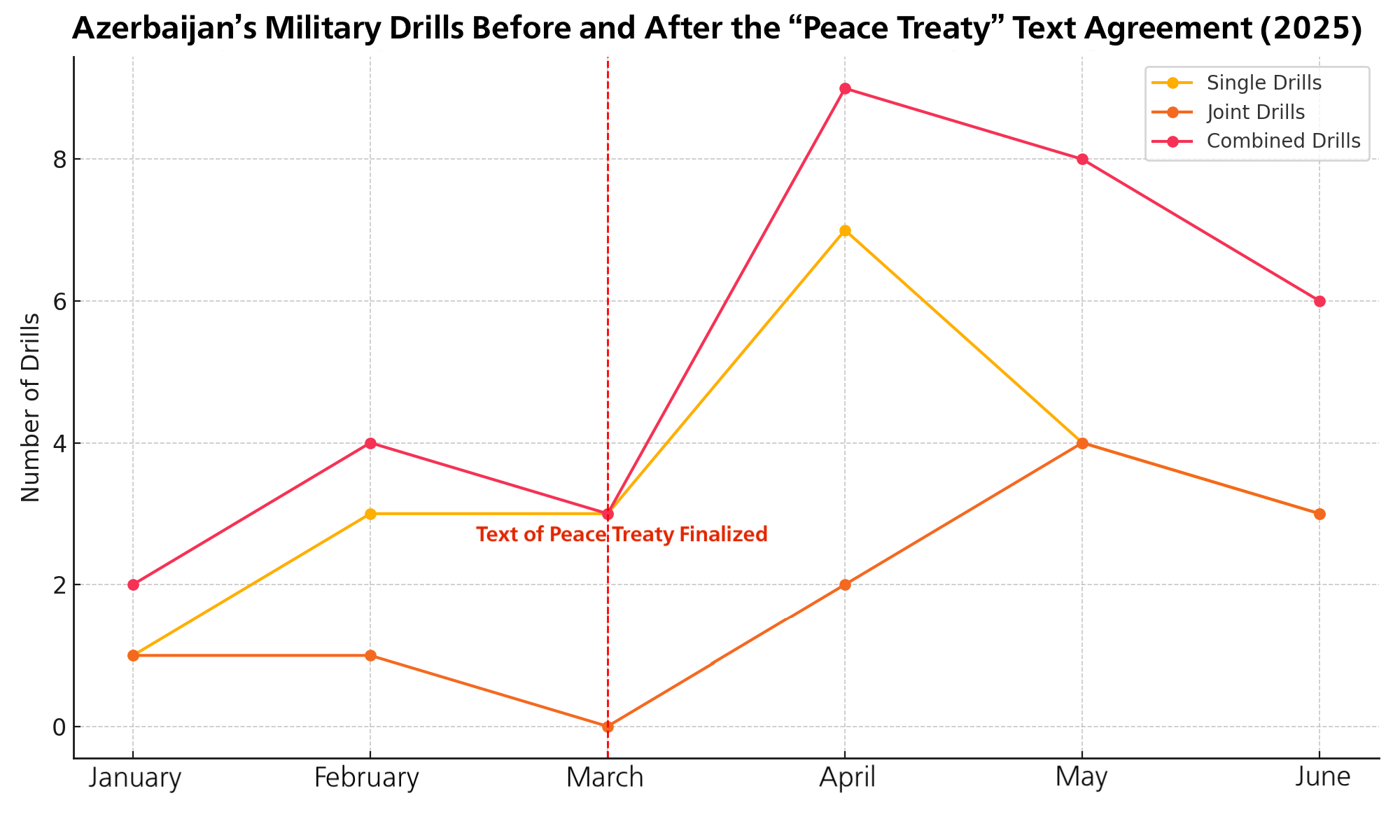
Visual Overview of Drills January-June 2025
Two Years of Weapons Deals Reveal Baku’s Military Ambitions
Azerbaijan’s military budget continues to grow steadily, contradicting its purported “peace agenda.” Let’s examine the figures.
In 2020, Azerbaijan’s defense expenditures amounted to $2.2 billion. Following the Artsakh War, $2.7 billion in 2021 and $2.8 billion in 2022. This trend continued in 2023, reaching $3.3 billion, and climbed further to $3.7 billion in 2024.
In December 2024, during an interview with Russia’s RIA Novosti, Aliyev announced that in 2025, “the military budget will reach a record high, around 5 billion dollars. This is a necessity. We would not need to allocate at least 60% of this amount if there were no such threats.” This unprecedented increase raises questions about Azerbaijan’s commitment to the peace negotiations it claims to be pursuing.
In February 2024, Azerbaijan made one of its most significant military purchases when it signed a $1.6 billion contract with Pakistan for JF-17 Block III fighter jets. This agreement was later expanded in June 2025—after the peace treaty text was finalized—to a $4.6 billion deal for 40 aircraft, including training and armaments. Analysts note that this deal will undoubtedly raise alarm bells in Yerevan.
This serves as another indicator of Azerbaijan’s questionable intentions toward peace. The irony lies in the fact that while Azerbaijan’s military budget continues to grow, its leadership—particularly President Ilham Aliyev—portrays Armenia’s defense reforms as an “arms race,” a “regional threat,” and a “dangerous path.” The reality is quite the contrary.
Summary
Despite the finalized text of a peace treaty between Armenia and Azerbaijan, Azerbaijani President Aliyev has refused to sign the agreement. Instead, he has escalated his demands and is leveraging the process to extract further concessions from both Armenia and the United States, which has expressed interest in securing long-term regional peace. Azerbaijan’s actions—including the institutionalization of the expansionist “Western Azerbaijan” narrative, suppression of peace discourse, sham trials targeting Armenians, a coordinated campaign of threats and disinformation, and intensified military activity—suggest a strategic intent to avoid genuine reconciliation. Taken together, these developments reveal a troubling pattern: Aliyev appears more focused on prolonging regional tensions and pursuing territorial ambitions than on recognizing Armenia’s sovereignty or fostering lasting peace.
Unfortunately, this game is working in Aliyev’s favor, largely thanks to the cards handed to him by Prime Minister Pashinyan. Driven by a desperate desire to secure a signed agreement ahead of the 2026 parliamentary elections, Pashinyan has made fateful mistakes—consistently relinquishing key negotiating cards held by the Armenian state, including a disregard for the right of return for the Armenians of Nagorno-Karabakh.
Pashinyan’s repeated shifts in position since 2021, particularly with regard to Nagorno-Karabakh, have signaled to Aliyev that “toasts get sweeter” the longer the process is drawn out—in other words, that delaying negotiations results in increasingly favorable terms. That’s why Aliyev is more interested in sustaining the process than in reaching a concrete outcome. This approach is further enabled by the dangerous policies of various regional and international actors who are eager to appease him.
Aliyev’s insatiable political appetite remains underestimated—both in Yerevan and in other capitals. This is precisely why he rejects even highly beneficial proposals: he’s convinced he can get more. Over the past five years, this belief has only been reinforced. Unless he is convinced that further gains are no longer possible, there is little chance he will reconsider his current strategy—and at this point, he has no reason to believe otherwise.
Footnotes:
[1]16.03.2025, 16.03.2025, 16.03.2025, 17.03.2025, 17.03.2025, 18.03.2025, 18.03.2025, 18.03.2025, 19.03.2025, 19.03.2025, 20.03.202520.03.2025, 21.03.2025, 30.03.2025, 31.03.2025 , 31.03.2025
[2] 01.04.2025, 02.04.2025, 07.04.2025, 9.04.2025, 9.04.2025, 10.04.2025, 11.04.2025, 12.04.2025, 19.04.2025,28.04.2025
[3] 6.01.2025, 6.01.2025
[4] 10.05.2025, 14.05.2025
[5] 31.01.2025, 11.02.2025
[6] 25.01.2025, 10.02.2025, 20.02.2025, 28.02.2025
[7] 24.04.2025, 30.04.2025, 2.05.2025, 9.05.2025, 20.05.2025, 20.05.2025
[8] 18.03.2025, 12.03.2025, 6.03.2025, 8.04.2025, 9.04.2025, 12.04.2025, 28.04.2025, 28.04.2025, 29.04.2025, 29.04.2025, 1.05.2025, 5.05.2025, 16.05.2025, 29.05.2025
[9] 4.06.2025, 10.06.2025, 14.06.2025
[10] 2.06.2025, 3.06.2025, 11.06.2025
EVN Security Report
Armenia, the 12-Day War and Strategic Ambiguity
Armenia faces a strategic dilemma after the 12-Day War, when Israel and the United States tried to dismantle Iran’s nuclear program through force. With key bilateral partnerships on both sides, Yerevan needs to utilize the policy of strategic ambiguity to navigate an increasingly complex and high-risk regional landscape.
Read more
The Quartet and Securitized Minilateralism: France, India, Poland and Armenia’s New Security Paradigm
What mutually beneficial foundations could bring France, India, Poland and Armenia together in a security alliance, and what might such a quartet mean for Armenia’s security architecture? To explore this, Nerses Kopalyan introduces the concept of securitized minilateralism.
Read more
Subversion and Electoral Interference: Russia and Armenia’s 2026 Elections
Drawing from Moldova’s recent experience, Armenia must brace for a coordinated and covert Kremlin strategy aimed at electoral interference and destabilizing its democracy ahead of the 2026 parliamentary elections. Nerses Kopalyan explains Russia’s evolving hybrid warfare tactics and “traceless manipulation” operations.
Read more
Aliyev’s Performative Gamble: The Draft Agreement on Peace
Aliyev’s unilateral declaration of a draft peace agreement was a calculated gamble to capture U.S. attention rather than a genuine step toward peace with Armenia. This strategy backfired, exposing Azerbaijan’s bad faith engagement, with Washington preferring the narrative of its strategic partner Armenia.
Read morePolitics

Russia’s Election Interference Playbook
As Armenia prepares for parliamentary elections in 2026, early signs show intensified Russian interest and possible interference. What can Yerevan learn from the experiences of Moldova and Romania? Sandra Sadek explains.
Read more
Conditioning Peace on Constitutional Change: Impact on Armenia’s Sovereignty and Identity
Azerbaijan’s demand that Armenia amend its Constitution as a condition for peace raises serious concerns over sovereignty, governance, and national identity. Sossi Tatikyan explores the strategic, legal, and symbolic implications of constitutional change under external pressure and asymmetric diplomacy.
Read more
Armenia’s Perpetual Search for a Fitting Constitution
In this in-depth piece, Hovhannes Nazaretyan chronicles Armenia’s constitutional history since independence, outlining the country’s three constitutional referendums to date and detailing the current process of drafting a new Constitution.
Read more
India-Pakistan Escalation, Nuclear Deterrence and Armenia’s Defense Outlook
The India–Pakistan escalation underscores the power and limits of nuclear deterrence, reveals shifting regional alliances involving Turkey, Azerbaijan, and Pakistan, and highlights implications for Armenia’s security posture, including the role of Indian weapons systems in its evolving defense strategy.
Read more
Deterrence and Coercion: Armenia and Azerbaijan’s Diverging Defense Postures
As Armenia focuses on defense reforms aimed at deterrence, Azerbaijan intensifies its military build-up and superiority despite ongoing peace talks. Sossi Tatikyan analyzes diverging strategies, spending and alliances, highlighting how the military imbalance threatens regional stability and undermines prospects for lasting peace.
Read more
New Frontiers: Armenia Looks to Central Asia
As Armenia reorients its foreign policy away from Russia, it is deepening ties not only with the West, but also with non-Western partners. Hovhannes Nazaretyan explores Armenia’s evolving engagement with Central Asian states as part of that strategy.
Read more