


Listen to the article.
Inside a modest building just off Arshakunyants Avenue in Yerevan, the Media Initiatives Center office, home to the media.am newsroom, doesn’t look like the front line of a digital battleground. There’s a recording studio, a small library, and a handful of desks where journalists quietly sift through a flood of headlines, fact-checking posts in Armenian, English, and increasingly, Russian.
At the helm of this effort is Gegham Vardanyan, a physicist-turned-journalist who has led the independent outlet for nearly two decades. These days, he and his team spend more time than usual on Telegram, monitoring channels that spread conspiracies about Armenia’s government, warning of imminent war with Azerbaijan, or casting Russia as the country’s only reliable ally.
Russia’s influence in Armenia is nothing new. For decades, Russian-language media dominated Armenian airwaves, Kremlin talking points circulated largely unchecked, and Moscow’s political presence went unquestioned by many. But as Yerevan distances itself from Russia and inches closer to the West, Moscow’s tone and tactics are beginning to shift. Ahead of Armenia’s 2026 parliamentary elections, evidence is mounting of a more coordinated and aggressive effort to reassert Moscow’s grip on the country. From high-level political appointments to disinformation campaigns, proxy organizations, and digital warfare, the Kremlin appears to be enhancing its playbook—one already deployed in Moldova and Romania—on Armenian ground.
“We have a decline of trust toward almost every institution in Armenia,” Vardanyan says. “Russia tries to downgrade democracy everywhere…in Armenia as well.”
Some Armenian officials are expecting foul play by Russia in their upcoming elections. In early May, the President of the Armenian National Assembly, Alen Simonyan, accused Russia of waging “a hybrid war” against Armenia and that Moscow plans to increase its activity in the country in 2026. Maria Zakharova, spokesperson of the Russian Ministry of Foreign Affairs, called Simonyan’s “aggressive language” a cause for “bewilderment.”
But just one month prior, Sergei Kiriyenko, first deputy chief of staff of the Presidential Administration, was appointed by Russian President Vladimir Putin to “deal with the topic of Armenia.” According to Vedomosti, a Russian-language business daily newspaper, Kiriyenko’s current agenda in Armenia is mostly informational but is expected to ramp up as the 2026 elections near. Kiriyenko is reportedly the same mind behind Russian influence in the elections in Moldova, Abkhazia (a statelet in Georgia recognized only by Russia), and South Ossetia (also a a breakaway region in Georgia backed by Russia).
“Maybe he will be responsible for the interference in the wider (region) including Armenia, which wouldn’t be good news because he’s very cynical and he’s very resourceful,” says Valeriu Pasa, chair of watchdog.md, a think-tank in Moldova tackling Russian disinformation and influence in the country, among other topics.
While Kiriyenko typically operates within the Kremlin’s domestic policy sphere, his oversight of Armenia, Moldova, Abkhazia and South Ossetia points to a growing convergence between Russia’s domestic and foreign political strategies, says Howard Amos, former editor-in-chief of the Moscow Times and freelance journalist who has covered Russia for over a decade.
“In some way, Russia clearly sees (these places) as their backyard,” Amos explains. “That suggests that they don’t see those countries so much as foreign policy. It’s almost domestic policy, which again speaks about Putinism and Russian imperialism, how that’s changed since the war in Ukraine.”
The same month Kiriyenko was appointed, about 100 journalists from around the world, including Armenian journalists from AlphaNews.am, Hayeli.am, and Yerevan.today, gathered in Moscow for a forum hosted by Eurasia, a new Russian-backed nonprofit organization promoting a Eurasian ideology among former Soviet states, especially in countries where there is a growing divergence away from Russia. The Eurasia website lists Moldovan criminal fugitive and oligarch Ilan Shor as a patron, but on paper, Nelli Parutenco, former treasurer of Shor, is listed as the director. Shor is under European and American sanctions and was convicted in his home country for stealing $1 billion from three banks in 2014. Today, Shor lives in Russia and works as a proxy for Moscow’s agenda, laundering money to procure weapons for the Russian army on international markets.
One of the council members of this new organization is Mikael (Mika) Badalyan, an Armenian nationalist, pro-Russian blogger who often appears on Russian media and head of the opposition movement, Azatagrum (“Liberation”). Badalyan played a key role in bringing Armenian journalists to the Eurasia forum in Moscow, Vardanyan says, noting that some of the journalists in attendance later published articles promoting Russia’s interests and initiatives in a favorable light.
A prominent example was comments made by AlphaNews Editor-in-Chief Tigran Kocharyan that Russian initiatives in Armenia should be accompanied by appropriate media coverage. “People in Armenia often receive information that everything is bad in Russia, there are sanctions, the people are starving and nothing is developing there,” he says, according to an article published on his website. “And thanks to such initiatives (like Eurasia), Armenian youth come and see Moscow’s electric buses, enter the metro, supermarkets, go out to Red Square, and understand that Russia has been able to suppress sanctions.”
The leadership of the Eurasia group is also stacked with Russian government officials and pro-Russian proxies. The board of trustees includes Vyacheslav Volodin, chairman of the Russian State Duma, as head of the board; Margarita Simonyan, editor-in-chief of RT (Russian state-owned television); Andrey Kondrashov, director general of TASS (another Russian state-owned news agency); Petr Mikhailovich Fradkov, chairman and CEO of Promsvyazbank (Russian state-owned bank); Shor, among others. The Council of Eurasia also features representatives from various former Soviet satellite states, including Armenia, Moldova, Belarus, Uzbekistan, Kyrgyzstan, Kazakhstan and Tajikistan, implying a large outreach of operations.
While Eurasia is beginning to exert influence in Armenia, the organization has already created a strong track record for itself in Moldova. During the 2024 presidential and EU referendum elections, Eurasia explicitly paid Moldovan voters to vote against joining the EU. Russia spent nearly $220 million to buy votes and rig Moldova’s elections. Moldovan law enforcement later arrested around 130,000 people who were part of a vote-bribing scheme organized by exiled Russian oligarchs. Similar tactics were used in the 2023 Moldovan elections, including deepfakes, hack-and-leak operations, and financing campaigns to buy influence and votes. Authorities in Moldova report that the Kremlin allocated around $55 million toward destabilization efforts in the country in that year. Those efforts were pushed by Russian-backed parties and oligarch-owned media looking to polarize the country.
“The modus operandi of Russians is not ideology, as it was like communism,” Pasa notes. “Even in communism, it wasn’t just ideology. It is money.”
Eurasia presents itself as a foundation with “the declarative role of promoting the Eurasian Union and other propagandistic stamps like that,” Pasa explains. “In reality, it’s a need to manage, to interfere in foreign politics of Russia.” With concentrated efforts and attention in Moldova, their hatched plan was considered “quite successful,” he continues. “Even if they didn’t have the full victory in the referendum and the elections, they obtained more than they expected, and they kept this polarization and division in (the society).”
While some physical involvement is beginning to emerge out of Moscow into former states in Russia’s orbit like Armenia, the attacks have flared up online via the dispersion of Russian propaganda on Telegram channels. An investigation by media.am reveals at least 13 Telegram channels fueling pro-Kremlin stances on Armenian issues, including narratives that cooperation with the West is a danger to Armenia and will lead to its destruction; that Azerbaijan may launch a new war against Armenia and undermine its sovereignty; or that Russia is Armenia’s only savior in case of future aggression from its neighbor to the East.
Many of the posts describe Armenia’s fate if it seeks closer ties to Europe, akin to Ukraine’s current position. Others fuel conspiracies that Prime Minister Nikol Pashinyan’s draw toward the West is a distraction from more pressing internal issues in the country. Local Armenians, although not direct proxies of the Kremlin, often play a role in regurgitating Russian talking points, pushing against a Western narrative.
One of the main bloggers is Eurasia’s Badalyan. He often shares pro-Russian messages and takes on his Telegram channel, including that Pashinyan is implementing “the Turkish project” by suppressing all opposition sympathetic to Russia. He also posts in support of Samvel Karapetyan, a Russian-Armenian billionaire, who is under Ukrainian sanctions for suspected embezzlement of municipal property and for his company’s, Tashir Holding, ties with the Moscow mayor’s office, according to OpenSanctions. Karapetyan was recently arrested in Armenia for allegedly planning a coup.
“Fear and hatred of Samvel Karapetyan,” Badalyan writes in one of his posts. “It is impossible to describe Pashinyan’s attitude towards the respected businessman Samvel Karapetyan in any other way. Wherever images of Karapetyan appear in Armenia, they are almost immediately dismantled.”
While Russia might not directly be manipulating the media, its propaganda machine is in full force and working in Moscow’s benefit, Amos explained.
“It’s not like someone, certainly the Kremlin, is sitting there giving an order to do this,” he says. “It kind of just happened because the machinery’s in place and they’re used to doing it and they kind of know what or they anticipate or they think they know what Putin wants or whatever.”
Digital disinformation was a key tool in Russia’s subversion of Romania’s 2024 presidential elections. During the campaign, Moscow capitalized on platforms like TikTok to propel a pro-Russian and far-right candidate, Călin Georgescu. In mid-September, Georgescu was not registering in opinion polls, with less than 1% of voters indicating support, explained Ioana Avadani, executive director of the Center for Independent Journalism in Bucharest, Romania. Yet, after the first round of voting, Georgescu’s support soared to 23%, raising alarm bells.
“Everybody asked, ‘How was it possible?’” Avadani recalls. “People who understand how social media platforms work said it is not possible without manipulation. You cannot gain 20% organically in three weeks just because people suddenly like you. They assume that there was foul play.”
Following this upset, Romania’s Constitutional Court declared the elections were being manipulated and canceled them. Romania became the first EU and NATO member state to annul a presidential election as a result of evidence of massive external interference in the digital environment, explains Mihai Rotariu, communications expert at the Romanian National Cybersecurity Directorate.
New elections in Romania were held in May 2025. Moscow attempted once more to deploy similar tactics to disrupt the country’s democratic process. Hacking attacks were launched by pro-Russian groups on government websites, and Romanian authorities, with help from the European Union, opened special reporting channels with social media channels to combat illegal and false content from reaching the masses.
“Mainstream media or traditional media is rapidly losing ground to social media and influencers as well as losing the trust of the audience,” Rotariu continues. “Romanians get most of their information these days from social media rather than TV or press. This is why social media platforms such as Meta, TikTok, Discord, or Telegram are weaponized to target youngsters but also marginalized groups.”
Avadani describes the first interference attempt in Romania as a near success, “not because they wanted Mr. Georgescu to be a president, but because they wanted us to lose trust in the electoral process. It was a very visible satisfaction.”
Similar disinformation tactics were reported in Georgia’s latest elections, where the conservative and populist party, Georgian Dream, stoked fears of war with Russia to win reelection last fall.
“You could make a sort of similar case in Armenia, that sort of bad relations with Russia could lead to war with Azerbaijan and people are tired of war, we want peace, etc.,” Amos explains. “It’s playing on what happened in Ukraine, isn’t it? Like you piss off Russia and then you get a war.”
Part of the issue with the rising prominence of social platforms in disseminating news is the lack of media literacy among the public, notes Nadine Gogu, director of the Independent Journalism Center (IJC) in Chisinau, Moldova.
“It is very important nowadays to help people understand how disinformation, manipulation are spread through social media and what a deepfake is, for instance, or how they should read the information, a special news report, when it comes to proper information,” Gogu says.
In preparation for 2026, Armenia’s Central Electoral Commission has been working to improve both its technical infrastructure and capacities to limit external interference in the electoral system. That includes regular training programs and exchanging experiences with representatives of electoral bodies of other countries and international organizations for the entire CEC staff, particularly the Information Technologies Analysis Department of the CEC, to “ensure alignment with the evolving demands of the time.”
“The security environment of the 21st century has significantly changed, largely due to the rapid development of information technologies,” the CEC writes in a statement to EVN Report.
Ahead of national elections, the CEC says it regularly organizes training sessions for stakeholders in the electoral process, including media partners. It also publishes a variety of guides and manuals for members (and candidates for membership) of electoral commissions, media representatives and observer organizations, political parties and their proxies on their rights and responsibilities.
Domestic cybersecurity reforms have also been initiated in recent years as digital threats intensify. In April 2020, the Armenian government, in partnership with USAID, adopted a Digitalization Strategy that emphasizes innovative technologies, e-governance, and cybersecurity integration. However, with the dismantling of USAID by U.S. President Donald Trump, it is unclear whether this initiative will have any impact during the 2026 parliamentary elections.
Armenia also established its first National Center for Information Security and Cryptography State Nonprofit Organization in March 2024 to develop information protection mechanisms and new software solutions. The government also partnered with nongovernmental organizations to create a strategy and action plan to combat disinformation through 2026.
While the government has attempted to curb the spread of disinformation, the efforts are not sufficient or counter-productive, says Artur Papyan, director at the Media Diversity Institute and co-founder of CyberHub-AM. Instead, a lot of the fact-checking work has fallen to Armenia’s civil society. There are several outlets that have taken up the task: Fact Investigation Platform, Hetq, Media Initiatives Center, CivilNet and the platforms Papyan runs, among others.
“We’re a 30-year-old country,” Papyan says. “We’ve grown up. We should take care of our own FIMI (Foreign Information Manipulation and Interference). The government is not doing enough, that’s clear. But it should and it has some resources, so it should allocate that.”
Sitting in his office at the Yerevan Press Club, Papyan experiments with AI for educational purposes. He shows how easy it is to create deepfakes of officials or how he was able to create a video just from a photo. He notes that a simple video where he superposes someone else’s face on top of his own takes him just 15 minutes and that outside actors with more resources could replicate these false videos easier and faster than him.
He also points to a government-backed fact-checking initiative launched during the 2020 war to combat disinformation called infocheck.am. However, the platform quickly turned into its own propaganda and disinformation outlet and was shut down.
“They were trying to do good or something, but they blew it,” Papyan explains.
Unlike its counterparts, like Romania, which also suffered from Russian disinformation, Armenia is neither a member of the EU nor NATO, explains Vardanyan. That means any attempts to combat election disinformation and digital attacks will be more challenging.
“In Europe, it’s easier because the EU (has) the Digital Service Act, which protects its citizens, and based on this Digital Service Act, they can push Meta or others to communicate and to cut, to just fire some suspicious activities and so on,” Vardanyan says. “But in Armenia’s case, it will be harder. This is a new challenge for our country to prepare for elections, to raise resilience and to protect our people from information interference.”
While there are some early signs of Russian interest in Armenia, there is still some uncertainty about the extent to which Moscow will seek to actively influence the 2026 elections. As the war in Ukraine rages on for its third year, much of the Kremlin’s resources and energy are focused on the conflict.
“Since the start of the war, it’s been very noticeable that Russia hasn’t been able to devote as much time and energy and resources to influencing things in the post-Soviet space,” Amos notes. “You see a lot of government regimes in that part of the world finding they have more space to be more independent.”
Another part of the Kremlin’s playbook in Moldova was the large involvement of the church, organized crime networks, voter bribes, rampant disinformation and manipulation, and Russian-backed media and political parties, Pasa explains. In Armenia, this tactic will easily be implemented. After all, money is easy to move in the country and there are many connections between Armenia’s business community and Russia, he continues.
“From my perspective, Armenia is very vulnerable, having very, very strong ties with Russia, dependencies,” Pasa notes. “Including partially in energy and other stuff, but most importantly, people-to-people, business contacts, and so on. So a lot of fortunes, businesses in Armenia depend on Russia, and that is obviously a path they will explore.”
The current upheaval between Pashinyan’s government and the Armenian Apostolic Church, which has been accused by the government of attempting a coup, has raised some alarm bells for organizations trying to combat disinformation.
“Beside this church (coup attempt), we see a Russian-Armenian businessman obviously linked with Russia and backed by Russian Foreign Ministry spokesperson Zakharova, by Russian TV channels,” Vardanyan says. “Of course, it has a connection with the elections. I can’t say there is direct foreign support, but the actions of the opposition and the government—to answer very sharply—are definitely part of this election, definitely, and of course, we are closely watching the information component of all this.”
It remains unclear if there is any outside interference, like from Russia, in this ongoing issue. “It’s quite possible. It’s possible, but we don’t know, that’s the thing. It’s hard to fact-check any version,” Papyan explains.
Adding to this is the large market share of the media landscape still operating in the Russian language, explains Vardanyan. “In terms of information, (Russian channels have) always been broadcast here,” he says, describing Russian as the main language for many Armenians to connect informationally with the rest of the world and thus making them more susceptible to disinformation.
Part of Russia’s success is its ability to use both digital disinformation and pay people to protest and sow discontent simultaneously in an attempt to undermine democratic institutions, Gogu explains.
“It’s kind of going hand in hand, this information manipulation on one side and on the other side, already preparing people,” Gogu says. “It’s all together. It’s very well organized.”
If Russia does get involved in the upcoming elections, it would not be the first time Armenia is cyber-targeted by groups linked to Moscow. Going back as far as 2015, Russian hackers with the group Fancy Bear, believed to be operating in the interest of the Kremlin and famously associated with its alleged interference in the 2016 U.S. presidential elections, targeted journalists based in Moscow, as well as those who cover Russian affairs. Over 200 journalists were targeted by Fancy Bear between mid-2014 and 2017, according to the Associated Press, including EVN Report’s Editor-in-Chief Maria Titizian. The group also targeted several Armenian government and military officials. The Russian Federal Security Service (FSB)-backed Turla has also been deployed in Armenia for cyberattacks.
In September 2024, Russian hackers reportedly hacked into an Armenian government-operated database. Most of the hacking attacks that year were launched by Russian or Russian-affiliated groups. In January 2024, the hacking group Anonymous Russia launched attacks against Armenian government websites, banks, and telecommunications companies in response to the country’s growing ties with the West. There were also cyberattacks in March 2024 by Russia-affiliated Anonymous Sudan on Team Telecom, one of the country’s main telephone providers, and in June 2024 by the People’s Cyber Army of Russia. Kremlin-backed bots have also recently directly attacked Pashinyan through false news reports, The Insider reports.
While Moldova and Romania ended up electing pro-EU presidents, Maia Sandu and Nicușor Dan, respectively, the extent of Russia’s interference in Armenia’s upcoming elections remains to be seen. But early signs point to a troubling and emerging pattern. Tactics similar to the ones used in Moldova and Romania were observed in the recent local Gyumri elections. Avadani compares Russia’s wide-reaching election interference to “a laboratory.”
“They test all kinds of solutions, and if they succeed, it’s okay,” she explains. “If they don’t succeed, at least they learn.”
The extent of Russia’s interference in Armenia will be determined by the stakes presented to voters in summer 2026. In places like Moldova, Romania and Ukraine, the elections were very much painted as existential, a battle between pro-West versus pro-Russian candidates, Amos notes, which Armenia has “more or less avoided.”
“If they think someone could come to power in Armenia, who would take Armenia out of Russia’s orbit and sever economic and political ties, then they’d invest more time and energy in trying to stop that happening,” Amos continues.
For most of Armenia’s civil society, like Vardanyan, Papyan and their teams, the Russia threat is growing and the work to combat disinformation is just beginning.
“We are watching this space and preparing for that, but we’re a small NGO, just like all the others,” Papyan says. “We feel that more needs to be done in this regard and certainly we’re worried about this.”
EVN Security Report
Subversion and Electoral Interference: Russia and Armenia’s 2026 Elections
Drawing from Moldova’s recent experience, Armenia must brace for a coordinated and covert Kremlin strategy aimed at electoral interference and destabilizing its democracy ahead of the 2026 parliamentary elections. Nerses Kopalyan explains Russia’s evolving hybrid warfare tactics and “traceless manipulation” operations.
Read morePodcast
Politics
Conditioning Peace on Constitutional Change: Impact on Armenia’s Sovereignty and Identity
Azerbaijan’s demand that Armenia amend its Constitution as a condition for peace raises serious concerns over sovereignty, governance, and national identity. Sossi Tatikyan explores the strategic, legal, and symbolic implications of constitutional change under external pressure and asymmetric diplomacy.
Read more
Armenia’s Perpetual Search for a Fitting Constitution
In this in-depth piece, Hovhannes Nazaretyan chronicles Armenia’s constitutional history since independence, outlining the country’s three constitutional referendums to date and detailing the current process of drafting a new Constitution.
Read more
India-Pakistan Escalation, Nuclear Deterrence and Armenia’s Defense Outlook
The India–Pakistan escalation underscores the power and limits of nuclear deterrence, reveals shifting regional alliances involving Turkey, Azerbaijan, and Pakistan, and highlights implications for Armenia’s security posture, including the role of Indian weapons systems in its evolving defense strategy.
Read more
Deterrence and Coercion: Armenia and Azerbaijan’s Diverging Defense Postures
As Armenia focuses on defense reforms aimed at deterrence, Azerbaijan intensifies its military build-up and superiority despite ongoing peace talks. Sossi Tatikyan analyzes diverging strategies, spending and alliances, highlighting how the military imbalance threatens regional stability and undermines prospects for lasting peace.
Read more
New Frontiers: Armenia Looks to Central Asia
As Armenia reorients its foreign policy away from Russia, it is deepening ties not only with the West, but also with non-Western partners. Hovhannes Nazaretyan explores Armenia’s evolving engagement with Central Asian states as part of that strategy.
Read more
Fairy Tales, Textbooks and Territorial Claims: Weaving the Myth of “Western Azerbaijan”
Azerbaijan has institutionalized the notion that Armenia is “Western Azerbaijan” through state-sanctioned textbooks, children’s literature, and academic curricula. Intensified since the 2020 war, this narrative reflects expansionist ambitions that extend beyond Nagorno-Karabakh—even as peace talks continue.
Read more
Courting Influence: Azerbaijan’s Lobbying Network in Italy
Azerbaijan’s lobbying efforts in Italy reveal a coordinated network of academics and media figures promoting pro-Baku narratives. Jelena Melikyan explores the ethical concerns, historical distortions, and impact on Italian public discourse, particularly regarding Armenia and Nagorno-Karabakh.
Read more
EU-Armenia Relations at a Crossroads: Between Normative Values and Pragmatism
Armenia's deepening relationship with the European Union faces complex challenges amid regional pressures and security concerns. As Yerevan strategically diversifies from Russian influence, EU engagement has grown, however, its impact remains limited without a credible membership path, a strategy tailored to Armenia’s vulnerabilities and balancing its normative commitments with its geopolitical and energy interests.
Read moreFrom Our Podcasts

Up Close & Personal with Artur Papyan
Artur Papyan, Director of MDI Armenia and Co-founder of CyberHUB-AM, opens up about his childhood in Gyumri, his journey through international study, his lifelong passion for tech and gadgets, and candidly shares his thoughts on Armenia’s evolving media landscape, including his favorite football team, in this episode of Up Close & Personal with EVN Report’s Maria Titizian.
Read more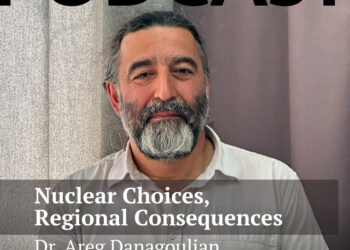
Nuclear Choices, Regional Consequences
MIT nuclear physicist Dr. Areg Danagoulian analyzes Iran's nuclear weapons program following recent Israeli strikes, assessing regional security implications for Armenia. The conversation explores Armenia's nuclear energy future, the need for small reactors to replace aging infrastructure, and challenges in developing nuclear engineering expertise domestically.
Read more

A major reason that Pashinyan is so unpopular and that people distrust him has nothing to do with Russia.
Like Trump, Pashinyan and his party say things that are way, way out of line.
Some examples:
Questioning the Armenian Genocide and questioning the number and names of its victims.
Making a big deal out of Mt. Ararat being outside present-day Armenia, as if Armenians are wrong to see it as a national symbol.
Questioning Armenia’s coat of arms.
Marginalizing the Diaspora.
Throwing temper tantrums.
That’s a partial list.
Pashinyan has made himself and Armenia look silly FOR NO GOOD REASON.
No rational leader does these types of things.
Russia feeds off Pashinyan’s absurdities.