

Listen to the AI generated audio article.
23-year-old Gurgi lives in Akner, a village just a few kilometers away from the city of Goris in southern Armenia. Gurgi was born with cerebral palsy, which affects his movement and speech. After four surgeries, he can now move around with a walker, but he also still uses a wheelchair. Most of his mornings used to begin the same way, booking a taxi and waiting for a ride to his rehabilitation session. He would watch the road as the car would approach and then drive off.
Even though Akner is a mere five minute drive from an outpatient facility run by Santé Arménie in Goris where Gurgi receives care, taxis that can accommodate a person with a disability and the equipment they need are few and far between. “There were times when because there wasn’t a car, I couldn’t go to my appointments,” he says.
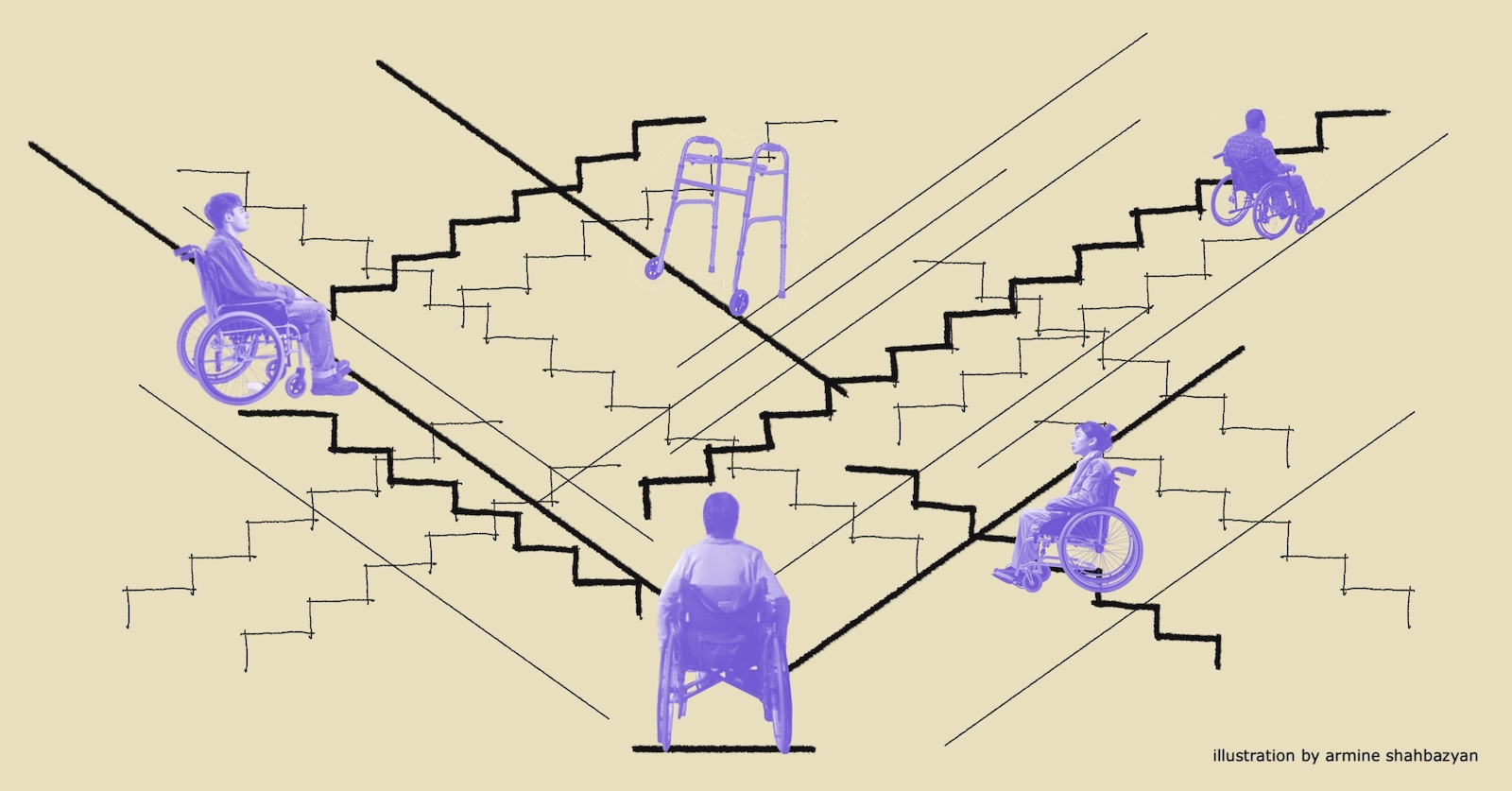
His experience isn’t unusual for people with mobility-related disabilities in Armenia. A lack of dedicated facilities that can support their rehabilitation needs is only part of the problem. Even when these facilities are available, an equally urgent issue is how to get there. And transportation issues not only affect more than just preventing individuals from receiving the care they need, they also confine them from access to ordinary life, such as going to school, or even a simple trip to the grocery store.
Almost 200,000 people in Armenia have a disability according to statistics from 2020, though the real number is likely to be higher and is not necessarily limited to mobility-related disabilities. And while small steps have been taken to improve ways of getting around, much of the public transport network remains inaccessible, and the infrastructure to navigate everyday life, such as ramps, are regularly blocked off or too steep.
Like Gurgi, Kristiné also attends the Santé Arménie Neuro-Orthopedic Rehabilitation Center for Adults in Goris. Living with cerebral palsy, she uses a wheelchair to get around. She used to live in Tegh, 20 kilometers away from Goris on the border of Azerbaijan. When she would order a taxi to go to the center, one would show up and then drive away immediately after seeing her. “No taxi would take me,” she says. Rather than an unwillingness to transport a person with a disability, the problem usually is that many cars are retrofitted to run on gas. This involves installing a cylinder in the boot, the only place a large wheelchair could reasonably fit.
Santé Arménie’s Goris center now has a ‘social taxi’ service, a EU-funded specialized van which can transport people with mobility disabilities to the kinesiotherapy, speech therapy and psychology services at the center. With an electrified ramp at the rear door, the van can accommodate those with larger wheelchairs, who can be strapped into the back of the van and taken to appointments, as well as other locations around town. “I can now go to the store, to the center of the city,” with the vehicle, says Kristiné, who now lives in Goris.
Shushanik Mirumyan, the center’s coordinator, acknowledges that the acquisition of the vehicle is a small step, but one that helps “shape a more humane society.” The van gives patients “a psychological sign that they are included in society,” she adds. The UNDP also recently funded seven vans for use by various disability-focused organizations in Armenia.
Yet these improved modes of transport remain the exception rather than the rule. Even in Yerevan, metro stations are fitted with long escalators but no elevators. Accessible taxis can cost up to 15 times more than standard taxis, according to a UN report. And intercity buses are still mostly run by a network of minivans. However, changes have been made in recent years. All the new buses that operate within Yerevan imported from 2020 to 2024—almost 750 vehicles—have ramps, as do the newly acquired trolleybuses, according to the municipality. Free parking permits for Yerevan are also available for people with mobility disabilities.
Over the past decade, the city has also invested in hundreds of ramps on sidewalks around the city—though these have often been criticized for being too steep, cut off during construction, or accompanied by steps that defeat the purpose of the ramp. Sidewalks are also frequently disrupted by construction, have uneven paving, or are too narrow to navigate. Several electronic ramps acquired by the municipality for public buildings are also non-functional, according to disability activists.
Outside Yerevan, the situation is worse. In Goris, only two stores are accessible with her wheelchair, Kristiné says, everything else is off-limits without assistance. The city’s characteristic cobblestoned streets, which are a drawcard for visitors who venture south, are also an obstacle too rocky for her to navigate. For Gurgi, his college has stairs and he relies on his mother to help him climb them when he attends. For nearly anything outside his home, he needs assistance because of prohibitive infrastructure, he says.
Further north, Tamara Vanoyan describes similar struggles facing people with disabilities in Gyumri. Vanoyan is the coordinator at the Emili Aregak Center in Gyumri, which supports young people with disabilities and their families. She says the families in their community often don’t have the means to transport their disabled child, nor are there services available for them. “In Gyumri, there’s absolutely no adapted transport,” she says. “Not even taxis.”
The center supports around 200 beneficiaries, 50 of whom have mobility issues, and about 20 of those have severe disabilities such that their wheelchairs aren’t readily foldable. Part of their work is involving the children in Gyumri’s cultural life, such as taking them to cafes, public spaces, museums and theaters, Vanoyan says. To get around, they have a vehicle which can accommodate eight people at most, but the car is 15 years old and aging, she says, and is no longer reliable. When it’s not functional, children miss out on their sessions and social activities. “We drive it slowly within the city, longer trips are dangerous because it could break down,” she says. “Now we spend more on it than it helps us.”
Similar to the situation in Syunik, she describes the children’s difficulty in coming by taxi. “Often the taxi arrives, sees the wheelchair and says, ‘I have no space’,” Vanoyan says. “The child is left stranded and confused.” The situation is particularly difficult for children coming from somewhere more remote to Gyumri. “There are no physiotherapy services for children, they need to get to Gyumri,” Vanoyan says. “This is a major problem, there’s no service anywhere.” With more fit-for-purpose vehicles, the children would be able to receive more frequent physiotherapy, and arrive more punctually to sessions, she says.
Still, Vanoyan sees small but meaningful progress, especially in the softening of attitudes towards disability. People are more ready to accept a child with a disability, even in schools, Vanoyan says. For many years, children with any form of disability were hidden, isolated, and not seen among other children. Now disability is becoming more accepted, she says, particularly with the government’s commitment to universally inclusive education this year—meaning schools must ensure accessibility and equal opportunity for each child regardless of their special needs. “Children see other children with disabilities beside them,” Vanoyan says. “They’re very open, very willing to help.”
But such integration has also had teething issues—namely complaints about disruptions to the class, and a lack of resources to support the children. The majority of teachers tell her that children with disabilities need to be separate so they can be cared for better, Vanoyan says. “But I don’t want to blame our country too much because when we compare, we’re not lagging that far behind.”
“For 15 years now, changes have been made at the legislative level in both education and healthcare systems, but there are still many gaps,” Vanoyan says.
“The most obvious gap is that people don’t have access to transportation.”
Also see
How Does One Get Around With a Wheelchair in Armenia?
In this personal story, Mannig Georgelin shares what it’s like to get around Armenia in a wheelchair—the challenges, the kindness of strangers, and why better accessibility matters for building a more welcoming and inclusive society.
Read more
“I Chose to Live”: Surviving Disability in Armenia’s Prisons
While some efforts have been made to improve conditions for inmates with disabilities, accessibility measures in Armenia’s penitentiary institutions remain piecemeal. Most facilities are still ill-equipped to accommodate people with mobility issues, creating daily challenges for those behind bars.
Read more
Choosing Contentment
This is a story about the beautiful complexity and strength of mothers, especially those raising a child with a disability.
Read morePhoto story
But Now I Dance
As the lights dim on the stage of the Opera, it’s not difficult to imagine that 136 pieces of shrapnel and bullets have been removed from the bodies of the boys on stage. As they dance, all one sees is their passion to keep living.
Read more