

Listen to the AI generated audio article.
When Azerbaijan launched the Second Nagorno-Karabakh War in 2020, Armenia had no meaningful drone fleet. It had a handful of reconnaissance aircraft, virtually no loitering munitions, and a military leadership that had dismissed the threat posed by Azerbaijan’s drones, despite the lessons of the April 2016 Four-Day War. Azerbaijan, meanwhile, had spent the previous decade building an entirely different capability. During the six weeks of the 2020 war, Azerbaijan’s drone campaign devastated Armenian armor and personnel, while Armenia had few effective means to defend against or respond to the strikes.
Nearly six years later, Yerevan showcased a very different picture. Thirteen indigenous drones from six private companies were displayed during the May 28 military parade, alongside several foreign acquisitions, and further prototypes were shown at a defense expo days later. Armenia’s domestic drone industry has grown considerably, driven by active private investment and state support. Whether the systems on display meet their stated specifications and can be produced at scale is a question that only battlefield conditions can answer.
How Armenia Fell Behind in the Drone Race
After the May 1994 ceasefire which ended the First Nagorno-Karabakh War and froze the conflict along a line of contact, Baku struggled to procure arms from many traditional suppliers. Israel’s “relaxed attitude about its customer base [was] a perfect match for Azerbaijan” as Western countries were reluctant to sell military hardware. Baku’s first reconnaissance drones purchased from Israel (Aerostar and Orbiter), were debuted at the June 2008 military parade in Baku. By 2011, a joint venture with the Israeli UAV manufacturer Aeronautics opened in Azerbaijan for local assembly of drones.
Armenian plans to build UAVs were first revealed in March 2010, but work had reportedly begun four years earlier at the Khanperyants Military Aviation Institute. When an Israeli recon drone was downed in Nagorno-Karabakh in September 2011, military analyst Artsrun Hovhannisyan noted that it is “absolutely indisputable” that Armenia “urgently needs UAVs, and not just a few” and that the issue “must remain at the center of our attention.” He argued that while Baku is purchasing Israeli drones, Armenia is building its domestic tech from scratch, “which could make us a leader in the sector in a few years.”
The first Armenian reconnaissance drone, Krunk-25 (“Crane”), was unveiled during the military parade in Yerevan on September 21, 2011, although it had reportedly been developed around 2009. During the parade, it was presented as being “by no means inferior to foreign drones in terms of their tactical and technical specifications.” Developed by the Khanperyants Military Aviation Institute for aerial surveillance and photography, it was reported to have flight endurance of 3.5 hours, and an operational range of 70 km. Armenia was said to possess 15 units with five mobile control stations, which were integrated into the automated artillery fire control system. At the time, the Krunk-25 was hailed as evidence of the Armenian military’s modernization, with Deputy Defense Minister Davit Tonoyan expressing confidence that Armenian drones would become “quite competitive in the international market.” By 2013, authorities reported that Krunk drones were being “intensively utilized” by the armed forces.[1]
Another recon drone, X-55, was unveiled in April 2014 and resembled the Russian UAV Ptero-E4 acquired two years earlier and on whose basis it may have been created.[2] The X-55 drone could reportedly fly six hours and had a range of 100 km. Unlike the Krunk, it was catapult launched, while the former required a runway. An upgraded version, called Armi-55M, was presented in August 2017 and deployed by the Armenian army two years later. Azerbaijan claimed to have downed X-55s on several occasions.
These early Armenian UAVs were not advanced systems and had limited capabilities. There were no known kamikaze drones or combat variants (UCAVs) capable of carrying guided munitions.
A Warning (Mostly) Ignored
In the meantime, Azerbaijan rapidly expanded its inventory with surveillance drones and loitering munitions from Israel. The Harop, Israel’s first loitering munition export to Azerbaijan, was supplied around 2015, with one hundred units delivered by 2018. During its assault on Nagorno-Karabakh in April 2016, Azerbaijan made extensive use of these Israeli systems. The first-ever use of the Harop specifically gained much international attention.[3]
Following the 2016 Four-Day War, veterans, analysts and tech leaders unanimously identified Armenia’s lack of drone capabilities as a serious deficiency. The official response was largely dismissive. The Defense Ministry pointed to the downing of 14 Azerbaijani drones during that war as evidence that the Armenian military knew what it was doing. Alik Mirzabekyan, the Deputy Defense Minister tasked with integrating advanced technology into the military, whose council the IT sector had criticized for producing “practically zero results” over four years, was nonetheless dismissed from his post. Defense Minister Seyran Ohanyan, for his part, complained that domestic industry had never presented the military with a “finished” product, a remark that raised deeper questions about the absence of a coherent policy to establish and develop a defense technology sector in the first place.
Armenia’s September 2016 military parade did not introduce any new UAVs, but the domestic industry began to finally make some progress on loitering munitions. Their development was first revealed in September 2017 and several models were showcased at a defense expo in March 2018. Two, tentatively designated as Krunk-9 and Krunk-11, entered service that year, but their deployment has not been confirmed. A kamikaze quadcopter developed by UAV Lab called Bzez (“Beetle”) was introduced in June 2019. It carried a 4.6 kg high-explosive fragmentation warhead to a range of 8 to 9 km.[4]
Drones surfaced again in active combat during the clashes in Tavush in July 2020. Armenia claimed to have hit three Azerbaijani tanks with indigenous loitering munitions, while Baku used the SkyStriker, a light Israeli drone. Armenia showcased some of Azerbaijan’s Israeli drones shot down over the years after the July fighting, while in August that year, Armenia’s Hi-Tech Industry Minister released two videos of indigenous loitering munitions being tested.
Devastation and Reassessment
By the time Azerbaijan launched the 2020 war against Nagorno-Karabakh, it had acquired from Israel at least 36 reconnaissance drones across five different models, as well as 450 loitering munitions spanning three models, according to the Stockholm International Peace Research Institute (SIPRI), which tracks global arms transfers. To address the gap in its reusable strike-drone capability, distinct from expendable loitering munitions that destroy themselves on impact, Azerbaijan also procured the Turkish-made Bayraktar TB2, capable of both reconnaissance and precision strikes. The TB2 became the first non-Israeli UAV in Azerbaijan’s arsenal.
Although described as the world’s first drone war, the conflict was characterized by a marked asymmetry in UAV capabilities. The combined Israeli-Turkish inventory provided Azerbaijan an overwhelming advantage over Armenia, which only had recon drones and loitering munitions highly limited in quantity and capability. An estimated 12 Bayraktars were acquired by Baku only months earlier and were operated by Turkish crews during the war. Armenian forces managed to take down at least two and, possibly, a third one. Strikes by Bayraktars may have been responsible for the majority of Armenian manpower losses.
Armenian drone use was underwhelming.[5] Through the six-week-long war, Armenia’s Defense Ministry released a single video of a strike by an unidentified indigenous loitering munition, possibly the same as the one shown in May 2020, which authorities had said would enter mass production in the coming months.
The 2020 war, ending with significant hardware and manpower losses, shocked the Armenian public, which for years had been told the Armenian military was the “most combat-ready army in the region.” Not only did Armenia have no proper drone fleet, but also no effective countermeasures. In the 2021 book Storm in the Caucasus, analyst Douglas Barrie argued that Armenia watched Baku systematically build up its drone and loitering munition capabilities but “seemingly paid little attention” to the threat. Additionally, on the battlefield, the Armenian military failed to utilize “readily available” passive countermeasures, such as camouflage, concealment, dispersal, and deception, leaving its ground forces heavily exposed. Colonel Zhirayr Amirkhanyan, who is now assistant to the Chief of General Staff, argued in 2022 that while the drone threat was identified as early as 2016, Armenian military leaders believed that “future operations would be positional in nature and fought with an attritional approach.”
Lessons Learned?
Nearly six years later, the May 28 military parade featured a range of domestically produced and foreign-made UAVs already inducted in the Armenian military. The parade also marked the debut of the military’s newly established UAV Forces, a dedicated branch created to oversee drone operations.
Leonid Nersisyan, a defense analyst at APRI Armenia, argues that Armenia’s experience in recent conflicts acted as a powerful motivator as it forced state institutions to become more agile, stripping away layers of bureaucracy to expedite defense procurement and accelerate domestic production, including UAV production. Between 2023 and 2025, the government awarded 171 billion AMD ($450 million) in contracts to domestic defense companies, with a significant share going to drone manufacturers, leading to a dramatic expansion of the indigenous inventory.
The parade showcased a total of 13 indigenous systems by six private domestic companies. By far the largest domestic drone producer is Davaro with six drones developed by the company shown at the parade.[6] Founded in 2007, Davaro started as an electronics retailer and introduced its first UAV in 2016. Two years later, the company had developed 11 systems. It secured its first government R&D contract in 2019 and its loitering munitions were deployed in active military conflict the next year.
In a recent interview, Hi-Tech Industry Minister Mkhitar Hayrapetyan noted that Davaro currently employs 300 people and is the largest player along with Arsenal. In the past eight years, Davaro’s facility has grown from 9 to over 5,600 square meters.
The Drone Fleet Today
Among domestic drones, one that received perhaps the most attention locally and abroad was Dev-K developed by Davaro. It is a jet-powered interceptor drone designed specifically to hit medium-speed aerial targets flying up to 9,000 meters, similar to the Bayraktar TB2.
Three loitering munition models developed by Davaro were showcased at the parade. The lightweight Dev-1.1 is designed for destroying radar installations thus suppressing enemy air defenses as far as 50 kilometers. Much larger and more capable are Davaro’s Dev-3 and Dev-3.1 designed to target ground assets, armored vehicles, and radar installations. They utilize different targeting methods. Dev-3 features a superior 300 kilometer flight distance and a larger 10-kilogram warhead, but relies on a 50 km video data-link for an operator to manually choose targets. Dev-3.1 can fly half the distance and has half the warhead size, but features superior electronic warfare resistance and relies on onboard AI to autonomously identify and select high-priority targets. Both visually resemble the Israeli-made Harop. Davaro had begun development no later than 2019 with the Dev-3.1 undergoing official testing (evaluation) as early as February 2021.
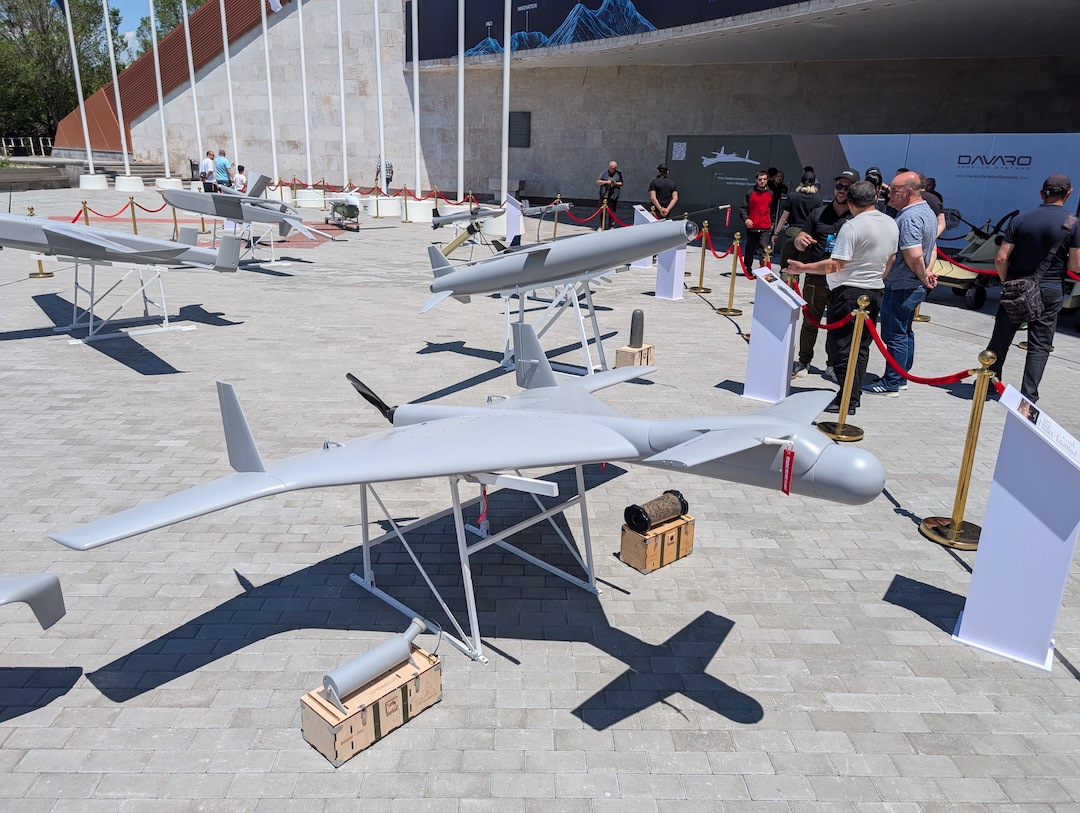
Davaro’s Dev-3.1 (foreground) and Dev-K (background) loitering munitions at the RISE expo.
The Dev-4 is designed for both reconnaissance and strike operations. It has a maximum flight distance of 200 kilometers and can carry a payload of up to 20 warheads weighing a total of 8 kilograms with a strike accuracy of 20 meters. Davaro’s only purely reconnaissance drone, Bib-10, is designed for aerial photography, video surveillance, and artillery fire coordination. It has an operational range of up to 100 kilometers.
Besides Davaro, two loitering munitions developed by the company Aerodynamics were shown. Both are named Meghu (“Bee”). The Meghu-1 has an operational range of 60 kilometers and utilizes a truck-based system for the simultaneous launch of six UAVs, while the Meghu-5 can strike targets up to 40 kilometers away.[7]
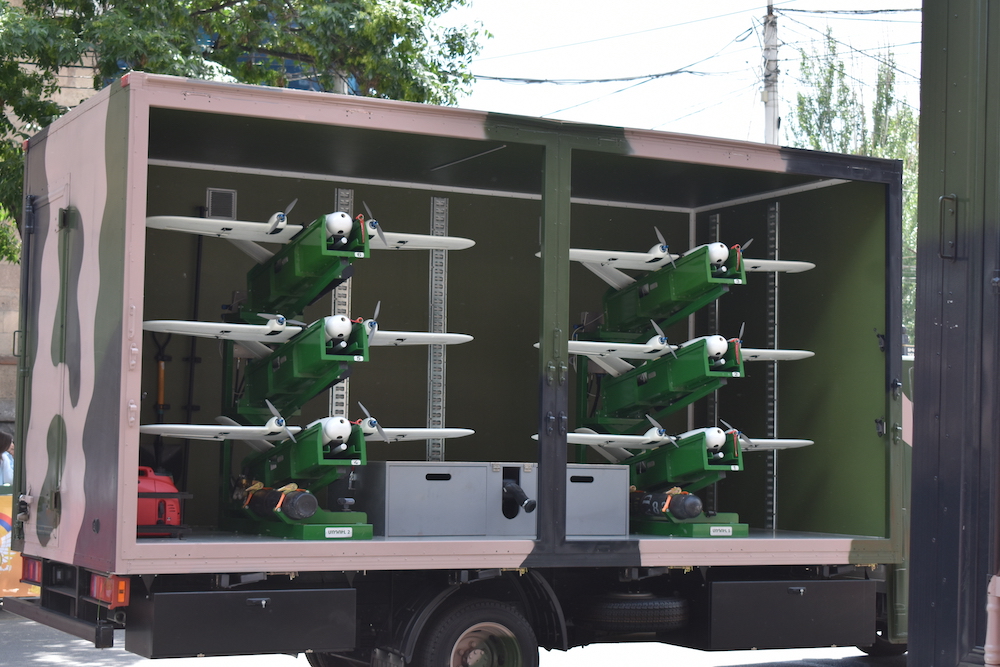
The Meghu-1 at the parade.
The rest of the UAVs at the parade are all designed for surveillance and reconnaissance, differing mainly in endurance, altitude ceiling, and launch method. They share a focus on aerial photography, artillery coordination, and battlefield awareness. Among them, IDS’s Storm-320 is the only one currently deployed in the armed forces with vertical takeoff and landing (VTOL) capabilities. It first appeared during a June 2024 exercise. UAV LAB’s UL-350 and UL-450 were first introduced in 2022 and are based on the Russian Supercam S350 and the Israeli Orbiter-3, respectively.[8] The AW5R, produced by AirWorker, is designed primarily for mapping. Conceived as early as 2019, it has been described by a company engineer as comparable to the Turkish Bayraktar Mini, the Russian Eleron-3, and the American RQ-11 Raven. The last recon drone, SBM-1 was developed by Scarif (Skarif), a little-known company.
The indigenous inventory was not the whole picture. The parade also made Armenia’s foreign drone procurement visible for the first time. All appear to be Chinese, while the American V-BAT drone, revealed earlier, was not shown.
A lightweight loitering munition named Kaytsak (“Lightning”) was announced as capable of striking mobile and stationary targets at a range of up to 17 kilometers. It has been integrated into special forces units and is designed for repelling enemy infiltration attempts.[9] It is most likely the CH-901/FH-901, a tube-launched variant developed by China Aerospace Science and Technology Corporation (CASC) and comparable to the American Switchblade 600.[10]
Twin non-domestic loitering munitions were presented under the names Vorot-1 (“Thunder”-1) and Vorot-2 (“Thunder”-2). Their origin was not revealed, but military watchers identified them as the Chinese anti-radiation (radar hunting) FL-300A kamikaze drone. The first was shown on top of a pickup truck, while the second in a six-box configuration inside a truck-mounted container. Despite the different designations, both appeared to show the FL-300A, which has a reported operational range of 280-300 kilometers.
Vorot-1 was described as capable of reaching speeds of up to 220 km/h, which, together with its distinctive bulbous nose housing the radar seeker, suggests it is the FL-300A (designated ASN-301 for export). A significant discrepancy emerged, however, with Vorot-2. Although it appeared visually identical to the FL-300A, the official parade commentary described it as a long-range loitering munition capable of remaining airborne for six hours. Those specifications do not match the anti-radiation FL-300A. Instead, they more closely correspond to another member of Norinco’s Feilong family: the FL-300D, a low-cost, long-range loitering munition with a claimed range of 1,000 km. Whether Armenia has actually inducted this system remains unclear, however, as the hardware displayed did not resemble the FL-300D.
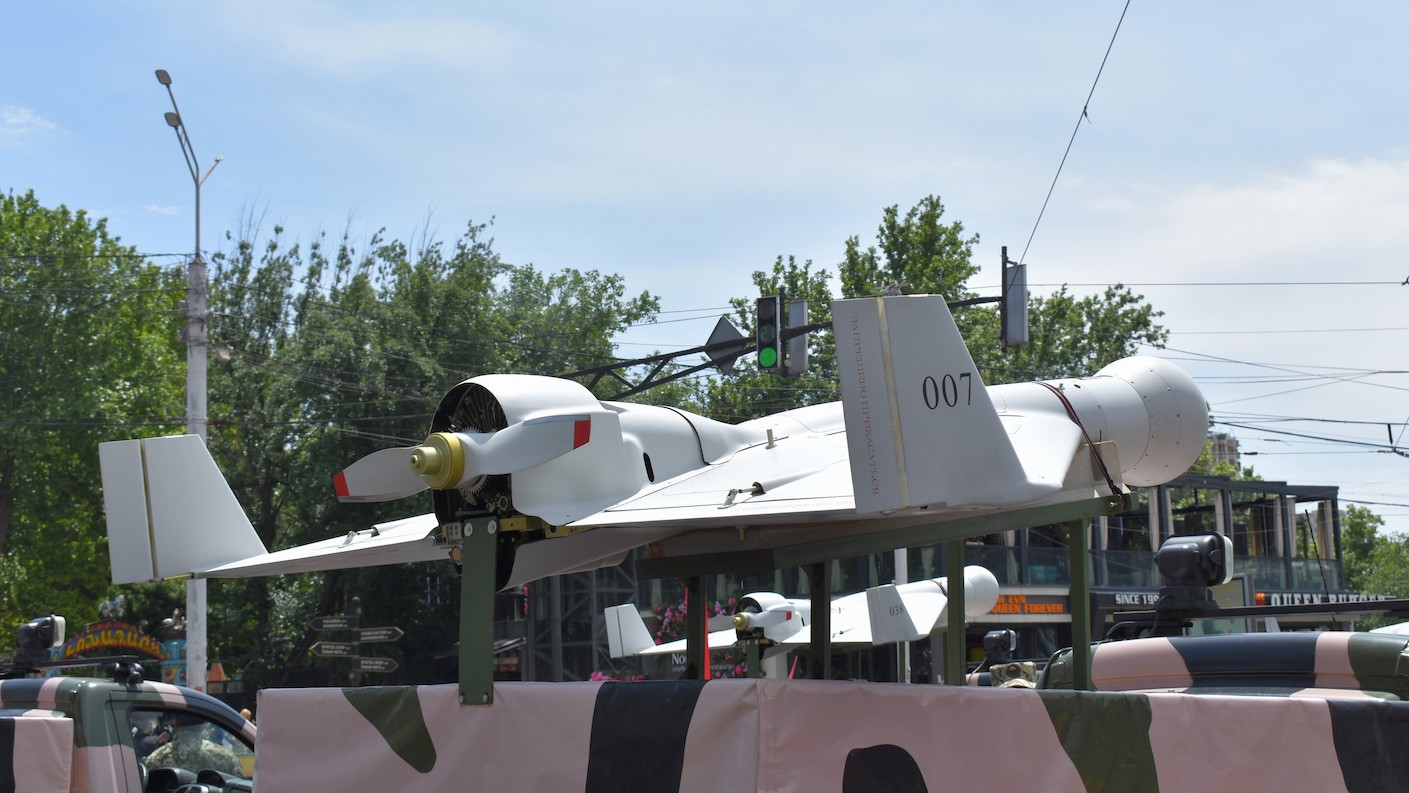
The Chinese anti-radar FL-300A loitering munition, designated as Vorot-1, at the parade.
The largest UAV to be showcased at the parade was the Chinese CH-4B with its 18 meter wingspan. Three units were parked at Republic Square before the parade. Appearing more like a small aircraft, it has been designated by the Armenian military as Aghegh (“Bow”). Representing a completely new tier of capability as the only medium-altitude long-endurance (MALE) system in Armenia’s inventory, it stands alone in its class. The drones were seen carrying AR-1 and AR-2 guided air-to-ground missiles designed for armored vehicles and fortifications and for unarmored vehicles and personnel, respectively.
During U.S. Vice President JD Vance’s visit to Armenia in February 2026, Pashinyan revealed that Armenia had purchased V-BAT drones from the United States. Vance called it the first-ever major American sale of military technology to Armenia and put the deal’s value at $11 million. A single unit was displayed at the Presidential Palace, but no V-BATs appeared at the May 28 parade, and no further details have been reported since the February announcement. Developed by U.S. company Shield AI, the V-BAT is a vertical takeoff and landing (VTOL) reconnaissance drone well suited to Armenia’s mountainous terrain.
Genuine Progress, Open Questions
The parade, which took place just ten days before a pivotal election, was highly politicized. However, the showcasing of Armenia’s new defense equipment was a welcome development. Armenian defense companies have been widely credited with genuine progress.
Former Defense Ministry spokesperson Artsrun Hovhannisyan calls them a “national pride.” Former chair of the Military-Industrial Committee Avetik Kerobyan, critical of state support levels, acknowledges that many firms have succeeded in localizing manufacturing and finding export markets largely on their own. Whether that pride translates to battlefield effectiveness is another question entirely. Eduard Arakelyan of the Regional Center for Democracy and Security identifies what ultimately matters: none of these systems have been tested in combat, which means specifications on paper, however impressive, remain exactly that. Another key question, echoed by the Russian Military Informer channel, concerns industrial scale. Specifically, whether Armenia can establish sustained, cost-effective output that modern drone warfare demands.
Looking Ahead
The RISE expo held days after the parade, offered a glimpse into where the domestic UAV industry may be headed. Industry leader Davaro presented its ever-growing inventory, from micro-loitering munitions to a glide bomb.
UAV Lab introduced UL-650, a long-endurance drone carrying two GBL “fire-and-forget” guided munitions. This represents the second serious indigenous armed drone prototype after Davaro’s Aralez, introduced in 2022.[11] A company representative told EVN Report that the drone weighs 40 kg and can fly for over 9 hours. The GBL munitions were developed by the company Locator and first unveiled last year at a defense expo in Athens. The autonomous precision munitions have reportedly drawn interest from several partner countries.
Two trends observed at the expo can be singled out. First, while little has been revealed publicly about the scale and extent of adoption of cheap first-person view (FPV) drones in the military, available information suggests some efforts are being made.[12] Domestic companies, most notably Feron, displayed a variety of FPV models with warheads at RISE.
The second trend concerns small drone interceptors that have likewise become increasingly visible in the Ukraine war. At least two Armenian firms unveiled their prototypes. Davaro’s RD-1 could be seen at RISE, while Nemesis developed by Yerevan Aerospace Engineering was displayed at the Eurosatory expo in Paris.
Photos by Hovhannes Nazaretyan.
Footnotes:
[1] Azniv (“Noble”), a new variant of the Krunk-25, was shown in April 2014. It was also known as Krunk-25-2. A smaller recon drone, Baze (“Hawk”), was unveiled during a parade in Stepanakert, the capital of Nagorno-Karabakh, in May 2012. It had a claimed maximum range of 30 km and flight duration of one hour.
[2] Although initially given to Armenia’s Ministry of Emergency Situations, the Russian Ptero-E4 drones were later reportedly transferred to the armed forces.
[3] In the most publicized case, a loitering munition killed nine Armenian volunteers travelling in a bus.
[4] A prototype of another kamikaze, Hresh (“Monster”), was unveiled in March 2018. It resembles the X-shape design of the Israeli Hero-30. Carrying a 1.6 kg warhead, it could fly to 20 km. It has been renamed HDS-7 (Hornet-7) and taken over by Davaro. There is no indication it has been inducted into the military so far.
[5] Visual evidence pointed to the downing by Azerbaijan of an X-55 recon drone, a Bzez quadcopter and another, unidentified quadcopter.
[6] Each Davaro system has three known designations. The article uses the names announced at the parade, which are the official Armenian military designations. The alternative names used on the company website as follows: DDS-10K and Draco-10K for Dev-K, DDS-1 and Dragonfly-1 for Dev-1.1, DDS-3 and Dragonfly-3 for Dev-3, DDS-3.1 and Dragonfly-3.1 for Dev-3.1, DDS-4 and Dragonfly-4 for Dev-4. The name “Dev” appears to derive from the Armenian word meaning “monster” or “demon.”
[7] Both models were showcased at the RISE expo days later as Zeel A1 and Zeel A5, respectively, under the brand Zeel AI. The CEO of Zeel AI, whose links to Aerodynamics are unclear, is Paruyr Abrahamyan. As of 2024, Aerodynamics was headed by Hayk Chobanyan, former Minister of High-Tech Industry. Aerodynamics declined to comment on the two companies’ (brand names) relationship, but they appear to operate from the same location.
[8] The latter can also carry a single AGB-003 guided bomb with 2 kg warhead.
[9] Some observers online misidentified it as Davaro’s MDS-1 (Mosquito-1), however, it was not announced as a Davaro or domestic product.
[10] The system also has a 48-tube truck-mounted swarm configuration, but it is unclear whether Armenia possesses the latter.
[11] Davaro’s Aralez combat drone was unveiled at the ArmHighTech-2022 expo and shown carrying four SMA-A5 guided munitions developed by AURS. The drone had stated flight endurance of six hours and range of 600 km, while the munitions featured 7 kg warheads. It could also carry smaller AGB-003 munitions from UAV Lab. The project appears to have been shelved or scrapped.
[12] Defense Ministry video reports show that cadets at the Vazgen Sargsyan Military Academy in Yerevan and the Monte Melkonyan Military College in Dilijan undergo dedicated drone training, including by using simulators for FPV drones. An MoD-linked Telegram channel reported that these are part of a large-scale effort to integrate FPV tech into the armed forces.
Statecraft & Governance

The Cost of Ruling and the Rise of the Anti-Incumbent Base
Armenia's 2026 parliamentary vote confirmed the incumbent’s victory, but it also revealed the growing effects of the "cost of ruling," an emerging anti-incumbent electorate, and a more sophisticated voting public. Nerses Kopalyan dissects the data behind the country's evolving political landscape.
Read more
How America Became a Pillar of Armenia’s Security
From access to American weapons systems, to implementation of TRIPP, to cooperation on critical minerals, the agreements signed during U.S. Secretary of State Marco Rubio’s visit represents a new stage in U.S.-Armenia relations. Nerses Kopalyan examines their security significance and writes that it was a recognition by Washington that Armenia’s security and stability have become increasingly important components of its regional policy.
Read more
Armenia Flexes Its Smart Power
Armenia is seeking to redefine its global role through “smart power". By hosting the European Political Community Summit and a series of major international forums, Yerevan is leveraging diplomacy, connectivity and strategic partnerships to expand its international relevance, resilience and foreign policy autonomy.
Read morePolitics

Armenia’s Next Democratic Challenge: Building a Credible Opposition
Democracies are judged not only by those who govern, but also by the strength of those who challenge them. Reflecting on Armenia’s 2026 parliamentary election, Armine Bagiyan argues that building a credible, constructive opposition is essential to the country’s democratic consolidation.
Read more
Armenia’s New Army: Diversification, Rearmament and the Military Balance
The May 28 military parade in Yerevan was more than a showcase of new weapons. It revealed the contours of Armenia’s emerging “new army”, one built on diversified international partnerships, expanding domestic defense production and a determined effort to adapt to a transformed regional security landscape. In this in-depth analysis, Sossi Tatikyan examines what these changes mean for Armenia’s evolving military balance and regional security.
Read more
The Enclave Issue Between Armenia and Azerbaijan
As Armenia’s parliamentary election campaign intensifies, the issue of Soviet-era enclaves between Armenia and Azerbaijan has re-emerged as a sensitive political and security question. Sossi Tatikyan explores their historical origins, legal status, international parallels and the possible scenarios being discussed within the peace process.
Read more
How Armenia and Azerbaijan Are Lobbying for Influence in D.C.
As Armenia and Azerbaijan compete for influence in Washington, a new lobbying battle is reshaping U.S. engagement in the South Caucasus. From diaspora advocacy to multimillion-dollar lobbying campaigns, both sides are working to influence American policy, peace efforts and regional power dynamics.
Read more
Cognitive Warfare: Toward a Resilience Framework for Armenia
As modern conflict increasingly targets how societies think rather than what they control, Armenia faces growing exposure to cognitive warfare. Sossi Tatikyan explains the concept, maps its risks in Armenia’s post-war context, and outlines a resilience framework to strengthen cognitive security, public trust and democratic stability ahead of the 2026 elections and beyond.
Read more
Prisoners of War and Peace: The Fight for Freedom From Baku
A harrowing account of Armenian prisoners of war held in Azerbaijan, Gibran Caroline Boyce follows one family’s years-long fight for justice. As peace talks advance, it examines human rights abuses, legal battles and the unresolved fate of detainees left behind.
Read more
Armenia’s Mining at the Crossroads of Rare Earths, Geopolitics
Armenia’s mining sector stands at a pivotal moment, as rising global demand for critical minerals draws U.S. and EU interest. Hovhannes Nazaretyan explores its economic weight, untapped potential, geopolitical significance and the environmental and governance challenges shaping its future.
Read moreOpinion

One Battle After Another: What I Think About the Armenian Election
Against the backdrop of Yerevan’s wine festival, Mikayel Zolyan explores the anxieties and hopes of post-election Armenia, the challenge of Russian interference, the responsibilities of citizenship, and what it means to shape the country’s future rather than simply watch it unfold.
Read more
Armenia After the Election: Beyond Old Divides
In the wake of Armenia’s parliamentary elections, K.M. Greg Sarkissian reflects on the deep divisions shaping debate in both the homeland and the diaspora. Rather than questioning one another’s patriotism, he argues, Armenians must find ways to bridge differences and build consensus around the country’s future.
Read more
The Women They Refuse to See
Who does the work that keeps Armenia’s institutions functioning? Ahead of the parliamentary elections, Davit Khachatryan examines the disconnect between the women who sustain public life and the political class that claims to represent it.
Read more
“Orbán, Go Home!” Why Hungarians Were Fed Up
In this sweeping look at Viktor Orbán’s rise and fall, Mikayel Zolyan explores how Hungary’s “illiberal democracy” unraveled, driven by economic decline, political fatigue and how an unlikely challenger, Peter Magyar, capitalized on the moment, with broader implications for Europe, Armenia and beyond.
Read more

Thank you for this well researched and informative article. I would like to point out that only drones without intelligence information is not effective. Also the fatal drone attacks were effective because Armenia did not have good camouflage and a la soviet the movements of troops and arms were done in columns which they became easy targets.