
Listen to the AI generated audio article.
Gear in hand, Anna Arzumanyan, Arthur Zeitounian and David Gevorkian hike up the rocky hill, careful not to slip. Across the Akhuryan River, just 380 meters away, the adhan, or the Muslim call to prayer, echoes from the minaret of a mosque in Turkey. Their destination is just a few steps away—the abandoned St. Shushanik Church near the ancient village Bagaran, on Armenia’s border with Turkey.
The main church structure dates back to the 7th century and is an important architectural remnant of the Bagratid Kingdom, a medieval Armenian era spanning nearly two centuries. Today, it stands partially in ruins, with scattered bullet holes and Russian graffiti tags left by the occasional visitor.
It’s already been a long day for the team. Starting at 8:30 in the morning, they packed up their gear at the Armenian Cultural Heritage Institute’s office, located in downtown Yerevan. Then, an hour drive to Armavir region to secure authorization from Armenian authorities to enter the guarded buffer zone between both borders. But the journey stalled when they learned they also needed to get permission from the Russian Federal Security Service, whose border guards have monitored sections of the 328-kilometer Armenia-Turkey border since 1992.
An hour later, they are back on the road, heading toward a remote military outpost marking Armenia’s border line. Beyond the barbed-wire fence lies a buffer zone only accessible through special permission and an escort from Russian border guards. Finally, at around 1 p.m., Arzumanyan, Zeitounian and Gevorkian get to St. Shushanik Church.
Arzumanyan sets up the laser. Zeitounian mans the drone. Gevorkian handles the camera. For over three hours, the team carefully documented every corner of the church and the surrounding environment under the sweltering sun. At the top of the hill, situated at 1,160 meters above sea level, the trio’s task is crucial: to collect enough photographs and scans of the church to recreate an accurate, scalable 3D model of the site.
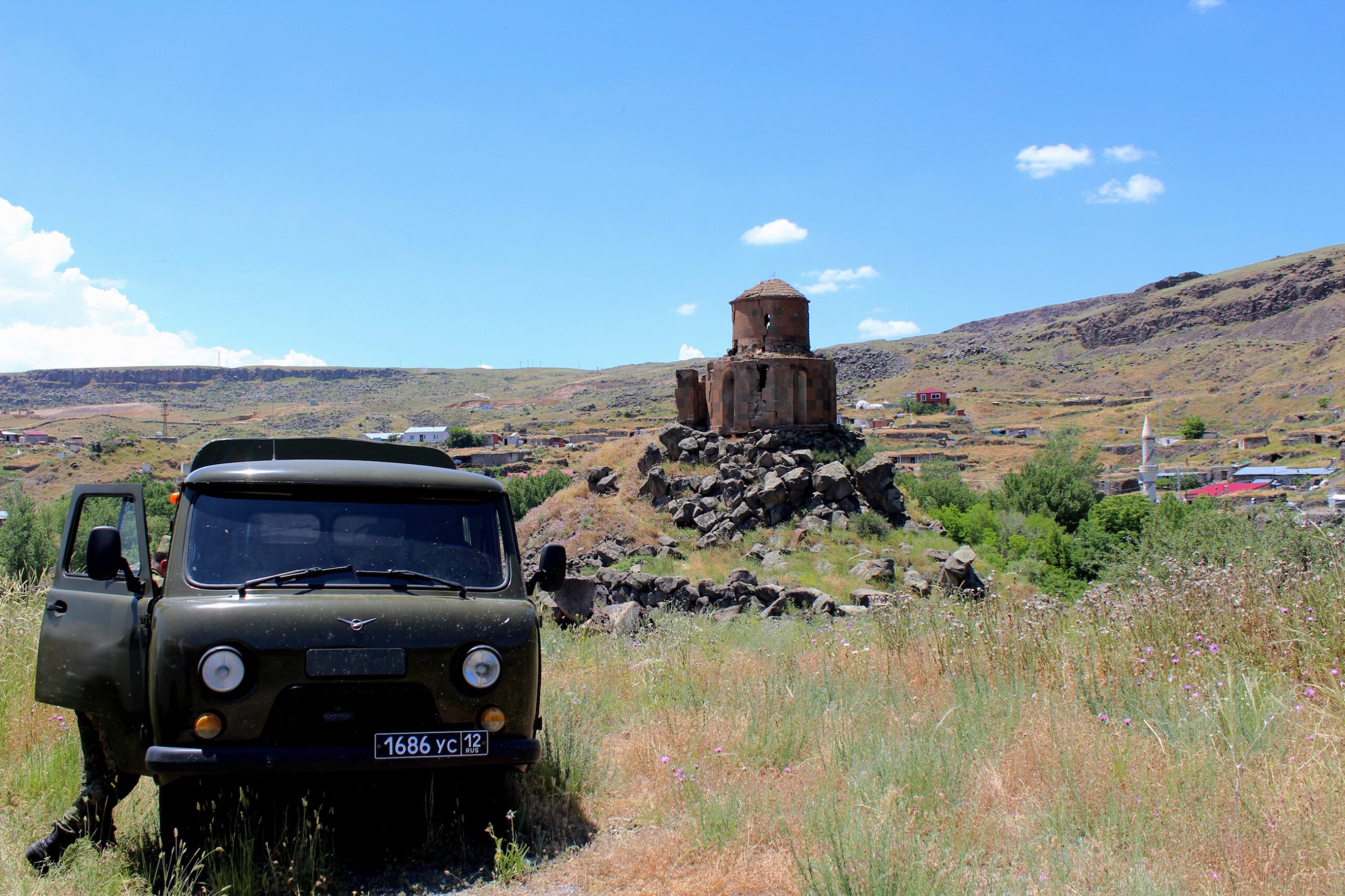
A Russian FSB Border Guard waits in his truck near St. Shushanik Church, a 7th century Armenian church on the Turkey-Armenia border.
The three specialists are part of the Armenian Cultural Heritage Institute, whose goal is to create “a living archive” of the country’s culture. Armenia’s long but tense history with Turkey and Azerbaijan has been marked by war and territorial loss. As the country is now forging a new path toward normalizing relations with its neighbors, a group of dedicated Armenians from both the homeland and the diaspora is journeying across the country not only to preserve the cultural sites lost to Azerbaijan, but to also extensively digitally document, for the first time, the country’s rich history and make it accessible to a new generation.
“We have this idea that heritage is not an ending point of history, but rather a starting point to create our future based on it,” says Hulé Kechichian, general director of the Armenian Cultural Heritage Institute.
The Institute’s work first began in 2020 as the Armenian Heritage Scanning Project, an initiative of the TUMO Center for Creative Technologies. Launched in response to the Second Nagorno-Karabakh War and the imminent risk of losing Armenian cultural sites in the region, the team had only weeks to act. Between 2020 and 2022, they made several expeditions to document threatened churches, monasteries and monuments.
Many of those scans are now among the only surviving digital records of Armenian cultural presence in territories that came under Azerbaijani control. Since then, Azerbaijan has continued to destroy Armenian churches and holy sites there, including the Holy Mother of God Cathedral in Stepanakert, the largest Armenian cathedral in Nagorno-Karabakh, which was demolished in April 2026.
Around 40 sites in Nagorno-Karabakh were documented before the territory’s entire Armenian population of some 120,000 was forcibly displaced in 2023. Realizing the importance of such work, it became the starting point to preserve the heritage not only of Karabakh but other endangered monuments in the country, Kechichian says. The Institute officially became its own entity in 2025.
Raised in France, Kechichian studied art history at the Ecole du Louvre in Paris. She eventually repatriated to Armenia and joined the Institute in 2023. For her, the Institute’s work reflects a sense of responsibility shared by many diaspora Armenians to preserve and strengthen their connection to their ancestral homeland. It’s also an effort to safeguard the cultural heritage that forms an essential part of Armenian identity.
“It’s very natural contributing to this thing that was put in me and many Armenians from childhood – this kind of responsibility,” Kechichian explains.
For Zeitounian, one of the field specialists, the 2020 Karabakh War was the impetus for the move to Armenia from France. He also joined the Institute in 2023.
“I really searched for a project that would allow me to invest myself in this country and that’s why I decided to join TUMO and work on scanning all these monuments,” he says.
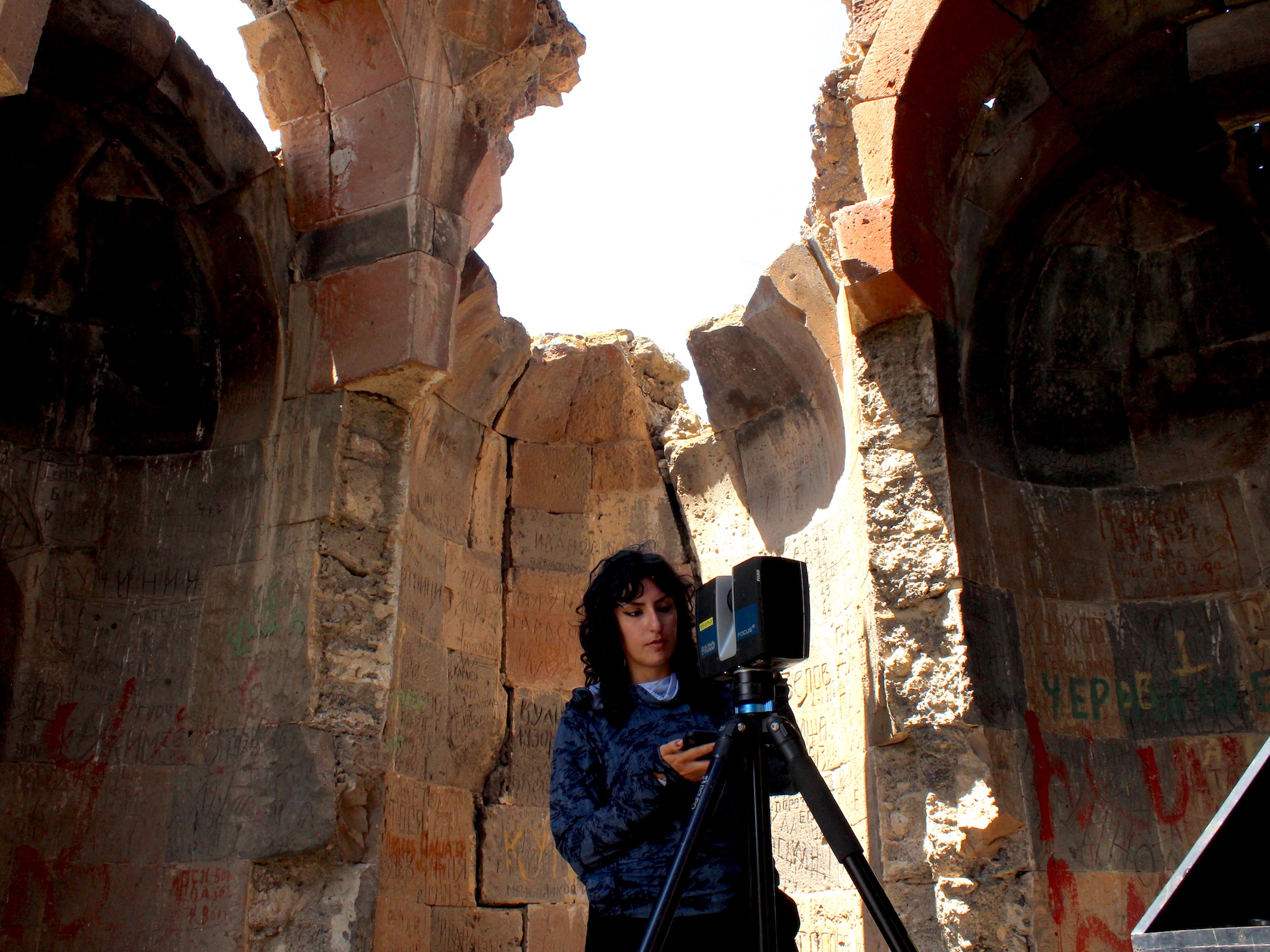
Anna Arzumanyan sets up her laser inside St. Shushanik Church to collect data points and eventually recreate a 3D model of the site.
Since its inception, the Institute has scanned around 280 monuments across the country, including those in Nagorno-Karabakh. So far, however, only 30 have been rendered into actual 3D models on the organization’s open-access website. Rendering the scans is computationally intensive and the Institute’s limited computing capacity means sites are prioritized and can take months to complete. The Institute is currently working on securing additional funding to expand its computing infrastructure and accelerate the process.
Trained in video game design in the United Kingdom, Arzumanyan returned to Yerevan to apply the same photogrammetry techniques used in game development to digitally reconstruct Armenia’s cultural heritage for the Institute.
“Buildings just degrade and if there’s no way for us to restore these buildings in real life, at the very least, what we can do is document them, so we have a digital version of them to continue researching and preserving through that technology,” Arzumanyan says.
By digitizing these sites, the Institute’s 3D models allow users to explore every corner and detail of Armenia’s cultural heritage, inspiring creativity and even prompting new research. Some critics question whether historic Armenian motifs and monuments should be adapted or reinterpreted for creative purposes, Kechichian says.
“We don’t subscribe to that kind of criticism because this is really our vision, to make it malleable and to make it accessible in a way that is really approachable,” she says.
Efforts to document important sites across Armenia have emerged over the years, mostly through projects led by public universities. However, many struggled from a lack of consistent funding and none have attempted to build a comprehensive, publicly accessible digital archive on the scale of the one the Institute is currently creating.
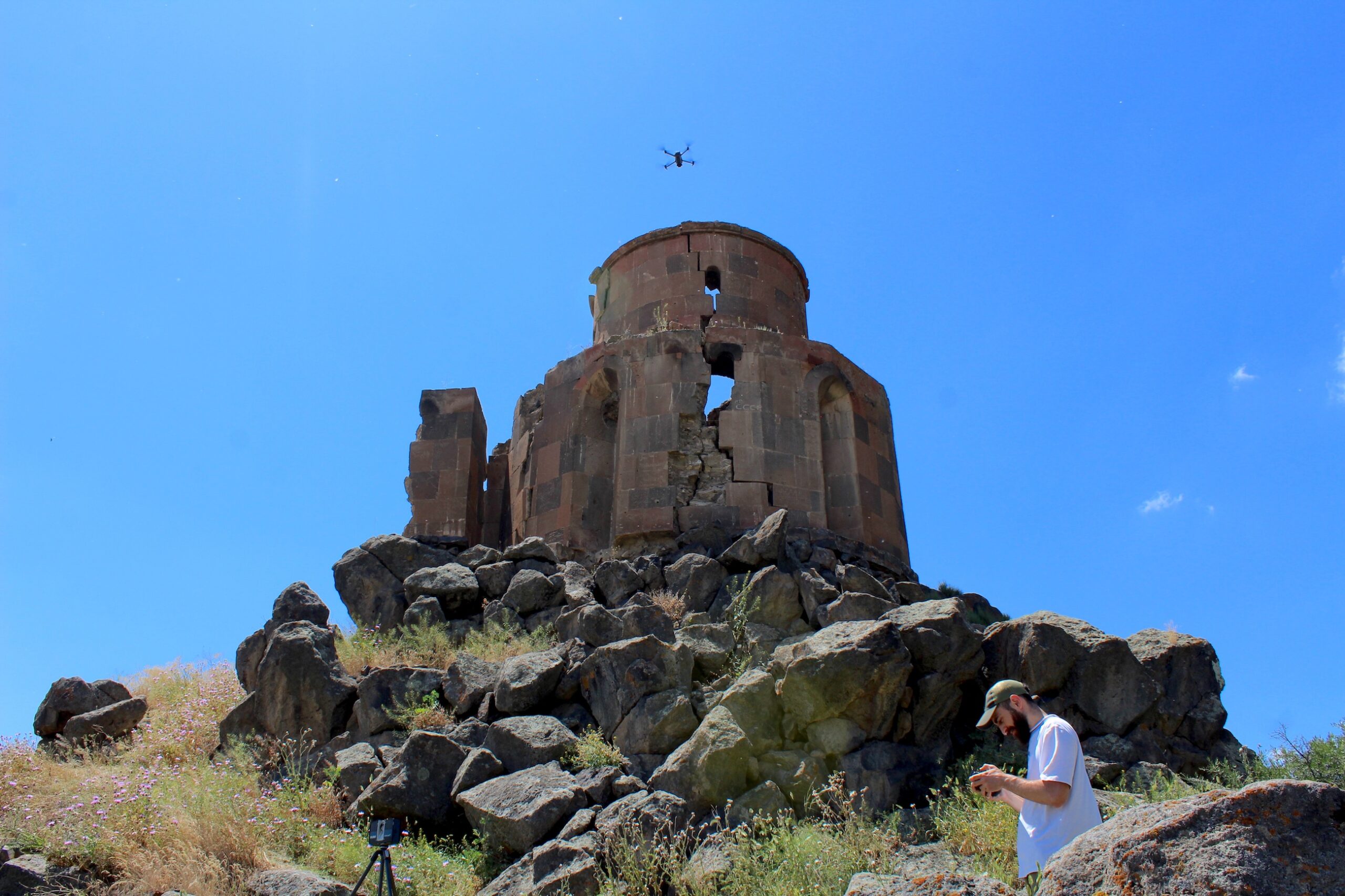
Arthur Zeitounian guides a drone around St. Shushanik Church to capture photos of the site’s entire circumference.
The loss of Armenian territory over the past century—from the Armenian Genocide in the Ottoman Empire to the recent wars with Azerbaijan—has also sparked ongoing debates about the historical presence of Armenians in certain contested territories, particularly Nagorno-Karabakh. Since regaining control of parts of Nagorno-Karabakh during the 2020 war and seizing the remainder following its September 2023 military offensive, which forced the territory’s entire Armenian population to flee, Azerbaijan has not only demolished Armenian cultural and religious sites but also promoted claims that seek to erase or deny the longstanding Armenian presence in the region.
The looming threat of Azerbaijani historical revisionism prompted the Institute to partner with the Starling Lab for Data Integrity, a research center co-founded by Stanford University and the University of Southern California, to protect the integrity of and authenticate the data collected at various Armenian sites. Through the initiative, Starling Lab stores the data files in a decentralized manner, similar to blockchain. If something were to happen to one of the nodes housing the data, there are other nodes storing the same information, ensuring several secure backups.
In a time of increasing polarization, such efforts have become crucial to protect and safeguard history, says Basile Simon, director of Starling Lab’s Human Rights Initiatives.
So far, the Institute has only sent the data collected from Nagorno-Karabakh for safekeeping as the most important archive to protect. Kechichian says this technology gives the data a protective label.
“It’s some kind of guarantee that nothing would happen to that data and that (Starling Lab) are endorsing the quality and the reality of the data,” Kechichian says.
Standing amid the rolling green hills of the Bagaran region, Zeitounian reflects on both the beauty of the landscape and the pain of standing at a border that wasn’t always there. In the distance, atop a cliff in the Turkish town of Kilittaşi, stands another abandoned Armenian church, a silent casualty of history and the passage of time. For the Institute specialists, it is a reminder that not every Armenian site can be saved, making the work of documenting those that remain all the more urgent.
Photos by Sandra Sadek.
Arts & Culture
Tamara Khanum: Reclaiming Dance as Defiance
An Armenian exile’s daughter who became one of the Soviet Union’s most celebrated performers, Tamara Khanum used dance to challenge patriarchy, embody cultural resistance, and redefine womanhood in Central Asia, even as her art was folded into the Soviet project.
Read more
Between Knowledge and Ideology: The Soviet Armenian Encyclopedia
A landmark of Soviet-era scholarship, the Soviet Armenian Encyclopedia remains the most comprehensive reference work in Armenian. Shaped by ideology yet vast in scope, it reflects both the intellectual ambition and the political constraints of its time.
Read more
Lost Twice: How 1920s Western Armenian Literature Predicted the Diaspora’s Extinction
In this compelling exploration of how early Western Armenian writers foresaw the cultural erosion of diaspora life, Andronik Papyan draws a stark parallel to today’s Armenian community in Russia, arguing that without language, institutions and literary production, identity risks fading into symbolism.
Read more
110 Years Later, the Perpetrator Becomes the Host
Berlin marked the 110th anniversary of the Armenian Genocide last year with an unprecedented cultural program. Yet the commemorations also exposed a deeper paradox: Germany, once complicit in the genocide, now hosts the memory work, as artists and curators confront history, responsibility and contemporary politics.
Read more
The Geometry of Power: From the Louvre to Yerevan
Tracing how power reshapes cities, Heghine Pilosyan’s essay moves from Paris to Yerevan to show how architecture, land and urban form have served as instruments of authority, across monarchy, socialism and post-Soviet capitalism, revealing striking continuities beneath shifting ideologies.
Read more
Who Am I to Tell Your Story?
Filmmaker Eric Nazarian challenges the cultural gatekeeping that dictates who is “allowed” to tell certain stories. Drawing on a life shaped by multiethnic Los Angeles, he makes a powerful case for cross-cultural storytelling as resistance, empathy and a reminder that art transcends borders.
Read more
Of Roland Barthes, Ludwig Mies van der Rohe and Photographs of Women Architects
Through forgotten photographs and Barthes’ language of studium and punctum, Talinn Grigor uncovers the overlooked histories of Armenian women architects in modern Iran, tracing their encounters with Mies van der Rohe and revealing silent, resilient cosmopolitanism in a male-dominated world.
Read more
The Armenian Refugee Who Photographed a Defining Era of European Migration
The archives of Studio Rex, a photo studio founded by Armenian Genocide survivor Assadour Keussayan in Marseille, document decades of European migration. These once-practical photographs have become powerful historical artifacts chronicling diverse immigrant experiences from the 20th century.
Read more