

Listen to the AI generated audio article.
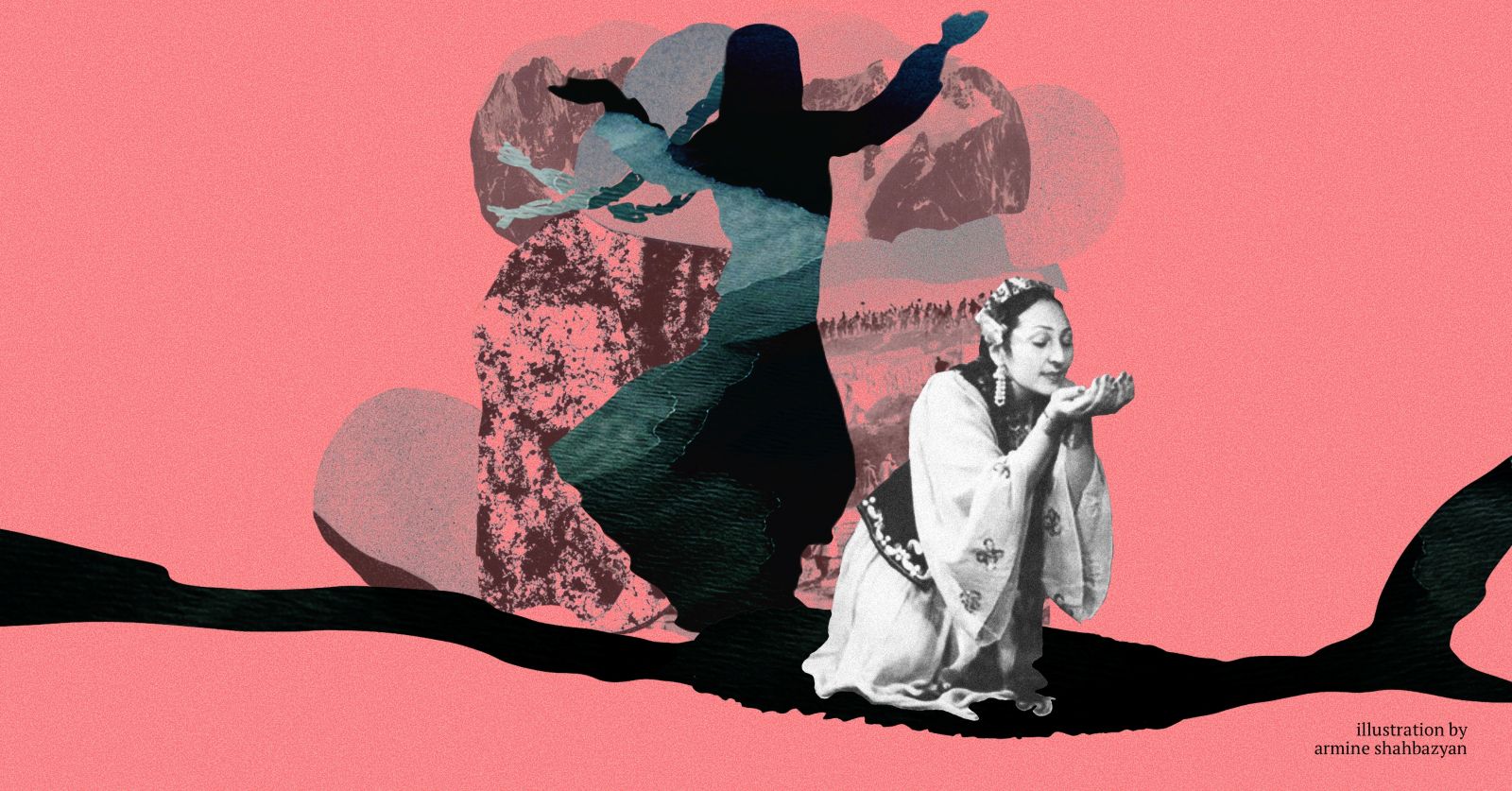
In the summer of 1939, on the bank of a newly dug canal in the Fergana Valley, a woman danced.
She wore intricate Uzbek garments, coins at her waist, long dark braids that swung as she turned. Her wrists moved with such sudden precision that the camera missed frames. She snapped her fingers and began to sing. As you watch, you forget for a while that the footage is grainy black and white.
Her dance is a language older than the Soviet Union—one that, on any ordinary day, would be considered too intricate for the Soviet authorities’ taste, too culturally distinct, and thus too dangerous to survive within the monotonous architecture of socialist culture. But in this case, it is encouraged. A calculated opening of the gates: a woman’s body allowed to take hold and take space in patriarchy, both old and new. With this striking visual, the Soviet authorities achieved three things: a woman in Central Asia emancipated (and thus economically useful); a display of cultural diversity in the USSR (and therefore the benevolence of the authorities in allowing it to exist); and a push to celebrate and rejoice over at the prospect of growing cotton (and thus volunteer to do so, consistently, over decades with little to no pay).
The dance itself is older than the Russian Empire that exiled the dancer’s father to this valley. Her smile is enormous and unguarded. She is 33 years old and completely, unapologetically herself.
This is Tamara Khanum—born Tamara Petrosyan—dancing at the opening ceremony of the Great Fergana Canal: a 270-kilometer waterway built in just 45 days by 160,000 Uzbek and Tajik laborers mobilized by the Soviet state to irrigate the cotton fields of Central Asia and sever the empire’s dependence on Western markets. The rivers diverted to feed this canal would one day help drain the Aral Sea to a fraction of its former self, leaving behind salt desert, toxic dust, and one of the worst environmental catastrophes of the 20th century.
Make no mistake: Tamara broke rigid guardrails. She was, in every sense of the word, a revolutionary. But her story is woven through with Soviet agendas and carries the oldest burden of women’s emancipation: the question of whether liberation is truly liberation when it requires the blessing of power to exist.
Tamara’s trailblazing was not abstract in any way. It was literal and physical: she performed in villages, on rooftops, and in town squares at a time when a woman who danced in public in Central Asia risked her life. One of her closest colleagues, a young dancer named Nurkhon Yuldasheva, was murdered by her own brother[1] for removing her veil and dancing on a public stage. The day after her death, thousands attended her funeral in the public square, and women threw off their veils in front of her coffin. In later years, Tamara would point to Nurkhon’s photograph and say simply: “She was my student.” An American visitor noted decades later that the grief was still fresh.
For anyone who has witnessed Uzbek female dance, it’s an unhinged, full-bodied thrill, and the idea of trying to contain it seems not just cruel but almost absurd.
Tamara was spared this cruelty from her own kin—perhaps because she was Armenian, or perhaps because of her father Artem’s own history of rebellion, a trait that seemed to run in the Petrosyan family.
Tamar was born into a family from Artsakh. Her father, Artem Petrosyan, was born in Nagorno-Karabakh, then left for Baku, where he found work as a lathe operator in the Nobel factory. In 1905, Baku erupted: labor strikes broke out across the oil fields, and mobs attacked the Armenian quarter of the city. The Russian authorities, who had quietly issued arms permits to Muslim communities in the preceding weeks, stood aside and watched.[2] Artem joined the defense and the strikes. For this, the Russian imperial authorities exiled him to Turkestan, to the far edge of the empire, to the Fergana Valley.
While in exile, the family had four daughters. Tamara and her sisters attended the railway school and lived across the street from a girls’ gymnasium—a modest but cosmopolitan upbringing for the daughter of a political exile. Her maternal grandmother, a practicing Orthodox Christian, often took her to church. Her father played the tar and sang in both Armenian and Uzbek. By Tamara’s own account, he was stern and hard-working, and though he loved music, he had little enthusiasm for the idea of his daughter pursuing a career in dance.
Tamara was eight when, at a neighbor’s wedding, she watched the yallachis, female performers who danced at women’s events, arrive in their paranjis, the heavy veiled robes that concealed their bodies entirely. Tamara slipped into their performance uninvited, dancing alongside them.
At 13, she performed publicly for the first time. It was the first time in the region that a woman danced publicly without a veil—and lived.
At 19, she was selected to represent the Soviet Union at the First International Exhibition of Decorative Arts in Paris in 1925; it was also the first time Central Asian dance had been seen in the West. She performed in voluminous Central Asian silks and heavy jewelry, in stark contrast to the pseudo-oriental dancers who appeared half-dressed in Paris music halls at the time. After one performance, the American-born dancer and choreographer Isadora Duncan came backstage, praised her artistry, and asked to touch the back of her neck to count her vertebrae, astonished by the fluidity and flexibility of her movements. Tamara later recalled how, walking through the streets of Paris in her layered Uzbek costume, crowds gathered to admire the garments and lined up to try them on.
The experience in Paris laid the foundations for Tamara’s new, essential role: a cultural ambassador of a culture not her own; a cultural shapeshifter, able to carry, both literally and figuratively, very diverse cultural embodiments and unravel them effortlessly on stage.
Over the course of her career, she performed over 500 songs in 86 languages, wearing the authentic national costumes of 86 peoples. Yet audiences across the Soviet Union and beyond could never agree on what nationality she was. A Soviet theater critic wrote that she created “a character condensed into a symbol of the best, most important, unrepeatable character traits of a people in its entirety,” and yet, the critic noted, she never lost herself in the process—the Armenian exile’s daughter from the Fergana Valley.
Soviet authorities willingly utilized Tamara as the living embodiment of their cultural tolerance and diversity, while quietly erasing the inconvenient truth: her very presence in that valley was the product of imperial exile, and that the family who raised her into rebellion had been put there by force.
In 1935, she opened the first ballet school in Tashkent. That same year, she performed at the London International Folk Dance Festival and was introduced to the British public for the first time, under the patronage of Queen Mary and King George V, at the Royal Albert Hall. The British press called her extraordinary. In 1937, she developed the balletic sequences in Uzbekistan’s first opera, Farhod and Shirin, celebrated as the artistic summit of Soviet modernization in the republic. She headlined the 1937 Dekada of Uzbek Art and Literature in Moscow, the Soviet Union’s great showcase of national culture.
By the late 1930s, her signature genre had crystallized: the song-and-dance miniature, performed in the authentic national costumes of each people she represented. Colleagues described her ability to absorb the essence of a people’s culture in days and then perform it with such conviction that audiences believed she was one of them. Foreigners who saw her perform could not agree on what nationality she was. That was the point.
After the Second World War, she toured the world. France, England, Poland, China, Norway, Indonesia, Czechoslovakia, Germany, Iran, Italy, Turkey, India, Mongolia, and Pakistan. In Kabul in 1958, she arrived to perform for local women and found them dressed in the latest fashions from England and America: high heels, short skirts, painted nails. She was, she noted with some irony, the only authentically dressed Eastern woman in the room. The world she had been sent to represent was changing faster than the Soviet state had anticipated.
She continued performing well into old age and was awarded the Stalin Prize (1941) and named the People’s Artist of the USSR (1956). Her home in Tashkent became a gathering place for the city’s cultural life, its walls lined with the most intricate, vivid costumes from different cultures.
I first learned about Tamara Khanum because I couldn’t orient myself in the streets of Tashkent. It was July, the chilla, as locals call it—40 days of peak summer heat. It was unbearable, and I checked my phone to find my way back home. The map showed I was on a street called Tamara Khanum. I knew the name Tamara was not of Uzbek origin, so I looked it up and discovered the street was named after an Armenian woman. Uzbekistan had named an entire street after an Armenian woman, and on its corner stood her house museum.
As I watch videos of Tamara dancing, a simple truth is suddenly revealed. She danced as if she did not care whether her dance and her art were against patriarchy or accepted norms. She danced with a carelessness that suggested she did not know her dance was being used by the Soviet regime to advance its international agenda and internal goals to exploit Central Asian land and its people.
When she danced on the shore of the Fergana Canal on that sunny afternoon in 1939, she did not think of Soviet politics or the bourgeoisie, of any fight against colonialism or the struggle against capitalism. She did what she felt was her true essence. She did it almost instinctively, freeing her movements from both physical and figurative restraints, and in doing so she paved the way for women in Central Asia to take back their culture and autonomy over their bodies. What should we call this defiance? It is, by default, a key feature of feminism, but it was much more.
The rivers ran thin. The sea disappeared. The dances remain.
Footnotes:
[1] Marianne Kamp, The New Woman in Uzbekistan: Islam, Modernity, and Unveiling under Communism (Seattle: University of Washington Press, 2011), 205–206.
[2] Luigi Villari, Fire and Sword in the Caucasus (1906).
Arts & Culture

Between Knowledge and Ideology: The Soviet Armenian Encyclopedia
A landmark of Soviet-era scholarship, the Soviet Armenian Encyclopedia remains the most comprehensive reference work in Armenian. Shaped by ideology yet vast in scope, it reflects both the intellectual ambition and the political constraints of its time.
Read more
Lost Twice: How 1920s Western Armenian Literature Predicted the Diaspora’s Extinction
In this compelling exploration of how early Western Armenian writers foresaw the cultural erosion of diaspora life, Andronik Papyan draws a stark parallel to today’s Armenian community in Russia, arguing that without language, institutions and literary production, identity risks fading into symbolism.
Read more
110 Years Later, the Perpetrator Becomes the Host
Berlin marked the 110th anniversary of the Armenian Genocide last year with an unprecedented cultural program. Yet the commemorations also exposed a deeper paradox: Germany, once complicit in the genocide, now hosts the memory work, as artists and curators confront history, responsibility and contemporary politics.
Read more
The Geometry of Power: From the Louvre to Yerevan
Tracing how power reshapes cities, Heghine Pilosyan’s essay moves from Paris to Yerevan to show how architecture, land and urban form have served as instruments of authority, across monarchy, socialism and post-Soviet capitalism, revealing striking continuities beneath shifting ideologies.
Read more
Who Am I to Tell Your Story?
Filmmaker Eric Nazarian challenges the cultural gatekeeping that dictates who is “allowed” to tell certain stories. Drawing on a life shaped by multiethnic Los Angeles, he makes a powerful case for cross-cultural storytelling as resistance, empathy and a reminder that art transcends borders.
Read more

Ms. Pogosyan, how do you know what Tamara Khanum was thinking when she danced on the shore of the Fergana Canal? Why must we always inject heavy-handed ANTI-Soviet propaganda into a celebration of a great dancer’s achievement? Is it that, by acknowledging anything at all good about 70 years of Soviet construction, victory, and security, we are opening the floodgates for a comparison to the last thirty years of destruction, diminishment, defeat and humiliation, brought to us by Free Enterprise and our Western saviors?