
Transitional Justice Agenda for the Republic of Armenia
Should Armenia implement the tools of transitional justice? This White Paper, developed by Dr. Nerses Kopalyan is a comprehensive transitional justice agenda for the Republic of Armenia.
Dr. Nerses Kopalyan is an Associate Professor-in-Residence of Political Science at the University of Nevada, Las Vegas. His fields of specialization include international security, geopolitics, political theory, and philosophy of science. He has conducted extensive research on polarity, superpower relations, and security studies. He is the author of "World Political Systems After Polarity" (Routledge, 2017), the co-author of "Sex, Power, and Politics" (Palgrave Macmillan, 2016), and co-author of "Latinos in Nevada: A Political, Social, and Economic Profile" (2021, Nevada University Press). His current research and academic publication concentrate on geopolitical and great power relations within Eurasia, with specific emphasis on democratic breakthroughs within authoritarian orbits. He has conducted extensive field work in Armenia on the country's security architecture and its democratization process. He has authored several policy papers for the Government of Armenia and served as voluntary advisor to various state institutions. Dr. Kopalyan is also a regular contributor to EVN Report.
Should Armenia implement the tools of transitional justice? This White Paper, developed by Dr. Nerses Kopalyan is a comprehensive transitional justice agenda for the Republic of Armenia.
While taking the reader through the complexities of international law, Dr. Nerses Kopalyan writes that when Armenia and Azerbaijan speak about peace, they mean completely different things. What they are actually saying is that they seek peace on their own terms.
When the Ministry of Diaspora was eliminated, many believed it went against the interests of the Armenian Diaspora. Nerses Kopalyan provides an alternative approach that alleviates bureaucratic bloating, enhances legislative efficiency offering the Diaspora a healthy dosage of political capital and a culture of reciprocity.
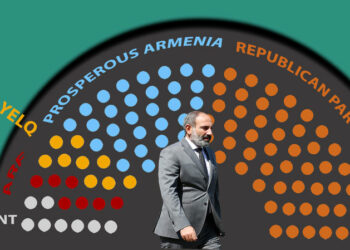
Dr. Nerses Kopalyan provides an in-depth analysis of the parties and coalition of parties that are running for the Dec. 9 snap parliamentary elections. Of the 11 political forces preparing for the campaign, Kopalyan writes, only six are competitive and have the capacity to influence and effect the policy discourse during the campaign.
With snap parliamentary elections around the corner and if all indicators hold true, Prime Minister Nikol Pashinyan’s Civic Contract party remains poised to sweep the vote. The question that the prime minister will have to consider is whether he wants to rule or govern.
Dr. Nerses Kopalyan writes that the municipal election was not about Yerevan, the Council of Elders, or the Mayor: it was about reifying Pashinyan’s dominance of the Armenian political universe.
Formulating the compatibility of transitional justice with Armenia's laws and constitutional statutes shouldn't be problematic, writes Nerses Kopalyan. However, the Pashinyan government, must go out of its way to make certain that the formation of any element of the instruments of transitional justice are fundamentally impartial, profoundly non-politicized, and unequivocally objective.
Nerses Kopalyan examines and debunks the arguments that the arrest and detention of Armenia’s second President Robert Kocharyan is politically motivated and that the basis of the arrest lacks cogent and substantive legal foundations. Kocharyan has been charged with “overthrowing constitutional order” regarding the events of March 1, 2008 that left ten people dead.
Nerses Kopalyan writes that Prime Minister Nikol Pashinyan’s declaration of war against the entrenched powers of the previous system is not simply a singular attack against corruption, but rather a broad multi-pronged strategy that envisions an ideational restructuring of Armenia’s political culture.
Policies of previous administrations were not shaped by ideology, but rather, by a drive to consolidate illegitimate power through patronalistic politics. Nerses Kopalyan argues that the political ideology of Nikol Pahsinyan’s new government is aggressive centrism.
EVN Report’s mission is to empower Armenia, inspire the diaspora and inform the world through sound, credible and fact-based reporting and commentary. Our goal is to increase public trust in the media. EVN Report is the media arm of EVN News Foundation registered in the Republic of Armenia in 2017.
SUPPORT INDEPENDANT JOURNALISM