

Understanding the Aliyev Regime’s Armenophobia
The contours of Armenophobia presuppose the dehumanization of an entire people, where hatred and aversion towards an Armenian is embedded in Azerbaijan’s political culture, writes Nerses Kopalyan.
Dr. Nerses Kopalyan is an Associate Professor-in-Residence of Political Science at the University of Nevada, Las Vegas. His fields of specialization include international security, geopolitics, political theory, and philosophy of science. He has conducted extensive research on polarity, superpower relations, and security studies. He is the author of "World Political Systems After Polarity" (Routledge, 2017), the co-author of "Sex, Power, and Politics" (Palgrave Macmillan, 2016), and co-author of "Latinos in Nevada: A Political, Social, and Economic Profile" (2021, Nevada University Press). His current research and academic publication concentrate on geopolitical and great power relations within Eurasia, with specific emphasis on democratic breakthroughs within authoritarian orbits. He has conducted extensive field work in Armenia on the country's security architecture and its democratization process. He has authored several policy papers for the Government of Armenia and served as voluntary advisor to various state institutions. Dr. Kopalyan is also a regular contributor to EVN Report.
The contours of Armenophobia presuppose the dehumanization of an entire people, where hatred and aversion towards an Armenian is embedded in Azerbaijan’s political culture, writes Nerses Kopalyan.
That the same people who made a mockery of democracy are now lamenting an imaginary backsliding, is intellectually insulting to the Armenian citizen, writes Nerses Kopalyan.
During an extraordinary session, Armenia’s National Assembly initiated and unanimously approved a set of Constitutional amendments to address the crisis of political and institutional legitimacy of the Constitutional Court.
Gagik Tsarukyan is a remnant of the previous system. The era of oligarchs is over, and Tsarukyan must make his peace with that. Armenia is no longer a country for corrupt old men, writes Dr. Nerses Kopalyan.
The Armenian government has initiated a broad set of cases against the oligarchs and Robber Barons of the former regime composed of the upper echelon of the previous-pyramid hierarchy. Nerses Kopalyan looks at a number of high-profile cases.
The experience of combating the coronavirus pandemic in Armenia can and should serve as an important foundation to develop long-term and institutionalized mechanisms of crisis management with the support of Diasporan experts and professionals.
Toxic masculinity is not only an attack on femininity, it is also an attack on manliness, on the cultural precepts of Armenian society and it is an assault of ontological proportions, writes Nerses Kopalyan.
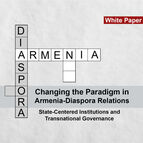
How should Armenia-Diaspora relations develop moving forward? This new White Paper argues that relations must be defined through state-centered institutions and transnational governance.
The International Republican Institute recently published its fourth public opinion survey since the Velvet Revolution. The survey found that a healthy majority of Armenians believe the country is heading in the right direction.
If we are to develop and build a functional relationship between the Homeland and the Armenian Diaspora, we need to understand the discrepancy between the Diaspora’s devotion to Armenianness and the Republic of Armenia’s vision for the Armenian world.
EVN Report’s mission is to empower Armenia, inspire the diaspora and inform the world through sound, credible and fact-based reporting and commentary. Our goal is to increase public trust in the media. EVN Report is the media arm of EVN News Foundation registered in the Republic of Armenia in 2017.
SUPPORT INDEPENDANT JOURNALISM