

Listen to the AI generated audio article.
Two years ago, while job hunting in Yerevan, I came across an opening for a content writer. Nothing about it raised any concerns. The position was advertised through the company’s page, the organization had a professional-looking website, and everything suggested it was a genuine opportunity. As a recent graduate eager to gain experience, I applied without hesitation.
The initial communication seemed routine. I exchanged messages with a company representative and was invited for an interview. As the process continued, however, the lines began to blur. It was never quite clear whether I was speaking with an HR specialist, a manager, or the company’s owner. When I arrived, the person I had been communicating with introduced himself as the CEO. While that is not unusual for very small businesses, it was the first sign the company lacked a formal hiring process.
The address listed on the company’s website turned out to be a private residence. Because many startups operate from coworking spaces or unconventional offices, I didn’t find this suspicious at first. However, when I arrived, it was clear this was not a typical workplace environment.
Inside were several people, but no desks, computers or signs of a functioning office. The setting felt unprofessional and far removed from what I expected from a company that presented itself as established and credible online.
A few hours later, the same person asked to meet again, on a Sunday, to discuss salary. I couldn’t understand why compensation hadn’t been discussed during the interview, or why the conversation was taking place over WhatsApp outside working hours rather than through official company channels.
Nothing illegal happened, and I left safely. Still, I couldn’t shake the feeling that something about the experience wasn’t right.
Later, as I spoke with other job seekers, I realized my story wasn’t unusual: vague communication, unclear expectations and interview processes that left them wondering whether the job itself was genuine. That raised a larger question: what should a professional hiring process actually look like?
“Endless Test Tasks”
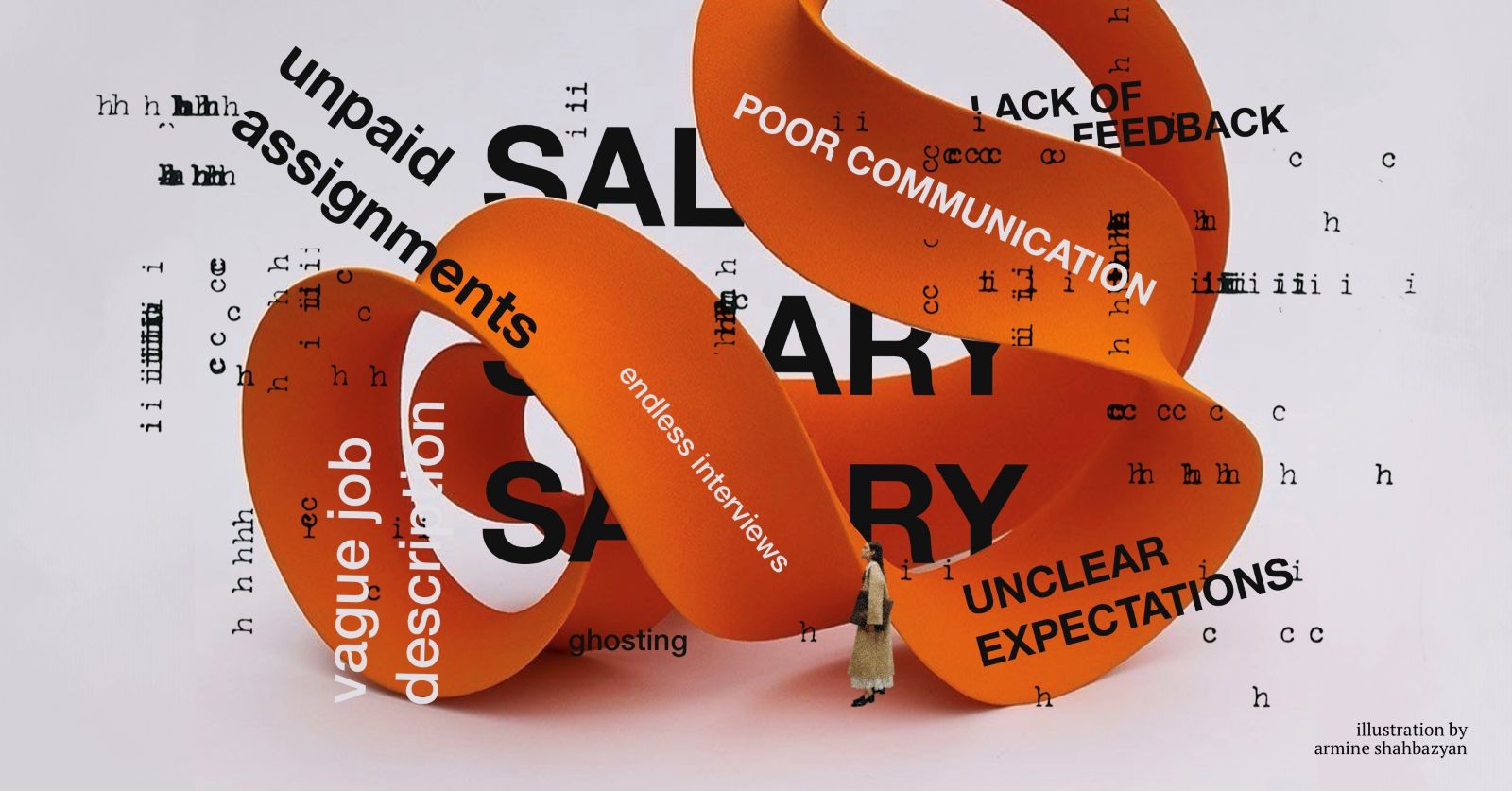
Among the complaints I heard most often was the growing use of unpaid recruitment assignments.
Many companies ask candidates to complete writing samples, marketing strategies, design projects, or coding tasks before an interview. Skills assessments can be a legitimate hiring tool. The problem arises when they become so extensive that they resemble unpaid work.
Candidates often spend hours, sometimes days, completing assignments with no guarantee of feedback, compensation, or further communication. In some cases, applicants are ghosted after submitting the assigned work.
The Communication Problem
One frustration came up again and again in conversations with other job seekers: silence.
You send off an application and hear nothing. Days turn into weeks. You begin to wonder whether the position has been filled, whether anyone has read your CV, or whether the vacancy was ever real to begin with. After a while, you stop checking your inbox with anticipation and start checking it out of habit.
Large organizations often use applicant-tracking systems that automatically acknowledge applications, but many employers in Armenia still rely on informal hiring practices that can leave candidates in the dark. You invest time tailoring your CV and cover letter, yet receive no indication that your application was even reviewed.
The silence doesn’t always end after an interview. Candidates are told to expect a decision within a week or two, only for that deadline to come and go without a word. Some travel to Yerevan for interviews, take time off work or university, and spend hours preparing, only to be left wondering what happened. Even a brief rejection email would acknowledge the time and effort every applicant invests in the process.
When Salary Becomes a Mystery
Salary transparency is another challenge. Many vacancies do not disclose compensation ranges, requiring applicants to spend significant time in interviews before learning whether a position meets their financial needs.
Negotiations can be particularly difficult for young professionals and recent graduates who lack market information or bargaining power. The absence of clear salary ranges may also lead to unequal outcomes for candidates applying for the same role.
Although salary transparency tools have emerged globally, many vacancies in Armenia still do not disclose compensation ranges. As a result, candidates may go through multiple interview stages before learning whether a position aligns with their expectations.
Armenia’s Job Market Today
Armenia’s recruitment landscape has become increasingly digital. Platforms such as staff.am and Worknet.am now serve as the primary bridge between employers and those seek employment. Yet despite the growth of these platforms, there are clear issues with communication and transparency: unanswered applications, unclear job descriptions, and vacancies that require significantly more responsibilities than originally advertised.
The legal situation surrounding recruitment tasks is less straightforward than many applicants assume. Armenia’s labor legislation primarily regulates employment relationships after a labor contract has been established. However, employers should not use recruitment exercises to obtain substantial productive work without compensation. This concern arises when assignments become extensive enough to generate tangible value for the employer. For example, asking a marketing candidate to develop a complete campaign strategy, a writer to produce publishable content, or a designer to create finished branding materials may raise ethical, and potentially legal, questions if the work is ultimately used by the company without payment.
A Matter of Professional Standards
Many of the hiring complaints are not necessarily violations of labor law. Being ghosted after an interview, waiting weeks for a response, or encountering vague salary discussions may be legal. However, they raise questions about professional standards and workplace culture.
As Armenia competes for skilled workers and seeks to reduce talent migration, recruitment itself has become part of an employer’s reputation. The hiring process is often a candidate’s first interaction with an organization. When that experience is marked by poor communication, or excessive unpaid tasks, companies may lose talented applicants before employment even begins.
That said, the challenges facing job seekers are not unique to Armenia. According to the International Labor Organization, young people worldwide continue to face significant obstacles when entering the labor market, including unstable employment, temporary contracts, and difficulties transitioning from education to work.
What Fair Hiring Should Look Like
A professional recruitment process doesn’t require perfection, but it does require respect.
At a minimum, employers should:
- Acknowledge receipt of applications.
- Communicate realistic hiring timelines.
- Limit unpaid assessments to reasonable demonstrations of skill.
- Provide feedback when possible.
- Be transparent about salary expectations and job responsibilities.
- Maintain professional boundaries throughout the hiring process.
Armenia’s labor market has evolved rapidly over the past decade, particularly in technology, communications, and service industries. Yet many hiring practices haven’t kept pace. For people entering the workforce, finding a job is already stressful. The hiring process should evaluate candidates’ abilities, not their willingness to tolerate uncertainty, unpaid labor, or unprofessional behavior.
As Armenia seeks to retain talent and build a competitive workforce, improving recruitment practices is not simply an HR issue. It is a question of workplace culture, trust and respect.
Law & Society

Strike Against the Sweatshop: Migrant Workers in Ijevan
Indian migrant workers at a textile factory in Ijevan went on strike over abusive working conditions, unpaid wages and rising production quotas. Their protest exposes deeper problems in Armenia’s labor system, where weak protections leave migrant workers vulnerable to exploitation, surveillance and coercion. Garren Jansezian’s report from Ijevan.
Read more
Anatomy of a Process: Yerevan’s Metro
A decades-long effort to expand Yerevan’s metro reveals a familiar cycle of ambitious promises, shifting timelines, and stalled execution. The long-delayed Ajapnyak station underscores deeper structural challenges in governance, planning and accountability behind Armenia’s unfinished infrastructure.
Read more
Building a Family-Based Child Welfare System in Armenia
An in-depth look at Armenia’s shift from institutional child care to family-based welfare explores the roles of poverty, disability, stigma and law. Tigran Melikian examines recent positive reforms, remaining gaps and what it will take to ensure every child grows up in a family.
Read more
Armenia’s Long Road to Health Equity
Armenia has launched universal health coverage, replacing out-of-pocket payments with a national insurance system. After years of delay, the reform expands access and reframes healthcare as a social right rather than a privilege. The challenge is effective implementation, writes Hranoush Dermoyan.
Read more
License to Chaos: The Reality of Driving in Yerevan
From chaotic intersections to the challenges of getting a driver’s license, navigating Yerevan’s roads reveals deeper issues of enforcement, infrastructure and culture. Through personal experience and research, Hranoush Dermoyan explains what it takes, and what it costs, to drive safely in Armenia.
Read more

I can definitely relate to all the notes mentioned in the article regarding poor communication and uncertainty throughout the whole process.
I’d want to bring up the point and my experience that way more people get hired because of networking than they do when applying to a job online. As much as the process is digitalized, as humans we are much more receptive towards real, on-shit interactions. And, for the recruiter, when that first stage of application turns from reading a bunch of CVs to asking someone you know whether they know someone, it smoothens out the process quite a bit. The recruiter has higher trust in their contact referring a potential employer than in endless lost of identical looking CVs.
While this fact does get exploited, with people getting hired because they are someone’s relative or very close friend with less regard to their actual competence, making networks and knowing who to approach for what is a very important skill. And if anything, it encourages socializing in this progressively isolated and digitalized world.