

Listen to the AI generated audio article.
In 1968, Yerevan turned 2,750 years old.
For Susanna Harutyunyan, who was 11 years old at the time, the city seemed to have dressed up for the occasion. Countless flowers lined the sides of the road leading to the Erebuni Archaeological Museum, people arrived in their finest clothes, and balloons filled the streets. It was the first-ever Erebuni-Yerevan celebration, a grand week-long commemoration that would become an enduring Yerevan tradition.
Harutyunyan, now head of Modern History at the Yerevan History Museum, still remembers the excitement. In hindsight, celebrating a city whose history stretched back 2,750 years, older, as the celebration proclaimed, than Rome, during the Soviet era may seem unexpected, but Harutyunyan says it felt natural
Harutyunyan recalls that, although social divisions may have existed beneath the surface, they were not particularly visible in everyday life. And while people embraced socialism, they also maintained their Armenian identity. For historian Dr. Pietro Shakarian, this coexistence reflects what German scholar Maike Lehmann has called “Apricot socialism”: the distinctly Soviet Armenian ability to reconcile national identity with Soviet ideology.
“Within the Soviet context, this was the idea that you could be both national and Soviet,” Shakarian explains. “The Soviet government understood fairly early on that in the national republics like Armenia this sense of identity and nationality was so strong that it had to be accommodated.” In practice, he says this meant making concessions to Armenian nationalism while emphasizing its compatibility with Soviet socialism.
The celebration emerged amid a renewal of Armenian national identity that began with the onset of Nikita Khrushchev’s Thaw, Shakarian says. The process commenced on March 11, 1954, when Anastas Mikoyan came to Yerevan and delivered a speech calling for the rehabilitation of the poet Yeghishe Charents, and the republication of writers including Raffi, and more flexible and inclusive cultural policies. This marked an early step in the national revival that followed Stalin’s death in 1953.
A decade later, this opening found an overt political expression. On April 24, 1965, mass demonstrations in Yerevan demanded Soviet recognition of the 1915 Armenian genocide. These unsanctioned protests paved the way for the construction of the genocide memorial at Tsitsernakaberd in 1967, a year before the first Erebuni-Yerevan celebration. Together, these developments became a powerful and officially sanctioned symbol of Armenian historical memory.
At the same time, because certain historical topics had become politicized and were seen as sensitive or controversial in the Soviet context, many Armenian scholars turned their attention to ancient history.
According to Harutyunyan, multiple archaeological excavations took place in the 1940s, leading to the discovery of the first cuneiform inscriptions. Efforts to decode the writing intensified, and further excavations were organized. Among these discoveries was an inscription of King Argishti I identifying the foundation of Erebuni in the fifth year of his reign, conventionally dated to 782 BCE.
Shakarian emphasizes that Urartu was not Armenia in the modern national sense, but that the connection between Erebuni and Yerevan provided a powerful historical narrative. The inscription of King Argishti I gave the city what has often been described as its “birth certificate”: a documented foundation date that could anchor Yerevan’s antiquity in the ancient past.
On this basis, Shakarian notes, Ludwig Gharibjanyan, the First Secretary of Yerevan, proposed celebrating the city’s anniversary in a June 1967 letter to Armenian First Secretary Anton Kochinyan.
All decisions first required approval from Moscow and according to Harutyunyan, officials evaluated requests based on whether they might cause “harm” to the Soviet “friendship of peoples.” If they were deemed harmless, they were approved; if not, a series of negotiations would begin.
A city-wide celebration emphasizing something as distinctly “national” as Yerevan’s antiquity might not have been permitted. However, approving the Erebuni-Yerevan celebration was not only practical but also beneficial. According to Harutyunyan, the event helped project a positive, more democratic image of the USSR abroad. It was also not without precedent.
“In 1947, the USSR marked the 800th anniversary of Moscow and in 1957, the 250th anniversary of Leningrad,” says Shakarian. “Thus, it seemed only natural to have a similar commemoration honoring the birthday of Yerevan, the oldest continuously inhabited city in the Soviet Union.” Shakarian also notes that Soviet history textbooks often began with the history of Urartu—a point, he adds, often highlighted by the current director of the Hermitage, Mikhail Piotrovsky, the son of Urartu specialist and archeologist Boris Piotrovsky.
At the local level, the celebration served another purpose; it allowed Soviet Armenian authorities to accommodate Armenian national sentiment while appealing to the diaspora. “They wanted to show the brethren in the Levant and elsewhere all that Soviet Armenia had accomplished,” Shakarian explains.
Securing Moscow’s approval fell to Kochinyan, assisted by Badal Muradyan, chair of Armenia’s Council of Ministers. Together, they led efforts to make the celebration a reality. Negotiations went back and forth for a simple reason: an event of this scale would need funding, and that funding needed justification. The presence of diaspora dignitaries and the opportunity to showcase Armenia’s cultural and historical achievements helped make the case.
One of the most enduring products of the 1968 celebration was the song “Erebuni-Yerevan,” written by Paruyr Sevak and composed by Edgar Hovhannisyan. Kochinyan specifically recruited the two to create what would become Yerevan’s unofficial anthem. As Shakarian explains, Kochinyan believed that Sevak was uniquely suited to write the lyrics, given the poet’s role in the revival of Armenian national consciousness and his efforts to secure recognition of the Armenian Genocide through petition campaigns.
The city underwent extensive preparations for the celebration. Harutyunyan recalls that 2,750 trees were planted across the capital while a park with 2,750 fountains was built for the occasion. Around 20,000 people filled the stands of Yerevan’s football stadium to watch a show featuring soldiers dressed as Urartian warriors, according to journalist Mark Grigoryan, who was ten years old at the time. Throughout the city, people rode in horse-drawn carriages styled after the ancient Urartian ones.
Part of the Cascade had already been built, Harutyunyan recalls, while a choir of 2,750 singers gathered to perform the “Erebuni-Yerevan” for the first time. The performance was conducted by Tatul Altunyan, the founder of Armenia’s National Song and Dance Ensemble.
Grigoryan remembers how quickly “Erebuni-Yerevan” became beloved and part of everyday life, particularly among schoolchildren. “We as kids were involved…and the song came out, we all knew it and sang it in schools,” he says.
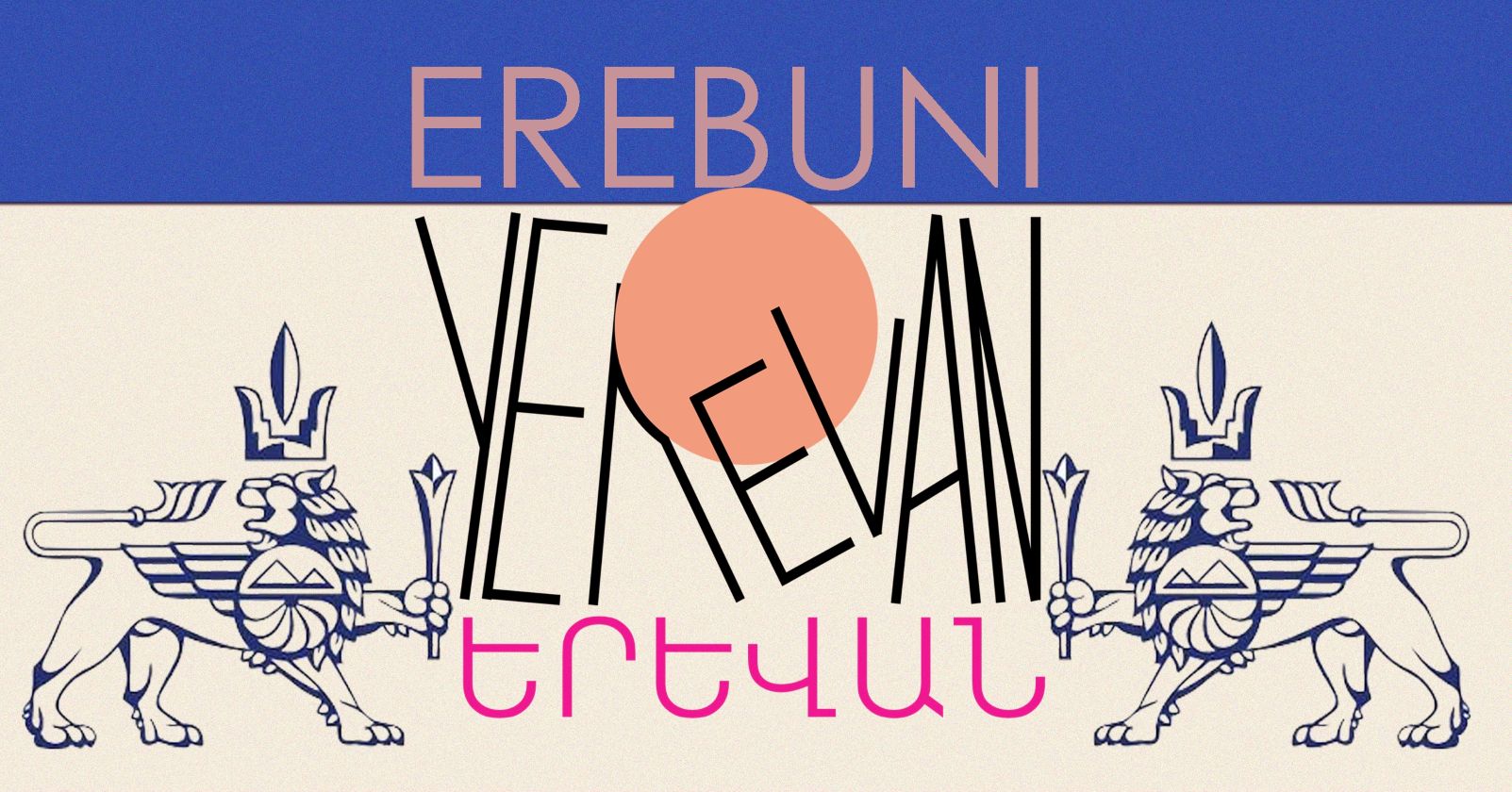
After the first celebration in 1968, Erebuni became an enduring symbol of Yerevan’s ancient origins. Images of Erebuni and modern Yerevan appeared together on postage stamps and city maps; the symbols even found their way onto cigarettes, brandy, and clocks. The message was one of continuity that only deepened people’s pride.
For Grigoryan, that connection was more than symbolic. Much of Yerevan had been built during the Soviet period, making it, in his words, “the new capital for the old people.” Erebuni gave the city, and its residents, a tangible link to a much deeper past. “No one knew how old the Armenian nation is; Yerevan was a new city, so what could we say?” he recalls. “Then came Erebuni, and it gave us the foothold to say…we are at least 2,750 years old, 30 years older than Rome.” For Grigoryan, that discovery became “a point of national happiness.”
LIFESTYLE
Lace Up
SALT’s September issue is all about movement: running, cycling, walking, wandering and remembering. From Armenia’s growing running culture and the Tour of Armenia to the human body serving as spectacle, we explore how the city is experienced in motion. We also look back at Yerevan’s memories and uncover a coffee shop hidden behind a secret door.

The Secret Is Out
In a city overflowing with coffee shops, Secret stands out by hiding in plain sight. This tiny cafe, tucked away in a courtyard off Saryan Street, turns ordering coffee into a playful ritual of mystery, anonymity and discovery, only to find itself going viral in an age when keeping a secret is nearly impossible.
Read more
Can Cycling Culture Cross the Finish Line?
The Tour of Armenia has put the country on the international cycling map and sparked new interest in the sport. But turning that momentum into a genuine cycling culture will require more than races and enthusiasm: Yerevan needs the infrastructure to make cycling a safe, practical part of everyday life.
Read more
The Body in Service of Spectacle
Yerevan has a new kind of billboard: people. As human advertisements take to the city’s streets, Isaac Stephenson looks beyond the novelty to ask what their presence says about advertising, public space, visual pollution and the increasingly creative ways brands compete for our attention.
Read more
The Run Is On
Once uncommon in Armenia, running has grown into a vibrant culture of clubs, races and communities. From Yerevan to Gyumri, Vanadzor and Dilijan, runners are reshaping attitudes toward fitness, friendship and outdoor life, turning a once-unfamiliar pastime into a growing part of everyday life.
Read more