
Listen to the AI generated audio article.
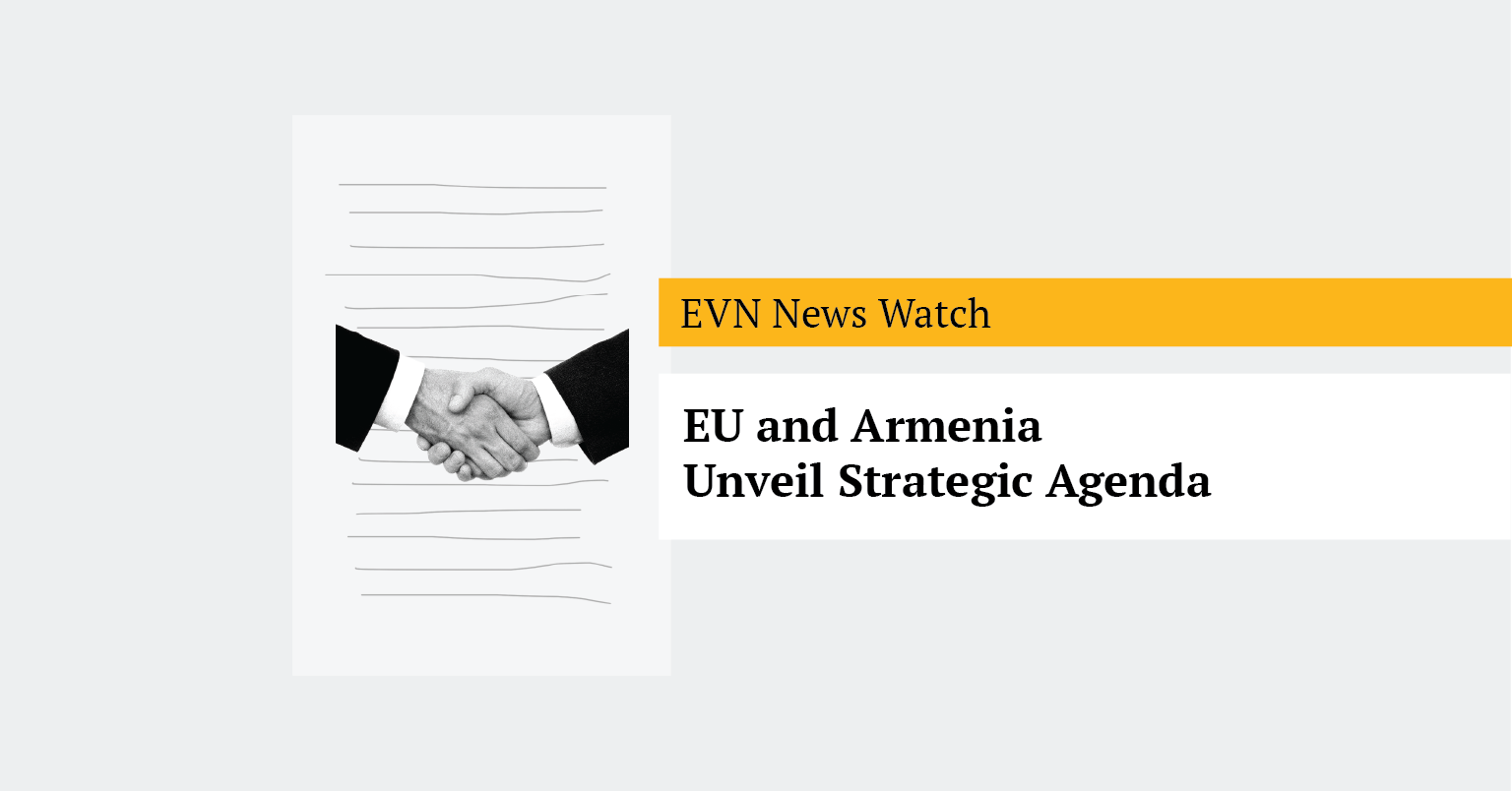
On December 2, Armenia and the European Union adopted a new Strategic Agenda in Brussels, marking a significant step toward a deeper and more comprehensive relationship. The document replaces the 2017 Partnership Priorities and lays out a more ambitious roadmap that builds on the Comprehensive and Enhanced Partnership Agreement (CEPA).
The signing took place during the 6th session of the Armenia–EU Partnership Council, which concluded with a joint press conference featuring Armenian Foreign Minister Ararat Mirzoyan, EU High Representative for Foreign Affairs and Security Policy Kaja Kallas, and EU Commissioner for Enlargement Marta Kos.
The new agenda will expand EU-Armenia cooperation across governance reforms, human rights, economic development, digitalization, energy security, trade and defense, with a strong emphasis on improving transport, energy and digital connectivity through initiatives like Global Gateway and Armenia’s Crossroads of Peace initiative. Framed around short- and medium-term priorities, it seeks to bolster Armenia’s resilience in a fragile regional environment, advance visa liberalization efforts and maintain EU support for displaced Armenians from Nagorno-Karabakh.
In her opening remarks during the press briefing, Kaja Kallas praised Armenia’s progress, including recent agreements with Azerbaijan, calling them a breakthrough for regional peace. She said that the new strategic agenda will deepen EU-Armenia cooperation in governance, economic modernization, security and visa liberalization. The EU also pledged €15 million to support Armenia’s resilience, fund demining, confidence-building measures, and efforts to counter foreign interference ahead of next year’s elections. Kallas highlighted the threat of disinformation and stressed the role of civil society and independent media, noting further discussions with EU foreign ministers on reforms and electoral integrity will follow in December.
Foreign Minister Mirzoyan said while CEPA has served as a “strong legal foundation” for the partnership, ties have developed “far beyond CEPA.” He described the new agenda as “complementing CEPA and elevating our partnership agenda to a strategic level.” He added, “this is absolutely not the end of our ambition.”
Enlargement Commissioner Marta Kos elaborated on what EU–Armenia defense and security cooperation may involve. She said discussions have focused on support for border management, as well as demining activities linked to past conflicts, including training and equipment. She noted that the EU also plans to provide tools to counter disinformation campaigns, which she said are ongoing and intensifying. This package mirrors the assistance the EU has provided to Moldova, which Armenia has also expressed interest in.
Responding to concerns about the economic risks Armenia could face if deeper EU integration triggers Russian retaliation, Kaja Kallas said the issue had been discussed extensively during the visit. She said the global order is shifting, making it crucial for partners like Armenia to align more closely with the EU’s foreign and security policies. Kallas acknowledged that sanctions on Russia are difficult but emphasized that they are necessary to end the war with Ukraine and that partner countries are also expected to comply. She noted that the war is harming all economies, which is why sanctions matter, and highlighted EU efforts to help Armenia diversify its trade so it is less dependent on Russia. Kallas stressed that strict, collective implementation of sanctions is essential, as preventing circumvention would shorten the war by limiting Russia’s ability to finance it.
In a briefing with Armenian reporters a day earlier, on December 1, Marta Kos provided more nuanced details regarding the partnership agenda. On security and defense cooperation, she noted that “reinforced security and defense cooperation” is one of its three pillars. Specifically, Kos mentioned consultations, countering disinformation and foreign information manipulation and interference, hybrid threats and cyber security.
On connectivity, she announced that the EU will invest €500 million, together with the German development bank KfW, in the project called Caucasus Transmission Network to connect Armenian and Georgian power grids and start work on Armenia–Turkey grid interconnection with the aim to reduce energy dependence on Russia.
Kos framed TRIPP as a small but strategic component of the broader connectivity corridor linking Central Asia to Europe. “It’s only 42 kilometres,” she noted, “but what matters is ensuring that connections to the east and west advance in parallel.” She also revealed that the EU is discussing the creation of a quadrilateral format with Armenia, Azerbaijan, Turkey and the EU to coordinate how TRIPP will link to wider regional routes in both directions.
Background
Armenia–EU relations are currently based on CEPA, signed in November 2017, and fully in force since March 2021 following ratification by Armenia and all EU member states. CEPA commits Armenia to an ambitious reform agenda grounded in democracy, transparency and the rule of law, including judicial reform, anti-corruption measures, stronger institutional accountability, and expanded economic, employment and social opportunities for citizens.
As Armenia continues to diversify its foreign relations and deepen ties with Western partners, Prime Minister Nikol Pashinyan signaled Yerevan’s openness to closer integration during a speech at the European Parliament in October 2023, stating that “Armenia is ready to be closer to the European Union, as much as the European Union considers it possible.”
In February 2024, the EU-Armenia Partnership Council, which supervises implementation of CEPA, agreed to launch work on a new EU-Armenia Partnership Agenda, establishing more ambitious joint priorities for cooperation across all dimensions. Negotiations concluded on June 30, 2025, when EU’s chief diplomat Kaja Kallas and Armenia’s Foreign Minister Ararat Mirzoyan met in Yerevan. The sides called it “a pivotal moment in Armenia-EU relations.”
In a press release issued after their meeting, this new Strategic Agenda was described as a “comprehensive framework”, which is “a testament to the mutual desire to elevate the relationship to a new level and reflects the European aspirations of the people of Armenia, as also affirmed in the law on the launch of the process of Armenia’s accession to the European Union.” The sides said it “aims to unlock the full potential of the CEPA, guiding efforts to bolster Armenia’s resilience, sovereignty, territorial integrity, and sustainable development.”
On July 14, Armenian Prime Minister Nikol Pashinyan met with European Council President António Costa and European Commission President Ursula von der Leyen, welcoming the “political agreement” on the text of the EU-Armenia New Partnership Agenda, which they called “a key milestone in their shared commitment to deepening ties.”
Ahead of the summit, on November 28, the EU released its 2025 Partnership Implementation Report on Armenia, which reviewed Armenia’s progress under CEPA and detailing how the new Strategic Agenda will expand cooperation across political, security, economic and social spheres. The report highlights ongoing reforms in governance, rule of law and human rights, while noting persistent challenges such as political polarization, economic vulnerabilities and hybrid threats that could impede democratic development and external commitments.
Also see

Smoke Signals or Political Will: Armenia’s EU Membership Bill
Armenia’s parliament passes a bill formally declaring the country’s intent to pursue EU membership. Supporters see it as a step toward strengthening democracy, security and economic well-being, while critics question its necessity, arguing that deeper ties with the EU were already progressing without such a declaration.
Read more
Armenia’s EU Ambition
Armenia’s government has introduced a law to pursue EU membership, signaling ambitions to align with Europe’s governance standards. Though membership is distant, the initiative could drive internal transformation, drawing lessons from neighboring countries' experiences on similar paths.
Read more
Armenia’s Path to Visa-Free EU Access
Obtaining a visa-free regime with the EU is not a sprint but a marathon, requiring sustained efforts from Armenia. Even after achieving visa-free status, the process will require ongoing reforms and adjustments. Anna Barseghyan explains.
Read more
European Peace Facility’s First Assistance Measure for Armenia
Sossi Tatikyan explores the reasons behind the EU's decision to provide assistance to Armenia through the EPF, the significance of this measure, the diverse perspectives within Armenia and the ensuing hostile reactions from Azerbaijan and Russia.
Read more