

Listen to the AI generated audio article.
When Defeat Becomes a Turning Point
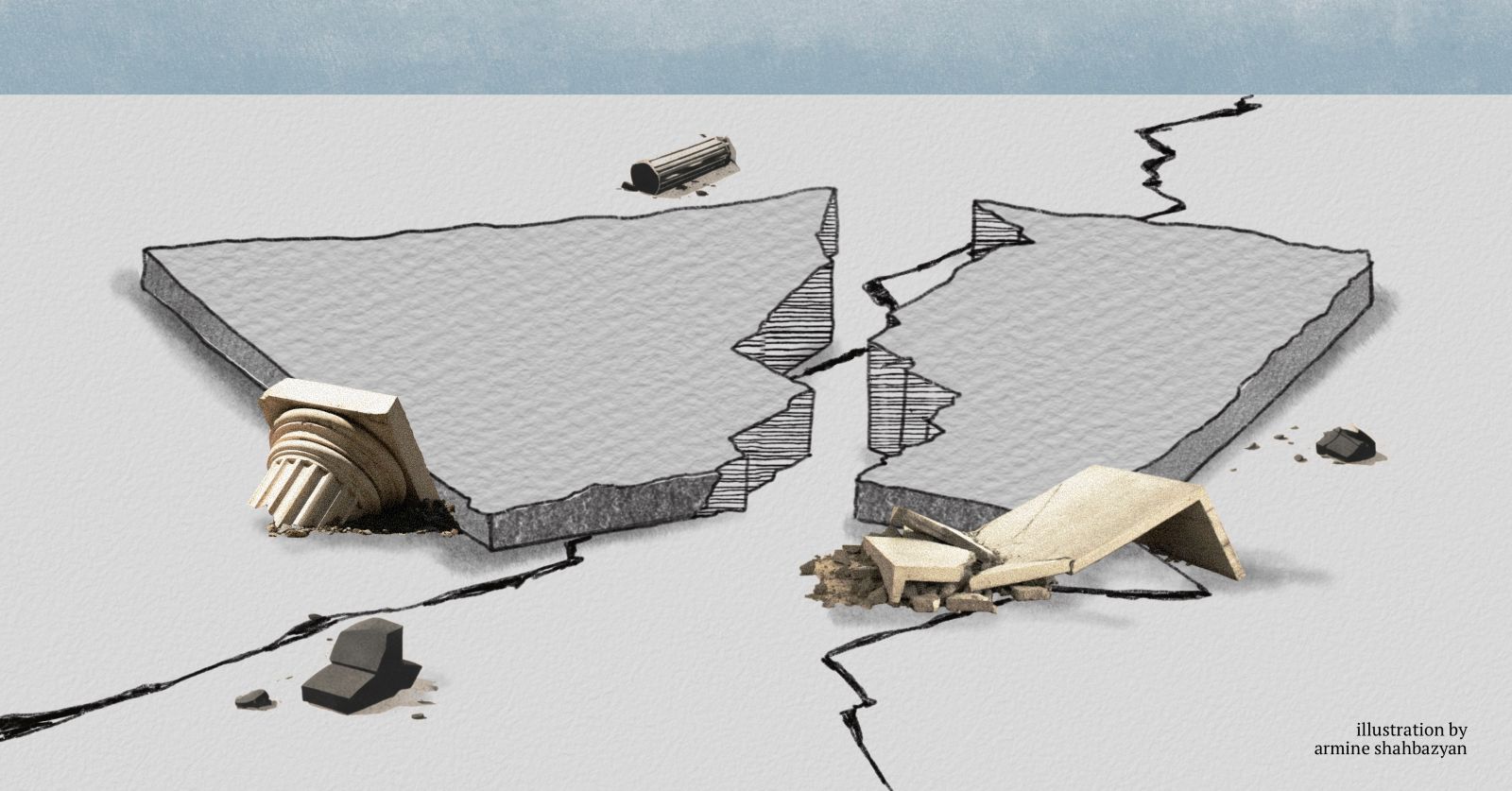
The loss of territory is never merely geographic. It is political, social and deeply symbolic. Few events in the modern history of nations are as transformative as a catastrophic defeat that shatters a long-standing national promise. For Greece, the destruction of Smyrna and the loss of Asia Minor in 1922–1923 marked the definitive collapse of the Megali Idea, the irredentist project of restoring Hellenism across Anatolia. For Armenia, the loss of Artsakh between 2020 and 2023 represents a similarly traumatic rupture, ending a central pillar of post-Soviet Armenian statehood and identity.
Although separated by a century and radically different international contexts, these two experiences invite comparison. Both defeats triggered crises of political legitimacy, mass displacement, and a forced reckoning between national memory and state capacity. Greece ultimately managed, painfully and imperfectly, to reframe its national narrative and recenter the state around bounded sovereignty and internal consolidation. Armenia now stands at a similar historical crossroads, but without the benefit of a stabilizing international settlement or a consensual post-defeat narrative.
This comparison is not about equivalence. It is about understanding how nations absorb defeat—and whether they transform trauma into a new political horizon or remain trapped in unresolved loss.
The Political Shock: Leadership, Responsibility and Legitimacy
The Asia Minor Catastrophe of 1922 produced an immediate and violent political reckoning in Greece. Military collapse triggered the September 1922 revolution, forced the abdication of King Constantine I, and led to the Trial of the Six—the prosecution and execution of leading political and military figures. While deeply controversial, these events reflected a widespread social demand for accountability. The monarchy emerged profoundly delegitimized, and within two years Greece transitioned to the Second Hellenic Republic from 1924 to 1935.
This was not a clean or stable process. The interwar period saw coups, counter-coups, and institutional fragility. Yet the key point is that defeat generated a rupture in political legitimacy that the system attempted—however crudely—to address. Responsibility for failure was centralized, and the state sought to reset itself on new terms.
Armenia’s post-Artsakh trajectory is markedly different. Defeat produced neither regime collapse nor clear institutional reckoning. Instead, it entrenched long-term polarization. Responsibility remains endlessly contested—between past and present governments, between civilian and military leadership, between external constraints and internal mismanagement. Rather than a decisive moment of accountability, Armenia entered a prolonged “trial without verdict,” where legitimacy is constantly questioned but never conclusively reconstituted.
Unlike Greece after 1922, where defeat produced a brutal—if deeply controversial—political reckoning, Armenia’s post-Artsakh experience has been marked by incomplete and contested accountability. One of the most striking episodes came in February 2021, when Chief of the General Staff and General Onik Gasparyan, publicly called for the resignation of Prime Minister Nikol Pashinyan, citing the government’s handling of the war and its aftermath. This unprecedented civil–military confrontation revealed the depth of institutional fracture that defeat had produced.
Yet this episode did not lead to a transparent or systematic examination of responsibility. No fully independent, public, and comprehensive inquiry has clarified the strategic, operational, and political causes of the defeat. As a result, multiple blind spots persist. These include unresolved questions about intelligence failures, political decision-making during critical phases of the war, and—most sensitively—the coordination (or lack thereof) between the armed forces of the Republic of Armenia and those of Artsakh.
This absence of clarity has had lasting consequences. Rather than producing a shared understanding of what went wrong, the defeat has been politicized and fragmented. Competing narratives coexist: some emphasize diplomatic isolation, others technological asymmetry, others leadership errors, and still others structural military weaknesses. Without an authoritative assessment, public debate oscillates between accusation, denial, and fatalism.
The contrast with the Greek case is instructive. In Greece, accountability was concentrated, sometimes violently, on identifiable political and military elites. This allowed the state to symbolically “close” the chapter of Asia Minor, even as social trauma endured. In Armenia, by contrast, the lack of a transparent reckoning has prolonged the crisis of legitimacy. The defeat of Artsakh remains both a national trauma and an unresolved political dispute, inhibiting the emergence of a shared post-defeat doctrine.
More broadly, this unresolved civil–military tension raises a deeper question: can a state reform its security architecture and strategic culture without first establishing a shared understanding of how and why it failed? Comparative history suggests not. Without such clarity, post-defeat societies struggle to move from mourning to reconstruction. They risk remaining trapped in a cycle of polarization and mistrust.
The contrast is instructive. Greece’s response was destabilizing but transformative; Armenia’s has been stabilizing in form but corrosive in substance. Where responsibility remains diffuse and unresolved, political trust continues to erode.
Refugees as a Test of the State
Few experiences test state capacity more brutally than mass displacement. Following the Treaty of Lausanne in 1923, approximately 1.5 million Orthodox Christians were forcibly transferred to Greece from Asia Minor, while around 500,000 Muslims were relocated to Turkey. The influx overwhelmed housing, employment, public health, and social cohesion. Refugees arrived traumatized, impoverished, and often resented by locals.
Yet over time, refugee integration became central to Greece’s nation-building project. With international assistance and strong state intervention, refugees were settled, enfranchised, and gradually incorporated into political and economic life. They reshaped urban landscapes, strengthened labor movements, and profoundly influenced modern Greek culture and memory. The trauma of Smyrna did not disappear, but refugees became agents of a redefined Greek nation.
Armenia now faces a similar challenge, though smaller in scale, with the displacement of Artsakh Armenians. Their integration is not merely a humanitarian issue; it is a political litmus test. Housing, employment, legal status, and social inclusion will shape how citizens perceive the Armenian state. If displaced Artsakh Armenians become fully integrated stakeholders, they may contribute to social renewal. If they remain marginalized, they risk becoming a permanent reminder of loss and state failure.
History suggests a simple but unforgiving rule: nations are judged by what they do with their refugees. Integration strengthens sovereignty; neglect fractures it.
The Collapse of a National Promise: Abandoning the Megali Idea
The Megali Idea was not just a foreign policy doctrine; it was Greece’s national purpose. It provided a historical mission that linked statehood to expansion, memory to territory, and identity to restitution. Its collapse in 1922 was therefore existential.
Greece did not erase the memory of Asia Minor. Smyrna remained central to Greek historical consciousness, literature, and collective mourning. What changed was the relationship between memory and state doctrine. The state stopped organizing itself around irredentist redemption and instead reframed Smyrna as a tragic lesson in overreach. National identity was re-anchored in survival, consolidation, and modernization within recognized borders.
This separation between memory and strategy was decisive. Greece mourned without governing through mourning.
Armenia faces a parallel dilemma. For three decades, Artsakh was not only a territorial issue but a foundational element of Armenian post-Soviet identity, security thinking and diaspora mobilization. Its loss has created a vacuum. The unresolved question is whether Artsakh becomes a memory structured around rights, justice and dignity, or whether it remains an implicit strategic objective that the state lacks the capacity to pursue.
The Greek experience suggests that abandoning an expansionist doctrine does not require abandoning historical consciousness. It requires redefining the role of memory in statecraft.
International Settlement: Lausanne and the Armenian Void
One decisive difference between the two cases lies in the international context. Greece’s defeat culminated in the Treaty of Lausanne, which, despite its brutality, produced a clear if painful settlement: recognized borders, population exchanges, and a new regional order. Lausanne ended ambiguity. It forced Greece to confront a definitive geopolitical reality and reorganize accordingly.
Armenia has no equivalent. There is no comprehensive peace settlement, no robust security guarantees, no clear regional architecture. Borders remain contested, deterrence uncertain, and alliances fluid. This absence of closure prolongs strategic anxiety and fuels domestic polarization.
Without a stabilizing framework, post-defeat societies struggle to move from mourning to planning. The Armenian case illustrates the dangers of living in an unresolved “after,” where neither war nor peace provides structure.
Long-term Implications: Three Paths After Defeat
Greece’s trajectory after 1922 was neither linear nor serene. But abandoning the Megali Idea eventually allowed for a redefinition of patriotism around state capacity, citizenship, and institutional development.
Armenia today faces three broad scenarios:
First, there is a realist refoundation: a sober reassessment of security doctrine, integration of displaced populations, institutional reform, and diversified external partnerships. Second, traumatic stasis: politics dominated by grievance, blame and symbolic maximalism, with limited strategic recalibration. Third, radicalization or exhaustion: either through ideological overreach or widespread civic disengagement. Which path prevails will depend less on memory itself than on how memory is politically instrumentalized.
Greece did not overcome Smyrna by forgetting it. It overcame Smyrna by ceasing to govern in its name. The catastrophe became a foundational memory rather than a strategic horizon. Armenia now faces a comparable historical moment. The loss of Artsakh can either paralyze the state or compel its reinvention. The lesson is stark: after defeat, the central question is not what the nation remembers, but what the state can credibly guarantee. Security, dignity, and integration, not nostalgia, determine whether loss becomes an endpoint or a turning point.
Opinion

Honor Thy Dead
A new national day of remembrance raises difficult questions about memory, truth and accountability, especially after the 2020 Artsakh War. Honoring the dead requires more than ritual, or a date on a calendar, it demands names, transparency and a truthful reckoning with how and why the war was lost.
Read more
The False Politics of Revisionism
In this sharp critique of political revisionism in Armenia, Nerses Kopalyan examines how distorted narratives seek to undermine the Velvet Revolution, erase popular sovereignty, and normalize cynicism, victimhood and authoritarian nostalgia as tools to weaken democracy and collective agency.
Read more
Armenia’s Hate Speech Blind Spot
The arrest of two Armenian podcasters has reignited debate over where free expression ends and criminal liability begins. Beyond one case, the episode exposes Armenia’s unresolved legal blind spot in addressing sexualized, gendered abuse without undermining democratic speech.
Read more
Missing in Action? On Russian Deployments From Armenia and Artsakh to Ukraine
As Russia’s war in Ukraine drags on, there are allegations—some founded, some unfounded—that troops and resources have quietly been redeployed from Armenia’s Gyumri base and the former peacekeeping mission in Nagorno-Karabakh. Justin Tomczyk examines online activity that reveals this movement of forces and what a planned surge of troops to Gyumri means for the region.
Read more
Notes From Armenian Street: Lessons on How Moldova Defeated Russia’s Hybrid War
Moldova’s quiet resilience tells a story of survival. Political analyst Mikayel Zolyan traces how this small nation confronted Russian hybrid warfare, reclaimed its democratic voice, and reflects on what its hard-won lessons might mean for Armenia’s struggle against disinformation and dependence.
Read more
How Small Powers Turn Vulnerability Into Strength
At a time when multilateralism is faltering and power politics dominate international relations, micro-states and small powers can still exist, assert themselves on the world stage, and turn vulnerability into strength—becoming indispensable to others.
Read more

There is a lot to unpack in this article. The author compares the loss of Greek Asia Minor , centered on the burning of Smyrna by the Turks, to the loss of Artsakh by Armenia, and the different responses to those catastrophes. I agree with some of the comments but also profoundly disagree with others. I agree that there should be an open reckoning for the loss of Artsakh, why it happened, and make people accountable, to help with the healing process and make Armenia stronger in the future. Where I disagree is the following statement by the author,
“Greece did not erase the memory of Asia Minor. Smyrna remained central to Greek historical consciousness, literature, and collective mourning. What changed was the relationship between memory and state doctrine. The state stopped organizing itself around irredentist redemption and instead reframed Smyrna as a tragic lesson in overreach. National identity was re-anchored in survival, consolidation, and modernization within recognized borders.”
Greece could do that because it had internationally recognized borders going back to its war of independence in 1832, even though it was painful to let go of Constantinople , Smyrna and other historical Greek cities. It is as if the Treaty of Sevre was accepted by the international powers and Armenia became a sovereign nation on its historic lands in 1920. Instead the Treaty of Lausanne consolidated Kemal’s Turkey over all of Anatolia and Armenia became a rump state guaranteed by the nascent Soviet Union. The existence of Armenia is by no means guaranteed by major powers today and Armenia has to fight to keep every inch of land including Karabakh and Nakhichevan. Armenia cannot afford to “let go” of Artsakh as if it was a bad idea or over reach. Artsakh was (is) essential for the defense of Armenia, which is now much more difficult. I am not proposing that Armenia adopt an irredentist foreign policy today, but instead build up state capacity and watch carefully what happens in the region. It has to stop once and for all relying on aid from Russia, France, US or some other country.
Thank you for this thoughtful and nuanced comment. I appreciate both the points of agreement and the areas of disagreement — which go to the heart of the debate.
Let me clarify what I was (and was not) arguing.
My comparison between Smyrna and Artsakh was not meant to equate historical contexts mechanically, nor to suggest that Armenia can simply “do what Greece did.” The geopolitical situations are profoundly different, and you rightly point out that Armenia’s security environment remains fragile and unresolved.
My central argument concerns the relationship between memory and state doctrine.
Greece did not erase Smyrna from its historical consciousness. It integrated the trauma into its national narrative — but it decoupled collective mourning from state strategy. The irredentist “Megali Idea” ceased to be the organizing principle of state policy. Memory endured; doctrine shifted.
The Armenian case is more complex because, as you note, Armenia’s borders and security guarantees have historically been unstable. Yet precisely because Armenia is vulnerable, it must think carefully about the distinction between historical justice, emotional attachment, and sustainable statecraft.
Recognizing a strategic defeat does not mean morally legitimizing it. Nor does it mean “letting go” in the sense of erasing memory or renouncing solidarity. It means asking a difficult question: can a small state organize its long-term survival around a territorial claim it currently cannot defend militarily or diplomatically?
You are absolutely right that Armenia must build state capacity and reduce dependency on external patrons. In fact, this is very much aligned with the article’s conclusion. The core issue is not whether Artsakh mattered — it did, deeply and historically. The question is whether the post-2020 Armenian state can afford to structure its entire strategic horizon around reversing that outcome in the short or medium term.
This is not a call for passivity or resignation. It is a call for strategic clarity.
Open reckoning, as you suggest, is essential. But reckoning must include not only accountability and mourning — it must also include a sober assessment of power, geography, and state capacity. Without that, memory risks becoming a substitute for strategy.
The debate itself is healthy. It shows that Armenian political thought is wrestling with necessary, if painful, questions. Best regards, TY
Thank you for your thoughtful response and clarifying what you were saying. As a third generation Armenian living in the diaspora, I am very aware of the power of memory of loss of homeland, the emotions that it can create, and how it can be manipulated to generate fake and useless political activity, masquerading as real strategy. That is why it is so critical to build state capacity in Armenia, and also in the diaspora. It also means making difficult political compromises with Armenia’s enemies.