

Listen to the article.
On August 11, 2025, Armenia and Azerbaijan jointly released the full text of their negotiated peace agreement, called the Agreement on Establishment of Peace and Inter-State Relations between the Republic of Armenia and the Republic of Azerbaijan. Though the agreement was reached in principle on March 13, it wasn’t published until recently following the Washington Summit hosted by President Trump.
While the agreement after decades of failed negotiations is newsworthy, the text itself isn’t particularly surprising. In the words of conflict expert Olesya Vartanyan, “why did it take so long to develop and agree on something so basic?” Most of the agreement reiterates fundamental principles that have been long established in international law, such as respecting sovereignty and territorial integrity and refraining from intervening in the internal affairs of each other.
However, some articles of the peace agreement go beyond the norm, with one requiring both countries to end their international lawsuits against each other. Article XV of the peace agreement states that
[T]he Parties shall withdraw, dismiss, or otherwise settle any and all interstate claims … related to the issues existed between the Parties before the signing of this Agreement in any legal forum … and shall not initiate such claims … [nor] be involved in any manner into such claims … initiated against the other Party by any third-party.
Put simply, this article requires both parties to terminate all ongoing international cases against each other and to refrain from initiating new ones. This would affect the high-profile cases before the International Court of Justice, for which preliminary measures were issued in December 2021, as well as the less-publicized proceedings between Armenia and Azerbaijan at the European Court of Human Rights and the Permanent Court of Arbitration. All of these cases must be terminated, without any judicial conclusion, within the first month of the peace agreement coming into effect.
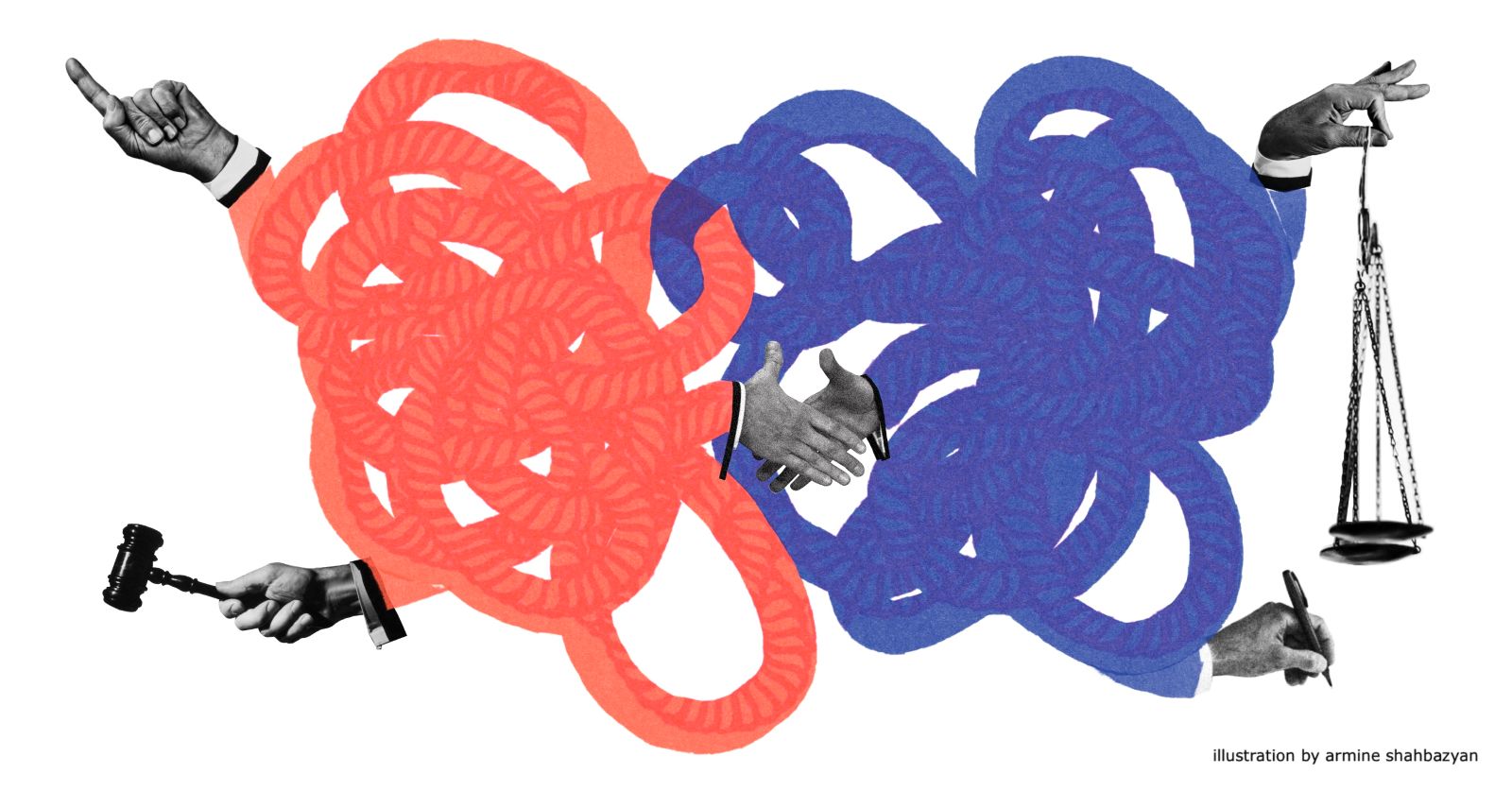
What the peace agreement does is prioritize peace over justice. The question of what should come first, peace or justice, is an old question in the field of transitional justice. The prevailing view is to find a balanced, context-specific approach where peace and justice mechanisms complement one another. However, that often means one is at least partially sacrificed to preserve the other.
The peace agreement limits the pursuit of justice, but perhaps less significantly than many might assume. Lawyers prize court rulings because they establish legal certainty and create authoritative judgments that others (including other courts) can rely on. For victims though, a successful judgment might not result in any meaningful justice for them.
Justice is bottom-up, not top-down. From decades of experience, we’ve learned that achieving a sense of closure after a period of grave injustice requires a response that is inclusive, victim-centered and supports community ownership. A top-down imposed sense of justice achieves none of that. Examples of successful bottom-up approaches to achieve a sense of justice among the broader populace are South Africa’s Truth and Reconciliation Commission, created after apartheid, and Rwanda’s Gacaca trials established after the genocide. Both mechanisms gave victims an opportunity to share their experiences publicly, while incorporating processes aimed at holding offenders responsible.
Even with almost unlimited resources, top-down approaches can fail at producing social reconciliation. The most prominent example is the former Yugoslav states. The International Criminal Tribunal for the former Yugoslavia was created by the United Nations to prosecute war crimes, genocide, and crimes against humanity occurring during the Yugoslav wars. It operated for 24 years and was successful in indicting 161 alleged perpetrators and holding 111 trials. From the perspective of legal administration, the Tribunal was a success. From the perspective of social healing, it was an abject failure. Slobodan Milošević was charged with sixty-six counts (he died before his trial ended) yet is still praised as a great leader, denial of the Srebrenica genocide still exists, and distrust and prejudice between the peoples in the area remains strong. For all the good the Tribunal made in establishing a historical record and putting perpetrators in jail, many people on the ground were dissatisfied with it, denied its findings, and felt that justice was not done.
This peace agreement cements what we already knew: justice and closure won’t come from above but must come from the people. The pressing question, then, is how. From a legal standpoint, the peace agreement does not restrict cases brought by individuals. This means that cases brought by individuals to the European Court of Human Rights, national ombudsmen, or to UN bodies are unaffected. These methods can still establish a record of rights violations and potentially ensure compensation for the victims. However, beyond these individual pathways there is the possibility of something grander: a truth commission involving both Armenians and Azerbaijanis.
A truth commission is an official, nonjudicial body tasked with establishing the facts after a period of mass human rights abuses. It’s a tool used in the field of transitional justice after a systemic change has, such as a peace agreement, allowed for an investigation into past abuses, abuses too expansive for a traditional judicial system to manage effectively or fairly. Notable examples include South Africa’s Truth and Reconciliation Commission, developed after the fall of apartheid regime, and Colombia’s Comisión de la Verdad, established through the peace accord between the government and the FARC-EP rebels.
The scale of extrajudicial killings, mob violence, declarations of hate, and episodes of ethnic cleansing that have occurred between Armenia and Azerbaijan since the break-up of the Soviet Union is more than any judicial body, be it the International Court of Justice or the European Court of Human Rights, can thoroughly address. For any sort of comprehensive justice to occur, there needs to be broad engagement of both populations. This is something only a truth commission can provide. The alternative is to end the frozen conflict but remain in a cold peace.
One precedent exists for a truth commission between two states: the joint effort of Indonesia and Timor Leste. It was created to investigate the atrocities committed during Indonesia’s brutal response to Timor Leste’s independence referendum, where the Indonesian military killed 100,000–180,000 people. Despite being the clear perpetrator, Indonesia agreed to participate, and when the commission released its final report condemning abuses by the Indonesian military, the president fully endorsed the report. Indonesia was willing to do this because the truth commission provided an opportunity to turn the page, avoid lengthy individual prosecutions, and normalize bilateral relations.
To be clear, a bilateral truth commission between Armenia and Azerbaijan isn’t going to materialize any time soon. Expecting one now is as unrealistic as thinking the two governments could sign a single document that resolves all the problems between them. The point is simpler, but essential: anyone who advocates for justice should know that the work doesn’t end with a signature. A peace agreement can set the terms for interstate relations, but on its own it cannot resolve injustices, deliver accountability, or heal relations between people.
Opinion

What Does Armenia Stand to Gain? Musings on the Washington Signing
The Washington documents mark a new stage in Armenia-Azerbaijan talks, lowering the risk of renewed war for at least three years, writes Davit Petrosyan. Armenia’s challenge is to use this window of opportunity to strengthen its security and spur economic development, as the real outcome hinges on what follows, not what’s signed.
Read morePolitics

U.S.-Brokered TRIPP in the Armenia-Azerbaijan Deal: Opportunities and Risks
The proposed “Trump Route for International Peace and Prosperity” (TRIPP) has sparked sharp debate in Armenia. Sossi Tatikyan explores its origins, legal and operational framework, geopolitical implications, and the controversies it has stirred both domestically and internationally.
Read more
Iran’s Strategic Uncertainty and Armenia’s Security Challenges
Amid Iran’s strained ties with Israel and the U.S., fragile diplomacy, and shifting regional alliances, Armenia faces heightened security risks. These dynamics could trigger a broader realignment of power in the South Caucasus, directly shaping Armenia’s future stability. Anna Gevorgyan explains.
Read more