

Listen to the AI generated audio article.
The French president’s historic visit to Damascus on July 7 returned Syria to the center of regional diplomacy, as if Kissinger’s old adage had regained fresh relevance: “You cannot wage war in the Middle East without Egypt, nor make peace without Syria.” Yet Syria is increasingly becoming the laboratory of a new regional balance, as competing powers seek to shape the post-Assad order. Today, Syria resembles a patchwork of competing spheres of influence, with each regional and international power pursuing its own objectives. The tension between these rival projects will largely determine the future of the Levant, with Lebanon likely to serve as the first barometer.
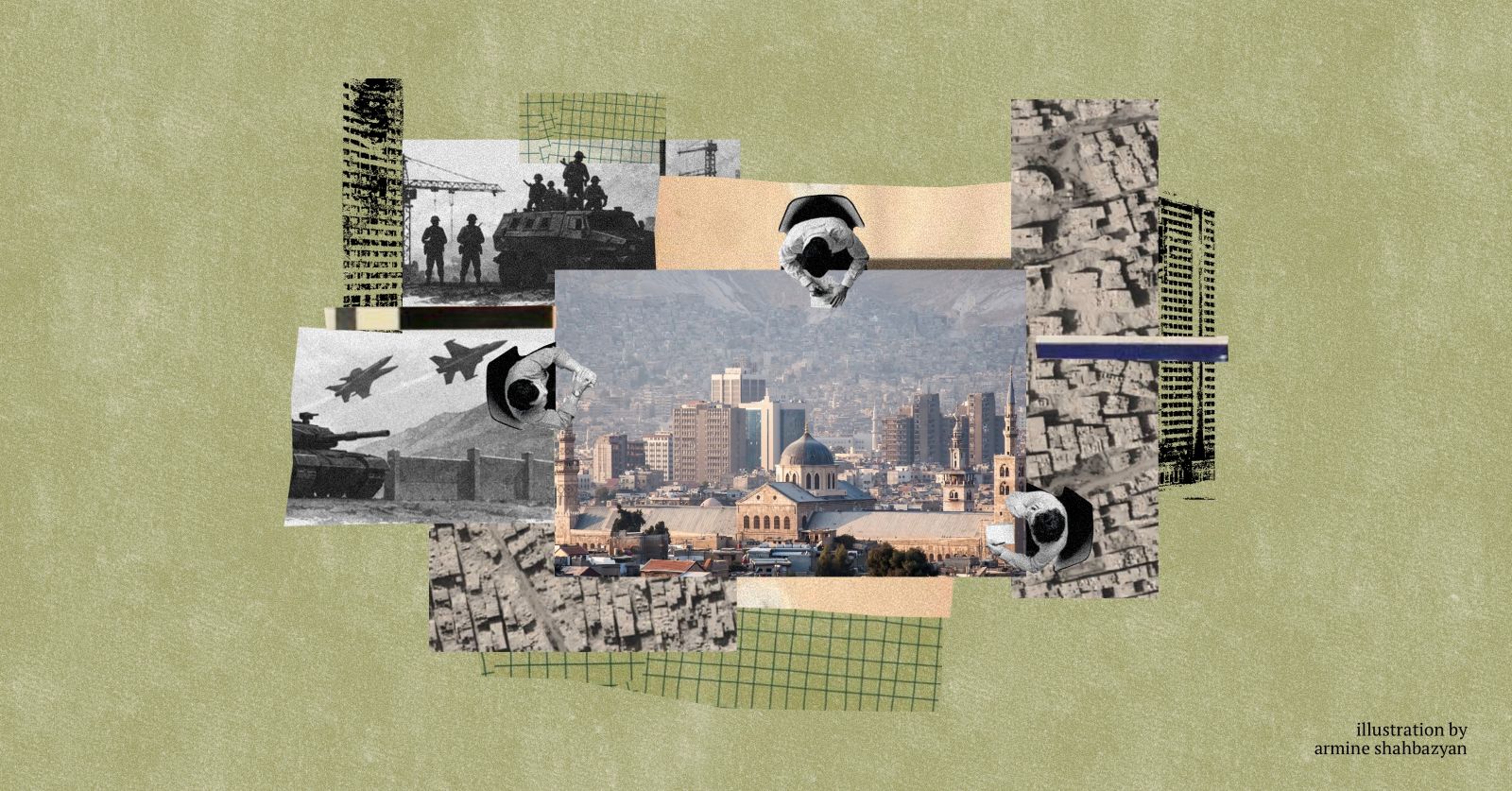
In 1965, British journalist and author Patrick Seale described Syria as a “mirror of rival interests” among regional and international powers in The Struggle for Syria: A Study of Post-War Arab Politics, 1945–1958. Sixty years later, his diagnosis remains strikingly relevant. After 13 years of devastating war, Syria has once again emerged as a geopolitical center of gravity in the Levant. The actors have changed, but the contest for influence remains. Where Nasser’s Egypt, Hashemite Iraq, Israel, the United States and the Soviet Union once competed to shape Syria’s trajectory, today Turkey, Israel, Saudi Arabia, Qatar and the United States and, to a lesser extent, Russia are vying to shape the country’s post-Assad order.
In this theater where the balance of the Middle East is being played out, the main protagonists are pursuing competing ambitions. Saudi Arabia intends to have a say in Damascus’ foreign policy since it is helping finance reconstruction. Israel wants to preserve its strategic depth and prevent any threat to its northern borders, even if that means contributing to Syria’s long-term fragmentation by cultivating ties with the Druze community. Turkey, for its part, aspires to become the dominant external power in post-Assad Syria. The future stability of Lebanon, the fate of the Kurds, and the recomposition of the entire Levant may well depend on this confrontation.
For Turkey, Syria offers strategic depth and is central to several of Ankara’s security priorities: control of the north of the country, neutralization of Kurdish organizations linked to the PKK, securing its southern border, and the installation of a Syrian government compatible with its interests. Added to this is a broader ambition: to make Syria the heart of a Turkish sphere of influence in the Levant, using reconstruction, infrastructure, trade networks, and military cooperation to extend Ankara’s political and economic influence. The reconfiguration of Aleppo, Syria’s economic capital, illustrates this dynamic as its economy, infrastructure and trade networks become more closely integrated with Turkey.
Israel, for its part, is guided by a different strategic logic. Its objective is not to shape Syria’s future but to prevent it from once again becoming a military platform capable of threatening Israeli security. The gradual weakening of the Iran-Syria axis does not mean the end of belligerence. Tel Aviv seeks to preserve complete freedom of military action, prevent the deployment of advanced weapons and military capabilities near the Golan Heights, and maintain a de facto buffer zone in southern Syria. Any lasting presence of foreign forces likely to restrict this freedom is perceived as a strategic threat.
These priorities risk dividing Syria into competing spheres of influence. In the north, Turkey is seeking to consolidate its military, political and economic influence; in the south, Israel continues to enforce its own red lines through preventive strikes and an indirect security presence.
Between these two competing strategies, Damascus risks becoming less the decision-making center of a sovereign state than the object of permanent competition between outside powers. This new balance has one essential feature: it makes an open war between Turkey and Israel unlikely, but renders an indirect conflict far more likely. Confrontations could take the form of proxy warfare through allied armed groups, clandestine operations, targeted strikes, intelligence operations, influence campaigns, and shows of force designed to test the other side’s red lines without crossing the threshold into direct confrontation.
Israeli Hegemony Shaken by Neo-Ottoman Ambitions
This strategic assessment cannot be reduced to military considerations alone. In Jerusalem, Turkey is no longer seen as merely a difficult partner, but as a revisionist power whose regional ambitions could, in time, rival Israel’s strategic superiority. For more than two decades, Israeli security doctrine focused on the Iranian threat and the “axis of resistance” linking Tehran to Beirut via Damascus. The dramatic weakening of this axis has not produced a safer environment; on the contrary, it has opened up a new arena of competition with a NATO member state—one endowed with a rapidly expanding defense industry, growing power-projection capabilities, and now decisive political influence over Syria’s new authorities.
This shift helps explain Israel’s close scrutiny of any Turkish attempt to establish a military presence in Syria. An air base protected by modern air-defense systems would considerably reduce the freedom of action the Israeli air force has enjoyed over Syrian territory for more than a decade. For Israeli strategists, the stakes extend beyond Syria: the goal is to prevent an outside power from gradually eroding the operational superiority that underpins Israel’s doctrine of deterrence.
This concern is even more acute as Western allies increasingly seem to regard Turkey as an indispensable partner once again. In a recent analysis published by Foreign Policy, German historian Stefan Ihrig notes that the strategic needs of NATO, Europe, and the United States are driving a rehabilitation of Ankara, despite the authoritarian drift of Erdoğan’s regime. Turkey now appears indispensable to Euro-Mediterranean security because of its geographic position, arms industry, control of the straits, and channels of communication with Moscow, Tehran and Damascus. But the author warns that such a strengthening of Turkey “would certainly not be a victory for Greece or for Israel,” where Erdoğan’s aggressive rhetoric “will continue to fuel deep concerns.” In other words, Turkey’s return to the heart of the Western system could paradoxically increase tensions in the Levant rather than ease them.
Turkey’s Expanding Reach in the South Caucasus
This dynamic is not confined to the Levant: it also extends into the South Caucasus, where Turkey has steadily expanded its regional influence since the 44-Day War of 2020. Its military support for Azerbaijan, the “one nation, two states” relationship with Baku and its leadership in the Organization of Turkic States all reflect an ambition to deepen Turkey’s political, economic and transport links eastward, from the South Caucasus to Central Asia. Ankara views prospective regional transport links, including TRIPP, as potentially strengthening connectivity with Azerbaijan and the wider Turkic world.
At the same time, Turkey’s expanding role remains constrained by the interests and relationships that shape the region. Its close strategic partnership with Azerbaijan continues to influence the pace and scope of normalization with Armenia, despite the appointment of special envoys and agreements on steps toward opening the land border. New transport links are similarly geopolitically sensitive. Iran has expressed concern over aspects of the U.S.-backed TRIPP project and its potential implications for the regional balance, while repeatedly emphasizing the importance of preserving internationally recognized borders and its direct connection with Armenia.
These parallel dynamics extend Ankara’s geoeconomic reach toward the borders of Russia and Iran and strengthen its role in shaping regional security, while also exposing the limits of its room for maneuver. In the South Caucasus, as in the Levant, Turkey is therefore not unilaterally imposing a new regional order. Rather, it is expanding its influence within a landscape shaped by alliances, competing interests and the strategic constraints imposed by other regional powers.
Lebanon, Victim of Turkish-Israeli Rivalry in the Levant
Any escalation between Turkey and Israel would have consequences for Lebanon and Syria. Israel would continue to regard Hezbollah as its most immediate threat, while Turkey might be tempted to expand its influence among some Sunni communities in the country’s north, particularly in Tripoli and the Akkar region. Lebanon may not become a primary arena of confrontation, but its political fragility and exposure to competing regional interests could once again make it vulnerable to rivalries playing out beyond its borders.
The more significant development, however, lies elsewhere. For two decades, the dominant reading of the Middle East centered on the Israel-Iran confrontation. That rivalry remains central, but it no longer fully explains the regional realignments now underway. The emerging competition between Turkey and Israel is less an ideological confrontation than a contest over the shape of the regional order. Who will have the greatest influence over security in the Levant? Who will shape Syria’s reconstruction? Who will exert decisive influence over the new political order in Damascus?
Sixty years ago, Patrick Seale described Syria as the battlefield for the ambitions of others. His observation retains all its force. But this time, the question is no longer simply which powers are competing for influence in Syria; it is what kind of regional order will emerge from that competition. And it may be in Syria and the wider Levant, as much as in Gaza or the Gulf, that the Middle East’s next strategic architecture is beginning to take shape.
Recently published

Traveling With a Lost Homeland
What does travel mean when you can’t return to the one place you most long for? Journeying through Morocco, Siranush Sargsyan finds traces of her lost homeland, Artsakh, in unfamiliar landscapes, traditions and people, revealing how displacement transforms the experience of elsewhere.
Read more
Why the Creative Class Won’t Save Yerevan
Yerevan may be culturally vibrant, but who has the power to shape the city? Heghine Pilosyan examines why artists and intellectuals cannot safeguard its cultural identity alone, as redevelopment, commercial interests and weakened institutions redefine what, and whom, the city is built for.
Read more
Built for One Era, Tested by Another: Armenian Tech and AI
AI has disrupted the assumptions on which many technology companies were built. Through Wirestock, Renderforest and CodeSignal, Ellen Tovmasyan explores how Armenian-founded companies are adapting their products and business models to remain competitive in a rapidly changing global market.
Read more
Women, Mining and the Unpaid Labor of Reproduction
Women are increasingly visible in Armenia’s mining industry, but employment does not necessarily mean equality. In Kajaran, Gayane Ghazaryan explores how women navigate hazardous work, limited economic alternatives and the unpaid domestic labor that begins when their shifts end.
Read more