

Listen to the AI generated audio article.
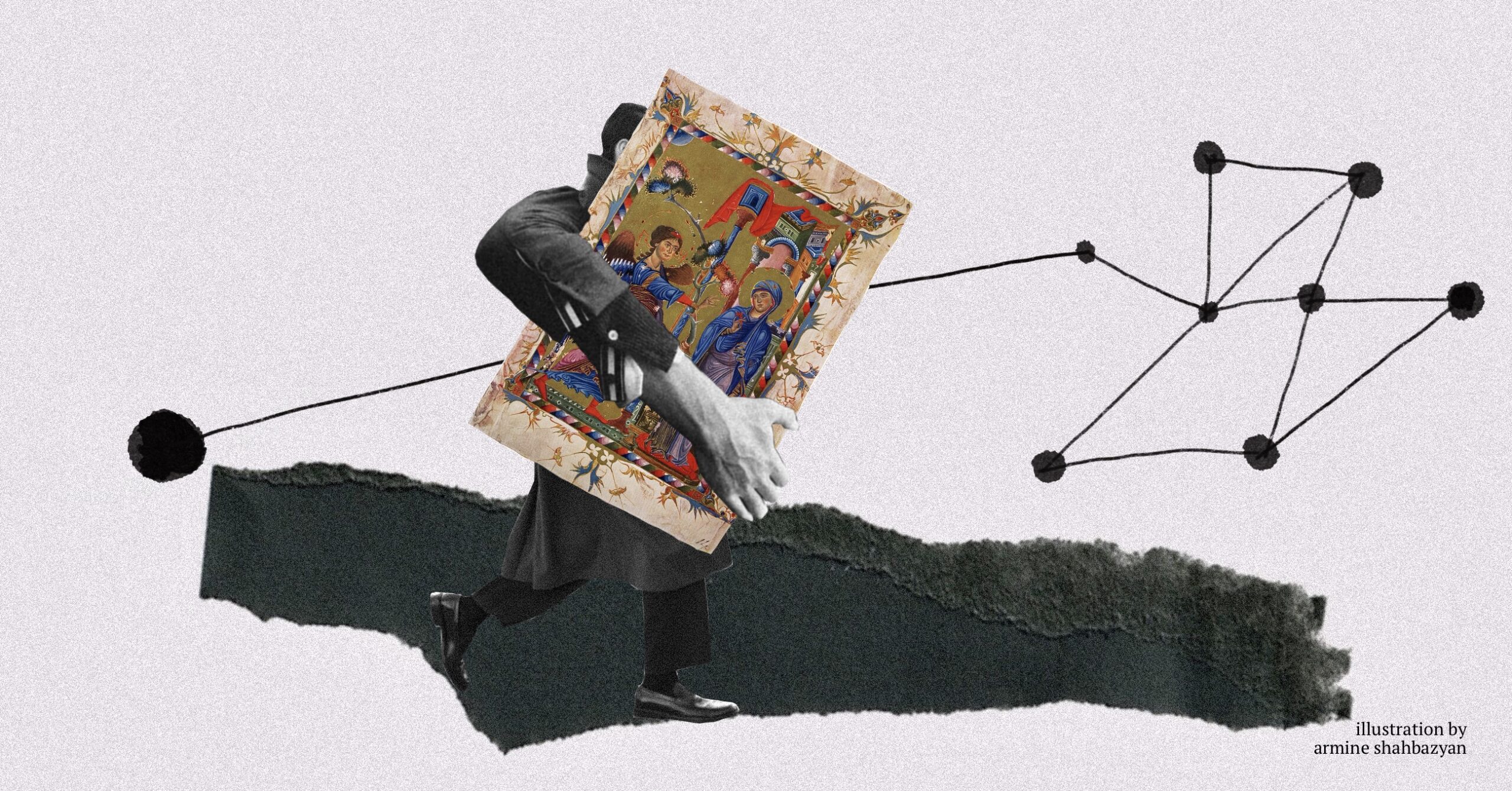
In 1607, the scribe Khachatur of Khizan completed a richly illuminated manuscript of the New Testament. He had begun his work in Khizan, near Lake Van, but finished it in Isfahan, where he had been taken during the forced relocation of Armenians into the Persian interior on the orders of Shah Abbas. In a note left in the manuscript, Khachatur recalls the events of 1604 and describes the “suffering, destruction, and ruin of the Armenian homeland.” Ten years after the deportations, another scribe was already referring to Isfahan as “my land of Isfahan.”
Gradually, the new place became home, but the old one was never forgotten.
Where Does a Nation Exist?
Armenians constantly ask themselves who they are. But sooner or later, this question leads to another: what is a nation, does it exist, and, most importantly, where does it exist? Today, this is no longer just an academic question. The main foundations of Armenian identity have come under question: the memory of the Genocide, Artsakh, and Armenian history itself, with its traditional connection between the past and the land.
This brings us to a paradox that is difficult to ignore. Can Armenians accept the political loss of a territory while preserving its memory? And more broadly, is reconciliation possible without historical amnesia?
The answer begins with a simple observation. Memory is neither a storehouse of recollections nor a political program in itself, though it can be the product of one. It is connected to history, which we read selectively, deciding what to preserve and what to leave in the past. Most often, we want to remember who we once were. But this memory inevitably takes us to places that now lie beyond Armenia’s borders: Van and Mush, Ani and Kars, Nakhichevan and Artsakh. This is why our sense of belonging is closely tied to places we have never visited and events we have never experienced. An Armenian from Yerevan or Los Angeles may identify as someone from Mush or Van, even if neither they nor their parents have ever lived there.
For many, this memory becomes a basis for territorial claims, and it would be dishonest to pretend otherwise. But territorial claims are only one possible interpretation of this memory, and not necessarily the most accurate one. Modern borders answer the question of sovereignty, while historical memory answers a different question: where and how a people has existed over time. Preserving the memory of Van, Ani, Mush, Kars, Nakhichevan, and Artsakh is not the same as demanding their return.
To avoid confusing these concepts, we need to distinguish between three elements: territory, presence, and memory. Territory means the land and control over it. Presence means the people who live there. Memory is what continues to connect a people to the land even after they have lost control over it and are no longer present there. Armenian history offers a rare opportunity to see how these three elements can become separated, and what remains when the first two disappear.
The Memory We Choose
Before moving on, we should clarify what we mean by memory, people, nation and diaspora. Each of these concepts refers to different historical realities, and how we understand them largely shapes our answers to the questions we have raised.
For us, memory is not a single, unchanging view of the past, but a set of different ways of maintaining a connection to it. These include family histories traced back to the legendary Hayk, memories of a particular town or village, and cultural heritage passed down from one generation to the next. To understand how these forms of memory survive over time, we can turn to a distinction made by Jan Assmann. He identifies two types of memory: communicative memory, which lives on in the stories of witnesses and their descendants for several generations, and cultural memory, which relies on writing, rituals, and symbols and can survive for thousands of years.
This distinction is especially important for Armenian history. From an early period, Armenian writing also served as a way to preserve the past. Later came the hishatakarans, memorial notes left in manuscripts, which historian Sebouh Aslanian describes as “sites of memory.” Through them, names, events, and information about places were preserved, sometimes long after people had left those places behind. National symbols work in much the same way. Consider Mount Ararat, which has stood outside the borders of the Armenian state for more than a century but remains one of the most recognizable symbols of Armenia.
However, memory is preserved not only in books and symbols. It is also passed down within families, and later generations may experience what their ancestors went through almost as if it were their own. Literary scholar Marianne Hirsch describes this phenomenon through the concept of postmemory. It refers to the relationship of the second generation to powerful, often traumatic events that took place before they were born. This connection to the past is formed not through personal memories, but through stories, imagination, projection, and creativity. In the Armenian case, the most obvious example is the memory of the Genocide. But a similar process can also be seen in the preservation of regional identities. A descendant of repatriates from Kessab in Syria, who grew up in Yerevan, may feel nostalgic for a village they have never seen. What matters here is not so much ancestry itself, but the ability of an inherited past to become part of one’s personal identity.
This understanding of memory also encourages us to look differently at the relationship between a people and its territory. Here, we draw on the work of anthropologist Liisa Malkki, who showed that the idea of peoples as communities necessarily “rooted” in a particular state territory is neither natural nor universal. It is a historically developed way of thinking, found not only in nation-states but also in academic research. Historian Benjamin Braude, writing about the pre-modern world, similarly noted that attachment to a homeland did not always imply the kind of exclusive territorial belonging associated with the modern nation-state. Therefore, when discussing the historical connection between Armenians and particular places, we should be careful not to project modern ideas of borders and sovereignty onto the past.
A People Without a State of Their Own
It is commonly assumed that every nation has its “own” territory, usually the land where its nation-state exists or is supposed to exist. However, for most of Armenian history, the lands inhabited by Armenians did not fit within the borders of a single state. The very idea that every nation needs its own state with clearly defined borders emerged much later.
The desire to define one’s “own” territory inevitably leads to a search for ideal borders. In the 19th and 20th centuries, such claims repeatedly became causes of war. Yet, as Razmik Panossian notes, 19th-century Armenian intellectuals imagined their homeland as a space encompassing the Ottoman vilayets and Russian Armenia, without trying to draw its exact borders. The idea of a historical homeland could therefore exist without the need to define it politically.
But the Armenian world took shape not only in the historical homeland. It also included communities far apart from one another, where Armenian culture continued to develop. Between the 17th and 19th centuries, New Julfa, Constantinople, Tiflis, Venice, and Armenian settlements in India became some of its most important centers. During this period, much of Armenian cultural and intellectual life shifted from the historical homeland to diaspora communities. In the 20th century, Lebanon became especially important, with its Armenian community emerging as a model of diaspora life in the 1920s and 1930s. Armenian communities in Russia also continued to play an important role.
Diaspora can shift the sense of belonging from a particular homeland to a wider transnational community, and this sense of belonging does not necessarily involve a desire to return. In other words, the Armenian world was united not only by a shared historical territory, but also by connections between communities located far from one another.
However, the transnational nature of the Armenian world does not mean that territory lost its importance for national identity. The belief in the right to ancestral lands remains one of the foundations of national identity. The question, rather, is how Armenians understood and maintained their connection to their historical lands during periods when they had no political control over them. To find an answer, we need to look back long before the emergence of modern nation-states.
A Space Created Through Words
The idea of an Armenian space was shaped not only by political borders, but also through historical writing. Historian Tim Greenwood shows that even in Late Antiquity, there was no single understanding of this space. Alongside the political territory of the Arsacid Kingdom, which came to an end in 428, there was also an ecclesiastical space; a network of bishoprics under the authority of the Catholicos. Armenian authors, meanwhile, described it as the land of Hayk’s descendants, without defining its exact borders. It is impossible, however, to know how widely these ideas were shared at the time. We are dealing primarily with a literary tradition.
Yet this tradition made it possible to preserve the image of a united Armenia even when political reality did not reflect it. As Greenwood notes, Armenian authors sought to create a sense of a distinct Armenian space, sometimes in contrast to existing administrative divisions. This is especially clear in the History of Armenia by Movses Khorenatsi. By tracing Armenian ancestry back to the legendary Hayk, he connected the origins of the Armenian people to the biblical narrative, and their historical homeland to Mount Ararat and the surrounding lands. The story of the struggle between Hayk and Bel also became a story of freedom, resistance to tyranny, and the right to live on ancestral land. In this way, the idea of a historical territory was justified not so much through political power as through a shared sense of origin and history.
Another example is the Ashkharhatsuyts, an Armenian geographical work from the early Middle Ages. It presents Greater Armenia as a single space made up of 15 provinces, despite the political, religious, and linguistic divisions that existed at the time. The author also describes regions that had already passed under the control of neighboring states, including Artsakh, which had been transferred to Caucasian Albania. As Greenwood observes, the geography of Greater Armenia was already historical when the text was written: its greatest territorial extent had long been a thing of the past. Thus, the Ashkharhatsuyts described not only a geographical space, but also how that space continued to be remembered.
However, historical memory did more than preserve the past. It could also reshape its boundaries, emphasizing some territories while leaving others aside. Greenwood draws attention to the fate of Roman Armenia, which became, in Armenian historical tradition, “not a silent space, but a silenced one.” In other words, the idea of the Armenian world was shaped not by the full range of historical experience, but by what authors considered worth preserving.
Written memory became especially important after the deportations of the early 17th century. Historian Aida Gureghyan shows how hishatakarans helped Armenians make sense of exile and preserve their sense of community. She compares these records to “a family album of the Armenian people, filled with images of the past, interpretations of the present, prayers, and hopes for the future.” At the same time, the authors of hishatakarans can hardly be called impartial witnesses. Historian Avedis Sanjian criticized them for their limited perspectives and tendency to dramatize events. But as Gureghyan argues, when studying how Armenians understood themselves and their past, this subjectivity is not an obstacle but an important feature of the source.
Over time, the ways of representing this space also changed. Sebouh Aslanian compares two maps that illustrate this shift. The first, created in the late 17th century, depicts Armenia through the locations of some 800 sacred sites, without clear political borders. As Aslanian describes it, this space was “fuzzy rather than geometric.” The second map, commissioned by the Madras merchant Shahamir Shahamirian in 1778, presents Greater Armenia with cities, rivers, mountains, and a capital in Yerevan. While the first map reflects the sacred geography of the Armenian world, the second shows an attempt to imagine it as a future political entity.
This distinction is also important for today’s discussion about Armenia. When Prime Minister Nikol Pashinyan speaks of the Republic of Armenia’s territory of 29,743 square kilometers and calls on Armenians to stop looking for a homeland beyond its borders, he is speaking not only about state boundaries but also about the very meaning of homeland. Yet the borders of a sovereign state and the historical space of a people are not the same thing. Reducing Armenian history and the geography of its memory to the present-day territory of the republic means ignoring how Armenians have understood and imagined their homeland over the centuries.
Multilocality
For centuries, the Armenian world existed in many centers at once.This dispersion, often described as multilocality, allowed communities living under different political authorities and across great distances to maintain connections and sustain a shared cultural life. They were united by faith, historical memory, and, later, the idea of the nation. At the same time, there was no single understanding of Armenian identity. As Razmik Panossian notes, Armenians “were, and remain, a heterogeneous nation” that did not develop around a single center.
This dispersion also had its advantages. Panossian refers to historian George Bournoutian’s observation that the lack of political unity proved to be a “blessing in disguise” for Armenians: their culture continued to develop even after kingdoms fell and capitals were destroyed. As some centers declined, others preserved and developed Armenian cultural life.
Much of this was made possible by the communities’ own resources. Armenian merchants, “partly out of a sense of duty, partly out of faith, and partly out of social and commercial necessity,” financed the construction of churches, the opening of schools, printing and intellectual projects. The wealth of New Julfa played an especially important role, supporting cultural activities far beyond the community itself. In this way, diaspora centers took on some of the functions performed by the state in European countries, particularly in education and culture. Yet their activities were not directed from a single center.
Different communities also developed their own ideas of what it meant to be Armenian. For example, the Mkhitarists in Venice did not invent the Armenian nation, but rediscovered it for the modern age. However, their activities faced opposition. Catholicos Simeon of Yerevan considered Armenian Catholics and the Mkhitarists “alien and hostile to Armenian identity.” At the same time, the spread of printing in the 17th and 18th centuries helped shape a religious understanding of the Armenian community centered on Etchmiadzin. Thus, the cultural revival was not a single, unified process: different centers defined what it meant to be Armenian in their own ways.
From these scattered and sometimes conflicting activities, the Armenian national movement of the 19th and 20th centuries gradually emerged. Panossian identifies three main centers where it took shape: Constantinople, connected to Armenian intellectual circles in Europe; Tiflis, which maintained close ties with Moscow, St. Petersburg, and Dorpat; and the six vilayets of Ottoman Armenia. Their interaction helped develop the national idea, but it also reinforced differences between Western and Eastern Armenians, laying part of the groundwork for the later division between homeland and diaspora.
Diversity was also present within the communities themselves. In Lebanon during the 1920s and 1930s, there were more than 30 Armenian hometown associations that maintained ties to particular towns and regions of the historical homeland. Secular diaspora leaders sometimes called them “useless weeds,” believing that such associations stood in the way of unity. In this way, the desire to preserve local identity could come into conflict with the idea of a shared national belonging.
This historical experience is also important for modern Armenia. The republic exists primarily because of its citizens, who contribute to its development and bear responsibility for its future. But Armenian national life has never been limited to the population of a single state. The diaspora has helped shape Armenian national culture and historical consciousness while living outside the homeland. Its voice, therefore, cannot be excluded from the broader Armenian discussion simply because of where its members live. A separate question is how this voice should be taken into account when making political decisions that primarily affect the people living in the republic.
Multilocality, therefore, does not imply complete unity or equal influence of all communities on national life. Its significance lies elsewhere: Armenian culture and identity developed through the interaction of many centers, each preserving its own distinctive features while contributing to a shared historical process.
Two Memories of One People
For a large part of the Armenian people, the shift from presence to memory came as a result of the Genocide. Razmik Panossian calls it “the cornerstone of modern Armenian identity, especially in the diaspora.” It marked both a break with the past and the historical homeland, and became a lens through which later generations understood their national history. The Genocide brought an end to the Armenian presence in much of historical Armenia. For the descendants of survivors, this is precisely what postmemory means: events they never witnessed become part of their lives through family stories, photographs, and rituals.
This brings us to an important difference that should not be overlooked. The 20th century Armenian diaspora was predominantly Western Armenian, and its historical homeland was not Soviet Armenia, but Western, Ottoman Armenia. Eastern Armenians gained statehood of their own, first as an independent republic and then as a Soviet republic, while much of Western Armenian life continued in the diaspora. Historical and symbolic Armenia was larger than the Armenian state, and for many diaspora Armenians, it was this wider Armenia that remained their homeland. For generations, they grew up hearing stories about the “old country,” preserving their identity in foreign and sometimes hostile surroundings. This is why many are willing to support reconciliation with Turkey, but not at the cost of giving up their symbolic Armenia. For direct descendants of Genocide survivors, this memory is sometimes all that remains of their ancestral homeland.
It is possible that, over time, identity within the Republic of Armenia will become increasingly state-centered and civic, while diaspora identity will remain largely historical, rooted in ancestry, and connected to a homeland beyond any single territory. Panossian notes that the homeland and the diaspora have never developed a single, uniform sense of national belonging. After 1991, Armenians on both sides of this divide became especially aware of just how different they were.
This makes the policy of homogenization all the more dangerous. I am not talking about ethnic homogeneity: Armenia was already the most ethnically homogeneous of the Soviet republics. I mean the attempt to bring the entire diversity of Armenian memory under a single state-approved narrative. In my view, this is exactly where the current policy is leading: in the name of promised reconciliation with neighboring countries, Armenians are being asked to limit their idea of their homeland to the borders of the republic. And this reconciliation is supposed to take place on their neighbors’ terms. This is unacceptable. Such a policy risks dividing Armenians into opposing camps rather than bringing them together. Yet diversity itself is not a threat to a nation as long as a strong sense of shared belonging remains.
In fact, something similar has happened before. During the Soviet period, ARF-Dashnakstutyun circles abroad viewed Soviet Armenia as a puppet state run by atheist communists, while the Ramkavars supported it. The Soviet leadership, in turn, saw the diaspora as “merely an appendage with no purpose of its own.” Today, we are once again being offered a Frankenstein’s monster of a nation-state, in which Armenian citizens are expected to be cut off from a living part of themselves, while only state borders, symbols and manifestos are considered worthy of attention. But can a people really be separated from its history so easily, and can this separation then be declared a condition for its future? Panossian warned that the concept of citizenship should be used with caution when discussing Armenians: citizenship is tied to the state, while the Armenian community has historically existed without a state of its own.
At the same time, the Soviet state was not simply a machine for forgetting. Under Stalin, a “state-imposed collective amnesia” was enforced, which repatriates tried to overcome in their private lives. But later, the same state erected memorials to the victims of the Genocide and the Battle of Sardarapat. And as early as 1962, at a celebration of the Armenian alphabet, Hovhannes Shiraz openly asked in his poetry when Ani, Ararat, Kars, and Ardahan would be returned. Even the state’s own memory policy, then, was not fixed. And there is no reason why the current course must become permanent.
With independence came another contradiction. In the 1990s, Levon Ter-Petrosyan insisted that political decisions should be made “here, on this land”: the government represented those living in Armenia, “the core of the nation,” while the diaspora could provide financial support. There is a clear logic to this: the future of a state should be decided primarily by its citizens. They pay taxes, defend the country, and live with the consequences of political decisions. But does this mean that Armenians outside the republic should remain silent about the fate of their historical homeland? If the right to take part in national life had always depended on one’s registered place of residence, the Armenian national revival itself would hardly have taken place.
Today, this contradiction has become even sharper. It is as if we are being asked to accept that if a territory no longer belongs to the Armenian state and Armenians no longer live there, we can simply forget about it and the heritage built up there over centuries. This creates a strange logic: the absence of an Armenian presence is supposed to justify abandoning the memory of that presence as well. But preserving this memory is precisely what Armenian culture has worked to do for centuries.
Such an approach could drive the state and the diaspora apart, leaving each trapped in its own bubble. One side could retreat into revanchism that cannot be put into practice. The other could become willing to pay any price for the illusion of an “era of peace,” presented as requiring the abandonment of the historical and political foundations of Armenian statehood established in the 1990s. This kind of division has happened before. In the 1990s, the image of the homeland and diaspora as “two wings of one bird” was soon replaced by the bitter realization that the bird could not fly. At times, things reached the point of absurdity: in 1995, one Dashnak wrote that it would be better for Armenia to be occupied by Turkey than to be ruled by Ter-Petrosyan. Radicalism, as we can see, is not limited to one side. The relationship between the republic and the diaspora can and should be reconsidered, but not under threats and not as an either-or choice.
What is even more troubling is something else. With the emergence of an Armenian nation-state, diaspora institutions risk no longer seeing themselves as independent guardians of Armenian identity. The responsibility for preserving Armenian identity is increasingly being passed on to the republic, whose citizens already have to live through constant challenges. But why should a state established at the end of the 20th century bear sole responsibility for the historical heritage of a people that has existed for thousands of years?
This is why preserving Armenian multilocality should become one of the main priorities for Armenians living outside the republic. The diaspora is not an extension of the state or a spare wallet to turn to whenever another crisis strikes. It remains a pillar of support for the historical homeland in its own right, however distant, forgotten, or even unloved that homeland may sometimes seem. Otherwise, the Armenian people will be putting all their eggs in one basket — a state they regained only recently. And Armenian history teaches us to handle that basket with care.
Armenia, cut off from the diaspora even at a symbolic level, may become more politically independent, but also more vulnerable. A large, well-organized diaspora is almost as important to the survival of a nation as its own state institutions. It cannot replace the state in every respect, but it can sustain Armenian life where state power is weak or absent. And after so many centuries of history, giving up this advantage would perhaps be the strangest decision of all.
Normalization Is Not the Same as Reconciliation
Reconciliation requires two equal partners, but today the Armenian side is far from always being treated as an equal. This is the main problem. It is important here to distinguish between two concepts. Normalization concerns relations between states: borders, diplomacy, and trade. Reconciliation is about how societies deal with a shared and often painful past.
Normalization is increasingly being presented as reconciliation. But one cannot replace the other. History, memory, and cultural heritage can become a foundation for closer relations rather than an obstacle to them. Architectural historian Heghnar Watenpaugh uses the example of Ani to show how heritage can stand between conflict and reconciliation. Recognizing the city’s Armenian past does not mean demanding changes to modern borders. But how can reconciliation happen if one side refuses to acknowledge the other’s very presence in their shared history?
For this to happen, all parties need to be recognized as having a voice and agency: they must acknowledge not only their own history, but also the place of others within it. Otherwise, Armenia risks becoming a punching bag, expected to recognize everyone else while no one is required to recognize it. The political realities of neighboring countries make the situation even more difficult. Turkey and Azerbaijan are hardly known for democratic freedoms or the rule of law, and nationalist rhetoric supported by state institutions does little to build mutual trust. It is difficult to speak of reconciliation between equals when one side constantly finds itself having to justify its position.
And yet the conversation must begin. It should not begin with demands to humiliate the other side or force it to accept every condition in advance. In this sense, Armenians have also long been held back by their own belief that Turkey must first recognize the Genocide before relations can be established. This debate is not new. In the 1990s, Levon Ter-Petrosyan’s government was prepared to normalize relations with Turkey without preconditions, while the Armenian Revolutionary Federation (Dashnaktsutyun) insisted on recognition of the Genocide. The diaspora generally took a harder line than the republic.
But we must not forget the trauma, the slap in the face that Armenians continue to receive from their two neighboring states. Denial of the Genocide is not simply a dispute over historical facts. It is a refusal to acknowledge another people’s tragedy and their right to speak about their own past. Holocaust denial carries a heavy reputational cost, while denial of the Armenian Genocide too often comes at almost no cost at all. How, then, can Armenians be expected to simply turn the page?
This is why dialogue can begin without preconditions, but reconciliation is impossible without recognition. Recognition should not be an entry ticket to dialogue, but its necessary outcome. Otherwise, we may end up with open borders, diplomatic relations, and trade, but without overcoming the historical conflict. There is nothing wrong with that if the goal is normalization. The problem begins when normalization is presented as reconciliation and Armenians are asked to forget the past in return.
At the same time, revisiting our own history is not only acceptable but necessary. Every generation returns to the past, chooses its heroes, reexamines myths and traditions, and tries to respond to the challenges of its time. Panossian describes this process more precisely than the familiar idea of the “invention of traditions”: Armenians did not create a new identity, but reinterpreted, renewed, and politicized an existing one. There is nothing wrong with this. On the contrary, this is how historical consciousness works.
But there is a fundamental difference between reinterpreting the past and abandoning it. Revising our understanding of history is one thing; rejecting it under pressure, for the sake of promised peace and within an imposed either-or choice, is quite another. If the price of reconciliation is historical amnesia, then what kind of reconciliation is it? And who, in that case, is reconciling with whom?
Memory as a Space
Memory is perhaps the only space that cannot be taken away along with the land: it travels with the people. The manuscript of Khachatur of Khizan, begun in Khizan and completed in Isfahan, is a clear example of this. Over the centuries, the ways Armenians maintained their sense of community have changed. In the 17th century, the Church was the main force holding the dispersed Armenian people together. For the 20th century, Panossian identifies a different foundation of unity: a subjective sense of belonging that gradually took the place of religion. Today, however, the Church itself has once again become a focus of political conflict. The actions of the current government increasingly resemble an attempt to “put it in its place”: to bring it under control and make it dependent.
There is no contradiction between faith and a subjective sense of belonging. The latter is shaped, among other things, by family stories, memories of the ancestral homeland, and ideas about a shared past. The Church, family, and the national idea can all lead to the same sense of community, even if people reach it in different ways. One does not have to live on ancestral land to consider it part of one’s own history.
The diaspora is one of the main guardians of this memory. For centuries, it has supported Armenian culture and passed it down to future generations, and one can only hope that this will continue. Especially now, when the Armenian government is increasingly pushing for a new understanding of the historical homeland limited to the republic’s present borders. The diaspora is not an appendage of the Armenian state, but an independent and inseparable part of the Armenian world. And no matter how hard others try to push it aside, it will always find a way to make itself heard. Almost like in Whack-a-Mole: push it down one hole, and it immediately pops up from another. Armenians have spent far too many centuries learning to live in different places at once to simply give that up now.
If the Republic of Armenia abandons this memory, it will cut itself off from a significant part of its own historical tradition. The state will then begin reinventing the Armenian nation within its borders, while Armenians outside those borders will continue searching for it without a state. And both sides will lose. Not because they must necessarily share the same political interests, but because neither can fully represent the entire Armenian historical experience.
This brings us back to the question we began with. It is possible to accept the political loss of land. But abandoning its memory is another matter. This memory is not a map of future borders or an obligation to reclaim what has been lost. It is the story of who we were and who we are. And if Armenians themselves agree to forget it, what will remain of the Armenia that existed beyond the borders of states for centuries and survived their fall?
Literature:
- Aslanian, Sebouh David. 2023. Early Modernity and Mobility: Port Cities and Printers across the Armenian Diaspora, 1512–1800. Yale University Press.
- Assmann, Jan. 1995. “Collective Memory and Cultural Identity.” Translated by John Czaplicka. New German Critique, no. 65: 125–33.
- Assmann, Jan. 2011. Cultural Memory and Early Civilization: Writing, Remembrance, and Political Imagination. Cambridge University Press.
- Brubaker, Rogers. 2005. “The ‘Diaspora’ Diaspora.” Ethnic and Racial Studies 28 (1): 1–19.
- Greenwood, Tim. 2019. “Armenian Space in Late Antiquity.” In Historiography and Space in Late Antiquity, edited by Peter Van Nuffelen, 57–85. Cambridge University Press.
- Gureghian, Aida. 2010. “Eternalizing a Nation: Armenian Hishatakarans in the Seventeenth Century.” Church History 79 (4): 783–99.
- Hirsch, Marianne. 2008. “The Generation of Postmemory.” Poetics Today 29 (1): 103–28.
- İçduygu, Ahmet, Irena Grigoryan, and Gülşen Doğan. 2025. “Armenia and Türkiye between Conflict and Cooperation: Explaining (with) Disaster Diplomacy.” Disasters 49 (2): e12674.
- Malkki, Liisa. 1992. “National Geographic: The Rooting of Peoples and the Territorialization of National Identity Among Scholars and Refugees.” Cultural Anthropology 7 (1): 24–44.
- Panossian, Razmik. 1998. “Between Ambivalence and Intrusion: Politics and Identity in Armenia-Diaspora Relations.” Diaspora: A Journal of Transnational Studies 7 (2): 149–96.
- Panossian, Razmik. 2006. The Armenians: From Kings and Priests to Merchants and Commissars. Hurst & Company.
- Watenpaugh, Heghnar Zeitlian. 2014. “Preserving the Medieval City of Ani: Cultural Heritage between Contest and Reconciliation.” Journal of the Society of Architectural Historians 73 (4): 528–55.

Introducing some
of the guests



Introducing some
of events


Recently published

My Neighbor, the Bear
In the village of Shatin, brown bears roam village streets, raid chicken coops and destroy orchards, bringing residents into growing conflict with a protected species. As habitat loss and human activity push bears closer to settlements, conservationists are searching for ways to protect both wildlife and the livelihoods of the people living alongside them.
Read more
Artsvanik: Life in the Shadow of a Tailings Dam
For decades, residents of Artsvanik have lived in the shadow of Armenia’s largest tailings dam. As the Zangezur Copper-Molybdenum Combine plans to expand the facility, the village continues to lose farmland and livelihoods. Through the lives and stories of its residents, Gayane Ghazaryan’s photo essay documents the human cost of mining and the promises of economic growth that have left communities behind.
Read more
A Thousand and One Afterlives: Ani at the History Museum of Armenia
Ani has been lost, remembered and reinvented in countless ways. From photographs and poetry to archaeology, satire and pilgrimage, a new exhibition at the History Museum of Armenia explores the many afterlives of the medieval capital, and how its ruins have continued to shape Armenian memory across borders and generations.
Read moreOpinion

Why a Russian 1,000 MW Nuclear Reactor in Armenia Would Be Problematic
As Armenia weighs its next nuclear reactor, the debate is about more than Russian versus American technology. MIT nuclear physicist Areg Danagoulian argues that a 1,000 MW reactor may be too large for Armenia’s grid, and could create new strategic and economic vulnerabilities.
Read more
Toward a Polycentric Transnation?
What if the Armenian Diaspora stopped asking what it can do for Armenia and began asking what it needs to become in its own right? Drawing on the history of New Julfa, Tigran Yegavian argues for a polycentric Armenian world in which Armenia and the Diaspora remain connected without one being subsumed by the other.
Read more
Tlön, Uqbar, Gandzasar: Notes on the Imaginary Land Called “Caucasian Albania”
Using Jorge Luis Borges’ imagined world of Tlön as a lens, Sebouh David Aslanian examines Azerbaijan’s decades-long reinvention of Caucasian Albania, arguing that a fabricated historical narrative has been deployed to appropriate Armenian heritage, erase the region’s Armenian past, and reshape the South Caucasus in the present.
Read more
From Survival to Statehood: Reflections on a Sovereign Armenia
Drawing on Armenia’s history and recent security challenges, K.M. Greg Sarkissian reflects on what sovereignty means for a small state navigating competing powers and argues that resilience depends not on choosing between geopolitical camps, but on strengthening institutions, diversifying partnerships, and building a country where Armenians can confidently build their future.
Read more
When “Diplomacy” Becomes a Vehicle for Information Manipulation
The European Union has invested heavily in Armenia’s resilience against foreign information manipulation. But when its own Special Representative reduces Azerbaijan’s state-sponsored historical revisionism to competing “narratives,” diplomacy risks becoming a vehicle for the very manipulation the EU seeks to counter.
Read more
Anchored in the Past: History as Ontological Resource in Armenian Collective Memory
Why do nations cling to familiar stories, even when reality changes? Drawing on theories of ontological security, collective memory and political psychology, Andronik Papyan examines how the loss of Artsakh unsettled Armenia's national narrative and the search for a new sense of collective identity.
Read more
Notes About War and Peace From Sarajevo
Traveling through Sarajevo, Mikayel Zolyan reflects on the city’s long history of war, nationalism and coexistence. From the assassination that helped ignite World War I to the devastation of the 1990s, he considers how a society emerges from conflict and learns to live with its past.
Read more
Regional Peace Cannot Be Built by Ignoring Azerbaijan’s Rhetoric
Baku’s “Western Azerbaijan” narrative continues to be prominent in state media, education and official discourse. Tatev Hayrapetyan examines how the concept has evolved, how it is being institutionalized, and what its continued promotion means for Armenia and the prospects for lasting regional peace.
Read more
Between Scylla and Charybdis: The Geopolitical Labyrinth of the South Caucasus
As Armenia redefines its foreign policy after the collapse of the post-Soviet security order, Ferdinant Grigoryan explores how strategic diversification and regional connectivity are reshaping the country's role in an increasingly fragmented geopolitical landscape.
Read more
A Beach House, a Khachkar, an Orchard
A beach house in Lebanon, Armenian khachkars and Kurdish orchards in Iraq seem to have little in common and while the legal and geopolitical contexts may differ, Karena Avedissian traces the logic that connects them, revealing how security narratives can transform people, places and memory into perceived threats.
Read more
Syria and the Levant’s New Fault Lines
Syria has returned to the center of regional diplomacy, emerging as a testing ground for a new balance of power. As Turkey, Israel and other actors compete to shape the post-Assad order, the consequences of this shifting regional architecture extend beyond the Levant to the South Caucasus.
Read more
Power to the Public
Armenia's takeover of Electric Networks of Armenia is about more than ownership. Drawing on international examples, André Vartan-Boghossian examines what makes an electricity system resilient, competitive and accountable, and why public control of critical infrastructure may strengthen both sovereignty and democracy.
Read more