


Listen to the AI generated audio article.
Shared equipment. Shared talent. Shared ambition. That’s the promise behind Engineering City, Armenia’s flagship technopark, where startups, manufacturers and multinational companies are expected to work not simply alongside one another, but together. The idea is simple: bring complementary companies together onto the same campus, give them access to advanced laboratories, manufacturing facilities and shared expertise and watch products move more quickly from concept to production.
Whether that vision is becoming reality is another question.
This spring, Inttegral Solutions announced plans to build a new technology center on the campus. The Armenian company, which develops semiconductor solutions for clients in the automotive, computing and sensor industries, marked the occasion by placing a symbolic capsule in Engineering City. At the heart of the new facility is a high-performance Siemens supercomputer, enabling Armenian companies to test and validate newly designed microchips locally rather than sending them abroad. The project is expected to create between 300 to 400 highly skilled jobs.
The investment illustrates what Engineering City is trying to achieve. An engineer developing a new sensor for a robotic hand, for example, could walk a few minutes to Inttegral Solutions to test and validate an integrated circuit. Without that proximity, those highly specialized steps often take place abroad, adding both cost and time to product development.
Conceived as campuses where companies establish branches and avoid redundant infrastructure, technoparks bring engineers, scientists, and academics into a shared ecosystem where resident firms pool talent and gain direct access to state-of-the-art facilities at every stage of the industrial process. Today’s technology is inherently interdisciplinary: designing a robotic hand from scratch can require a biomedical engineer to model the biomechanics of human movement, mechatronics graduates to assemble the motors, and a company like Inttegral to validate pressure sensors that mimic the touch of a human finger, among many other skills. In technoparks such as Engineering City, these professionals can cross-pollinate their knowledge more easily.
Located in Yerevan’s Nor Nork district, along Bagrevand Street, Engineering City is about a 15-minute drive from the city’s universities. The campus is divided into two zones: Engineering City 1, the original site, which houses the Engineering Plaza, a shared manufacturing facility and office space; and Engineering City 2, now under development, which is expected to accommodate 21 high-tech companies, according to Engineering City Project Manager Marina Minasyan. At the heart of the new campus is the High-Tech Accelerator, which supports startups and early-stage companies.
Engineering City originated as a public-private partnership between the Armenian government, the Enterprise Incubator Foundation (the leading technology business incubator in Armenia), and the World Bank. Its vision is to revitalize the country’s Soviet-era legacy of engineering, manufacturing, and science. Geared toward expanding Armenia’s high-tech footprint beyond software, the project established a centralized campus in Yerevan built around advanced laboratories and industrial production, and it also aims to bring new life to the neighborhood. Its central square has already hosted a big screen for 2026 World Cup games and is intended as a place where locals can relax or walk their dog. Today, Engineering City hosts dozens of high-tech firms specializing in fields like aerospace, microelectronics and robotics.
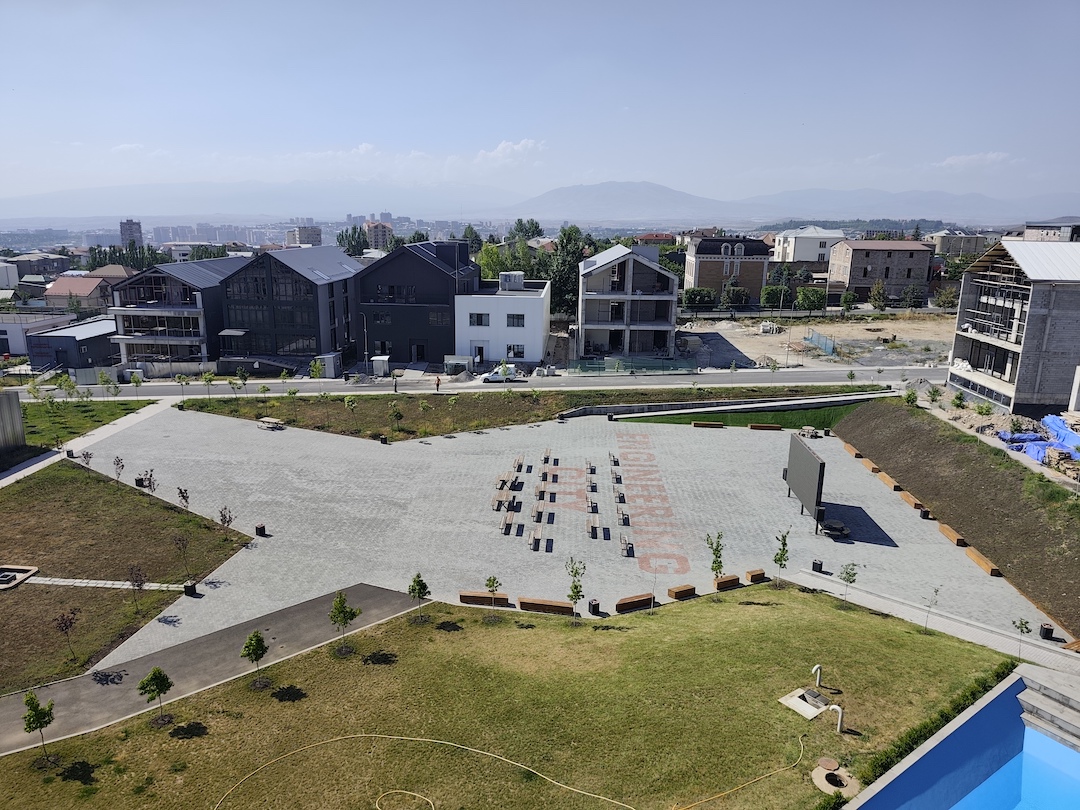
The central square of Engineering City 2 with the big screen and seats.
At full capacity, 30 resident companies will operate there. Some of the 22 companies currently based at Engineering City 1 are expanding to Engineering City 2 by opening a second branch. For now, only the Aznavour supercomputer and Hylink Technologies, which works in cybersecurity and embedded systems, operate at the new campus.
At the heart of Engineering City’s daily operations is its anchor tenant, National Instruments. The multinational, which will mark its 20th anniversary in Armenia next year, occupies two floors and employs 120 people. Its Yerevan branch is a major hub in the EMEA region, running specialized labs that test and validate hardware for automotive and tech giants such as Mercedes, BMW, ST Microelectronics, and CERN in Geneva.
“Imagine you’re ST Microelectronics and you have a new chip,” says Andranik Meliksetyan, Principal Solutions Architect and Team Lead at National Instruments. When ST is ready to scale the chip for mass production and sell it for third party companies’ products, they first ship it to National Instruments to make sure it works. “[The chip] is tested in different phases: validation, verification, characterization, and production test,” he explains. Configuring complex diagnostic rigs ensures that technologies like 5G antennas and autonomous car sensors function flawlessly before they ever reach a factory floor.
The newly announced Inttegral Solutions technology center is preparing to join them, with a focus on local chip validation. Meanwhile, a diverse mix of domestic firms is already active on-site. Among them is EVAN, a homegrown company that designs and manufactures electric vehicle charging stations. “It’s already being used a lot in the country,” Meliksetyan says of the charger, which is fully designed and assembled on campus. Nearby, medical technology startup ArmBionics aims to transcend physical disabilities by developing complete rehabilitation solutions and upper-limb prosthetics. These are just a few of the companies that reside in Engineering City with physical branches; early-stage startups and teams also rely on the infrastructure of the High-Tech Accelerator building as they scale up. Today, the Accelerator hosts fewer than 10 small companies or startups, but the space can accommodate dozens. One of them is ARCS.ai, which runs an educational program to boost the international competitiveness of local students in early cancer detection, aerospace, robotics, and AI. Together, these tenants form a highly specialized hub spanning education, product design, and manufacturing.
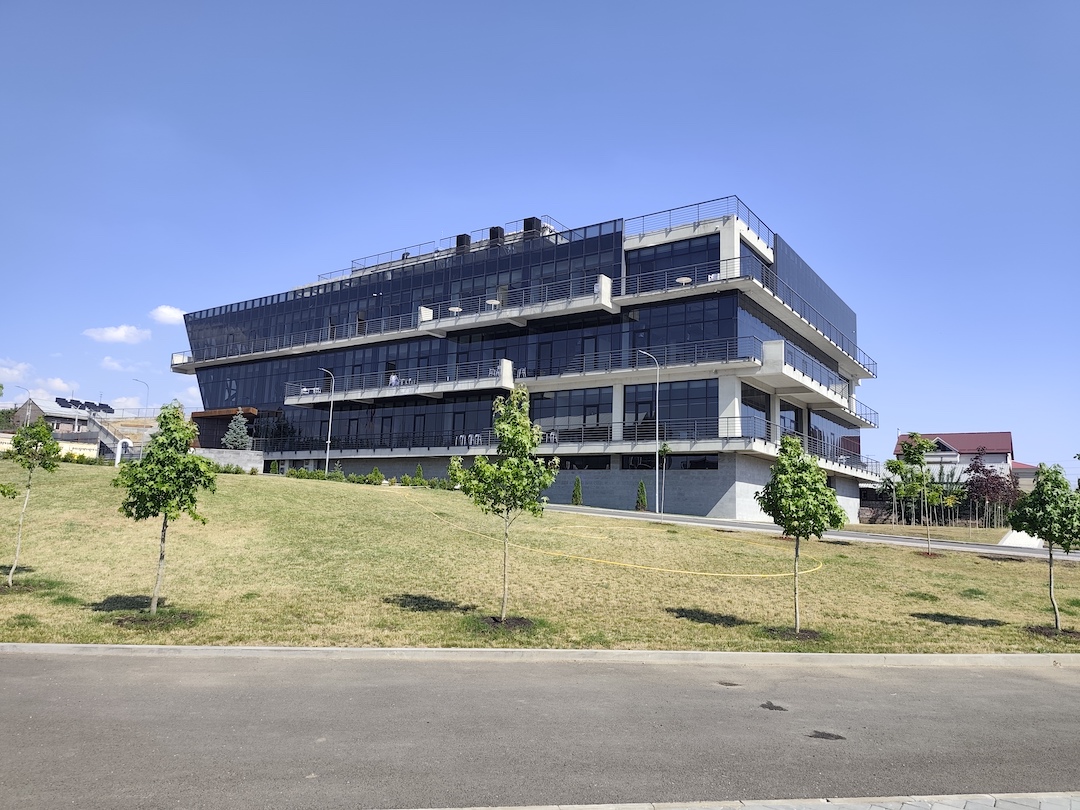
The High-Tech Accelerator building.
***
On the ground floor of Engineering City’s main building, the shared manufacturing division hums with daily activity. An automated assembly line for electronic circuit boards and computerized machines for precision manufacturing (so-called five-axis Computer Numerical Control machines) are available to the engineers working upstairs. This proximity is an immediate extension of their design benches. “I had a project three years ago,” says Meliksetyan. “It was really convenient to come down and see how my order was going because I ordered some parts and, imagine, it’s just under your nose instead of driving somewhere else.”
When Meliksetyan’s team designed a custom data acquisition board for monitoring signals, they simply sent the documentation downstairs. The shared facility handled parts procurement, ran the board through automated solder-paste stencils and baking ovens, and delivered a finished physical product. So far, one of the most successful examples of mass-production for products designed and fabricated entirely within the premises of Engineering City has been EVAN’s electric vehicle charging stations.
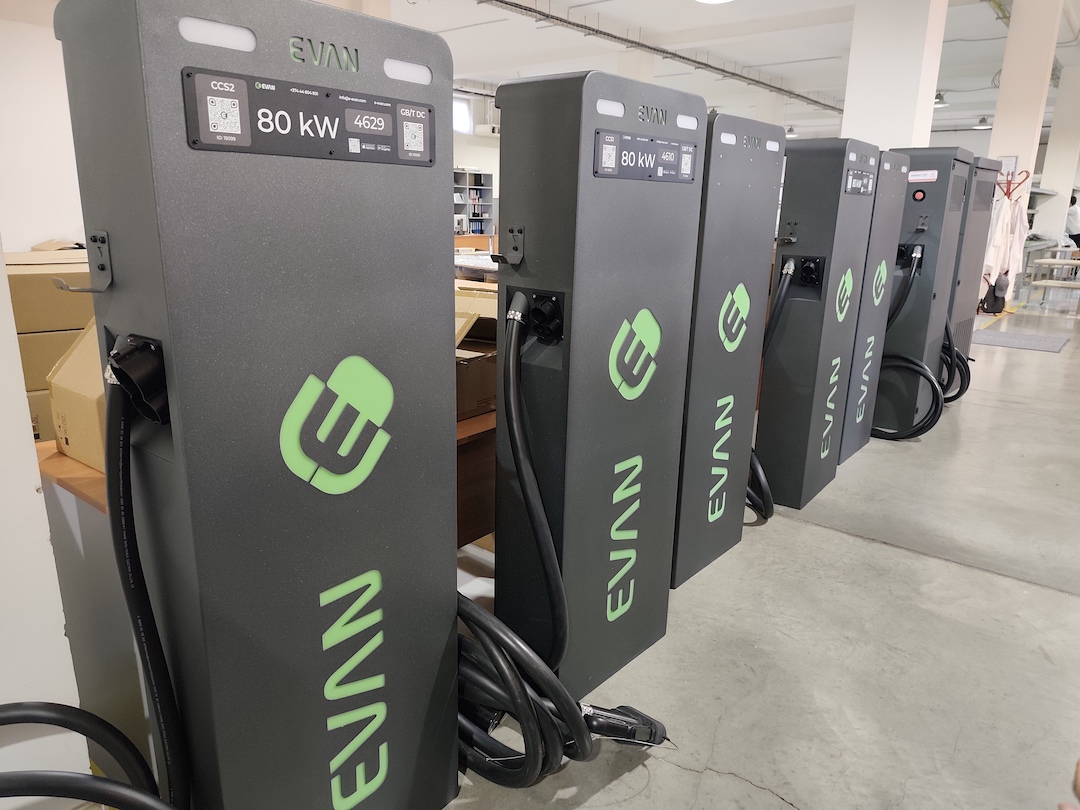
EVAN’s electric vehicle charging stations.
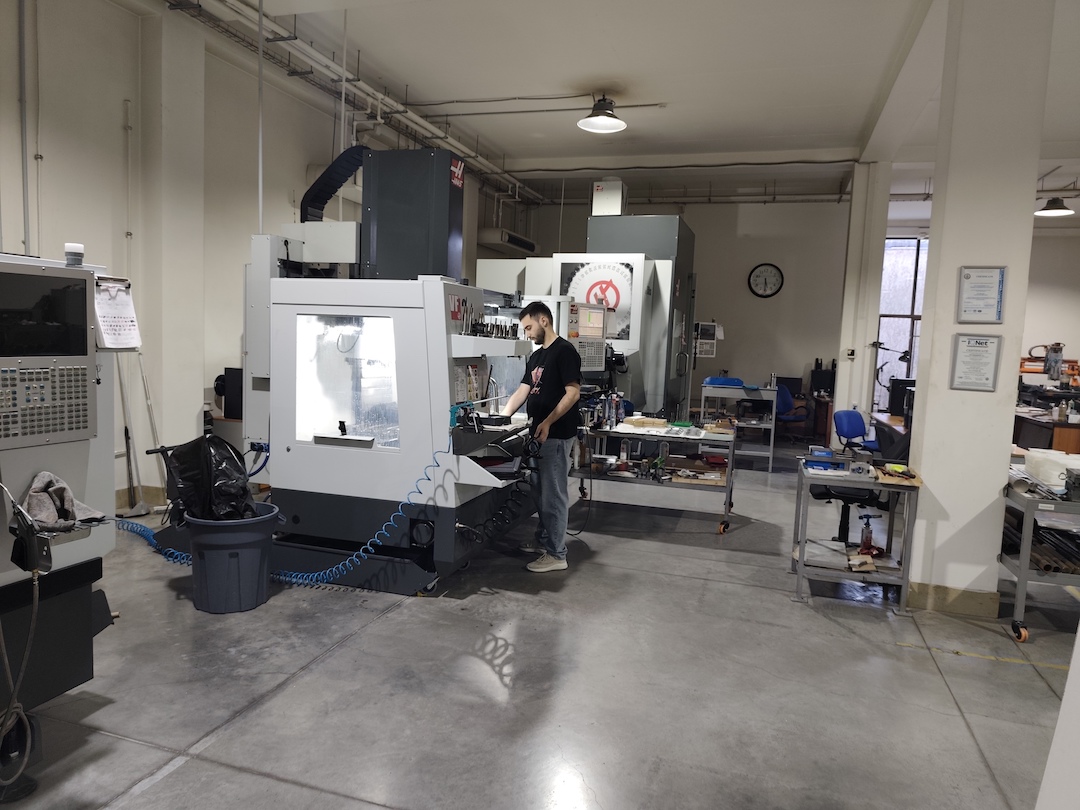
The shared manufacturing in Engineering City 1.
This fast, close-knit loop is where Engineering City’s shared-infrastructure model works best. According to Marina Minasyan, this collaboration is deliberately built into the campus layout, right down to dining habits. “The most important part of the engineering city is the cafeteria,” she says. When engineers meet at lunchtime, “they can work together, discuss ideas, and come up with really interesting projects.”
One of them is the Physical AI, Robotics and Smart Manufacturing research laboratory, led by Andranik Meliksetyan alongside their role at National Instruments. The laboratory operates in the High-Tech Accelerator. Its members work with JiVan, a humanoid robot used to support automation and robotics projects. JiVan serves as a testing platform for resident companies developing tools like a new robotic hand or a tactile sensor, or androids that could one day handle on-campus logistics—performing pick-and-place tasks and roaming throughout Engineering City.
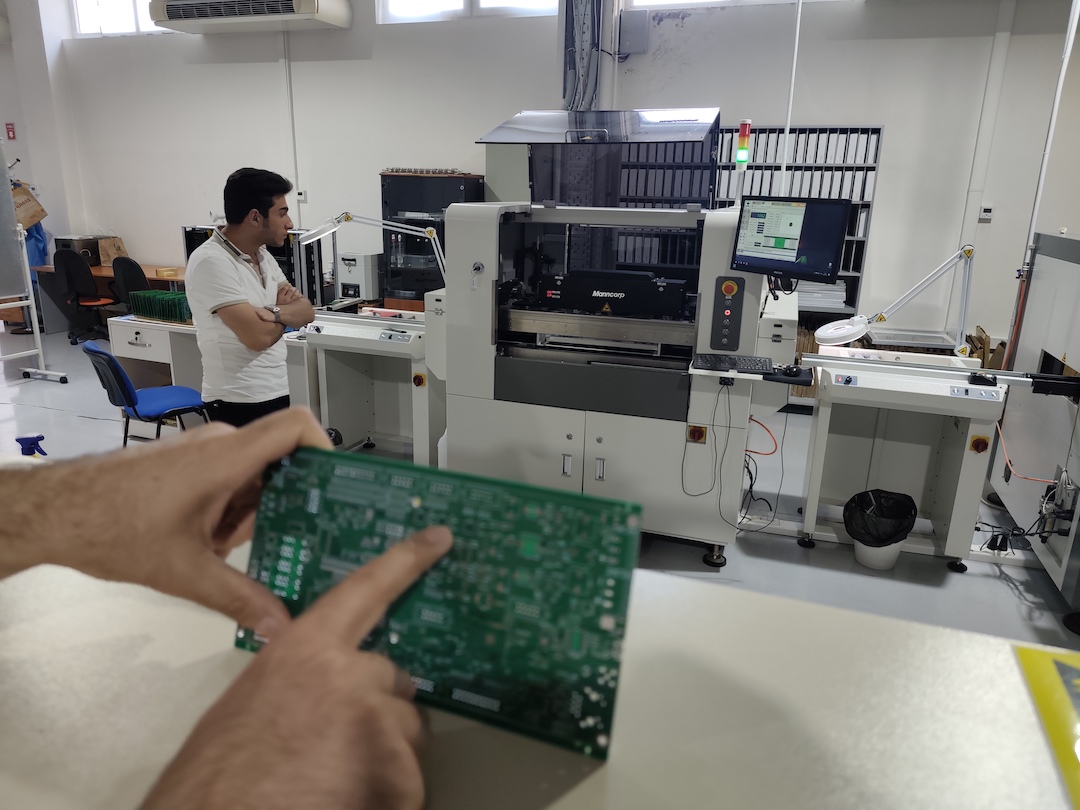
The automated assembly line of electronic circuit boards.
Yet moving beyond circuit boards, casual lunchtime conversations and robots reveals the limits of this collaborative ecosystem. While the hardware workshop is highly active, other shared assets are evolving on a different timeline. The Aznavour supercomputer, donated by the University of Toulouse after it upgraded to a more powerful system, sits quietly in its dedicated center. Subsidized by the government to provide free high-performance computing to local researchers and companies, its integration with the campus’s commercial tenants remains, for now, largely aspirational.
“For industry, there are some difficulties,” admits Hrachya Astsatryan, director and head of the Center for Scientific Computing at the National Academy of Sciences, who oversees the supercomputer. “One of them is trust. Another is security, because some companies say, ‘This is our data, and maybe you will do something,’” he explains, pointing to potential breaches of secrecy. Currently, the machine’s primary users are academic researchers and a few niche gaming applications, rather than the engineering firms next door. For those firms, the potential of the Aznavour has yet to be realized. Astsatryan says many companies would still rather buy cloud computing services from providers such as Amazon or Microsoft, which run calculations on their servers. By contrast, adopting high-performance computing, using the Aznavour’s processors, physically located on campus, is an ongoing, slow cultural process.
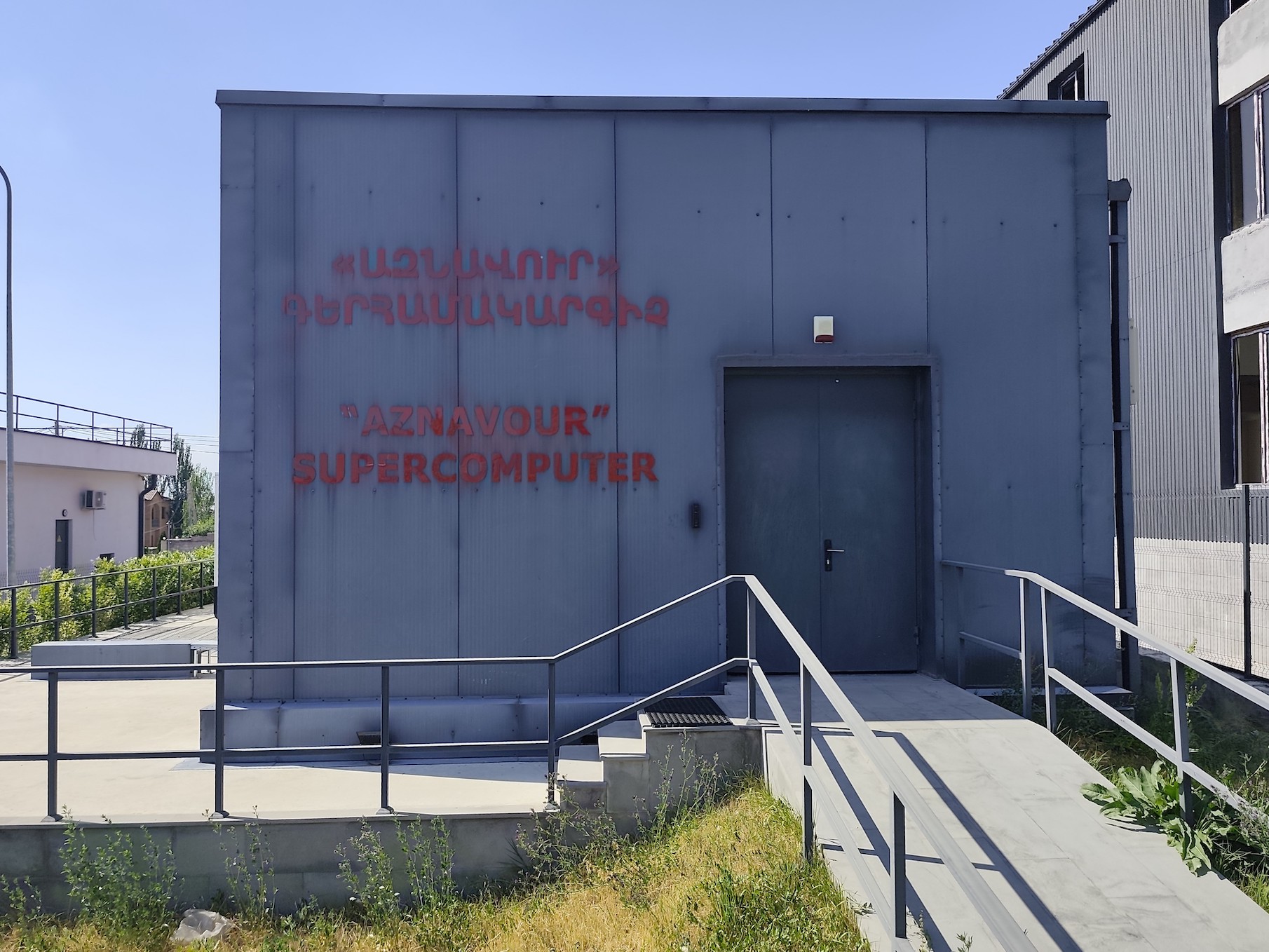
The Aznavour Supercomputer building.
Meliksetyan’s Physical AI, Robotics and Smart Manufacturing laboratory also highlights the gap between immediate co-location and deep integration. One of the lab’s goals is to automate the campus’s manufacturing zone. For now, however, the robot remains strictly a research tool.
When asked about active collaborations with incoming residents, lab researcher Grigor Shirinyan is careful to manage expectations: “Right now, [JiVan] is not going to be deployed in any factory… we just collaborate. If anyone from the Engineering City is open to collaborate, provide some of their techniques to us, we’re ready to plug them into our robot and do tests.” Currently, the synergy at Engineering City is highly successful as a shared machine shop and prototyping hub. But its grander vision of a fully integrated, automated hardware ecosystem remains a work in progress with an immense potential, not because of negligence or complacency, but because the technopark is still at an intermediate stage of growth.
***
That ambition rests on a specific financing structure. Since its inception in 2018, Engineering City’s official budget has run to $21 million US, split evenly between an initial World Bank loan and government/private co-financing. The loan agreement expired on May 31, 2024; since then, construction has been funded through the state budget via the Ministry of High-Tech Industry. That September, the government approved a further 1.94 billion AMD (about $5 million US), mostly to finish the High-Tech Accelerator. Of that, 1.88 billion AMD went toward construction and furnishing, described at the time as the penultimate planned allocation. The final installment, roughly 1.2 billion AMD, followed in the 2025 state budget, which also set aside about 36 million AMD specifically to cover the Aznavour supercomputer’s electricity costs. It’s a small figure, but a telling one: the state isn’t just building Engineering City, it’s still paying to keep the lights on.
The leap from a software-heavy reputation to a hardware engineering hub is a deliberate national strategy. As Marina Minasyan explains, while software can be written anywhere, hardware engineering depends on a complex, shared ecosystem that can turn ideas into exportable products. Bagrat Yengibaryan, Director of the Enterprise Incubator Foundation, sees this transition as a major opportunity: “In this era of artificial intelligence, this is also the best moment for Armenia to showcase its potential and attract the attention of major global players.”
Yet, scaling this ecosystem beyond its current footprint remains an open challenge. The direction seems right, but to grow further, the model must evolve from low-volume prototyping to true mass production. Andranik Meliksetyan describes a separate, dedicated manufacturing facility in Engineering City 2, designed to produce quantities in the hundreds of thousands.
But physical expansion is only half the battle; the model’s human and cultural limits loom large. As Astsatryan of the Aznavour supercomputer warned, the project’s longevity will ultimately be tested by whether it can bridge public infrastructure and private trust. A final caution comes from Yengibaryan: in a field where new technologies emerge all the time, “if you are not ready for the new, or if you are not the one creating it, then time will simply pass you by.”
Creative Tech
Seaside Startup Summit: Beyond the Pitch
Behind every polished startup pitch are difficult questions, uncomfortable feedback and constant iteration. A visit to Seaside Startup Summit in Lake Sevan reveals what mentors wish founders understood, and why building a successful startup is far harder than it looks.
Read more
Built for One Era, Tested by Another: Armenian Tech and AI
AI has disrupted the assumptions on which many technology companies were built. Through Wirestock, Renderforest and CodeSignal, Ellen Tovmasyan explores how Armenian-founded companies are adapting their products and business models to remain competitive in a rapidly changing global market.
Read more
Armenia’s Long-Awaited High-Tech Strategy Takes Shape
Armenia has finally unveiled a long-awaited strategy for developing its high-tech sector. Ani Toroyan examines the draft's strengths, shortcomings and whether it offers a clear roadmap for turning the country's tech ambitions into long-term innovation and economic growth.
Read more
Inside Plug and Play Armenia: What Local Startups Can Expect
Plug and Play’s arrival in Armenia is about more than adding another startup accelerator to the ecosystem. It represents a new model of mentorship, global connectivity and founder development, challenging local startups to think bigger, move faster and build with international markets in mind.
Read more
What Does Technological Sovereignty Mean for a Small State Like Armenia?
As artificial intelligence reshapes global power, Armenia is beginning to grapple with a new question: what does technological sovereignty mean for a small state? Elen Tovmasyan explores an emerging doctrine that rejects AI grandeur in favor of strategic dependence, local adaptation and institutional resilience.
Read more
Armenia’s Tech Labor Market Faces a Triple Shock
Armenia’s tech labor market is being reshaped by three converging shocks: a global venture capital slowdown, geopolitical fallout from the Russia-Ukraine war, and the rapid rise of AI. Together, they are transforming hiring, redefining skills, and exposing vulnerabilities in the country’s tech growth model.
Read more
From Noise to Meaning: Krisp’s Next Step in Voice AI
Krisp, known for eliminating background noise, is moving into a new phase of voice AI. Its Accent Understanding feature aims to make speech easier to follow across accents, raising both practical benefits for global work and deeper questions about identity and communication.
Read more
Armenia’s AI Story Is Coming Into Focus
A series of recent announcements, from a major AI factory expansion to plans for a small modular nuclear reactor, suggest Armenia’s technology ambitions are moving beyond rhetoric. Together, they hint at an emerging strategy linking AI infrastructure, energy capacity and the country’s growing innovation ecosystem.
Read more
A Cold Room, a Hot Field: YSU’s Supercomputer and Armenia’s AI Ambitions
At Yerevan State University, a new supercomputing center powered by 64 NVIDIA H100 GPUs is transforming Armenia’s AI research landscape. Backed by major public investment, the facility lifts long-standing computational limits, enabling advanced machine learning, cross-disciplinary collaboration and stronger global scientific partnerships.
Read more
Armenian Women in Tech Lead on Their Own Terms
In Armenia’s tech sector, women founders are redefining leadership while navigating motherhood, bias and limited representation. Through resilience, education and visibility, they are building successful companies, and in the process reshaping what the “ideal founder” looks like.
Read more
When AI Speaks Armenian։ Podcastle’s New Voice for a Nation
Armenian finally sounds natural in AI. Elen Tovmasyan explores how Podcastle’s new Armenian text-to-speech technology could transform media, education, accessibility and diaspora engagement, while raising important questions about ethics, voice ownership and what it means for a “small” language to enter global AI systems.
Read more
Why 2025 Mattered for Armenia’s Tech Sector
2025 may be remembered as a turning point for Armenia’s tech ecosystem, a year of long-term foundations taking shape. Ani Toroyan writes that while these developments open new opportunities they also raise expectations and if the past year was about setting direction, then 2026 will be about delivery.
Read more
AI, Drones, Blockchain and Agriculture
Young Armenian entrepreneurs are bringing AI, drones, and blockchain into agriculture, developing tools tailored to small-scale farmers. From smart beehives to precision spraying and traceable wool, agritech startups are reshaping rural livelihoods while navigating a small, cautious market.
Read more
The Quiet Strategy Driving Global Wins for Armenian Startups
Armenian startups rarely win abroad through formal “global expansion” plans. Instead, founders reveal the quiet force that actually opens doors, from Netflix to P&G: the informal, trust-based networks of the Armenian diaspora, where shared identity becomes a powerful competitive edge.
Read more