

Listen to the AI generated audio article.
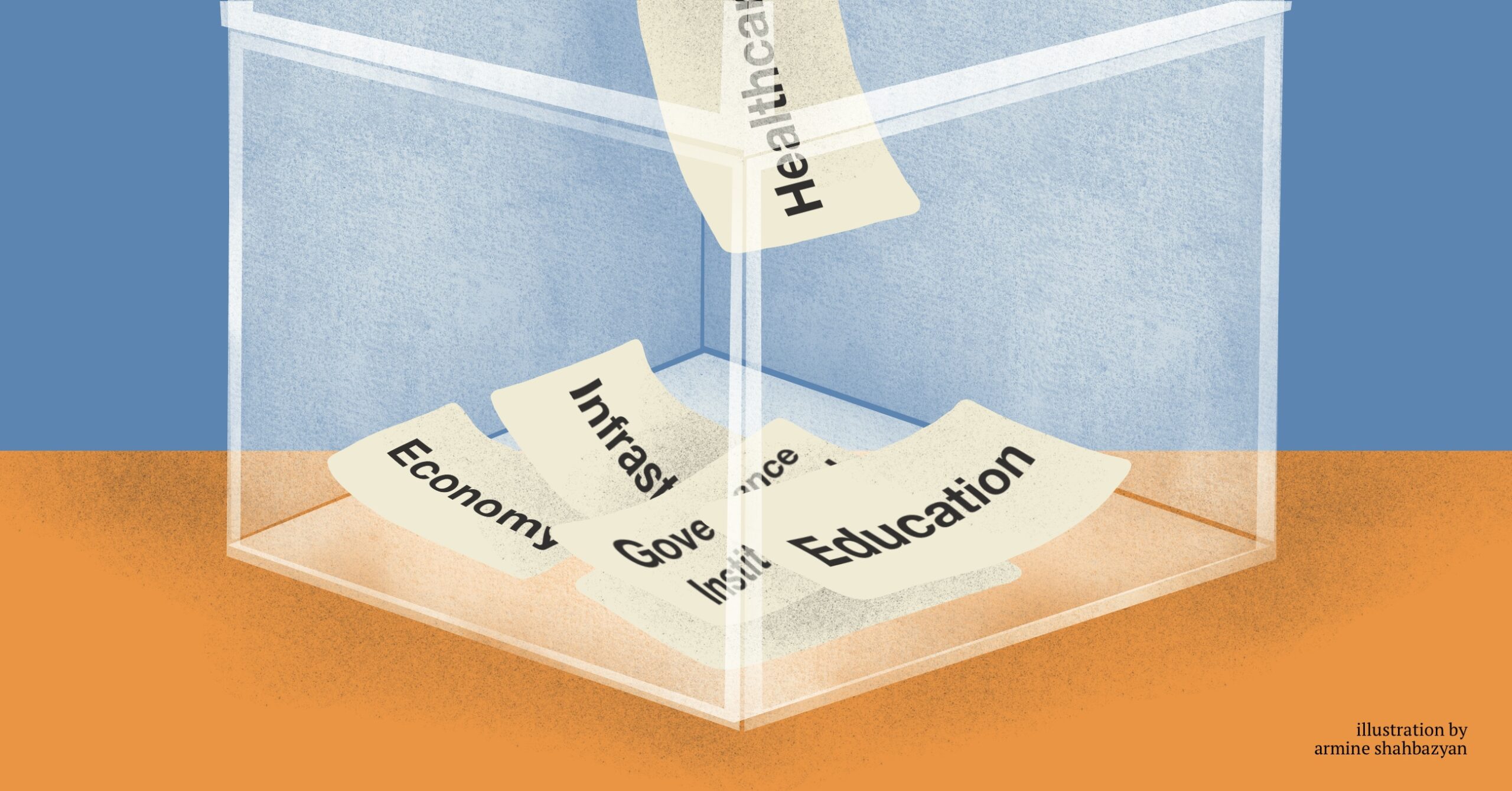
While foreign policy and security remain central to Armenia’s pre-election campaign and core issues of public concern, voters are also increasingly focused on domestic socioeconomic challenges. Although 19 political forces are officially contesting the parliamentary elections, not all have published detailed platforms. Among those that have, particularly the more competitive parties and alliances, domestic policy has become a major focus of the campaign, with significant attention devoted to the economy, education, healthcare, governance and social welfare.
Civil Contract (Nikol Pashinyan)
The ruling Civil Contract Party’s campaign platform on social policy largely builds on reforms the government says it has already begun implementing. During campaign events and meetings with voters, Prime Minister Nikol Pashinyan frequently points to progress in healthcare, road construction, and the renovation and construction of schools and kindergartens, framing the election as a referendum on the government’s record.
After placing peace at the center of its campaign, Civil Contract presents education as its next major priority. In the party’s platform, education is described as the “strategy of strategies,” arguing that the system must equip citizens with the skills necessary for a prosperous, fulfilling and happy life.
The placement of education as the second major section of the platform, directly following the party’s central campaign theme, the “Institutionalization of Peace”, underscores the importance Pashinyan and Civil Contract attach to the sector, viewing it as the primary vehicle for implementing the state’s broader development strategy.
Among its proposals, the ruling party pledges to build, reconstruct or renovate 100 kindergartens and early education centers, expand preschool access for children aged 0–2 across all enlarged communities, and introduce mechanisms for regularly updating preschool standards and externally evaluating educational quality.
In general education, the party promises to construct, reconstruct, renovate and fully furnish another 300 schools, implement the second phase of voluntary teacher certification with a base salary of 300,000 AMD and additional bonuses, and adopt a Law on the Status of Teachers that would establish broader guarantees, including housing support programs.
In higher and postgraduate education, Civil Contract plans to launch the first phase of the Academic City project, including a technology cluster and housing for 3,600 students; implement the provisions of the Law on Higher Education and Science adopted in September 2025; introduce a new admissions system aimed at easing the transition from school to university and promoting volunteer work; establish new funding mechanisms and scholarships to ensure access for academically qualified students; and further internationalize higher education by increasing the number of foreign students to at least 15,000 while improving the standing of Armenian universities in international rankings.
The ruling party also pledges reforms in extracurricular and vocational education, presenting them as important components of a more modern and competitive education system.
In the field of science, Pashinyan’s party promises to increase state funding for scientific research to 1% of GDP between 2026 and 2031. According to the platform, science should advance not only as a fundamental discipline, but also through applied research and innovation that can improve governance, the economy, education and technological development. The party describes science as both a constant companion to and a driving force behind national development.
Civil Contract frames economic development as a core state priority, arguing that sustained growth is essential for financing education, infrastructure, healthcare, social benefits, science, diplomacy and national defense. According to the party, economic expansion is the foundation upon which the state can strengthen institutions and improve citizens’ quality of life.
The platform also emphasizes economic predictability, pledging to amend the Tax Code no more than once per year between 2026 and 2031 while introducing additional measures aimed at improving stability for businesses and investors.
In agriculture, the ruling party prioritizes the development of intensive farming, with a focus on expanding intensive, organic and experimental agricultural practices. At the same time, it stresses the importance of improving living conditions in rural communities and overcoming what it describes as “muddy, underdeveloped conditions” in Armenia’s villages.
In a broader list of 100 promised measures, the party outlines a series of economic and social targets for the next five years. These include maintaining average annual GDP growth of at least 6%, increasing industrial output by 50%, doubling exports of Armenian-origin products to $8.9 billion, and raising the share of SMEs in GDP to 40%.
The platform also promises the creation of at least 25,000 new jobs annually, a five-percentage-point reduction in poverty, and full coverage of the population under the universal health insurance system.
In agriculture, the party pledges to modernize the sector through the introduction of advanced machinery and water-saving technologies, establish new logistics centers, construct smart livestock facilities and expand greenhouse farming.
Infrastructure promises include the construction and upgrading of 50 healthcare institutions, the launch of the Ajapnyak metro station project in Yerevan, the purchase of new electric buses and trolleybuses, and the introduction of a unified public transport network across Armenia.
The platform also places significant emphasis on housing and social programs, including the construction of 3,000 homes in border and rural communities, the provision of 1,000 new social housing units, housing support for 10,000 displaced Nagorno-Karabakh families, and the adoption of new housing assistance programs for large families.
Strong Armenia (Samvel Karapetyan)
Strong Armenia is one of nine political forces contesting the elections to have submitted an official platform. Its 75-page program focuses heavily on domestic policy, with particular emphasis on economic development and industrialization.
The party presents industrialization as the cornerstone of economic growth, employment and state development. It argues that Armenia needs a new industrial policy centered on manufacturing, technological modernization and export-oriented growth, with the state playing an active role in supporting domestic industry and helping Armenian products compete in international markets.
According to the platform, Armenia should seek to position itself as a regional industrial and technological hub through the development of strategic infrastructure, industrial parks, logistics systems, laboratories, innovation ecosystems and transportation networks. The party also envisions attracting and developing high-tech corporations capable of creating jobs while introducing new technological and professional standards to the country’s economy.
Strong Armenia also calls for diversifying the Armenian economy by expanding the range of exported goods and reducing dependence on any single export market. The party links industrial expansion to deeper integration into international markets, particularly the European Union. Its economic targets include increasing annual exports by 180–210 billion drams compared to 2024 levels, raising foreign investment six- to seven-fold, and expanding manufacturing’s share of GDP to 20%.
Job creation is another central component of the party’s economic vision. Strong Armenia says it aims to create at least 300,000 jobs, including 100,000 in the industrial sector, while projecting annual economic growth of more than 8% between 2027 and 2031. The platform argues that industrial development would generate broader spillover effects across the economy and places particular emphasis on increasing women’s participation in the workforce and creating greater opportunities for young people through technological modernization and innovation.
The party’s labor and education policies are closely tied to its industrial strategy. Strong Armenia argues that vocational education and workforce training should be reoriented toward the needs of industry and modern technologies. The platform calls for the modernization of vocational education institutions, the introduction of modular education systems and specialized certifications, and the expansion of applied higher education modeled on Germany and Finland’s Universities of Applied Sciences. It also emphasizes stronger ties between universities and industrial enterprises, internships and applied research.
Agriculture is also framed through the lens of industrial development and exports. The party proposes creating modern food processing systems, strengthening food value chains and introducing international food safety and certification standards. It describes food production and food security as matters of national security and argues that agriculture should become one of the foundations of Armenia’s economic development model.
Energy policy is another major focus of the program. Strong Armenia advocates commissioning a new nuclear power unit by 2036 to replace Metsamor, arguing that nuclear energy is essential for long-term energy security and economic development. At the same time, the party calls for a major expansion of renewable energy, including solar, wind and hydro power, alongside energy storage technologies and Smart Grid systems. Its stated goal is to create a diversified and technologically advanced energy system capable of reducing tariffs, increasing resilience and strengthening Armenia’s energy independence.
On social policy, the party links employment and poverty reduction directly to economic growth and industrialization. The platform proposes increasing pensions substantially to eventually exceed the minimum consumer basket and sees broader pension reform connected to labor market reforms and greater participation of older citizens in economic life.
In education, Strong Armenia presents access to education and vocational training as essential to building a competitive economy. The party describes education as the foundation of state competitiveness, productivity and technological progress, arguing that it should function as a system of opportunity rather than privilege. Its platform promises to modernize vocational education, align training with labor market demands, and expand access across Armenia’s regions.
Healthcare is framed as both a social and national security priority. The party promises to expand access to healthcare, reduce medicine costs, modernize medical infrastructure and develop digital health systems, including telemedicine and electronic health records. It also identifies medical tourism, biotechnology and healthcare technologies as potential new economic sectors.
The program further calls for reforms in public administration, the judiciary and territorial governance. Strong Armenia advocates for a more decentralized and digitally integrated governance system, with stronger regional development policies and greater financial autonomy for communities. It also pledges measures to increase transparency, reduce bureaucracy, and modernize governance and judicial systems.
During campaign events, members of Strong Armenia constantly reference Samvel Karapetyan’s skills as a guarantee that they will fulfill their promises.
Prosperous Armenia Party (Gagik Tsarukyan)
Tycoon Gagik Tsarukyan’s Prosperous Armenia Party has also presented an election platform, though it is significantly shorter than those of Civil Contract or Strong Armenia. The program focuses heavily on economic growth, social policy and large-scale infrastructure projects.
The party argues that Armenia is facing a crisis across nearly all spheres of public, economic and social life and calls for a new economic, fiscal, monetary and industrial policy. It proposes transitioning from what it describes as a consumption-based economy to an investment-based model and sets the goal of tripling Armenia’s GDP within five years.
To achieve this, Prosperous Armenia proposes the creation of 10 tax-free industrial zones across the regions, significant tax cuts for micro and small businesses, reducing property tax by half, and a gradual increase of the minimum wage to 150,000 drams within two years. The party also advocates major intervention in the banking sector, including state repayment of certain small loans, credit amnesties for penalties and fines, lower loan interest rates and more affordable mortgages.
Prosperous Armenia promises to align the minimum pension with the consumer basket and gradually increase pensions toward a benchmark of 100,000 drams while indexing pensions annually to inflation. It also pledges to reduce gas and electricity tariffs by 10% and, beginning in 2028, make all state and community educational institutions — including kindergartens, schools, colleges and universities — free of charge. The program also includes student housing initiatives and employment programs aimed at helping young graduates secure their first jobs.
Prosperous Armenia also outlines a number of major infrastructure and development projects. Among them are the construction of the statue of Christ and “Noah’s Ark” complex, the completion of the North-South highway, the creation of a Syunik transport and energy hub, the construction of a new nuclear power plant, the development of copper smelters and data centers, and the establishment of free economic or offshore zones around Zvartnots airport and in Gyumri.
Agriculture is described as a pillar of national security. The party proposes reopening the Ministry of Agriculture, creating modern procurement and storage infrastructures, subsidizing agricultural loans and reforming irrigation management. It also argues that villages should become centers of prosperous living rather than mere survival.
In healthcare, Prosperous Armenia proposes a more extensive insurance system aimed at guaranteeing access to medical care throughout citizens’ lives. The platform includes plans for state-backed healthcare accounts for surgical and non-surgical treatment, free treatment for pensioners and minors in certain cases, and higher salaries for healthcare workers.
The party also devotes separate sections to the development of Gyumri and Yerevan. Gyumri is presented as a future industrial, logistics and sports center, while Yerevan is envisioned as a “smart and accessible capital” with expanded green zones, modernized transportation, new parking infrastructure and waste processing facilities.
Armenia Alliance (Robert Kocharyan)
The Armenia Alliance, headed by former President Robert Kocharyan and currently the main opposition force in parliament, has not formally submitted an election platform to the Central Electoral Commission. Instead, on April 8, a month before the official campaign period began, alliance representatives presented the social and economic components of their program to supporters.
The Armenia Alliance says its economic policy will focus on reviving industry and building a high-tech economy based on Armenia’s competitive advantages and human capital. It proposes a “Made in Armenia” policy aimed at associating Armenian-made products with high quality and technological progress. Under the alliance’s vision, industry would account for 25% of GDP, nearly doubling its current share, while high technologies would make up approximately 10% of industry.
The alliance advocates a policy of import substitution and stronger state support for domestic producers, particularly in strategic sectors and industries with significant social impact, including agriculture, agricultural processing and textiles. It proposes tax incentives, including profit tax and VAT exemptions in selected sectors, while also encouraging consumers to purchase locally produced goods. The alliance argues that the state should actively protect Armenian producers rather than rely solely on market mechanisms.
Support for small and medium-sized businesses is another major component of the alliance’s platform. It proposes tax refund mechanisms for small businesses, targeted financial and export assistance, consulting support for entrepreneurs and clearer definitions for SMEs. The alliance criticizes Armenia’s financial system for prioritizing consumer lending over investment in the real economy and proposes the creation of a multi-level investment fund for major infrastructure projects. It additionally calls for revising creditworthiness criteria and addressing the issue of blacklists that restrict access to financing.
According to the alliance, economic policy should focus not on “inflated numbers” but on job creation, reducing unemployment and ensuring fair income distribution. The platform projects the creation of 35,000–45,000 jobs annually.
The rising cost of food, medicine and utilities has created severe pressure on households, the alliance argues, and calls for the minimum wage and pensions to be indexed to the consumer basket. It also proposes subsidizing utility costs for vulnerable groups during winter, revising electricity tariffs, reducing property taxes and introducing a luxury tax. It additionally pledges to abolish Armenia’s mandatory universal declaration system.
Families are presented as a policy priority. The alliance proposes reducing income tax by 3% for each additional child after the second and introducing housing programs for young families. In healthcare, it emphasizes maintaining accessible medical services and ensuring the effective functioning of the universal insurance system.
Agriculture is framed as both an economic and food security issue. Under the program, “Prosperous Village and Competitive Agriculture,” the alliance focuses on increasing farmers’ incomes, strengthening food security and sustaining rural communities. Proposed measures include promoting land consolidation and agricultural cooperation while preserving ownership rights, supporting crop production and livestock farming, subsidizing seeds, machinery and fuel, improving water management and procurement systems, and establishing minimum procurement prices for strategic goods. Farmers, according to the proposal, would also receive loans of up to 15 million drams at 0% interest, while agricultural products would be insured against natural disasters.
Republic Party (Aram Sargsyan)
Aram Sargsyan’s Republic Party has also submitted a platform to the CEC, structured primarily around bullet points across five main sections, four of which concern domestic policy.
The Republic Party platform centers heavily on economic restructuring, energy development, technological modernization and state reform, presenting these as essential to ensuring Armenia’s long-term security and development. The party frames its broader vision around a “Future” strategy aimed at turning Armenia into a “secure, developed, technological state with a growing population” by 2040.
The party proposes transforming the structure of Armenia’s economy through industrial development, the elimination of monopolies and the creation of high-paying jobs. It argues that these reforms are necessary not only for economic growth but also for military, demographic, energy and food security. The platform proposes more extensive utilization of Armenia’s mineral resources, including reducing the role of Russian capital and, in some cases, nationalizing strategic assets before later offering shares on international stock exchanges.
Energy occupies a central role in the party’s program. The Republic Party proposes agreements with the United States for the construction of a 400 MW modular nuclear power plant and with France for a 600 MW nuclear power plant, with construction expected to begin in 2027. It also calls for the construction of new reservoirs capable of storing and managing up to five billion cubic meters of water.
The platform places particular emphasis on technology and the defense sector. In line with Armenia-U.S. memorandums signed in Washington in August 2025, the party proposes granting exceptional preferential conditions to semiconductor, artificial intelligence and technology industries, designating them as priority sectors of the economy. It also proposes granting priority status to the defense industry, including direct state participation in new technological and robotic sectors, as well as the creation of a new corporate city for 150,000 residents employed in the technological sector. According to the platform, these measures would reduce unemployment to 3% within 10 years.
The Republic Party also proposes extensive constitutional and judicial reforms. It advocates transitioning Armenia from a parliamentary to a presidential system of governance and introducing amnesties once every five years for certain categories of criminal and administrative offenses. The platform additionally calls for the introduction of jury trials in criminal proceedings involving serious crimes and, later, in civil and anti-corruption courts for cases deemed exceptionally important.
The party also proposes expanding Armenia’s judicial system by increasing the number of judges from 275 to 350 and adding additional assistant positions for judges, arguing that these reforms would significantly reduce the workload of the courts. It additionally calls for the continued development of institutions administering justice, including the prosecutor’s office, investigative bodies, mediators and notaries, alongside stronger oversight mechanisms.
Under its broader “Armenia 2040” vision, the platform argues for expanding the structure of government through the creation of a deputy prime minister position responsible for relations with the United States and the European Union, as well as new ministries for Atomic Energy and Energy, Agriculture and Water Resources, and Culture and Diaspora.
In education, higher and secondary vocational education should be free of charge and focused on quality, alignment with labor market demands and equal educational opportunities for the regions. In healthcare, it proposes mandatory healthcare insurance in addition to universal coverage, alongside the modernization of digital healthcare systems through unified electronic medical records and expanded research into rare diseases.
Wings of Unity (Arman Tatoyan)
Former Human Rights Defender Arman Tatoyan’s Wings of Unity has also presented an extensive 25-page program focused primarily on domestic policy, state governance, economic modernization, science and social policy.
A major focus of the party’s platform is governance reform and institutional restructuring. Wings of Unity argues for the creation of an “intelligent state governance” system in which public offices are occupied by experienced specialists, accountability and transparency are ensured through digital technologies, and the independence of the judiciary is fully protected. The party also proposes substantial electoral reforms, including lowering the threshold for parties to enter parliament, introducing the option to vote “against all,” revising party financing mechanisms and strengthening parliamentary oversight over the executive branch.
The platform also proposes strengthening the powers of the president and transitioning to the direct election of the president by popular vote. According to the party, Armenia’s executive, legislative and judicial branches should function independently, with legally transparent oversight mechanisms over one another. It also calls for the establishment of a “real anti-corruption system” based on digital procedures, institutions and public oversight.
Judicial reform occupies another major section of the program. Wings of Unity argues that the judiciary must have full independence from political authorities, businesses and private interests. It proposes eliminating disciplinary mechanisms over judges mediated through the executive branch, creating safeguards against conflicts of interest within judicial institutions and expanding the number of judges and judicial employees to levels corresponding to European averages. According to the platform, these reforms would reduce the duration of court proceedings by around 50%.
Science, education and human capital development are presented as the foundations of both state security and economic development. The party argues that science should become a strategic priority integrated into all spheres of governance, including security, healthcare, agriculture, public administration and technology. It pledges to at least double the number of people engaged in scientific work and increase state funding for science to at least 1.5% of GDP.
In education, Wings of Unity proposes creating a modern and universally accessible system centered on national identity, competitiveness and equal regional opportunities. The platform promises free higher education at state universities, expanded scholarships for strategic fields such as STEM and agriculture, broader preschool access and targeted incentives for teachers working in rural and border communities. It also proposes restructuring secondary education and developing major university clusters in Yerevan, Vanadzor, Gyumri, Goris and Kapan.
The party also places heavy emphasis on STEM education, technological skills and the integration of universities with labor market needs. It proposes significantly increasing education spending over the next decade, expanding vocational and non-formal educational opportunities, and strengthening the role of schools in shaping national identity and civic responsibility.
Economic policy is centered on transitioning Armenia from what the party describes as a consumption-based economy toward a production- and export-oriented model built on science, innovation and high-value industries. The program proposes the creation of industrial zones specialized by region, expansion of high-tech production and exports, modernization of capital markets and the introduction of digital financial systems. The party also proposes shifting Armenia’s tax architecture away from indirect taxation and toward more direct and progressive forms of taxation.
According to the platform, high-tech and science-based sectors should eventually account for 25–30% of GDP, while at least 100,000 highly qualified jobs would be created in science, engineering and technological production. The party also proposes targeted tax incentives for research and development, artificial intelligence, defense technologies and microelectronics, alongside mechanisms for involving Diaspora Armenian scientists and engineers in Armenia’s scientific and technological development.
Agriculture is framed as a knowledge-based and export-oriented sector. The party proposes introducing modern agricultural technologies, establishing regional technoparks, creating agro-consultation and procurement centers, expanding agricultural insurance systems and implementing minimum price guarantees for strategic agricultural goods. It also supports land consolidation policies and stronger logistical support for agricultural exports.
Family policy and social protection also occupy a substantial portion of the program. Wings of Unity proposes tax benefits for large families, free housing in the regions beginning from the fourth child, expanded preschool accessibility, affordable housing programs for young families and state unemployment insurance by 2030. The platform additionally promises to reduce poverty, expand employment programs for vulnerable groups and increase pensions to levels corresponding to the minimum subsistence basket.
In healthcare, the party advocates universal free medical care throughout Armenia, strengthened preventive healthcare, expanded regional access to services and a more transparent insurance system involving private insurers. The platform also proposes reducing medicine prices, expanding telemedicine and digital healthcare systems, revising healthcare worker compensation and retraining systems, and shifting Armenia’s healthcare model away from disease treatment and toward disease prevention and long-term health preservation.
Armenian National Congress (Levon Zurabyan)
Levon Ter-Petrosyan’s Armenian National Congress (ANC) is also among the forces that have presented party programs. Its platform is similarly extensive, with a significant portion dedicated to domestic issues.
A major focus of the party’s program is economic restructuring through infrastructure development, free competition and technological modernization.
Energy and water management occupy a central place in the platform. The party argues that Armenia’s energy stability should continue to rely on Russian gas supplies and cooperation with Russia in nuclear energy. It proposes constructing a new 1.2 GW nuclear power plant based on a Russian package proposal, modernizing the Sevan-Hrazdan cascade and developing storage capacities necessary for expanding solar energy production. The platform also calls for the creation of a Ministry of Water Resource Management, the completion of the Yeghvard and Kaps reservoirs, the restoration of the Arpa-Sevan tunnel and large-scale irrigation programs.
The ANC also places significant emphasis on free competition and tax incentives. It proposes new anti-monopoly legislation, restrictions on market dominance, legal separation of wholesale and retail trade and reduced criminalization of economic offenses. In taxation, the party advocates for a model centered on incentivizing economic activity and domestic production. Among the proposed measures are long-term tax stability guarantees, profit tax exemptions for major investors, reduced property taxes and targeted support for export-oriented and high-tech industries.
Agriculture is framed as a matter of economic sovereignty, national security and food independence. The party argues that the sector’s main challenge is ensuring profitability for farmers amid rising costs and marketing difficulties. It proposes restoring the Ministry of Agriculture, creating a system of state-supported operators to assist farmers with procurement and sales, introducing scientifically grounded agricultural zoning and quota systems, subsidizing local seed production and developing the umbrella export brand “Organic Armenia” for ecologically clean agricultural products.
The party also proposes major constitutional and governance reforms, arguing that the parliamentary system adopted in 2015 has produced instability and blurred accountability. It advocates a return to a semi-presidential system through a constitutional referendum within two years. The platform additionally proposes strengthening the independence of the judiciary, ending political persecutions, protecting civil liberties and introducing broader anti-corruption and administrative reforms based on automation and digital governance systems.
Technology and innovation occupy a substantial section of the program. The party argues that Armenia’s long-term development must be based on scientific progress and breakthrough technologies, including artificial intelligence, semiconductors, biotechnology, fintech and the crypto industry. It proposes state financing for research and development projects, public-private partnerships in high-tech sectors, the creation of a sovereign Armenian AI system and expanded incentives for venture capital and diaspora investment. The platform also advocates introducing Estonia’s e-residency model and establishing a High Technology Center for international conferences and startup development.
In education and science, the ANC proposes increasing education spending to at least 4% of GDP and science funding to 1% of GDP with gradual increases over time. The platform supports greater university autonomy, geographically distributed universities instead of the Academic City model, the creation of a Student Investment Bank providing long-term loans, expanded technological education in schools and reforms in vocational education. It also proposes the creation of a Ministry of Higher Education, Science and High Technologies.
In healthcare, the party supports the continuation of universal health insurance while focusing on technological modernization, telemedicine and domestic pharmaceutical production. The platform also includes a range of social policy proposals, including pension increases,support programs for women and young mothers, free retraining programs and expanded access to free kindergartens, particularly in the regions.
New Force (Hayk Marutyan)
Actor and former Yerevan Mayor Hayk Marutyan’s New Force has also not submitted a formal platform to the CEC, though the party has published a short program on its website.
The party describes its ideological foundation as social reformism, which it presents as a variation of classical social democracy centered on achieving social justice and welfare through continuous reforms. According to the program, the state should simultaneously ensure security and defense, encourage free-market relations, private property and entrepreneurship, while also assuming a regulatory role aimed at guaranteeing equal opportunities for market development and intervening more actively during crises when necessary.
The program argues that the excessive concentration of resources and social polarization distort democracy by allowing large resource holders to exert disproportionate influence over decision-making processes. It therefore emphasizes continuous reforms of state institutions aimed at improving the quality of public services, increasing the resilience of the state system to political and economic crises and strengthening resistance to external challenges. The party also advocates strengthening civil society institutions, including trade unions, as mechanisms for protecting labor rights.
In domestic policy, New Force prioritizes the establishment of a stronger multi-party system, greater transparency in political processes and the creation of a professional law enforcement system free from political influence. The party also calls for reforms of the armed forces, including the gradual introduction of a professional army alongside improved conditions for conscript service, as well as ensuring judicial independence and combating corruption and patronage, particularly what it describes as “elite corruption.”
The platform also advocates greater transparency and accountability in state and municipal procurement policies, reforms to the electoral system and stronger local self-government structures. It criticizes what it describes as unlawful interference by central authorities in municipalities and calls for strengthening the role of local councils.
The party supports encouraging private entrepreneurship in agriculture through preferential loans and subsidies while ensuring oversight over the targeted use of state support programs. It also advocates accessible preschool education, reforms aimed at free higher education and a universal healthcare insurance system. According to the platform, raising the educational level of society is a cornerstone of Armenia’s long-term development.
The program additionally emphasizes combating disinformation and introducing mandatory media literacy programs, strengthening civil society organizations and trade unions, encouraging demographic growth through repatriation and managed immigration policies, and ensuring the depoliticized functioning of independent constitutional institutions, including the Human Rights Defender, Constitutional Court and Central Electoral Commission.
The party also calls for an impartial investigation and legal-political assessment of the circumstances surrounding the 2020 war and subsequent military escalations in 2021, 2022 and 2023. It additionally emphasizes ensuring the universal use of Armenian as the state language.
Bright Armenia (Edmon Marukyan)
Edmon Marukyan’s Bright Armenia has not presented a traditional election platform centered on social and economic promises. Instead, throughout the campaign’s opening interviews and messaging, the party has framed the upcoming elections as existential for the Armenian state, focusing heavily on identity, institutional balance and state preservation.
A central theme of Bright Armenia’s campaign is what it calls an “identity crisis” that emerged after Armenia’s defeat in the 2020 war. Marukyan argues that Armenian society has faced years of demoralization and humiliation, while Azerbaijan has aggressively promoted nationalist narratives and territorial claims. The party says Armenia must restore confidence in its identity, history and statehood, reflected in its campaign slogan, “Defend Your Identity.”
Bright Armenia also emphasizes institutional reform and stronger checks and balances. Marukyan argues that Armenia’s current “super-prime-ministerial” system has concentrated too much power in the executive branch at the expense of parliament, the judiciary and the presidency. The party advocates a more pluralistic parliament capable of constraining unilateral decision-making.
Marukyan argues that a more fragmented parliament would strengthen Armenia internationally by making it harder for external actors to pressure a single leader into concessions. Bright Armenia advocates a coalition-style government led by a consensus prime minister and supports strengthening the presidency as a counterweight to executive power.
The presidency occupies a central place in the party’s political vision. Marukyan argues that the president should function as an independent moral and institutional authority capable of publicly challenging the government when necessary. In this context, he proposed Archbishop Mikael Ajapahyan as a potential presidential candidate following a change of government, describing him as an independent figure capable of defending national interests.
The party also frames many of its institutional proposals through what it calls a “European-model national state.” According to Marukyan, this does not mean integrating Armenia into Europe geographically or politically, but rather introducing European standards of governance, accountability and institutional culture within Armenia itself. He argues that Armenia should develop institutions capable of limiting abuses of power, ensuring judicial independence, preventing political humiliation of citizens and strengthening the credibility of state institutions.
Bright Armenia places greater emphasis on governance, institutional reform and national identity than on traditional socioeconomic promises. Marukyan explicitly states that the party is not prioritizing campaign pledges such as raising pensions or building infrastructure, arguing instead that preserving Armenian statehood itself must come first.
The party has also placed particular emphasis on judicial reform; it launched its campaign in front of the Supreme Judicial Council, with Marukyan criticizing the institution’s performance and arguing that promised judicial reforms had failed to materialize over the past eight years. He noted that the Council had changed five chairpersons during that period, which, according to him, undermined its independence. Marukyan also argued that public trust in Armenia’s judicial system had significantly deteriorated and pledged that a Bright Armenia victory would fundamentally transform the system. The party is contesting the elections under the slogan “Defend Your Identity.”
Bright Armenia has also focused part of its campaign on Armenia’s banking and financial system. Campaigning outside the Central Bank, Marukyan accused the country’s financial system of enabling excessive profits at the expense of ordinary citizens and criticized high lending rates, arguing that Armenian banks issue loans at significantly higher interest rates than those found in many European countries despite receiving comparatively affordable financing. The party promises to reduce loan interest rates, limit the movement of employees from state financial institutions into private banks and address banking fraud cases in which loans are allegedly issued using citizens’ personal data without their knowledge. Marukyan also accused the current authorities of defending corporate interests rather than protecting citizens struggling under debt burdens.
Elections

Party Positions: Foreign Policy and Security
Foreign policy and security have emerged as defining issues in Armenia’s upcoming parliamentary election, with parties sharply divided over relations with Russia, deeper integration with the West, regional normalization, TRIPP and the country’s broader geopolitical direction amid growing uncertainty in the South Caucasus.
Read more
Election Primer: Understanding Armenia’s Parliamentary Vote
Armenia heads to the polls on June 7, 2026 for its first regular parliamentary elections in nearly a decade. This primer breaks down the rules of the race, the key political players, and what’s at stake as the country prepares for a pivotal vote.
Read more
Incumbent Improves, Opposition Fragments: Armenia’s Parliamentary Elections Take Shape
The third wave of EVN Report’s voter behavior poll shows rising approval for Prime Minister Nikol Pashinyan and improving perceptions of the country’s direction, while opposition fragmentation persists. With nearly 40% of voters still undecided, and a significant share leaning toward the incumbent party, their eventual alignment remains decisive in shaping Armenia’s 2026 parliamentary elections.
Read morePodcast
Conceptualizing the Republic
A conversation with Dr. Mikayel Zolyan whose expertise includes the politics of memory, nationalism and democratization in post-Soviet societies about moving beyond the constructs put in place by the first administrations of independent Armenia: Kocharyan’s “outsourcing” of security, Sargsyan's pantheon of nationalist idols and now, the beginnings of a civic nation where citizenship with all its attributes is becoming one of the cornerstones of statehood.
Read more
Bending the Ear of the Nation
A conversation with Arsen Kharatyan, founder of Aliq Media, on the narratives of peace and war dominating the campaign messaging of both the ruling party and the opposition, and the specific domestic brand of political nihilism where the choice of leadership has, for several elections, been guided by the voter's interpretation of a lesser evil.
Read moreState of Play
No Silver Bullets in Geopolitics
Statecraft & Governance

Armenia Flexes Its Smart Power
Armenia is seeking to redefine its global role through “smart power". By hosting the European Political Community Summit and a series of major international forums, Yerevan is leveraging diplomacy, connectivity and strategic partnerships to expand its international relevance, resilience and foreign policy autonomy.
Read more
Iran War, Escalation and Armenia: Managing Ambiguity and Risk
The Iran War has produced two escalatory models: the U.S.-Israeli “escalate to de-escalate” approach and Iran’s “horizontal escalation” strategy. Armenia’s response is strategic ambiguity: avoiding entanglement while preserving ties with competing partners. To be successful in risk-mitigation, Yerevan must use “situational ambiguity” to navigate crises and de-risk the danger of entanglement.
Read more
Aliyev’s Forked-Tongue Policy: Peace Meets Anti-Armenian Propaganda
While Azerbaijani President Ilham Aliyev portrays himself globally as a proponent of reconciliation and regional cooperation, the data clearly demonstrates his questionable commitment to the peace process. In this expansive study, Nerses Kopalyan and a team of researchers produce empirically-grounded analysis, utilizing an AI machine-learning toolkit, of Azerbaijan’s media ecosystem, revealing the disconnect between Aliyev’s domestic propaganda and his diplomatic rhetoric on peace.
Read more
Armenia’s Doctrine of Multi-Alignment: Strategic Partnerships, Not Alliances
Armenia’s foreign and security policy realignment is reshaping regional dynamics. Nerses Kopalyan introduces the doctrine of multi-alignment to Armenia’s policy discourse, arguing that diversification is rooted in this doctrine, one that favors strategic partnerships over alliances to de-risk security and enhance statecraft.
Read morePolitics
How Armenia and Azerbaijan Are Lobbying for Influence in D.C.
As Armenia and Azerbaijan compete for influence in Washington, a new lobbying battle is reshaping U.S. engagement in the South Caucasus. From diaspora advocacy to multimillion-dollar lobbying campaigns, both sides are working to influence American policy, peace efforts and regional power dynamics.
Read more
Cognitive Warfare: Toward a Resilience Framework for Armenia
As modern conflict increasingly targets how societies think rather than what they control, Armenia faces growing exposure to cognitive warfare. Sossi Tatikyan explains the concept, maps its risks in Armenia’s post-war context, and outlines a resilience framework to strengthen cognitive security, public trust and democratic stability ahead of the 2026 elections and beyond.
Read more
Prisoners of War and Peace: The Fight for Freedom From Baku
A harrowing account of Armenian prisoners of war held in Azerbaijan, Gibran Caroline Boyce follows one family’s years-long fight for justice. As peace talks advance, it examines human rights abuses, legal battles and the unresolved fate of detainees left behind.
Read more
Armenia’s Mining at the Crossroads of Rare Earths, Geopolitics
Armenia’s mining sector stands at a pivotal moment, as rising global demand for critical minerals draws U.S. and EU interest. Hovhannes Nazaretyan explores its economic weight, untapped potential, geopolitical significance and the environmental and governance challenges shaping its future.
Read more
Azerbaijan Continues to Arm Itself While Talking Peace
Azerbaijan speaks the language of peace while steadily expanding and diversifying its military arsenal. As negotiations with Armenia inch forward, Hovhannes Nazaretyan examines Baku’s sustained rearmament, including its suppliers, capabilities and strategic intent, and what it reveals about the fragile balance between diplomacy and deterrence in the South Caucasus.
Read moreOpinion

“Orbán, Go Home!” Why Hungarians Were Fed Up
In this sweeping look at Viktor Orbán’s rise and fall, Mikayel Zolyan explores how Hungary’s “illiberal democracy” unraveled, driven by economic decline, political fatigue and how an unlikely challenger, Peter Magyar, capitalized on the moment, with broader implications for Europe, Armenia and beyond.
Read more
When Iran Falters: Shockwaves Across the South Caucasus
The outbreak of a U.S.-Israeli war against Iran carries consequences far beyond the Middle East. Given Iran’s pivotal role in regional balances, any weakening reverberates from the Caspian to the Persian Gulf. The South Caucasus, especially Armenia, already fragile after 2020, faces immediate and longer-term fallout.
Read more
Transforming Outrage Into Policy Reform
The dismissal of Armenia’s Genocide Museum-Institute director sparked widespread outrage, but fragmented media responses failed to translate public anger into meaningful reform, underscoring the need to channel attention into informed debate, coordinated advocacy, and concrete policy-driven change.
Read more
“No Armenian Casualties”
In this provocative critique of Armenian “neutrality” in the Middle East, Garren Jansezian argues that the refrain “no Armenian casualties” obscures moral responsibility, reinforces selective empathy, and risks aligning Armenian identity with dangerous geopolitical narratives at the expense of broader human solidarity.
Read moreThe Week in Review

Armenia and Turkey Launch Formal Trade Relations
In EVN Report’s news roundup for the week of May 15: Armenia and Turkey launch formal trade relations; Russian President Vladimir Putin demands clarity on Armenia’s European ambitions; Brussels releases its first progress report on Armenia’s visa liberalization process and more.
Read more