

Listen to the AI generated audio article.
Long before Prime Minister Nikol Pashinyan’s Crossroads of Peace initiative and the U.S.-backed TRIPP project, and amid different geopolitical realities, Armenian authorities had committed to a keystone infrastructure project to improve connectivity and make the country a transit hub. Effectively under blockade by Azerbaijan and Turkey, Armenia’s options were limited to its other two neighbors: Georgia and Iran. They serve as Armenia’s only links to the outside world, whether it is Russia, the EU, China, the United States, India or the Gulf states.
Officially called the North-South Road Corridor, the project aims to create a fast, safe four-lane road link between the Iranian and Georgian borders. It was approved by the Armenian government in January 2010 with financial backing from the Asian Development Bank (ADB). Construction was not launched until September 2012.
The whole highway is set to span 461 kilometers (286.5 miles) from Agarak on the Iranian border to Bavra on the Georgian border—down from the 556 km (345.5 mi) of the current route. Once completed, it will cut drive time from 9–10 hours to around six, while increasing average speed from 60 to 90 km/h. Hailed as a strategic project by the country’s authorities, it will facilitate links between the Persian Gulf and the Black Sea.
The total cost stood at $962 million when the project was conceived in 2009, a figure that rose to $1.5 billion by 2012 and to over $2.3 billion in 2016. Unofficial estimates today put its cost between $3 and $5 billion.
What traditionally slowed travel along the existing route was not just the road quality but Armenia’s mountainous terrain, especially in the southern region of Syunik. Elsewhere, the existing highway goes through urban centers like Yerevan and Gyumri instead of bypassing them entirely.
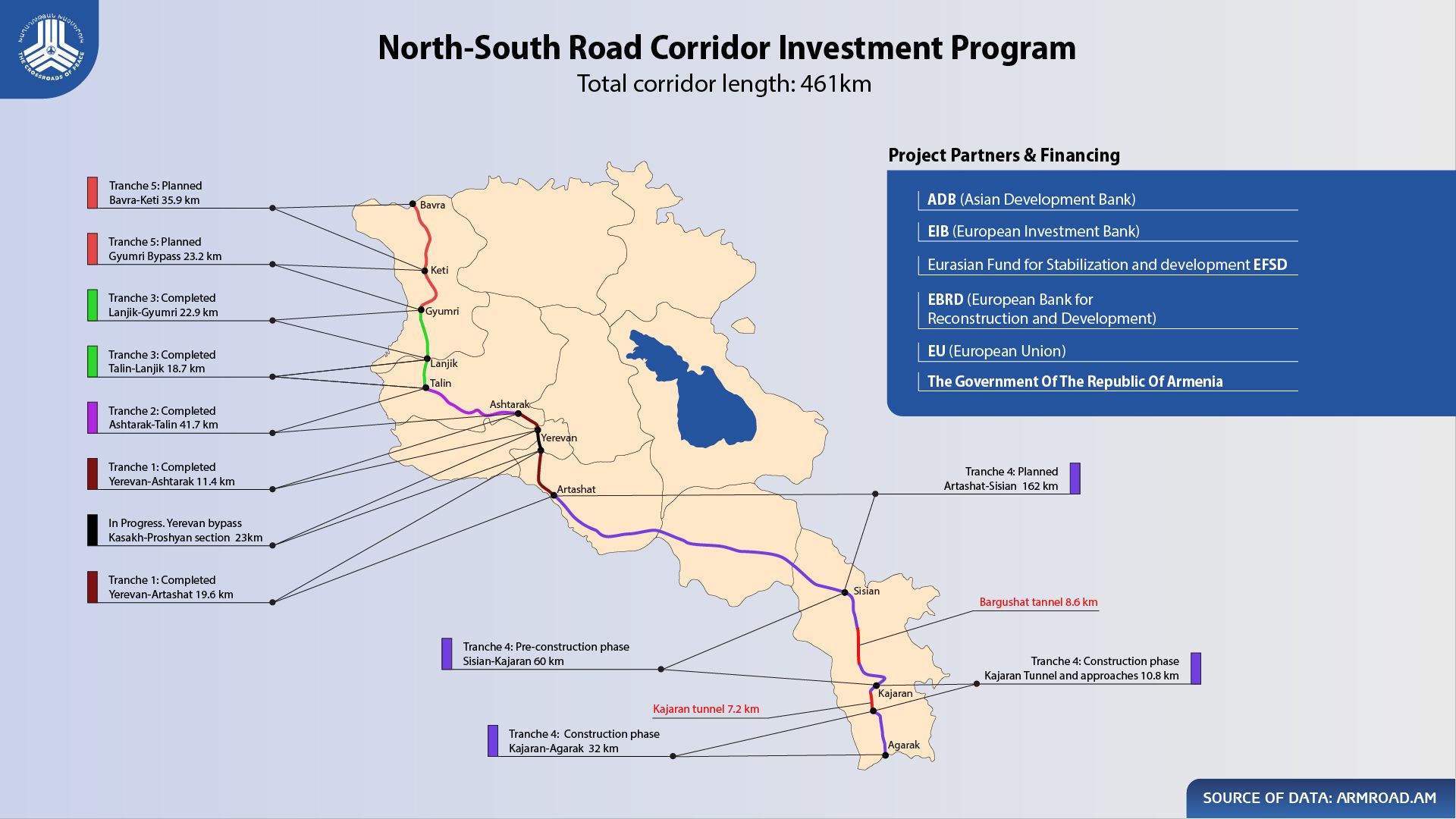
A map of the highway by the Road Department, an agency under the Ministry of Territorial Administration and Infrastructure, showing progress on its sections by June 2026.
Progress on the project has been notoriously slow. It requires massive investment, engineering and construction capacity, political will and bureaucratic competence to push it forward. In a 2023 paper, Armenian economists argued that the Armenian government lacks the skills and experience needed to complete all phases on schedule, including planning, bidding, land procurement and monitoring.
The least technically demanding sections of the corridor (Yerevan–Ashtarak and Yerevan–Artashat) were completed in December 2015 but had to be repaired and were inaugurated in June 2016. Totaling just 31 kilometers, these sections did not include the Yerevan bypass. More on that later.
A Slow Road to Gyumri
This April, the 84-kilometer section between Ashtarak and Gyumri was inaugurated nearly a decade after construction began. Work on the Ashtarak–Talin stretch started in 2013, followed by the Talin–Lanjik–Gyumri section in 2016. The completed stretch cost $243 million.
The Ashtarak–Talin stretch, however, was delayed for years after the Spanish contractor, Corsán-Corviam, ran into financial and operational difficulties. In 2016, the company faced criticism over construction quality and was fined $6 million for failing to meet contractual requirements. The following year, its parent company, Isolux Corsán, was declared insolvent by a Spanish court. It halted construction in Armenia by late 2018 and the contract was terminated by the Armenian government in July 2019. The dispute subsequently went to international arbitration, where proceedings remain ongoing.
Construction on the Ashtarak–Talin stretch finally resumed in late 2023, new contractors were selected, including an Armenian-Indian consortium and a Spanish company. The road was fully opened to traffic in late December 2025.
Separately, prosecutors launched a criminal investigation in September 2018 into alleged abuses involving several sections. Eight years later, the cases remain at the pre-trial investigation stage, with no convictions. Prosecutors initially alleged around $60 million in damage to the state, a figure they later declined to clarify. No high-ranking official has been held accountable, while the expiration of statutes of limitations could bring the cases to a close without a verdict.
Another hurdle on the Ashtarak–Talin subsection was the Agarak archaeological site. While the site itself was discovered decades earlier, additional remains were excavated during construction. After these findings, the highway was redesigned to bypass the site to avoid directly affecting it. Work on the 8 kilometer bypass was launched in January 2023 and completed in June 2025.
The rest of the section, Talin–Lanjik–Gyumri, also experienced many delays. Built by a Chinese contractor, Sinohydro, it was originally planned with a concrete surface, but after quality problems, the contractor switched to asphalt by early 2021. Officials explained it with the poor quality of stone aggregates, cement, and other components in Armenia. Talin–Lanjik was completed by late 2022 and Lanjik–Gyumri in March 2025.
Focus on Syunik
In the aftermath of the 2020 war, Syunik came under increasing stress as its eastern border became a front line. Previously, Armenian forces had controlled several regions of Azerbaijan since the First Nagorno-Karabakh War in 1993, which had effectively kept the line of contact between Armenian and Azerbaijani forces much farther east, away from Syunik. With Azerbaijani forces now stationed on the internationally recognized border itself, part of the Goris–Kapan highway came under Baku’s control by November 2021.
Following the September 2022 incursion into Armenia, Yerevan and its international international partners directed considerable effort toward strengthening Syunik. These efforts have included the EU’s Resilient Syunik Team Europe initiative and diplomatic signals such as Iran’s opening of a consulate in Kapan and France’s establishment of an honorary consulate in Goris. The EU’s civilian monitoring mission (EUMA), deployed along Armenia’s border with Azerbaijan, while not specifically focused on Syunik, has also helped mitigate security anxieties.
Against the backdrop of these anxieties, prompted by Azerbaijan’s repeated demands for a “corridor” through southern Armenia, Yerevan turned its focus to building a secure link between Syunik and the rest of Armenia and with Iran.
In the far south of Armenia, the Kajaran–Agarak section is being built by two Iranian companies at a cost of $214.4 million. Running 32 kilometers to the Iranian border, it features two tunnels and 17 bridges, including Armenia’s longest bridge at 720 meters. Work was launched in February 2024, with officials reporting 40% completion two years on. Full completion is scheduled for 2027.
This June, an important piece of the southern route broke ground, two years after the authorities had originally approved it. The 7.2-kilometer Kajaran tunnel, with 4 kilometers of access roads, is designed to bypass the mountainous Meghri pass and significantly reduce travel time. Carrying a price tag of nearly $400 million, it will take six years to build and be completed in 2032. The tunnel is being built by the same two Iranian companies working on the Kajaran–Agarak section.
The Yerevan Bypass Stalemate
The Yerevan bypass represents one of the best-known cases of poor planning and low state capacity in addressing problems that arose during implementation. Running along the western edge of Yerevan, the highway remained incomplete for years because a 250-meter section was held up by a legal dispute over compensation for the landowner whose parcel was to be vacated under eminent domain. In October 2022, the court had banned all construction work at the site pending resolution of the lawsuit.
Nairi Sargsyan, Pashinyan’s former aide, drew attention to the matter. In a social media post, he alleged that both the government and Yerevan City Hall had shown “complete inaction on this matter over the last three years.” The matter was apparently resolved by September 2026. Sargsyan revealed that work had resumed, with machinery clearing debris and rubble that had accumulated there over the years.
Yerevan Mayor Tigran Avinyan acknowledged that the project had long been delayed, but suggested that city authorities had committed to resolving the issue through a rights-based, negotiated approach in close coordination with the national government. After the court lifted the freeze on the parcel in April 2026, city authorities immediately awarded construction contracts to expedite the process, he said. Completion is now expected by March 2027.
The Road Ahead
At the time of writing, only 26% of the North-South Highway has been completed and opened to traffic. Just over 9% is under construction, while 13.5% is in active preparation. Just over half of the whole project is still in earlier-stage development.
Next in line for construction is the 60-kilometer Sisian–Kajaran section, the most costly portion of the corridor, with a price tag of €1.35 billion ($1.5 billion). The section will entirely bypass Goris and Kapan, Syunik’s largest towns, and cut the route by 54 kilometers. It is further broken down into three subsections, with the Bargushat tunnel, Armenia’s longest ever at 8.6 kilometers, forming the middle one. It is just one of nine tunnels and 27 bridges in that section. Funding will come from the Armenian government, the Asian Development Bank (ADB), the European Investment Bank (EIB), and France. Land acquisition and technical preparations are currently underway. The Armenian government has identified two French companies as partners for the Bargushat tunnel. The official target is late 2032; considering the past record, this is likely too optimistic.
The longest section of the project, and the least advanced, is Artashat–Sisian, covering around 162 kilometers. Its preliminary study and feasibility analysis were conducted back in 2018. This section is not as rugged as southern Syunik and will not require long tunnels, and much of it will likely entail upgrading and expanding the existing route rather than building a new road. A detailed design phase, expected to take approximately two years, is yet to follow.
One segment that could complicate matters is Karki, a small village on the route that sits inside Armenia but is claimed by Azerbaijan as an exclave. It has been under Armenian control since the early 1990s and is known as Tigranashen. Because the village lies directly on the route, how the dispute is settled will determine whether the highway runs straight through or must be diverted around it. Pashinyan has floated a mutual swap of exclaves. Azerbaijan claims three exclaves inside Armenia, which together are somewhat larger than Artsvashen, the Armenian exclave Baku has controlled since the 1990s, meaning a swap could require Yerevan to cede additional territory. If no swap materializes, Karki/Tigranashen becomes an obstacle to be bypassed, adding extra cost and travel time to the southern route.
Separately, construction is yet to start on the 60-kilometer section in the far north of the country. That includes a 23-kilometer bypass of Gyumri, the country’s second-largest city, and a 37-kilometer section from there to the Georgian border at Bavra. The design phase of the Gyumri bypass, considered a priority, was launched in early 2025 and is currently underway. It is to be followed by a feasibility study.
Sixteen years after the project was approved, the North-South Highway is still largely unfinished, with only a quarter open to traffic and half not even started yet. Chronic delays and cost climbs have been a recurring theme of this ambitious project, but its importance has not faded. Even if Armenia’s relations with Turkey and Azerbaijan fully normalize and borders open, this highway remains vital for the country. The road was conceived as a trade artery, but it is becoming a lifeline firmly tying the south to the rest of the country.

Statecraft & Governance

Armenia’s Political Culture Problem: Benevolent Nepotism and Underdevelopment
Post-Soviet cultural syndromes have reproduced a political culture in Armenia marked by benevolent nepotism, low institutional trust, disregard for the law and weak civic responsibility which has produced an unhealthy political culture, writes Nerses Kopalyan. He argues that reconciling Hayastantsi cultural norms with the demands of a modern state is essential to overcoming political underdevelopment.
Read moreState of Play
Politics

More Than a Hijab Ban: Aliyev’s Geopolitical Calculations
Tatev Hayrapetyan examines how Azerbaijan's hijab restrictions have become more than a domestic controversy, exposing tensions with Turkey and the competing strategic interests of Ankara and Tel Aviv. At the center is Aliyev's ambition to assert Azerbaijan's regional power, she argues.
Read more
Armenia and Azerbaijan at UNGA81: Two Visions of Peace and Regional Order
At the UN General Assembly, Armenia and Azerbaijan presented two visions of a changing regional order. Sossi Tatikyan examines their approaches to multilateralism, foreign policy, peace, connectivity and the conflict’s legacy, highlighting growing convergence alongside persistent differences in how the two countries frame the future.
Read more
Trade Before Politics: Armenia and Turkey’s Quiet Path to Normalization
For more than three decades, the Armenia-Turkey border has been closed but trading continued through indirect routes. Beatriz Arslanian examines Turkey’s decision to authorize direct trade, its economic implications for Armenia, and whether incremental economic ties can help advance long-delayed political normalization.
Read more
One Year After the Washington Accords
One year after the Washington Accords, Armenia and Azerbaijan have largely moved beyond military confrontation, but the foundations of peace remain fragile. Sossi Tatikyan examines the unresolved agreement, territorial and humanitarian issues, TRIPP, emerging economic asymmetries and the challenges of making peace durable.
Read more