
Listen to the AI generated audio article.
Ever since independence, the weakness of Armenia’s opposition has been one of the major obstacles to building a functioning democracy. The extreme personalization of political forces and the endless, often deeply unpragmatic, battles among political elites have left voters choosing sides rather than weighing competing policies and governing programs. Elections may come and go, but the feverish political discourse lingers and gathers momentum, forcing us to turn a blind eye to the structural failures that quietly undermine the state. Can Armenia move beyond this cycle without examining the conduct of those who are meant to challenge the government and offer the credible alternative its democracy so desperately needs?
Tracing Legislation
A natural starting point for assessing whether the opposition can function as a “government in waiting” is to examine its legislative record in the National Assembly.
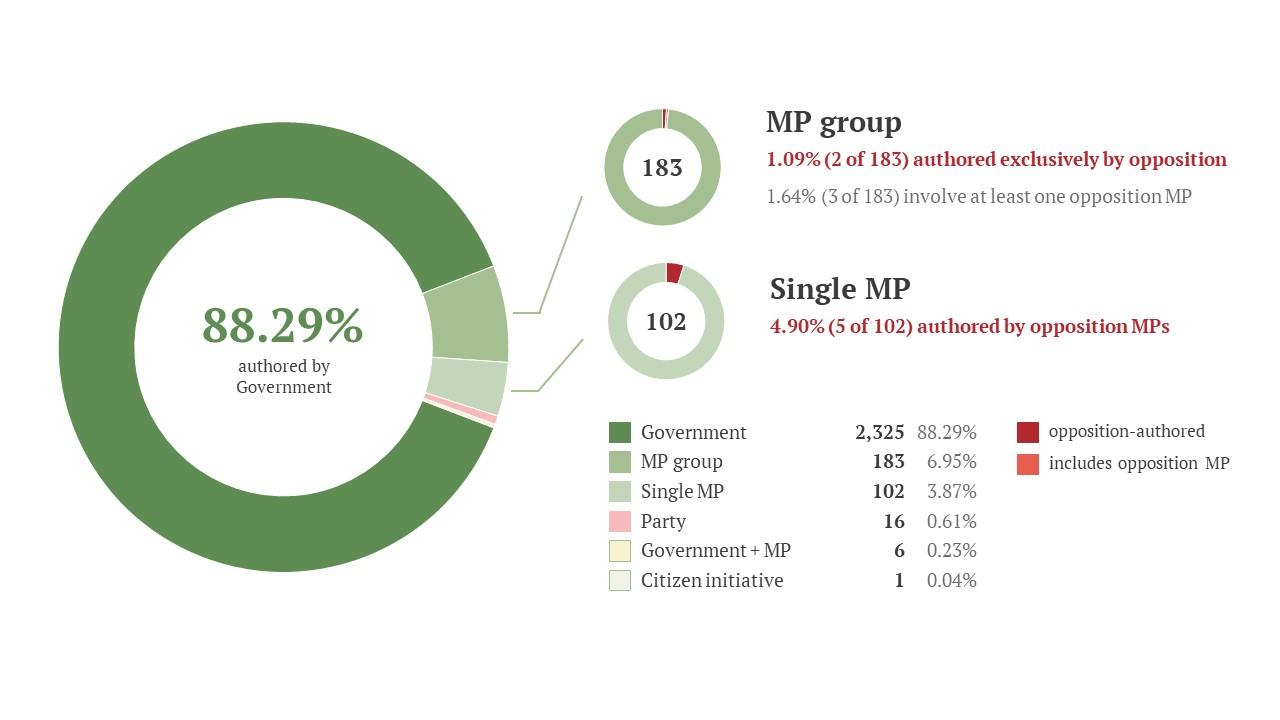
Authorship of fully adopted legislative initiatives in the National Assembly (2021-2026).
The government does not publish comprehensive statistics on parliamentary activity. The National Assembly’s official portal, parliament.am, lists legislative initiatives and their formal authors, identifying whether a measure was submitted by the government or by individual deputies. But no real answers lie there. How often are opposition initiatives rejected? How many amendments do opposition MPs propose? What happens during committee proceedings? And what of the many other legislative activities that rarely make the news? Much of this information is buried in thousands of draft laws, session agendas, and parliamentary transcripts. To fill this gap and build a more complete picture, dozens of datasets were compiled and structured, with each stage of the legislative process converted into a numerical unit.
Based on this count, Armenia’s 2021–2026 Parliament fully adopted 2,802 legislative initiatives over five years. Of these, 2,609 were authored by the government or its parliamentary majority, while only seven—0.25%—were introduced by the opposition. The remaining 186 initiatives concerned procedural matters.
The review also identified one, and only one, instance of collaboration between rival political forces: an initiative (Ref. Պ-1155-26.09.2025,05.11.2025-ՊԻ-011/2ամբ) authored by Ruben Rubinyan and Gegham Nazaryan. It amends the Law on Holidays and Remembrance Days by adding Article 1.2, establishing January 27 as the Day of Remembrance of Those Fallen in Defense of the Homeland. At the time, however, Nazaryan had already left the Hayastan faction and declared himself an independent opposition MP.
Nevertheless, the same pattern holds for the rest of the opposition’s legislation. Its bills are not only few in number; their subject matter is also largely symbolic, cultural, or procedural.
Two unavoidable questions follow these findings: Does the opposition offer legislation that is simply blocked by the majority, or do we have 35 mandates sitting in the chamber with no legislative agenda at all? And what share of the items put to a vote originated with the opposition?
Going through the session agendas on the same portal, I identified 1,048 agenda items put to a vote between August 17, 2021, and July 3, 2026. Of these, only 16 concerned initiatives introduced by the opposition. However, before a legislative draft can be brought up for a plenary hearing, it must first be submitted to a committee for consideration. Perhaps the opposition’s lawmaking work is more visible within the Standing Committees? Not quite.
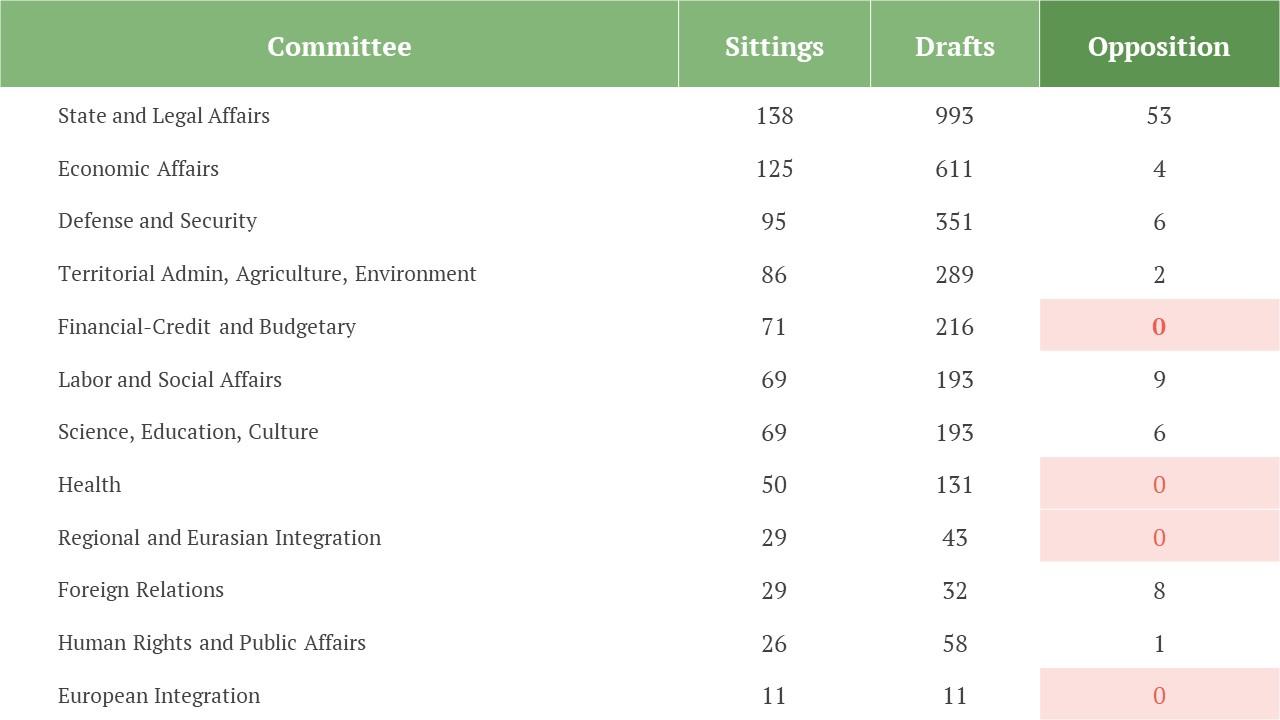
Opposition authored legislative drafts across Standing Committees.
By my count, the Standing Committees held 798 sittings to consider draft legislation, and 3,076 distinct drafts were submitted over five years. Of these, only 89—2.89%—were introduced by the opposition. Four committees—the Financial-Credit and Budgetary, Health, Regional and Eurasian Integration, and European Integration committees—considered zero opposition-initiated drafts.
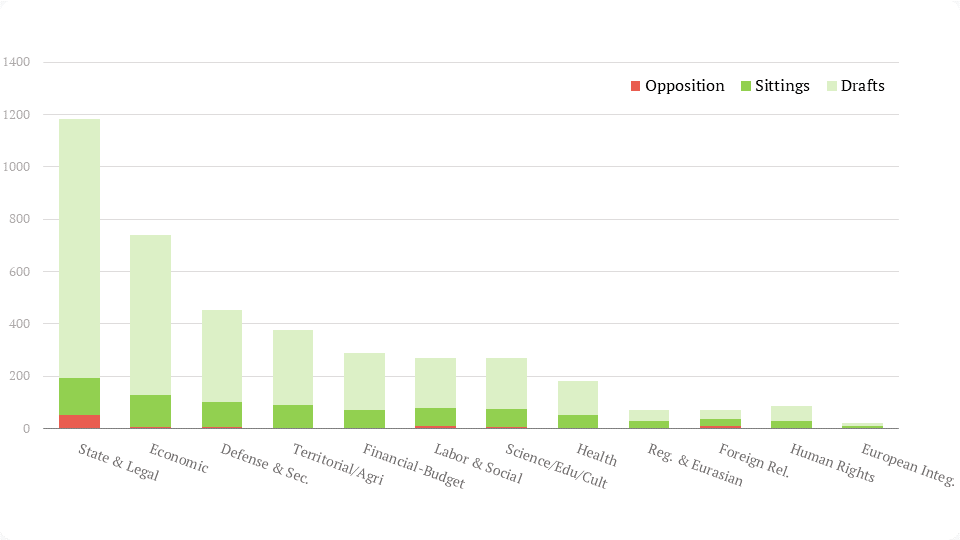
Distribution of legislative drafts and opposition participation by committee.
Another metric I tracked is the number of proposals submitted on legislative drafts. Of the 2,633 bills reviewed, only 590 received any proposals, totaling 792. The ruling majority accounted for 740 of these, while the opposition contributed 52, or 6.6%.
The Opposition Barely Opposes
The numbers tell a consistent story: at every stage of the legislative process, the opposition’s participation has been marginal. But a fair question remains: Why invest in drafting legislation when the parliamentary majority is unlikely to adopt it? Of the 89 opposition-sponsored drafts submitted over five years, only seven were adopted—a rejection rate of roughly 92%.
But the real cause for alarm lies elsewhere. Government dominance in legislation is hardly unusual in parliamentary systems where the governing party commands a majority. Opposition drafts are inherently easier to defeat. The problem in Armenia’s Parliament is not simply that opposition-authored bills rarely become law; it’s that the opposition produces so little legislation in the first place. Comparisons with established parliamentary democracies make this difference evident.
In Hungary, fewer than 1% of opposition-initiated bills were adopted during the 2018–2022 parliamentary term, even though opposition parties accounted for 40.82% of all legislative proposals submitted. In 2024, German opposition parties submitted at least half of the 88 legislative proposals originating in the Bundestag. Yet none of the 16 parliamentary-origin laws adopted that year were solely opposition-authored. In Ireland in 2023, legislators outside the government published 59 private members’ bills. None were enacted.
These opposition parties continue to develop policies and submit bills despite the small chances of enactment. In the parliamentary democracies we strive to emulate, proposing legislation serves purposes beyond getting it passed. A bill can put an alternative policy on the parliamentary record, force the government to take a position, initiate public debate, expose differences between parties, signal what the opposition would do in government, and give voters a concrete alternative to government policy. Even a bill doomed to fail does this work. A recorded vote makes the majority’s position explicit; a debate gives the public something specific to weigh, and a draft shows voters what the opposition would do with power. Over time, a sustained legislative agenda turns a collection of critics into a credible alternative.
The Armenian opposition has largely relinquished this role. By introducing just 89 drafts over five years and accounting for only 6% of proposals on draft legislation, compared with 60% to 80% in established democracies, it has left the government’s policy agenda largely unchallenged and voters with little to compare it against. What remains is political posturing: criticism without proposals and slogans where legislation should be. A parliamentary force that stops writing laws abandons its primary institutional duty.
Conclusion
Watch Western media for an evening, and you will see a curious talent for turning a recycling rule or the placement of a bike lane into an ideological war. Technical issues become political contests, mobilizing the public, generating debate, and finding solutions. Armenia, meanwhile, has developed a talent entirely of its own. Here, matters that are already political are inflated until every disagreement becomes a verdict on whether the country deserves to exist. And a verdict leaves no room for amendment, negotiation, or compromise. It can only be broadcast, manipulated, and exploited for the most self-serving and destructive ends.
The existential questions are real, and no serious person would argue that a country in Armenia’s position can afford to ignore them. But they cannot be the only questions. Existential rhetoric does not address emigration, and the birth rate does not recover simply because a speech is loud enough. These problems require policies, proposals, and sustained public debate. When the opposition chooses to spend its political capital on rhetoric rather than legislative work, Parliament becomes a platform for warnings of national catastrophe. What remains is little more than an illusion of rivalry played out on the evening news. Hundreds of thousands of citizens spend hours consuming political content, becoming steeped in politics yet largely unaware of the structural problems that, denied the headlines, quietly erode the state.
Another election day will come in a few years, and all the system will have given us is a spectacle of political intrigue, flying chairs, and inventive insults echoing through the halls of the National Assembly.
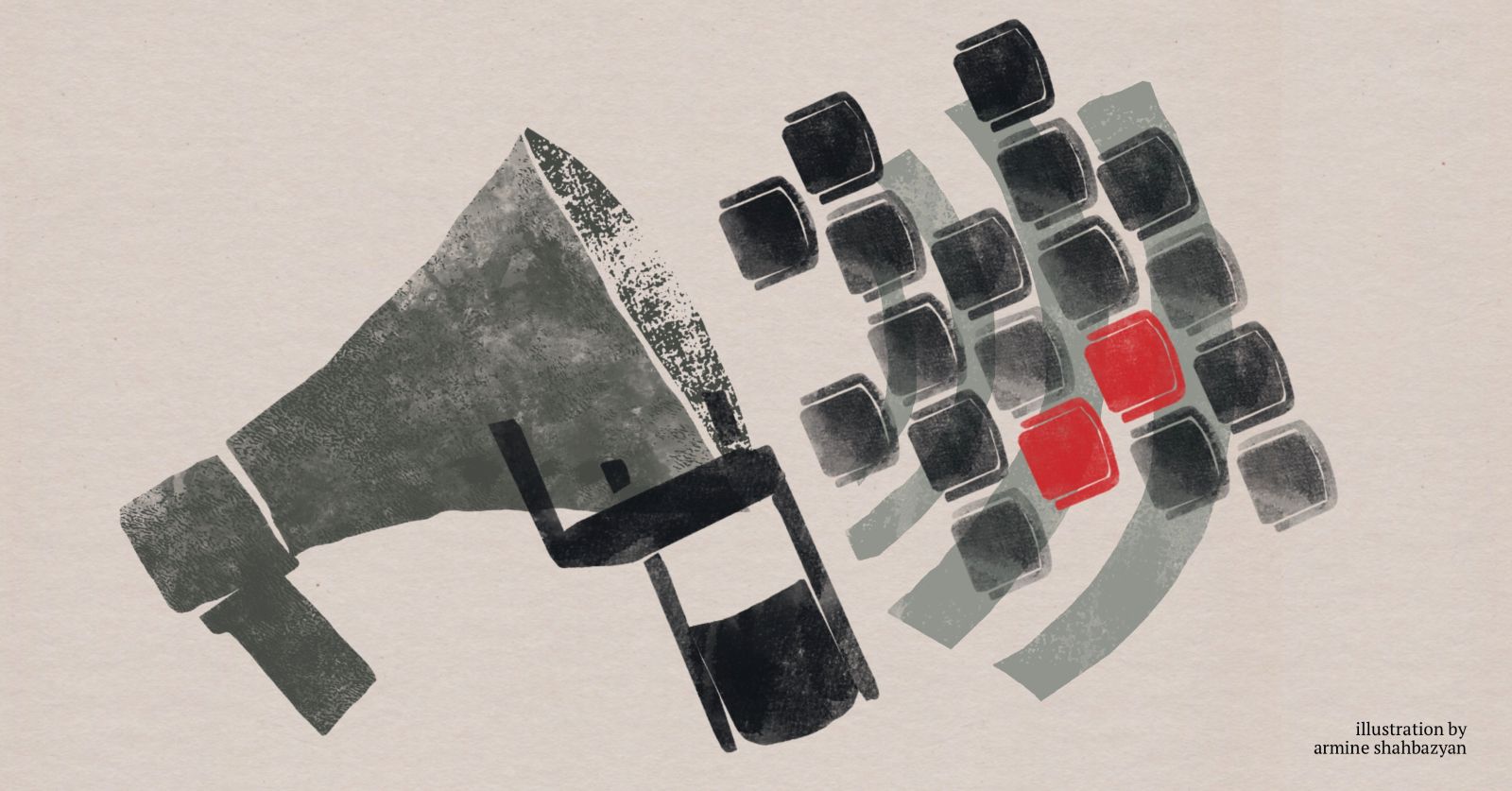
The room is loud, but the seats are empty.
Politics
The Long Road to a Shorter Route: Armenia’s North-South Highway
Armenia’s North-South Highway is meant to be a strategic lifeline, connecting the country to Iran and Georgia, strengthening Syunik’s links to the rest of Armenia and opening a trade route between the Persian Gulf and the Black Sea. Yet 16 years after its approval, the project remains largely unfinished. Hovhannes Nazaretyan examines the delays, cost overruns and challenges holding it back.
Read more
More Than a Hijab Ban: Aliyev’s Geopolitical Calculations
Tatev Hayrapetyan examines how Azerbaijan's hijab restrictions have become more than a domestic controversy, exposing tensions with Turkey and the competing strategic interests of Ankara and Tel Aviv. At the center is Aliyev's ambition to assert Azerbaijan's regional power, she argues.
Read more
Armenia and Azerbaijan at UNGA81: Two Visions of Peace and Regional Order
At the UN General Assembly, Armenia and Azerbaijan presented two visions of a changing regional order. Sossi Tatikyan examines their approaches to multilateralism, foreign policy, peace, connectivity and the conflict’s legacy, highlighting growing convergence alongside persistent differences in how the two countries frame the future.
Read more
Trade Before Politics: Armenia and Turkey’s Quiet Path to Normalization
For more than three decades, the Armenia-Turkey border has been closed but trading continued through indirect routes. Beatriz Arslanian examines Turkey’s decision to authorize direct trade, its economic implications for Armenia, and whether incremental economic ties can help advance long-delayed political normalization.
Read more
One Year After the Washington Accords
One year after the Washington Accords, Armenia and Azerbaijan have largely moved beyond military confrontation, but the foundations of peace remain fragile. Sossi Tatikyan examines the unresolved agreement, territorial and humanitarian issues, TRIPP, emerging economic asymmetries and the challenges of making peace durable.
Read more
Why Azerbaijan Still Shapes Armenia-Turkey Normalization
Five years into the latest normalization process, Armenia and Turkey have expanded dialogue and technical cooperation, yet the border remains closed. Hranoush Dermoyan examines why Azerbaijan continues to shape Ankara's policy, and how Turkey's domestic politics and economic interests complicate normalization.
Read more