
Listen to the AI generated audio article.
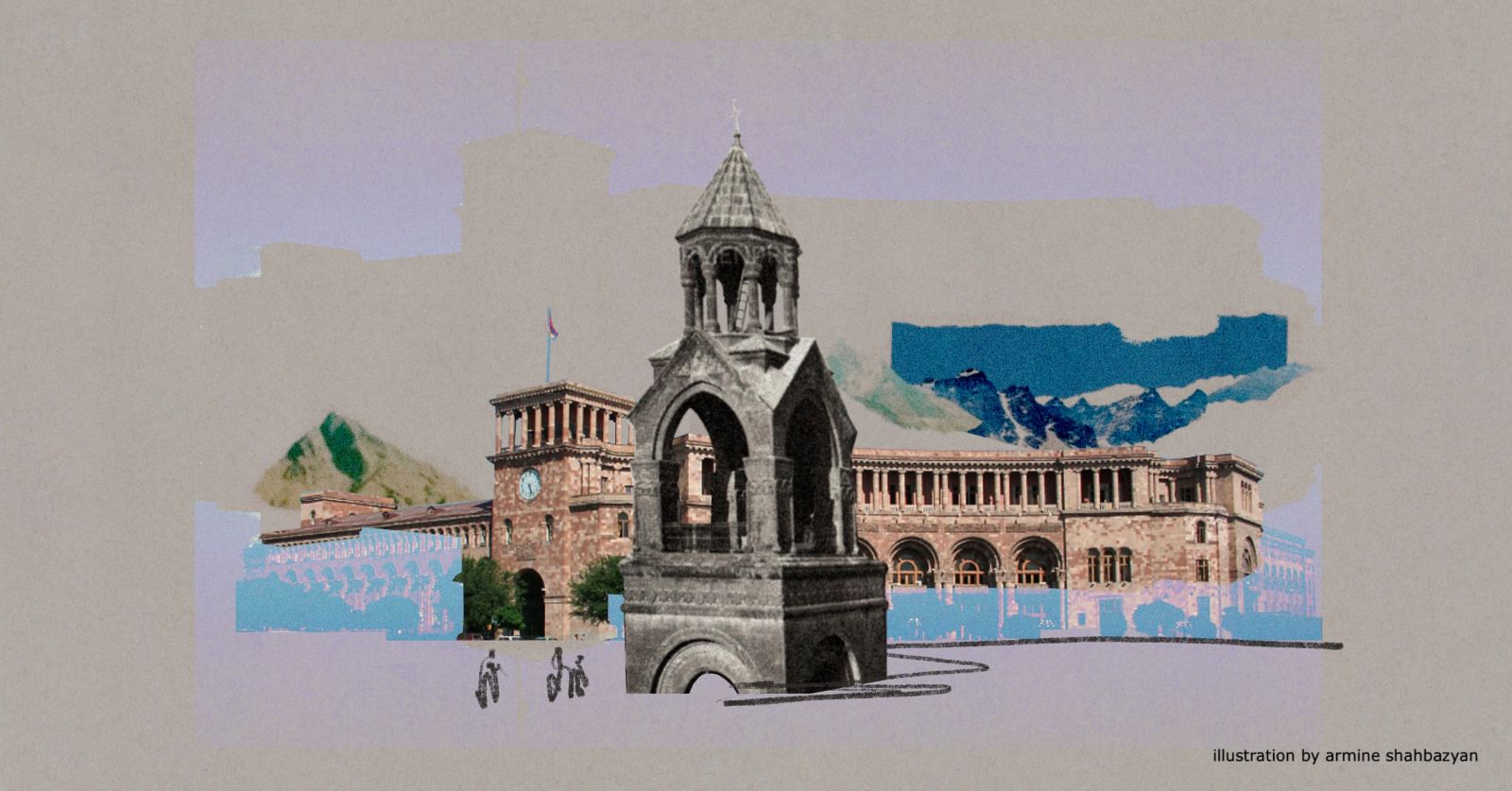
Church-state relations in Armenia have gained renewed prominence amid tensions between Prime Minister Nikol Pashinyan and Catholicos Karekin II, coupled with the recent arrests of two senior clergy, Archbishop Mikayel Ajapahyan for calling for the seizure of power and Bagrat Galstanyan for conspiracy to commit terrorism, mass riots and seizure of power. These events mark a particularly sharp rupture in a relationship that has long shaped Armenia’s political and social landscape, making it a timely opportunity to look back at how successive administrations have engaged with the Armenian Apostolic Church.
Since Armenia’s independence from the Soviet Union, the Church has been led by three Catholicoi: Vasken I (1955–1994), Karekin I (1995–1999), and Karekin II (since 1999). Both Catholicosal elections, in 1995 and 1999, were marred by government interference. Writing nearly two decades ago, Hratch Tchilingirian described post-Soviet church-state relations as “problematic”, with each side attempting “to exploit the other.” In 2015, Tigran Matosyan argued that as the Church revived after Communism, the Armenian state assumed a role of patronage, which the Church reciprocated with loyalty.
This primer examines how church–state relations have been shaped by both legal frameworks and personal dynamics across all four post-independence administrations, highlighting patterns of cooperation, tension and influence that have evolved over three decades.
Levon Ter-Petrosyan (1990-1998)
In Armenia’s first free elections in May 1990, non-Communist candidates under the umbrella of the Pan-Armenian National Movement (HHSh) won a majority in Soviet Armenia’s legislature, then called the Supreme Council. HHSh leader Levon Ter-Petrosyan was elected Chair, effectively becoming the leader of Armenia. That July, Catholicos Vasken I of the Armenian Apostolic Church was invited to address the Council’s inaugural session. The same body adopted Armenia’s Declaration of Independence in August 1990, which guaranteed freedom of conscience but did not mention or grant a special status to the Church.
A separate Law on Freedom of Conscience and Religious Organizations was passed in June 1991, which recognized the Armenian Church as “the national church of the Armenian people” in the preamble. While Article 17 of the law formally establishes the separation of Church and state, in practical terms, it also grants the Church significant privileges, such as exclusive rights to preach and disseminate its faith, revive its historical traditions and structure, and build or restore churches. The same article places the Church under state protection, both within Armenia and abroad. Amendments enacted in 1997 further reinforced its privileged status.
Following the independence referendum in September 1991, Ter-Petrosyan was elected Armenia’s first president. His inauguration in October 1991 established a precedent that would define Church-state ceremonial relations for decades. He took his oath on an ancient copy of the Gospels, receiving Catholicos Vasken’s blessing. Ter-Petrosyan’s symbolic reverence for the Church was displayed when in July 1994, he personally presented Catholicos Vasken with both an Armenian passport and the country’s highest honor, the National Hero award, making the religious leader the first recipient of each.
According to Felix Corley, a scholar of the Armenian Church, Ter-Petrosyan and Vasken I cultivated a carefully balanced relationship in which “the Church refrained from direct interference in government affairs, except in the realm of religious policy, while guaranteeing and endorsing statehood and providing almost sacramental endorsement of the new government and president.”
In 1993, the Church appealed to the authorities to help fight against what it perceived as the serious threat of newly emerging sects in Armenia. Later that year, President Ter-Petrosyan issued a decree, which imposed restrictions on religious groups besides the Armenian Church. The measure sought to regulate foreign religious organizations that were not formally registered, as well as registered groups whose activities were deemed unlawful or seen as “undermin[ing] the moral-psychological atmosphere in the republic.” The decree marked the earliest post-independence instances of the state aligning itself with the Church to assert control over Armenia’s religious landscape.
Armenia’s first Constitution, passed by a referendum in June 1995, did not establish a state religion, nor did it contain provisions about the relationship between the state and any particular religious institution. Article 23 guaranteed the freedom of religion. Under the Ter-Petrosyan administration, the Church was allowed to have chaplains in prisons (1993) and the military (1997).
Following Catholicos Vasken I’s death in 1994, Ter-Petrosyan directly intervened in the 1995 election of a new Catholicos of All Armenians. He invited Catholicos Karekin II of the Great House of Cilicia*, the Antelias-based See in Lebanon, to stand as a candidate. A month before the election, Ter-Petrosyan stated in an interview that he considered Karekin the “most worthy” of candidates, and on election day in April 1995, delivered a speech widely interpreted as a tacit endorsement.
Karekin was ultimately elected as Catholicos of All Armenians, taking the name Karekin I. His main opponent, Archbishop Garegin Nersisian, who would later become Catholicos Karekin II after Karekin I’s death in 1999, was reportedly pressured by the authorities to withdraw.
Freedom House noted at the time that Ter-Petrosyan’s “strong support of Karekin raised charges of interference in Church affairs.” Corley similarly argued that Ter-Petrosyan had “vigorously promoted” Karekin’s candidacy and the Catholicos was perceived as having “too-close association” with the president. Another scholar, Levon Petrosyan, argues that without Ter-Petrosyan’s support, Karekin “could not have been a favored candidate.”
With his endorsement of Karekin I, Ter-Petrosyan primarily hoped to unite the Sees of Etchmiadzin and Cilicia by having the Catholicos of Cilicia—first time ever—elected Catholicos of All Armenians. These hopes soon faded however.
Robert Kocharyan (1998-2008)
The current head of the Church, Catholicos Karekin II, was elected in October 1999 after the death of Karekin I.
The authorities, specifically President Robert Kocharyan, reportedly interfered in Karekin’s election. In late September 1999, a month before the election, several leading archbishops—including the Catholicosal Locum Tenens (acting Catholicos), the Patriarchs of Jerusalem and Constantinople (Istanbul), the primates of Russia, Artsakh (Nagorno-Karabakh), and the Eastern Diocese of North America—signed an appeal warning that the “higher echelons” of the Armenian government have “arrived at a consensus in favor” of one candidate and are thus jeopardizing the election and threatening the “internal unity” of the Church. They called on outside organizations to show restraint and not intervene in the election. Both Kocharyan’s office and Archbishop Garegin Nersisian (Karekin II), whom the appeal implied to be the government candidate, denied state backing. A week prior to the election several political parties and intellectuals called for its postponement.
Levon Petrosyan argues that Kocharyan, along with Prime Minister Vazgen Sargsyan, supported Karekin’s candidacy because “as a Soviet-style church administrator”, he “always adapted church policy to the ruling party’s ideology” and had close ties with the Diaspora allowing him to collect financial aid and attract investments. According to Petrosyan, the state and Karekin “did not have any major problems in controlling the election.”
The controversy over government interference soon faded following the assassinations of Prime Minister Vazgen Sargsyan, Parliament Speaker Karen Demirchyan and six others on October 27, 1999, the day Karekin was elected in Etchmiadzin. Nevertheless, Mesrob II Mutafyan, the Patriarch of Constantinople, who was the most vocal among the signers of the appeal, told a U.S. diplomat that he considered Karekin’s election undemocratic and orchestrated by Kocharyan. Mutafyan also saw Karekin as “overly politicized”.
Less than six months after Catholicos Karekin II’s election, on March 17, 2000, the Armenian government and the Church signed a Memorandum of Understanding (MOU), which recognized “the indispensable role and significance” of the Church in “the further development and strengthening of Armenian statehood.” The document sought to “further clarify the nature and content of the relations” between the state and the Church and laid the groundwork for a draft concordat to be finalized within nine months, in time for the 1,700th anniversary of Armenia’s conversion to Christianity in 2001. At the time, the memorandum was hailed as “a historical document”, a step toward formalizing the Church’s privileged status within the state.
Unlike the 1995 Constitution, Armenia’s revised 2005 Constitution, promoted by President Kocharyan and passed in a referendum, did mention the Church. Article 8.1 highlighted the Church’s role in the history of the Armenian people and provided that Church-state relations could be regulated by law. As a result of negotiations provided by the 2000 Memorandum and the 2005 Constitution, the Armenian parliament passed such a law in February 2007, giving legal expression to the Church’s special standing in Armenian public life.
With the 2007 law, the state recognized the Armenian Apostolic Church as the “national church” which regulates matters related to heritage and education. The state also recognizes church-performed marriages and divorces as legally valid, though the supporting legal framework for enforcement remains incomplete. It grants the Church financial advantages, including tax exemption for donations and religious fundraising and tax-free production and sale of ritual objects. It also allows the Church to maintain permanent chaplains in hospitals, military units, and prisons. A State Department report noted that the law “formally recognizes the role that the Armenian Church already plays in society, since most citizens see the Church as an integral part of national identity, history, and cultural heritage.”
Authored by Parliament Speaker Tigran Torosyan, the bill was closely discussed with and in “complete agreement” with the Church. Torosyan described it as “very important” as “for the first time, the relations between the state and the church are being regulated by law as a consequence of constitutional changes.” The law, however, has been criticized as vague for not addressing a number of issues.
In the meantime, church leaders maintained loyalty to the authorities, who in turn granted further privileges. In 2002, during Kocharyan’s first term, the Church obtained a nationwide broadcast TV channel (Shoghakat) and beginning in 2003, History of the Armenian Apostolic Church was introduced as a mandatory subject in public schools. The course was rolled out in phases, with full implementation completed by 2004.
Church loyalty also extended into electoral politics. On the eve of the February 2003 presidential election, Karekin II blessed newlywed couples in Artashat during the Trndez festival, an event attended by Kocharyan. It was essentially part of Kocharyan’s campaign. The opposition saw it as an endorsement of Kocharyan, but did not publicize their frustration until a year later, with one opposition leader saying the Church must “refrain from attending political shows.” In March 2003, Karekin II appealed to release 48 opposition members and activists jailed in protests against alleged vote rigging.
Petrosyan describes the relationship between Kocharyan and Karekin II as following the “old Byzantine model of state-church relations incarnated in modern Russia,” where the church is fully subordinate to and closely aligned with secular power.
Serzh Sargsyan (2008-2018)
The church’s loyal stance towards the authorities continued under Kocharyan’s successor, Serzh Sargsyan. Prior to the February 2008 presidential election, Archbishop Navasard Ktchoyan, Primate of the Ararat Diocese, twice endorsed Prime Minister Sargsyan for the presidency. This amounted to unprecedented interference by the head of the largest and most influential diocese that covers the capital Yerevan. First, in November 2007, Ktchoyan spoke at the congress of the then-ruling Republican Party of Armenia, delivering a political speech and effectively endorsing Sargsyan.
During a religious procession on January 31, 2008, less than a month before election day, Ktchoyan again endorsed Sargsyan, who was in attendance. Ktchoyan described him as a hero of the first Nagorno-Karabakh (Artsakh) war and used Sargsyan’s campaign slogan of “Forward Armenia” (Առաջ Հայաստան). Ktchoyan defended his move as simply reflecting his political sympathies as a private citizen. When pressed about his vocal support for Sargsyan and the ruling Republican Party, Ktchoyan justified it by its national conservative ideology and argued that many priests of his diocese are opposition sympathizers who attend anti-government rallies.
Following the February 19, 2008 presidential election, in which Sargsyan defeated former President Ter-Petrosyan, Karekin II was one of the first public figures to congratulate Sargsyan. Ter-Petrosyan rejected the results and launched round-the-clock protests in Yerevan. After two weeks of sit-ins, in the early morning hours of March 1, security forces violently dispersed protesters in Liberty Square, which led to a day of clashes, leaving eight people and two police officers dead. A state of emergency was declared and the army was called to restore order. That night, Karekin II attempted to mediate an end to the crisis by going to Ter-Petrosyan’s house, but was rebuffed by Ter-Petrosyan, who argued that the Catholicos had appealed to the wrong side, insisting that it was Sargsyan and Kocharyan, who had ordered the crackdown, who should be urged to halt the bloodshed.
Karekin later told U.S. Ambassador Marie Yovanovitch that Armenia “does not need a revolution” and accused the opposition of trying to politicize “his position by urging that the Church condemn the actions of the authorities.” In a 2008 confidential cable, Yovanovitch noted that during their conversation, Karekin interrupted to answer his “government phone”—like a Soviet-era hotline typically used by ministers to receive calls from the president.
Alignment of the Church and state continued during Sargsyan’s presidency. In a 2009 meeting with the Church leadership, the president notably said, “It is impossible to imagine a more experienced and influential ally for the state structures” than the Church.
In 2011, legislative amendments to Armenia’s tax codes proposed by the government and passed by parliament provided significant tax exemptions and property rights to the Armenian Apostolic Church. This included an extensive list of church buildings, cultural and educational institutions and other church-affiliated properties, which were exempted from property and land taxes. The amendments concerned 286 properties, mostly churches, but also non-religious properties. The amendments were controversial at the time, raising concerns even from the pro-church ARF and Prosperous Armenia parties and from other religious institutions, including Armenian Protestants and Catholics. Media coverage was quite negative with an essay in Hetq condemning “the illegitimate marriage” between Church and state, calling it an attempt to establish “clerical-feudal orders” of the Middle Ages. Former Prime Minister Hrant Bagratyan saw it as unconstitutional. The Church defended the move by arguing that it does not control any profitable enterprises and its revenues are generated through the sale of candles, books, and through donations from institutions and individuals.
In the 2010s, Armenia’s opposition became increasingly critical of the Church’s ties with the authorities. At a 2011 rally, chief opposition leader Ter-Petrosyan asserted that the Church had become “a tool of the state.” Months later, another key opposition leader, former Foreign Minister Raffi Hovannisian’s Heritage Party, accused the authorities of “engaging the Church in politics.” Earlier he had vowed to not allow anyone to make the Armenian Church subject to political party influence.
Following the disputed 2013 presidential elections, Hovannisian, who officially received nearly 37% of the votes, sought to prevent Karekin II from blessing Sargsyan’s inauguration. When he launched a hunger strike on March 10, he warned that if he blesses Sargsyan’s oath, Karekin will “desecrate the Bible.” The Church responded that attempts to make it “targets of political exploitation to be unacceptable.” Hovannisian doubled down, accusing the Church of “insert[ing] the Gospel of the Virgin Mary [on which the President takes oath] into this political struggle.” Hovannisian asserted that such a move would be an anti-Christian act. After Sargsyan’s inauguration, which Karekin did bless, Hovannisian declared him a “false Catholicos.”
In the early 2010s, Archbishop Navasard Ktchoyan became embroiled in a series of scandals. First, in March 2011, local media reported that he owned a Bentley worth $180,000 to $200,000, which was reportedly gifted by his godson. It later emerged that he owned a gun gifted by the Prime Minister sometime in 2007–08. Both gifts, associated with oligarchs and mafia godfathers, were seen as damaging to the Church’s reputation. Ktchoyan dismissed the media coverage as unworthy of serious attention. Two years later, in 2013, Ktchoyan’s name appeared in a Cyprus-registered offshore company alongside Prime Minister Tigran Sargsyan with suspicions of money laundering.[1]
The current Constitution, as amended in 2015, guarantees the freedom of activity of religious organizations and separation of Church and state (article 17). Simultaneously, the state “recognizes the exclusive mission” of the Armenian Apostolic Church as “the national church in the spiritual life of the Armenian people, in the development of their national culture and preservation of national identity” (article 18).
During the Sargsyan presidency, the church and Catholicos Karekin were often targeted for their perceived “close affiliation to the state and ruling party” with many Armenians seeing the Church as a collaborator with the ruling Republican Party. Political analyst Narek Mkrtchyan, who is currently Armenia’s ambassador to the United States, argued in a 2015 paper that during Sargsyan’s presidency, relations between the Church and state were transactional, with the Church receiving certain privileges from the state and providing legitimacy for the ruling government through its authority.
Nikol Pashinyan (Since 2018)
The 2018 Velvet Revolution not only resulted in a change of power and the removal of elites who had ruled Armenia since independence, but also disrupted the long-standing status quo between the Armenian Apostolic Church and the government.
In the first two years following the revolution, both Prime Minister Nikol Pashinyan and Catholicos Karekin II attempted to establish a working relationship. However, by 2020, deep-rooted divisions between Pashinyan’s administration and the Church leadership had become increasingly evident.
The Church and the Revolution
Mass protests erupted in Yerevan and across Armenia in April 2018 after it became clear that outgoing President Serzh Sargsyan intended to remain in power by assuming the new post of prime minister under the revised constitution, despite his 2015 pledge not to do so. His formal election as prime minister on April 17 only inflamed protests, which many viewed as a direct betrayal of public trust.
Public anger was directed not only at corruption, social injustice, and lack of transparency, but also at the leadership of the Armenian Apostolic Church—particularly Catholicos Karekin II. Protest banners rejecting the Catholicos appeared alongside posters denouncing Sargsyan, though protest leader Nikol Pashinyan and his team refrained from criticizing the Church in their speeches.
For most of the month-long protests, the Catholicos remained silent. On April 19, two days after Sargsyan’s election as prime minister, the Church issued a statement urging “solidarity, mutual understanding, and unity.”
Sargsyan resigned on April 22, a move that shocked the nation. That day, the Supreme Spiritual Council and the Bishops’ Synod released a joint statement urging peaceful resolution. In the following week, as the country faced uncertainty, Karekin II met with the presidents of Artsakh and Armenia, Pashinyan, and senior members of the ruling Republican Party (HHK) to discuss the situation in the country.
On May 8, after Pashinyan’s election as Prime Minister, Karekin II congratulated him and offered his blessings.
The New Administration and the Old Church (2018)
In the first few years of the Pashinyan government, relations with the Catholicos remained cordial. The heads of the Church and state regularly met and appeared together at various events. Less than a month after his election, Pashinyan met with the Catholicos, members of the Supreme Spiritual Council and other clergy, where he emphasized the importance of dialogue and cooperation in addressing the country’s challenges.
This relationship was soon put to the test when in the beginning of June a group calling themselves “New Armenia, New Patriarch” began staging protests in Yerevan and Etchmiadzin, demanding the resignation of the Catholicos, accusing him of corruption and claiming he was out of touch and no longer accepted as a spiritual leader.
On July 6, around two dozen demonstrators entered the chancery of the Mother See and launched an indefinite sit-in again calling for the resignation of the Catholicos. They were later removed by the police. Supporters of the Church believe the police could have acted sooner.
A few days later, when the Catholicos traveled to Gndevank in the Diocese of Vayots Dzor, members of the initiative surrounded his vehicle and obstructed the road. Mother See spokesperson Vahram Melikyan warned that the Catholicos faced danger. Police eventually dispersed the protesters, and Karekin II returned to Etchmiadzin.
Following the Vayots Dzor incident, Pashinyan said he viewed the unrest surrounding the Church as an internal matter, especially as some of those demanding the Catholicos’ resignation were active clergy, and saw no immediate need for government involvement. He also noted his dissatisfaction with how police handled the matter in dispersing the crowd.
The group lost momentum and became mostly inactive by the end of the year.
The incident did not appear to strain relations between Pashinyan and the Catholicos. In September, Pashinyan shared a selfie with Karekin II on social media during their trip to the U.S. for the opening of the Armenia Exhibition at New York’s Metropolitan Museum. The caption read: “This is a historic photograph. Why? Because this is the first selfie in Armenian history between the Catholicos of All Armenians and the leader of Armenia.”
On November 14, weeks before snap elections, Prime Minister Pashinyan and Catholicos Karekin II held their first one-on-one meeting at the Mother See. Two days later, Parliament rejected an opposition bill mandating extra security for the Catholicos after the Vayots Dzor incident. Soon after, during the election campaign, Pashinyan raised concerns about Church corruption, accusing Serzh Sargsyan, leader of the Republican Party of Armenia (RPA) of turning the institution into a government appendage while pledging to restore its dignity. The RPA, meanwhile, campaigned as the defender of the Church and national values.
Despite these tensions, relations remained cordial. After Pashinyan’s “My Step” alliance won a decisive victory on December 9, 2018, the Catholicos hailed the election as a political milestone. Days later, the two met again in Etchmiadzin, with Pashinyan calling it the start of a new era requiring a re-evaluation of Armenia’s recent history.
Cracks Appear (2019)
In early 2019, Prime Minister Pashinyan and Catholicos Karekin II co-chaired a new working group on Church-State relations, which met first on May 3. Pashinyan stressed the need for a permanent mechanism to recalibrate relations in Armenia’s post-revolution context, including clarifying where state and Church visions align on identity and civic values. He raised questions about teaching the “History of the Armenian Apostolic Church” as a standalone subject and about taxation of Church properties.
The Catholicos welcomed the initiative as a chance to resolve longstanding issues, reiterating the Church’s constitutional and historic role, while noting that many challenges remain.
Armenia’s Constitution recognizes the Armenian Apostolic Church as the national Church, citing its historic role. The Catholicos emphasized that secularism does not imply hostility toward religion or preclude cooperation, especially in a country with Armenia’s deep Christian heritage. Legislative approaches must consider the Church’s immense losses during the Genocide and Soviet era, including property destruction and confiscation. State support, he concluded, is vital for the Church to fulfill its mission in Armenia and across the diaspora.
In the following years, the working group would continue meeting sporadically but produced little tangible progress.
Tensions resurfaced on May 20, 2019, when Pashinyan called for the “seizure” of courts to reform the judiciary, prompting protests around the capital’s court buildings, with the Catholicos voicing deep concerns.
Another rift emerged in September 2019, when Pashinyan, during a press conference in Los Angeles, criticized certain clergymen. Clarifying his stance on Church autonomy, he said the Church should remain self-governed, but warned that if the Armenian people demanded it, the government could intervene. He accused some clergy of mistaking restraint for weakness: “They think, ‘this isn’t like the previous government, this is a weak one. Let’s destroy it.’ They will be hit back hard and be brought to their knees, literally and figuratively.” Etchmiadzin sought clarifications upon his return, but received none.
Another point of tension was the government’s push to ratify the Istanbul Convention, a legally binding Council of Europe treaty aimed at combating domestic violence. Armenia signed it in 2018 under Serzh Sargsyan, at which time the Church remained silent.
When Pashinyan’s administration began ratification discussions, the Church became a vocal opponent. In a July 26, 2019 statement, it criticized provisions recognizing self-determined gender identity and promoting “non-stereotypical gender roles” in education, warning that the convention could undermine Armenia’s spiritual foundations and threaten national security. Despite government assurances that ratification would not compromise Armenian values, the treaty remains unratified, facing sustained opposition and protests in 2019.
Amid the dispute, Pashinyan and the Catholicos maintained dialogue. In November 2019, the Prime Minister visited the Mother See, meeting the Catholicos and the Supreme Spiritual Council. Pashinyan acknowledged remaining challenges, while Karekin reaffirmed the Church’s historic commitment to stand by the Armenian state.
Cracks Widen (2020)
Tensions escalated on April 14, 2020, when the Catholicos publicly called for changes to former President Robert Kocharyan’s detention, citing his health during the pandemic. Two days later, the Church criticized criminal charges against Archbishop Kchoyan, questioning their timing and expressing hope for a fair investigation.
On April 20, Pashinyan accused the Church of joining oligarchs, the former regime, certain media, and diaspora structures in opposition to his leadership, claiming clergy engaged in “political intrigues” rather than adhering to biblical principles. The Mother See responded cautiously, disagreeing with the Prime Minister but refraining, according to their statement, from a full reply out of respect for the upcoming Armenian Genocide commemoration.
The Breaking Point: The 2020 War
During the 2020 Artsakh War, the Church sought to boost public and military morale. As Azerbaijan launched its assault, the Church called on the Armenian people to unite, urging all political forces to set aside differences in defense of the Homeland.
Following the November 9 trilateral statement that ended the war, the Church initially maintained a stance of cautious neutrality. That late night, into the morning hours of November 10, when protesters stormed parliament, vandalized property, and physically assaulted Speaker Ararat Mirzoyan, the Catholicos appealed for calm. He urged citizens to refrain from violence and for the government to provide comprehensive explanations regarding the decisions made and their impact on the future.
Days later, on November 16, the Supreme Spiritual Council, acknowledged the public’s shock over the loss of part of Artsakh, calling the outcry “justified.” While condemning violence, it insisted that officials be held accountable for wartime decisions, including through potential resignations. The Council also denounced the assault on the Speaker and rejected politically motivated persecution and hate speech from both the government and the opposition.
At a November 22 memorial service for fallen soldiers attended by the Prime Minister, the Catholicos renewed his call for unity.
By then, however, opposition forces had mobilized: 17 extraparliamentary parties, including Serzh Sargsyan’s Republicans and the ARF, demanded Pashinyan’s resignation. In December, the newly formed Homeland Salvation Movement, named former Prime Minister Vazgen Manukyan as their candidate to replace him and issued an ultimatum for Pashinyan to resign by December 8.
When Pashinyan refused, Karekin II publicly called on him to step down, citing consultations with Church leaders, state officials and civil groups. The following day, Pashinyan dismissed the appeal, saying the Patriarch had the right to express an opinion, but “the government and the people also have the right to disagree.” That same day, Aram I, Catholicos of the Great House of Cilicia, also called for Pashinyan’s resignation.
Tensions continued into late December. During Pashinyan’s visit to Syunik on December 21, a priest in Sisian pointedly refused to shake his hand. Pashinyan did not directly comment on the priest’s behavior, but the following day, in a social media post, addressing calls for his resignation, he accused the “elite” ousted by the 2018 revolution of seeking revenge. He added that this did not only refer to the political elite, but also those who once enjoyed privileges and lost them after the change in power.
The priest’s actions sparked criticism among Pashinyan’s supporters online, who called for a protest against the Church during the year-end service on December 27. Supporters of the Church and Catholicos Karekin II gathered in Etchmiadzin to show solidarity. Among them were also members of the opposition Homeland Salvation Movement, demanding Pashinyan’s resignation.
After the service, when asked by reporters whether the Church was interfering in politics, the Catholicos responded that the Church is guided by the interests of the nation, and had the right to speak on issues of national significance, just as any citizen would. He stressed that such statements should not be interpreted as political interference.
The Rift Widens (2021-2024)
On January 6, 2021 Prime Minister Pashinyan and key members of his administration stopped attending Christmas Services led by the Catholicos. Later that month, on Army Day, the country’s political and religious leaders visited Yerablur Cemetery separately, breaking with tradition. During his visit to Yerablur, Catholicos Karekin II again called for Pashinyan’s resignation, warning that the country faced an unprecedented crisis and, “it was only natural for the Church to speak out,” He stressed that the Church is a “supra-national institution” guided by national and state interests, and if the Church’s stance coincides with the views of a particular group or political force, this should not be interpreted as support for any political party.
Starting April 24, 2021 the Catholicos also stopped joining the Prime Minister and other officials at the Tsitsernakaberd Memorial.
The next flare-up in Pashinyan’s strained relationship with the Church came during the 2021 snap parliamentary election campaign, when he accused the clergy of corruption and of trying to impose their will on the government since the 2018 revolution. The Church dismissed Pashinyan’s claims as unfounded, pointing instead to the authorities’ own dismissive attitude toward the Church and national values.
On the eve of the vote, the Catholicos called on the people to refrain from hate speech and intolerance, and to approach the elections with vigilance, faith and unity. Following the election, both sides appeared to seek reconciliation: Pashinyan called for dialogue with the opposition and spiritual leaders, framing the election outcome as “the voice of the people” and “the voice of God,” while the Mother See welcomed his remarks and expressed hope for genuine cooperation.
Tensions quickly resurfaced, however, when Karekin II condemned the detention of Armen Charchyan, a prominent doctor accused of pressuring his subordinates to vote for the opposition, calling the charges disproportionate and urging his release given his health and family circumstances. Still, at the opening session of the new parliament, the Catholicos offered his blessing, again appealing for unity, civic responsibility and moral clarity.
Yet by September 21, Armenia’s Independence Day and nearly a year after the 44-day war, Pashinyan and Karekin II continued to mark solemn occasions separately, visiting Yerablur Military Cemetery apart—an enduring symbol of the rift between church and state.
In 2022, the Church continued to weigh in on key political developments. While it refrained from directly addressing Pashinyan’s April 13, 2022 announcement about lowering the bar on Artsakh’s status, on May 20 it urged authorities and pan-Armenian structures to ensure Artsakh’s right to self-determination not become a “subject of bargaining.”
After Azerbaijan’s September 13-14 attacks on Armenia’s sovereign territory, the Catholicos convened Armenia’s three former presidents for crisis talks. In November, Archbishop Bagrat Galstanyan announced he had received the Catholicos’ blessing to join an opposition rally scheduled for November 5 in support of Artsakh.
Earlier, during the October 6 quadrilateral meeting in Prague, Armenia and Azerbaijan agreed to base their negotiations on the 1991 Alma-Ata Declaration, widely interpreted in Armenia and Artsakh as recognition of Artsakh as part of Azerbaijan.
In early 2023, Catholicos Karekin II described the Church’s relationship with the government as purely ceremonial, neither reconciled nor antagonistic. By April, he again called for Pashinyan’s resignation, citing instability and the Prime Minister’s statements on Nagorno-Karabakh. Pashinyan countered that the Church was meddling in politics, arguing it should form a party if it wished to intervene in state affairs.
The Church condemned the government’s stated willingness to recognize Nagorno-Karabakh as part of Azerbaijan, calling the position and urging a clear expression of public will. As the blockade of Nagorno-Karabakh dragged into June, the Church criticized the authorities over the worsening humanitarian situation and pressed them to defend Artsakh’s right to self-determination. Following the forced displacement of Artsakh’s population in September, the Catholicos directly blamed Pashinyan for the loss, warning that current policies could bring further disaster.
Tensions also flared over the removal of “Armenian Church History” from school curricula, with the subject absorbed into Armenian History, Social Studies and World History. The Catholicos denounced the decision as “unacceptable,” stressing that the course was vital for shaping values and safeguarding national identity.
Tensions between the Prime Minister and the Catholicos flared again at the start of 2024, when Public Television declined to air Catholicos Karekin II’s traditional New Year’s Eve address, a practice dating back to 1990.
In February, the Supreme Spiritual Council condemned the government’s proposed constitutional reform as “bewildering” and possibly driven by “external coercion,” citing remarks from Azerbaijani and Armenian officials that fueled public suspicion.
Strains deepened after Bishop Bagrat Galstanyan led protests against border delimitation in Tavush and later called for Pashinyan’s resignation, emerging as the oppositions’ candidate for prime minister. The Church backed the movement, while Pashinyan accused the Catholicos of orchestrating it.
On May 28, during Independence Day commemorations at the Sardarapat Memorial, Karekin II was initially blocked by police from entering while Pashinyan was leading an official ceremony. Videos showed senior clergy, including the Catholicos, encountering a police cordon and being held back approximately 100 meters from the monument. After a brief standoff, they were allowed through.
The Mother See condemned the security forces’ actions at Sardarapat as “violent” and “shameful.” Pashinyan countered that police were clarifying whether the Catholicos planned “provocative” acts tied to protests, and said he was admitted once his visit was deemed ceremonial.
Amid ongoing demonstrations in Yerevan, the ruling Civil Contract party proposed ending the Church’s property tax exemption, though officials denied political motives.
Despite tensions, Pashinyan and other leaders attended the September 30 reconsecration of the Mother Cathedral in Etchmiadzin. During the service, the Catholicos warned against attempts to “battle” the Church. Days later, the Church reaffirmed its call for Pashinyan’s resignation.
By year’s end, Karekin II’s New Year’s address was once again absent from Public Television.
Public Spat (2025)
In 2025, relations between the Prime Minister and the Catholicos appeared to reach a breaking point. During a cabinet meeting in late May, Pashinyan launched an unexpected outburst against the Church, criticizing the condition of churches, likening them to storage rooms filled with discarded items.
This triggered a wave of mutual accusations between state and Church officials. In an unprecedented move, Pashinyan went so far as to call for the Catholicos’ resignation, alleging that the Catholicos had fathered a child, thereby violating his vow of celibacy and, in Pashinyan’s words, showing disregard for the values of the Armenian Apostolic Church.
While there seemed to be no clear cause for Pashinyan’s attack, some government-affiliated outlets criticized the Catholicos for his mid-May visit to Belarus to consecrate a newly built Armenian church in Minsk. This move was seen to undercut Yerevan’s policy of boycotting Belarus after Minsk openly backed Azerbaijan in the conflict with Armenia. In June 2024, Pashinyan had declared in parliament that neither he nor any other Armenian official would visit Belarus, a pledge that was strictly observed at CIS or EAEU events hosted in Belarus.
Against this backdrop, Pashinyan’s outburst reflected not only domestic tensions but also deeper concerns about the political role of the Church. The day after his accusations, the Armenian Times published an interview with political scientist Davit Stepanyan, who accused the Catholicos of serving Russia’s interests rather than Armenia’s.
During a parliament Q&A on September 10, Pashinyan said that the “timing, organizational matters, and content” of the Catholicos’ removal were under discussion, adding that the process would “culminate in a spiritual gathering” at the central square in Vagharshapat (Etchmiadzin).
“There will be no compromise, compromise is out of the question. Ktrich Nersisyan (Karekin II’s given name) must go, and I say—the sooner he goes, the better. Nothing will help, nothing will save anything,” Pashinyan declared.
*The Armenian Apostolic Church today maintains two Holy Sees: the Mother See of Holy Etchmiadzin, the supreme spiritual authority of the Church, and the Holy See of Cilicia in Antelias, Lebanon, which retains jurisdiction over much of the Diaspora.
Footnote:
[1] Businessman Ashot Sukiasyan, who was listed as a co-owner in the company, was sentenced in 2017 on charges of fraud, money laundering, and tax evasion. He insisted that Ktchoyan’s name and signature was used without his authorization to protect himself from pressure in Africa, where he had intended to invest in diamond mining. Ktchoyan categorically denied any involvement. Ktchoyan was charged in 2020, with the National Security Service alleging that he made promises to help Sukiasyan by convincing him to take full responsibility for all the crimes and falsify or destroy evidence that would prove his role in the scheme. Ktchoyan was acquitted in 2022. He is now being investigated for illicit assets and has been again charged and banned from leaving the country.
EVN Security Report

The Hybrid Threat Within and the Washington Accords: The Disinformation Virus
Before details of the Washington Accords emerged, pro-Russian factions in Armenia and the Diaspora launched a coordinated disinformation campaign. Drawing on scholarship, Nerses Kopalyan examines the “misinformation virus” as a hybrid warfare weapon undermining Armenia’s resilience and stability.
Read morePodcast
Politics

The Unfinished Peace Deal: Armenia–Azerbaijan Agreement Initialed Yet Unsigned
Armenia and Azerbaijan have initialed, but not signed, a peace agreement. While the deal advances hopes for normalization, the ambiguities and omissions leave a potential settlement fragile, contested and vulnerable to instability. Sossi Tatikyan explains.
Read more
Europe’s New Black Sea Strategy: What’s in it for Armenia?
The EU’s new Black Sea Strategy promises deeper security and connectivity in the region. But what does it mean for landlocked Armenia, caught between Russia and the West, seeking stability, resilience and a stronger place in Europe’s shifting geopolitical order?
Read more
Armenia, Azerbaijan and Constitutional Amendments: Lessons from the Prespa Agreement
Baku’s push for changes in Armenia’s Constitution has been likened to the Prespa Agreement, but the comparison falters: Prespa resolved symbolic disagreements, while Armenia confronts existential threats. Forced amendments risk undermining both legal norms and political stability.
Read more
Iran’s Strategic Uncertainty and Armenia’s Security Challenges
Amid Iran’s strained ties with Israel and the U.S., fragile diplomacy, and shifting regional alliances, Armenia faces heightened security risks. These dynamics could trigger a broader realignment of power in the South Caucasus, directly shaping Armenia’s future stability. Anna Gevorgyan explains.
Read more
U.S.-Brokered TRIPP in the Armenia-Azerbaijan Deal: Opportunities and Risks
The proposed “Trump Route for International Peace and Prosperity” (TRIPP) has sparked sharp debate in Armenia. Sossi Tatikyan explores its origins, legal and operational framework, geopolitical implications, and the controversies it has stirred both domestically and internationally.
Read more
Russia’s Election Interference Playbook
As Armenia prepares for parliamentary elections in 2026, early signs show intensified Russian interest and possible interference. What can Yerevan learn from the experiences of Moldova and Romania? Sandra Sadek explains.
Read more
Conditioning Peace on Constitutional Change: Impact on Armenia’s Sovereignty and Identity
Azerbaijan’s demand that Armenia amend its Constitution as a condition for peace raises serious concerns over sovereignty, governance, and national identity. Sossi Tatikyan explores the strategic, legal, and symbolic implications of constitutional change under external pressure and asymmetric diplomacy.
Read more
Armenia’s Perpetual Search for a Fitting Constitution
In this in-depth piece, Hovhannes Nazaretyan chronicles Armenia’s constitutional history since independence, outlining the country’s three constitutional referendums to date and detailing the current process of drafting a new Constitution.
Read more
India-Pakistan Escalation, Nuclear Deterrence and Armenia’s Defense Outlook
The India–Pakistan escalation underscores the power and limits of nuclear deterrence, reveals shifting regional alliances involving Turkey, Azerbaijan, and Pakistan, and highlights implications for Armenia’s security posture, including the role of Indian weapons systems in its evolving defense strategy.
Read moreOpinion

Resetting the Clock: August 8 and Armenia’s Path to Lasting Peace
Armenia did not achieve a sustainable, guaranteed peace on August 8. Rather, Armenia secured the opportunity to earn that peace by doubling down on efforts to become the primary guarantor of its security and prosperity, writes Raffi Kassarjian.
Read more
Advocating for Justice After the Peace Agreement
The Armenia-Azerbaijan peace process highlights the enduring tension between peace and justice. While legal rulings create certainty, they often fail victims. True reconciliation, experts argue, requires context-specific approaches where peace and justice coexist, even if one must yield to the other.
Read more
What Does Armenia Stand to Gain? Musings on the Washington Signing
The Washington documents mark a new stage in Armenia-Azerbaijan talks, lowering the risk of renewed war for at least three years, writes Davit Petrosyan. Armenia’s challenge is to use this window of opportunity to strengthen its security and spur economic development, as the real outcome hinges on what follows, not what’s signed.
Read more
Syria’s Disintegration
While a crime against humanity unfolds in Gaza amid the near-total indifference of Western governments, another tragedy is taking place behind closed doors: Syria is sinking deeper into decay with each passing day.
Read more
New Coalitions for a Dying World
Reflecting on the fall of Artsakh and the genocide in Gaza, Karena Avedissian calls on Armenians to reject isolationism and build principled solidarity with Palestinians and other oppressed peoples facing state violence, colonialism and global impunity.
Read more
Aliyev’s Endgame: Holding Peace Hostage
Despite agreeing to the text of a peace treaty in March, Azerbaijani President Ilham Aliyev refuses to sign, escalating demands while promoting expansionist ideology and intensifying militarization in a calculated strategy to avoid reconciliation and prolong regional instability for political gain.
Read more
How U.S. Involvement in the Iran-Israel War Can Impact Armenia
If the Iran-Israel conflict intensifies with further U.S. involvement, Armenia faces mounting security, economic and diplomatic risks. This analysis explores how regional instability, energy disruptions, and great-power pressures are reshaping Armenia’s strategic landscape and testing its delicate foreign policy balance.
Read more
Civic Defense Is Statecraft: Lessons From the Iran-Israel Conflict for Armenia
In light of the Iran–Israel conflict, Raffy Ardhaldjian argues that civil defense is a core function of sovereignty and a tool of statecraft—less about technical fixes, more about political will. Armenian political thought, he stresses, begins with readiness, not rhetoric.
Read more
The Armenian Soul in Buenos Aires
Exploring the Armenian-Argentine experience, Tigran Yegavian asks whether a diaspora can sustain Armenianness without a homeland, reflecting on identity, disconnection, and the enduring spirit that binds a dispersed people across generations and continents.
Read moreFrom Our Archives
The Seven-Year Restoration of the Mother See
After a seven-year restoration, the Mother See of Holy Etchmiadzin, considered the world’s oldest cathedral, was reconsecrated in 2024, a historic effort that preserved sacred murals, reinforced the ancient structure and culminated in a chrism blessing.
Read more
Yerevan’s Christian Heritage
Yerevan’s Christian heritage has usually been overshadowed because of its proximity to the Holy See of Ejmiatsin. The first accounts about churches in Yerevan are from records dating back to the Third Church Council of Dvin in 607 AD.
Read more